


 Login
 Blog
Cognex vs Keyence: Vision Systems Compared by Job on Packaging Lines

In short: Cognex vs Keyence is a choice between two inspection lineups that cover the same jobs on a packaging line: smart cameras, basic checks, code reading, AI tools and setup software. Compare them station by station, on your own samples, from each vendor's own pages. Counting output for OEE is a separate job that sits beside both.
- Cognex lists machine vision systems, 2D and 3D vision sensors, vision software and industrial barcode readers on its products page.
- Keyence lists vision sensors, vision systems from smart cameras to controllers, and fixed-mount and handheld code readers.
- Both food and beverage pages name labels, codes, fill levels and seals.
- Facts from each vendor's own pages, as of 12.11.2026, linked in place. No prices, no verdict, no ranking.
A carton line gets a new label check and a code reader before the case packer. Two names come up first: Cognex and Keyence. Both sell cameras, sensors, code readers and AI tools, so a brand against brand comparison goes nowhere. Comparing job by job works better.
This page puts the two side by side for five jobs, using what each vendor's own pages say. Fabrico wrote it. We do not sell inspection, so we have no product in this comparison; we make OEE and light MES software, and the last part of the page covers that separate job. For Keyence against other vendors, see our Keyence vision alternatives. For how Cognex In-Sight relates to OEE, see our Cognex In-Sight review.
Cognex vs Keyence at a glance
As of 12.11.2026, per each vendor's own pages, linked in the sections below. This is what each site says, in our words. A short cell means a short description on the page we read, not a gap: ask each vendor directly.
| Job | Cognex, per cognex.com | Keyence, per keyence.com |
|---|---|---|
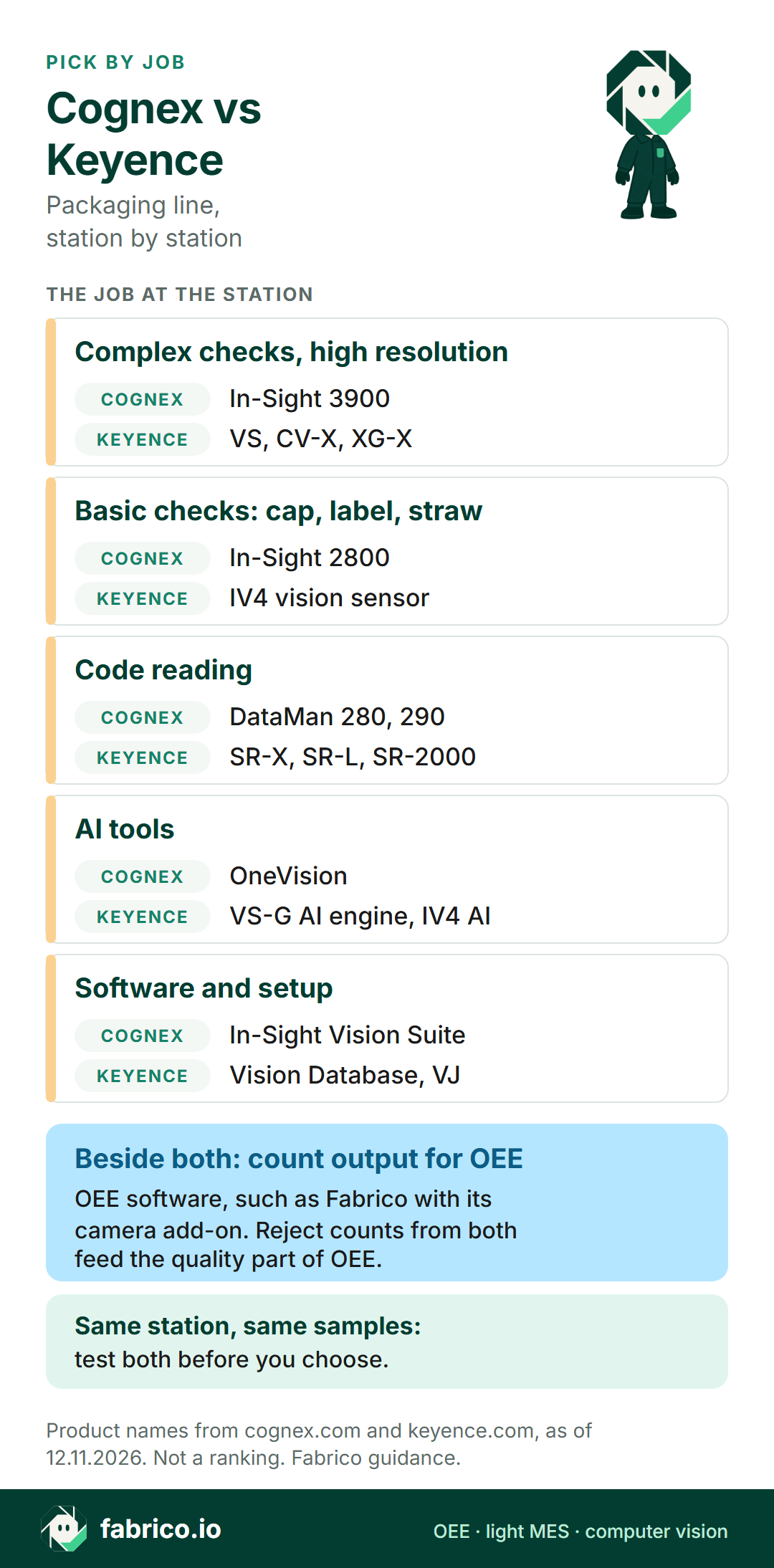
| Smart cameras and vision systems | In-Sight 3900: high-speed AI vision system, up to 25 MP | VS smart camera with 25 MP AI inspection; CV-X; XG-X with line scan and 3D |
| Basic checks | In-Sight SnAPP vision sensor (AI, no software to install); In-Sight 2800 for basic to intermediate vision | IV4 vision sensor: AI image setup in one click |
| Code reading | DataMan 280 and 290 fixed-mount readers | SR-X, SR-L and SR-2000 fixed-mount readers |
| AI tools | OneVision: train centrally, deploy on Cognex devices | VS-G controller with a 32-core AI engine; AI on VS and IV4 |
| Software and setup | In-Sight Vision Suite across In-Sight devices | Vision Database for results; VJ for PC-based vision |
| Food and packaging | Packaging defects, fill levels, labels, seals; barcode traceability | Labels, codes, fill levels, seals; sensor or system by check |
Smart cameras and vision systems
This is the job for complex checks: many features on one pack, measurement, several cameras or high resolution.
Cognex. Its In-Sight 3900 page describes a high-speed AI machine vision system built for high-throughput production lines. The page says it can analyze up to 5,000 parts per minute and process 25 MP images in real time. It names EtherCAT and industrial Ethernet for PLC synchronization, and point-and-click setup next to advanced programming.
Keyence. Its vision systems page lists several series. The VS smart camera runs 25-megapixel AI inspection and has an optical zoom function to set the image with a single click. The CV-X Series offers a 64 megapixel camera for conventional inspections. The XG-X is a customizable system that supports all Keyence cameras, including line scan and 3D. The same page lists LumiTrax lighting for surface checks and Multi-Spectrum lighting with 8 colours.
Ask both: how many features one camera checks on your pack at line speed, and which lighting each would fit for your film or foil.
Basic checks: vision sensors and vision systems
This is the job for simple yes or no checks: is the cap on, is the label there, is the straw attached. The two vendors name this tier differently.
Keyence calls it a vision sensor. Its vision sensors page says that with one click the IV4 recommends the image settings for detection, so image setup does not need vision engineering experience. The IV series can also read characters, and up to 32 detection setups can be saved, one per product, so a product change means loading that product's setup.
For simple presence and error-proofing checks, Cognex sells the In-Sight SnAPP, an AI vision sensor (cognex.com/in-sight-snapp). Cognex lists the In-Sight 2800 under its 2D machine vision systems. Its In-Sight 2800 page says it combines AI and rule-based machine vision for defect detection, classification, sortation and text reading. It can identify several defect types in one image, and its AI-based OCR is trained with 5 to 10 sample images. Its consumer packaged goods example is spotting product variations, such as scent, to make sure packaging is correct.
Ask both: what happens at a SKU change on your line, who loads the new setup, and how many sample images it takes.
Code reading: fixed-mount readers
On a packaging line, a code reader checks that the lot code, date or barcode is there and readable before cases leave.
Cognex. The DataMan 280 page calls it an all-purpose barcode reader that tracks and traces items through manufacturing and logistics, and says it reads heavily damaged or low-resolution codes. The DataMan 290 page describes embedded AI, decoding algorithms and lighting, with AI-guided positioning and tuning and a web-based setup screen that guides you step by step.
Keyence. Its code readers page lists fixed-mount 1D and 2D readers and handheld scanners. It says the SR-X series uses AI and decoding algorithms for stable reading between processes, with automatic focus and fully automatic tuning at the press of a button, and that the status and settings of readers on one network can be viewed in one list. The SR-L series reads labels moving at high speed without adjustment, per the page.
Ask both: how a no-read reaches your PLC, and whether the reject is counted so it can feed your OEE quality figure.
Want to see how reject counts and stops fit together on a line like yours? Book a demo and bring your station list.
AI and deep learning tools
Both vendors put AI into the camera and into the software. They describe it in different ways.
Cognex. As of 13.11.2026, the OneVision page describes a collaborative AI vision development environment: train centrally, adapt locally, deploy on any Cognex system. It says guided, web-based workflows cover labeling, training and validation, and that an application can be built once and deployed across several devices, lines and sites. Cognex says OneVision, In-Sight Vision Suite and In-Sight systems work together as one cloud-to-edge platform.
Keyence. The vision systems page says the VS-G controller has a high-speed processor with a 32-core AI engine, and comes with dedicated storage for traceability on a single controller. The VS smart camera starts up on a general-purpose PC with a few dozen images for learning, and the IV4 sensor uses AI for image setup.
Ask both: where the AI model is trained, on a PC, a controller or in a central platform, and who in your plant updates it when a pack design changes.
Software and setup approach
Cognex. The In-Sight Vision Suite page describes one software platform for all In-Sight products. As of 13.11.2026, the page says a release with In-Sight Firmware 26.2 adds 21 CFR Part 11 readiness, job validation to detect configuration drift, and MQTT support with image offload.
Keyence. The vision systems page lists Vision Database, software to analyze inspection results from Keyence vision systems, where program changes can be saved as backup settings and reloaded on the controller. The VJ series brings Keyence GigE cameras and lights to PC-based vision.
Ask both: where images and results are kept, who can see them, and how results reach your MES or OEE system. Where cameras see people at hand-pack stations, agree this with the works council first.
Food and packaging lines: what each vendor's page names
Cognex's food and beverage page says its machine vision and AI spot packaging defects, verify fill levels and check labels, and that barcode scanning gives traceability for recalls. It names bottles, cans, cartons and pouches, and checks for seal integrity, fill levels, print and labels.
Keyence's food and beverage packaging page splits the choice by check. Sensors fit presence checks, such as a cap on a bottle or a label in place. Systems fit complex inspections that need high resolution, precise measurement or several cameras. It says many Keyence sensors and cameras are rated IP67 for washdown, and it names label, code, fill level and seal checks.
For a wider view across food, drink and household lines, see our computer vision for FMCG buyer's guide.
The job beside both: counting output for OEE
Both vendors present their ranges for inspection, identification and code reading, per the pages above. OEE asks a different question. Not "is this pack good?" but "where did the shift go?": how long the line stopped and why, how fast it ran, and how many good packs it made. The difference is covered in depth in label and code vision vs an OEE camera.
The two jobs meet at one number. The label check and the code reader reject packs, and that reject count is the quality part of OEE. Stop times and the run count come from the machine signal. Keyence's vision sensors page says the IV4 can also count targets passing inline; if you plan to use any inspection count for OEE, check it against a hand count for one shift first. How accurate is camera OEE? shows how to run that check.
Worked example: one shift on a carton line
Sample data, not a customer's line or a product screen. Planned time is 480 minutes at an ideal 200 packs a minute, so the shift could make 96,000 packs. A label check and a code reader sit before a hand case-packing station that packs 12 to a case.
Stops took 60 minutes: a 30 minute changeover, 12 minutes of label reel changes and 18 minutes of stops after code reader no-reads. The line ran 420 minutes, so availability is 420 / 480 = 87.5%.
In 420 minutes the ideal is 84,000 packs. The labeller counted 76,440, so performance is 91.0%.
The label check rejected 620 packs and the code reader 340, so 960 in all. Good output is 75,480, so quality is 98.7%. OEE is 87.5% x 91.0% x 98.7% = 78.6%, the same as 75,480 good of 96,000 possible. The math is explained step by step in our OEE calculation guide.
The inspection systems did their job: they caught 960 packs. The OEE view adds the rest of the shift: the 60 minutes of stops and the 7,560 packs lost to slow running. The 18 minutes of no-read stops are worth a talk with the code reader supplier; the changeover is a job for the line team.
Where Fabrico fits
Fabrico is cloud OEE software with light MES. It sits beside a Cognex or Keyence system, not in its place. What it does today, per our OEE and MES overview and computer vision OEE page:
- Signals first. Stops and counts come from the machine signal: a PLC, sensor or counter. The operator adds the stop reason at the line on a tablet or phone.
- OEE and downtime by line and shift, with losses shown in money, on web, iOS and Android.
- The camera add-on, on request, counts output on the line, including at manual steps like hand case packing where no machine signal exists. With the camera add-on you can open the video for any moment on the shift timeline; in the standard setup it is streamed on request, not stored in Fabrico.
- Rejects in: a reject count or signal from the inspection system feeds the quality part of OEE.
- Data out through a REST API, webhooks, and Excel or CSV export.
- Roadmap, not live: stop detection by the camera add-on, jam zones on the camera add-on view, and a stop reason suggested by the camera add-on for the operator to confirm.
- Not Fabrico: inspection of packs, labels, codes, fill or seals. That stays with your vision supplier.
Test our claims like any vendor's. For what to compare across OEE tools, see our OEE software guide.
Questions to ask both vendors
Ask Cognex and Keyence the same questions, on the same station and the same samples.
- Which product for this check? Name the check first, then ask each which product in its range it would use, and why.
- Test on our samples. Ask for a test with good packs and real defects from your line, and count false rejects.
- SKU changes. How the setup changes per product, who does it, and how many images a new product needs.
- Signals to the PLC. How a reject or no-read reaches the PLC, and whether the reject count is available as a signal or count.
- Data and images. Where results and images are kept, who can see them, and for how long.
- Support. Who supports the system on site, and in which language.
What people ask next
How do I choose between Cognex and Keyence for a packaging line?
Start with the job at each station, not the brand: a basic presence check, a complex inspection, a code read or an AI defect check. Then ask both vendors to test the same samples from your line and to show how results reach your PLC. This page gives no ranking, and neither vendor's pages are a ranking either.
What is the Cognex counterpart to a Keyence vision sensor?
By job, the closest match on Cognex's pages is the In-Sight 2800, which Cognex's food and beverage page, as of 13.11.2026, calls an easy-to-use vision system with pre-trained AI for basic to intermediate tasks. Keyence sells the IV4 as a vision sensor for presence checks. The names differ, so compare them on the same check.
Do Cognex and Keyence both make fixed-mount code readers?
Yes. Cognex lists the DataMan 280 and DataMan 290 fixed-mount readers, and Keyence lists fixed-mount 1D and 2D readers including the SR-X, SR-L and SR-2000 series. Both describe AI in their decoding, per their own pages as of 12.11.2026.
Can Cognex or Keyence measure OEE?
Both present their ranges for inspection, identification and code reading. Their results, such as pass, fail or a read code, can feed the quality part of OEE as a reject count. Keyence's vision sensors page says the IV4 can also count targets passing inline. For OEE you still need stop times, speed and good output by line and shift, which is the job of OEE software.
Can Fabrico run beside a Cognex or Keyence system?
Yes. The vision system keeps judging each pack. Fabrico takes stops and counts from the machine signal and the reject count as a signal, and its camera add-on can count output where no signal exists. Fabrico does not sell inspection.
Where do the vendor facts on this page come from?
From Cognex's and Keyence's own public product pages, fetched on 12.11.2026 and linked in place; the Cognex software and AI lines were checked again on 13.11.2026. Products and pages change, so check each page again before you buy.
Want to see stops, speed and rejects together for a line like yours? Book a demo.
Related articles



Real Fabrico tiles, sample data.