





 Login
 Blog
Customer complaint investigation: trace it to the line

In short
- Sample and code first: secure the packs, a photo of the code and the count of affected units before anyone names a cause.
- The code gives a window: the date, lot and time from the coder, read against coding records or the ERP, point to a line, a shift and a span of minutes.
- The window gives the cause: stops, restarts, changeovers, speed changes, waste by reason and who was on shift.
- Money: in this example the withdrawal drops from 35,524 EUR (a whole day) to 2,218 EUR (a 90-minute window), if the retailer accepts the evidence.
- The answer is an 8D: containment, a proven cause, an action and a check on the next lots, not "operators will be retrained".
To trace a customer complaint to the production line, start with the code on the pack: the best-before date, the lot and the time printed by the coder. Coding records or the ERP order turn that code into a line, a shift and a time window.
Then open the line data for that window: stops, restarts, changeovers, speed, waste by reason, quality holds. That is usually where the cause sits. The written answer to the customer then follows an 8D, with evidence.
Below, for quality, production and plant managers in food, beverage and FMCG plants: a checklist for the first 24 hours, a table that maps each complaint type to its usual line cause, a worked example in euros with leaking pouches, and a comparison of paper logbooks, spreadsheets, a QMS module and shift data.
The first 24 hours after a complaint
A complaint from a retail chain arrives with a clock attached. The retailer wants to know what is on hold, whether the product is safe and when the written answer will come. If samples and a photo of the code are missing on day one, the investigation is guesswork later.
Work through these steps in order:
- Log the complaint. Date and time received, customer, store, product, number of affected units, the customer's exact words. One case number on every document.
- Ask for photos. The code in focus and close up, the defect, the front of the pack, the case label and the pallet label (SSCC) if there is one.
- Secure samples. Physical units from the retailer, plus the retained samples in your own warehouse for the same date and hour. Without a sample, the cause stays an opinion.
- Copy the code character by character. "14.05.27 L2 14:37" is different information from "May 2027". Note who copied it.
- Put stock on hold. Hold everything from the same date in the warehouse until the window is known. The process is set out in quality hold process design.
- Decide: quality or safety. A leaking pouch can be a cosmetic defect or a spoilage risk. The HACCP team decides, in writing, with its reasons.
- Answer the retailer the same day. Acknowledgement, case number, what is on hold and when the 8D will arrive. Short, and with no cause that is not yet proven.
Once safety is in question, the decision is no longer only commercial. As Article 19(1) of Regulation (EC) No 178/2002 reads, an operator that considers a food not in compliance with food safety requirements shall immediately initiate procedures to withdraw it from the market, where it has left the operator's immediate control, and inform the competent authorities.
Article 19(3) adds immediate notice where the food may be injurious to health. In Bulgaria the authority is the BFSA (БАБХ), through its regional food safety directorate.
ISO 10002:2018 sets out a complaints-handling process: receipt, assessment, analysis, response and a review of how well the process works. According to the ISO page, it is a set of guidelines, not certification requirements. It is a useful frame for the procedure, but it does not tell you how to find the hour of the defect.
From the code on the pack to the hour on the line
The pack code is the key to the whole case. The less it says, the bigger the withdrawal gets. Here is what a pack can carry and what each element tells you.
- Best-before or use-by date. Mandatory under Article 9(1)(f) of Regulation (EU) No 1169/2011. If shelf life is a fixed number of days, it leads straight back to the production day.
- Lot. Under Article 1(2) of Directive 2011/91/EU, a lot is a batch of sales units produced, manufactured or packaged "under practically the same conditions". You decide how large it is.
- Time from the coder. Many coders can print hours and minutes. It is the cheapest way to a smaller withdrawal.
- Line or head number. "L2" or a filler number separates output when one product runs on two lines.
- Pallet label. The SSCC and the palletising time link a case to a shipment into a given retailer warehouse.
The link from code to time lives in coding records, in ERP orders or on pallet labels. Article 18 of Regulation (EC) No 178/2002 requires you to know your supplier and the business you supplied: one step back, one step forward.
The internal link from lot to line is not spelled out in Article 18, but without it the withdrawal grows.
When the code is a date only
Article 5 of Directive 2011/91/EU allows the date to replace the lot mark if it shows at least the day and the month, in that order. That is legal, but the "lot" is then a whole day and often several lines.
In Bulgaria the Food Act points to the same directive: as its Article 19, point 1, reads, a Council of Ministers ordinance transposes the rules on lot marks.
With a date only, narrow the window like this:
- Which lines ran the product that day. If one, the window is that line's day. If two, look for a trace on the pack: seal pattern, print position, head number.
- Pallets to that warehouse. Labels and dispatch documents show which pallets went to the retailer and when they were palletised.
- The defect signature. A seal that leaks in the same spot points to one jaw. Compare it with the day's waste by reason.
- Line events. A stop, restart or changeover whose type matches the defect is the most likely window. Confirm it with retained samples from before and after it.
The first corrective action after a case like this is often the simplest: add hours and minutes to the code. It is a coder setting, not a new machine, and next time the window is minutes rather than a day.
Failure-mode table: complaint type, data, cause and evidence
Different complaints lead to different line events. The table shows what to pull for the window, the usual cause, and the evidence that closes the case. It is a starting point for the team, not a verdict.
| Complaint | What to pull for the window | Usual line cause | Evidence that closes it |
|---|---|---|---|
| Underweight (below declared quantity) | Checkweigher rejects, filler stops, restarts, product change | Start-up after a stop, new raw material with a different density | "Low weight" waste in the window, weighed retained samples |
| Leaking seal or cap | Sealer stops, speed by minute, "bad seal" waste | Speed raised after a stop, first minutes after restart | Waste by reason in the window, tests on samples before, inside and after it |
| Wrong label or date | Changeovers, label reel change, coder setup | Changeover without a first-off check | Time of the changeover, signed check or its absence |
| Foreign body | Manual interventions, cleared jams, repairs, detector alarms | Jam cleared by hand, repair without clean-down | Stop with reason and time, material matches a machine part |
| Taste or texture | Raw material lot change, product dwell in the hopper, long stops | Product held in the system during a long stop | Stop duration, lab analysis of samples |
| Short count in a case | Case packer stops, manual top-ups, case packer rejects | Jam cleared by hand, cases filled by hand | Manual intervention in the window, count check on samples |
Four patterns repeat across every row. Learn them and the investigation gets shorter.
- The first minutes after a restart. The machine has cooled or drifted and the operator is in a hurry. For seal and weight defects, look here first.
- The changeover. Wrong label reel, old date in the coder, wrong format. The first-off check is the weakest link.
- A speed raise. Catching up on the plan after a stop shortens sealing and filling time.
- A jam cleared by hand. A hand in the machine brings foreign-body risk and hand-filled cases.
Checkweigher rejects are especially useful for weight complaints. How to tie them to OEE and quality is covered in checkweigher rejects, OEE and quality.
One shift under the magnifier
This is what the window looks like when the shift's events carry a time stamp. It is the second shift from the example below: line 2, 200 g pouches, 14:00 to 22:00.
The picture says more than the logbook. An 18-minute stop, a restart at 14:30, a speed raise four minutes later, 140 units of "bad seal" waste and two complaint codes inside the same 40 minutes. The changeover at 17:40 is far from the window and drops out as a cause.
In a paper logbook the same shift is one line: "14:15 stopped, jam". No duration, no speed, no link to the waste. That is why, on paper, the window stays the whole day.
Worked example: leaking pouches from one date
The numbers are an example, not a customer's. A sauce in a 200 g pouch, sold to the retailer at 0.90 EUR a unit. The pack carries no lot number, only the date and the coder's time stamp; the stamps (14:37 and 14:52) are read from the complaint photos.
The retailer finds leaking pouches in two stores and asks for a credit note, a withdrawal from its warehouse and an 8D answer.
Facts for the production day:
- Three shifts on line 2, 72,000 pouches produced.
- 48,000 shipped to the retailer, 36,000 of them still in its warehouse and stores (half the day).
- Window with a margin on both sides: 14:00-15:30, 90 minutes. Less the 18-minute stop, that is 72 minutes at an average 55 pouches a minute, about 4,000 pouches.
- Half of the window sits with the retailer: 2,000 pouches.
- Team time: 20 EUR an hour. Average hourly labour cost in Bulgaria for 2025 was 12.0 EUR for the whole economy, per Eurostat; the team is managers, so the rate is higher.
| Cost | Paper: the day is withdrawn | Shift data: the window is withdrawn |
|---|---|---|
| Credit note | 36,000 × 0.90 = 32,400 EUR | 2,000 × 0.90 = 1,800 EUR |
| Return transport | 2 trucks × 650 = 1,300 EUR | 1 return on the regular run = 250 EUR |
| Destruction | 7,200 kg = 7.2 t × 120 = 864 EUR | 400 kg = 0.4 t × 120 = 48 EUR |
| Investigation hours | 4 people × 12 h = 48 h × 20 = 960 EUR | 2 people × 3 h = 6 h × 20 = 120 EUR |
| Total for the case | 35,524 EUR | 2,218 EUR |
In this example the gap is 33,306 EUR per case, if the retailer accepts the window. It will accept it when the evidence is solid: time-stamped events, waste by reason inside the window and retained samples from before and after it that pass the leak test.
On top of that, 24,000 pouches from the same day sit in your own warehouse. With a paper log they stay on hold until the investigation closes. With a clear window, everything outside it is released after a sample check.
The repeat risk per year
If the cause is not removed and the case repeats twice a year, in this example the bill is 71,048 EUR on paper or 4,436 EUR with shift data. The goal is zero cases, not cheaper ones.
The corrective action costs money too. After any stop longer than 10 minutes, the line runs 2 minutes at 50 pouches a minute before speeding up. That is about 10 fewer pouches per restart. With 4 such restarts a shift and a margin of 0.25 EUR a pouch:
- per shift: 4 × 10 × 0.25 = 10 EUR;
- per month (3 shifts × 22 days = 66 shifts): 660 EUR;
- per year: 7,920 EUR.
In this example the restart rule costs 7,920 EUR a year and protects against 71,048 EUR, if the two-cases-a-year risk holds. Check it with your own numbers: restarts per shift, margin and complaint history.
Root cause and the 8D answer to the retailer
In the example the cause is clear because every trace points to one place. The 18-minute stop cools the sealing jaws. The operator restarts and, 4 minutes later, raises speed from 50 to 60 pouches a minute to catch up on the plan. A shorter sealing time on cold jaws gives a weak seal.
The evidence that closes the case:
- both complaint codes (14:37 and 14:52) fall inside the window;
- 140 units of "bad seal" waste between 14:30 and 14:50, against the line's usual 10-15 an hour;
- retained samples from 14:40 leak in the squeeze test, while samples from 13:30 and 16:00 pass;
- no other stop that day is followed by a speed raise.
The answer to the retailer follows the 8D structure. The full method is in 8D problem solving step by step. For a retail complaint, each step is 2-3 sentences with evidence:
- D1 Team. Quality manager (lead), production manager, line 2 process engineer, shift 2 leader.
- D2 Problem. Leaking seal on a 200 g pouch, date 14.05.2027, codes 14:37 and 14:52, two stores, 37 units.
- D3 Containment. All pouches from the 14:00-15:30 window held in the warehouse; 2,000 pouches withdrawn from the retailer; the rest of the day released after sample tests.
- D4 Root cause. Speed raised 4 minutes after a restart on cooled jaws. Evidence: time-stamped events, waste by reason, samples.
- D5 Chosen action. Restart rule: after a stop longer than 10 minutes, 2 minutes at 50 a minute and a check of 5 seals before speeding up.
- D6 Implement and verify. The rule is in standard work from date X; "bad seal" waste after restarts is tracked for 30 days.
- D7 Prevent recurrence. Only the shift leader raises speed; the coder prints hours and minutes on every line.
- D8 Close. The 30-day result goes to the retailer; the case closes at zero repeats.
A common weak answer is "operators will be retrained". The retailer reads it as a missing cause. Training belongs in D6; it is not a root cause. ISO 9001 also asks for corrective action on nonconformities; the ISO page shows the 2015 edition as withdrawn and replaced by ISO 9001:2026, so check which edition your certificate names.
Retailer auditors look for the same logic. BRCGS Food Safety Issue 9 is the edition in force according to the BRCGS position statements (version 4.1, 06.10.2026). IFS Food is at version 8 according to the IFS site. The investigation records are evidence at the next audit too.
The scale of the topic in the EU shows in the ACN annual report for 2025: 10,490 notifications, 11% more than in 2024, with alert notifications up 14%.
Paper, spreadsheet, QMS or shift data: how to choose
The question is not which tool looks modern, but how fast it gives the window and the events inside it. A QMS module runs the case: deadlines, owners, the 8D. Shift data gives the line events. The two complement each other; neither replaces the other.
| Option | Cost | What it gives for the window | Fits |
|---|---|---|---|
| Paper shift logbook | No licence; 48 h per case in the example | Stop time without duration, no speed, no waste by reason | A small site with one line and rare complaints |
| Spreadsheet | No licence; typing hours every shift | Whatever was typed, often at shift end, from memory | A stopgap while a system is chosen |
| QMS complaint module | Vendor quote | Case, deadlines, 8D, documents; no line events | A plant with many customers and BRCGS or IFS audits |
| OEE and light MES, shift data | Quote per plant, by machines and modules | Stops with reason and time, changeovers, waste by reason, shift | A plant with several lines and retail customers |
| Camera footage of the stop minute | Vendor quote; needs a camera over the line | What exactly happened at the jam or manual intervention | Lines with frequent foreign-body or count complaints |
Who should pick which:
- One line, a few complaints a year: paper is enough if the logbook records the start and end of every stop and the coder prints the time.
- Several lines and retailers as customers: shift data from an OEE or light MES system. Compare the quote with the gap in the example: 33,306 EUR on one case.
- Many customers and audits: a QMS module for the case plus shift data for the events.
- Foreign bodies and manual interventions: add the camera minute to the stops.
If you are still choosing, the overview of production tracking software sorts the categories. For the audit side, see audit-ready OEE data.
Questions for a vendor
- Can the system show every event on one line between two times, on one screen, without manual assembly?
- Does the operator pick the stop reason at the moment of the stop, or is it typed in at shift end?
- Is waste recorded by product and by reason, with a time?
- How does a speed change or a restart after a stop show up?
- How is system time matched to the coder's code or the ERP order?
- What happens to the data if the network drops for a few hours?
- After training, how long does it take a quality person to pull the window for one complaint?
How to start
No big project is needed. The first steps cost hours, not licences, and shorten the next investigation this week.
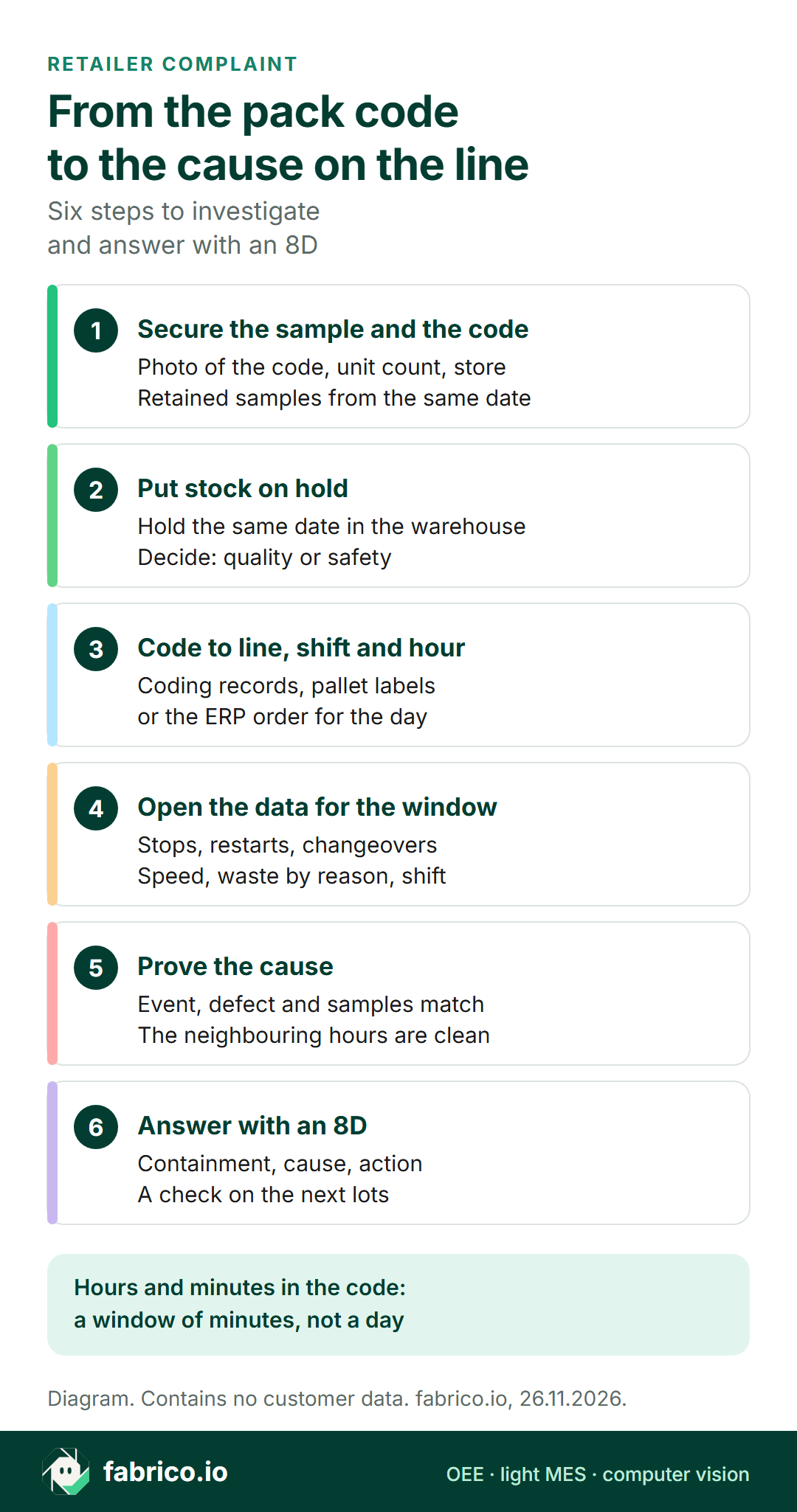
Text version of the diagram
- Secure the sample and the code: photo of the code, unit count, store, retained samples from the same date.
- Put stock on hold: hold the same date in the warehouse and decide quality or safety.
- Code to line, shift and hour: coding records, pallet labels or the ERP order.
- Open the data for the window: stops, restarts, changeovers, speed, waste by reason, shift.
- Prove the cause: the event, the defect and the samples match; the neighbouring hours are clean.
- Answer with an 8D: containment, cause, action and a check on the next lots.
Three things for this week:
- add hours and minutes to the code on every line;
- log the start and end of every stop in the logbook, not just the time;
- keep hourly retained samples for products with seal or weight complaints.
The next step is to look at stops by reason for a week. A real-time downtime Pareto shows which stops repeat and which restarts carry risk.
Where Fabrico fits
Fabrico is an OEE and light MES platform. It shows OEE by machine, line and shift; stops with a reason the operator picks in a few taps; changeovers against a standard time; and waste by product and reason.
The minute of a stop is opened from the shift timeline and streamed on request, not stored in Fabrico. The Financial impact module prices the losses in money.
Fabrico does not keep lots, traceability records or complaints. It gives the line events for the window; the link from code to time comes from the plant's coding records or ERP. There is one quote per plant, by machines and modules: pricing.
Sources
All sources accessed 26.11.2026:
- Regulation (EC) No 178/2002, Articles 18 and 19, EUR-Lex.
- Regulation (EU) No 1169/2011, Articles 9 and 24, EUR-Lex.
- Directive 2011/91/EU, Articles 1 and 5, EUR-Lex.
- Bulgarian Food Act, Articles 19 and 131, text published by the Ministry of Health.
- ISO 10002:2018 and ISO 9001:2015, iso.org.
- BRCGS, F926 Position Statements for Issue 9, version 4.1.
- IFS, IFS Food page.
- European Commission, ACN Annual Report 2025.
- Eurostat, hourly labour costs 2025.
Frequently asked questions
How fast should a retail chain complaint be answered?
Deadlines are in the supply contract. Good practice is an acknowledgement the same day, with the hold and a date for the 8D, and a full answer once the cause is proven.
Does the whole lot have to be withdrawn?
Where safety is at risk, the operator starts a withdrawal under Article 19 of Regulation (EC) No 178/2002. Its scope depends on how precisely the window is proven; without a time on the code, it is usually the whole day.
What can be done when the pack shows a date only?
Narrow the window through the lines that ran the product, the pallet labels, the defect signature and the line events. Then add a time to the code.
When must the food safety authority be told?
When the operator considers or has reason to believe that the food does not comply with food safety requirements, or that food it placed on the market may be injurious to health, under Article 19 of Regulation (EC) No 178/2002. The HACCP team documents the decision.
Can an OEE system replace a traceability system?
No. Lot traceability sits in the ERP or the coding records. An OEE system gives the line events for the time that traceability points to.
What evidence does a retailer accept?
Time-stamped events in the window, waste by reason, tests on retained samples before, inside and after the window, and a corrective action with a check on the next lots.
See one shift's events with time and reason. The demo shows stops, changeovers and waste by reason on the shift timeline.
Latest from our blog





Real Fabrico tiles, sample data.