





 Login
 Blog

Folder Gluer OEE: Makeready Time, Stops and Waste in EUR

In short
- Measure each job in rated minutes: good cartons divided by the rated cartons per minute for the style, added over all jobs, divided by planned minutes. Adding cartons alone mixes straight-line and crash-lock jobs.
- Keep makeready inside planned time: clock it from the last good carton of one job to the first approved carton of the next, against a standard per style.
- Break makeready into steps: in the example, a repeat straight-line makeready drops from 35 to 20 minutes once job preparation moves before the stop and settings are stored.
- Worked example: one gluer in Austria on three shifts runs at 47.5% OEE. Makeready overrun, start-up waste and feeder stops cost EUR 277.64 a shift, EUR 209,896 a year.
- Short runs carry the makeready: a 5,000-carton run pays EUR 27.54 per 1,000 cartons for its makeready; a 50,000-carton run pays EUR 2.75.
Folder gluer OEE is the share of planned time the gluer spends making good cartons at the rated speed for each carton style. Count good cartons at the delivery, convert each job to rated minutes, and divide by planned minutes, with makeready kept inside planned time.
On a gluer running many short jobs, the losses sit in a few places: makeready, feeder misfeeds and double sheets, glue skips and spatter, crash-lock bottom faults, delivery jams and speed below rated. This article breaks the makeready into steps, maps each running fault to a cause and prices all of it on one gluer in Austria.
Folder gluer OEE per job: the earned-minutes method
A folder gluer runs several jobs a shift, and each carton style has its own rated speed. In the example below, a straight-line cereal carton is rated at twice the speed of a crash-lock confectionery carton. Adding cartons across jobs mixes the two, so convert each job to rated minutes first.
- Planned time: shift minutes minus planned breaks. Makeready stays inside it.
- Rated speed per style: cartons a minute = rated belt speed in metres a minute / pitch (blank length in the running direction plus the gap, in metres). At 240 m a minute and a 0.8 m pitch, that is 300 cartons a minute.
- Good cartons: counted after the ejector at the delivery, never blanks fed at the feeder.
The plant sets one rated figure per style and size class and writes it on the job ticket. Then three formulas do the rest:
- Earned minutes for a job: good cartons / rated cartons a minute for its style.
- OEE for the shift: earned minutes of all jobs / planned minutes.
- OEE for one job: its earned minutes / its own makeready, stop and run minutes.
| Loss on a folder gluer | OEE factor | How to count it |
|---|---|---|
| Makeready | Availability | Last good carton to first approved carton |
| Feeder, glue, crash-lock or delivery stop of 2 min or more | Availability | Logged with a reason by section |
| Misfeeds and short stops under 2 min | Performance | From the run signal, not the stop log |
| Running below rated speed for the style | Performance | Rated minutes made / run minutes |
| Glue skip ejects, crash-lock faults, skewed cartons | Quality | Rejects after sign-off, by reason |
| Start-up waste before sign-off | Outside the quality rate | Blanks per job, priced as material |
Two rules keep the numbers comparable from week to week. First, fix the stop threshold once, for example 2 minutes, and keep it. Shorter stops fall into performance.
Second, makeready ends at the first approved carton, not when the machine first moves. Blanks spoiled before that are start-up waste: count them per job and price them as material, but keep them out of the quality rate.
Makeready on a folder gluer, step by step
Makeready is the gluer's changeover. Treat it like any changeover, with a standard time per style and a clock that starts at the last good carton. The general method is in changeover time.
The table shows the example plant's clocked makeready for a repeat straight-line cereal carton, and the target once the work is split into internal steps (machine stopped) and external steps (done while the last job still runs). The minutes are the example's, not a benchmark.
| Step | Now (min) | Target (min) | What shortens it |
|---|---|---|---|
| 1. Close the last job: last cases packed, pallet labelled | 4 | 2 | Labels and cases ready before the last 1,000 cartons |
| 2. Fetch the next job: ticket, approved sample, blanks, glue | 5 | 0 | Staged at the feeder while the last job runs |
| 3. Feeder: side guides, back stop, gate to blank size | 4 | 3 | Marks or stored values from the last run |
| 4. Prebreak, folding rails and carriers to position | 8 | 6 | Position readouts, settings stored per job |
| 5. Glue: nozzle positions, pattern, glue check sensor | 5 | 3 | Glue pattern on the job sheet, nozzles cleaned before the stop |
| 6. Delivery: compression belts, counter, case size | 3 | 2 | Preset from the job card |
| 7. First cartons: slow run, glue and squareness checks, sign-off | 6 | 4 | Checker at the machine on time, a written first-off list |
| Total | 35 | 20 | Step 2 moves before the stop; step 1 is prepared before it |
A crash-lock job adds the bottom section: hooks and back folders set to the bottom flaps, plus an opening test on the first cartons. In the example that adds 15 minutes, so the crash-lock makeready is 50 minutes now and 35 at target.
Floor rule: the gluer never stops to fetch anything. If a step needs the blanks, the sample or the glue, it happens before the last job ends.
A peer-reviewed case shows the method on a converting machine. In a corrugated box plant, Keyser, Severin and Geiger filmed a typical setup on a rotary die-cutter, with the crew's consent, and sorted internal from external steps.
By converting many internal steps to external ones, the average setup fell from 55 to 32 minutes, a 42% improvement. That was a die-cutter, not a gluer, but the example's 35 to 20 minutes (43%) is a target of the same order.
Job order helps as well. Jobs of the same style and size class run back to back keep the carriers near their positions. The schedule is made in the ERP or the planning sheet; the gluer team can give the planner the makeready minutes for each pair of styles.
Feeder misfeeds and double sheets
The feeder takes blanks from the bottom of the stack and sends them one at a time to the prebreak. Feeder stops start with two faults: a misfeed (no blank, or a late one) and a double sheet (two blanks at once).
- Nicks and stripping: blanks still joined at the nicks, or with waste left in from the die-cutter, travel together.
- Warped blanks: board that took up or lost moisture between press, die-cutter and gluer curls in the stack.
- Gate and stack: a gate gap set for the wrong board thickness, a stack too high or too low, worn feed belts.
- Slippery surfaces: high-gloss varnished blanks slide on each other and on the belts.
A misfeed that clears itself in seconds is a short stop: performance loss, invisible on a paper sheet. Forty of them at 15 seconds each are 10 minutes a shift. The pattern is covered in micro-stops.
The floor check takes a week. Count misfeeds and doubles per 1,000 blanks and note the board lot and the die-cut job on each count.
- If the rate follows the die-cut job, the die-cutter owns it.
- If it follows the board lot, board storage or supply owns it.
- If it follows the shift or jumps after a makeready, the setting owns it.
In the example, feeder stops of 2 minutes or more take 22 minutes a shift. That is EUR 75.24 of crew time a shift and EUR 56,881 a year, before the short stops are counted.
Glue skips, spatter and crash-lock faults
A carton with a weak side seam or a bottom that will not lock can pass the gluer unnoticed. It then fails on the brand's cartoning line, where an erector that cannot open it stops a food line. Give glue and crash-lock faults their own reasons, never a general "quality" entry.
| Symptom | Likely cause | OEE hit | First check |
|---|---|---|---|
| Glue skip (gap in the glue line) | Clogged nozzle, low pressure, glue too thick, varnish on the glue flap | Q (eject), A (alarm) | Glue-free area on the die line; nozzle clean at each makeready |
| Glue spatter or strings | Nozzle too far from the flap, too much glue, glue too thin for the speed | Q, A (cleaning) | Glue on printed panels; cleaning minutes per shift |
| Crash-lock bottom will not lock | Hook or back folder setting, weak creases, board grain against the fold | Q, A | Open and lock 10 cartons at sign-off and every hour |
| Skewed carton (fishtail) | Uneven folding belt speed or pressure, blank not square at the feeder | Q | Squareness gauge at sign-off |
| Side seam opens after compression | Too little compression time at high speed, too little glue | Q, may only show up at the customer | Pull test on 10 cartons after compression |
| Delivery jam | Packers behind, shingle too tight, counter set wrong | A | Where the jam started; whether packing kept up |
Where the gluer has a glue check sensor that ejects cartons with a skip, count the ejects per 1,000 cartons by reason. A rising rate on one job points at the glue or the board; a rising rate on every job after a makeready points at the setting.
Spatter is a loss twice. The cartons with glue on the print are rejects, and the cleaning stop that follows is availability loss. Log the cleaning as its own stop reason so it is not buried in "other".
In the example, glue stops take 14 minutes a shift and crash-lock faults 10. At EUR 3.42 a crew minute, that is EUR 47.88 and EUR 34.20 a shift.
Speed below rated: style, board and packing pace
Operators run below rated speed for real reasons: a crash-lock style, curling board, a small carton, or a glue that needs more compression time. Each one is a performance loss. Write the reason down, because a habit of running slower quietly becomes the new rated speed.
On straight-line jobs the delivery can set the pace. Two people taking shingled cartons off the belt and packing them into cases have a ceiling. When they fall behind, the operator slows the machine or the delivery jams.
Pushing packers harder is not the fix. EU-OSHA lists "Repetitive or forceful movements" and handling loads while bending and twisting among the physical risk factors for musculoskeletal disorders. Hand packing at a gluer delivery involves both.
The options are a third packer for the fast jobs, a packing aid at the delivery, or automatic case packing. Before choosing, run one test.
Run one straight-line job at rated speed for 10 minutes with an extra packer. If the delivery keeps up and the cartons stay square, packing was the limit, not the machine.
In the example, straight-line jobs run at 240 cartons a minute against 300 rated, and the crash-lock job at 120 against 150. That costs 54 rated minutes a shift: 36 on straight-line jobs and 18 on the crash-lock job, EUR 184.68 a shift.
Food cartons: glue, waste and the paperwork
Cereal and confectionery cartons are food contact materials. Regulation (EC) No 1935/2004, Article 3, requires them to be made under good manufacturing practice, so they do not transfer constituents to food in quantities that could endanger health or bring an unacceptable change in its composition.
Its Annex I lists adhesives, paper and board, and printing inks among the groups of materials that may be covered by specific measures. Glue, board and print on a cereal carton all sit inside that list.
Regulation (EC) No 2023/2006 sets the GMP rules. Article 6 asks for a quality control system that monitors GMP and identifies measures to correct any failure.
Its Annex says printed materials must be handled and stored "in their finished and semi-finished states" so that substances from the print do not reach the food-contact side. Printed blanks waiting at the gluer are semi-finished.
Article 17 of Regulation 1935/2004 adds that traceability "shall be ensured at all stages". At the gluer, three habits meet both rules and feed OEE at the same time:
- Write the board lot, the glue batch and the die-cut job on the job ticket.
- Count start-up waste and ejects per job, in marked bins away from good pallets, so no waste goes back into a case.
- Keep the approved first-off carton with the job record.
The trade body ECMA publishes a GMP guide for folding cartons that come into contact with food. ECMA says it complements GFSI schemes "such as the BRCGS and FSSC 22000" with folding carton specifics those schemes do not cover.
Use one job ticket for both purposes. The auditor and the weekly OEE review then read the same counts.
Worked example: one folder gluer in Austria, three shifts
A folding carton plant in Austria runs one folder gluer on three 8-hour shifts, 21 days a month. In the example, the jobs are short runs of cereal and confectionery cartons for food brands. The numbers are an example built to show the method, not a customer's data.
The market sets the pricing view. ECMA puts the European folding carton market at EUR 15 billion. In Austria, the paper and board converters' association PROPAK reports 2025 production value down 3% to EUR 2.23 billion, with packaging down 1.9%.
In a falling market, spare gluer capacity may be more likely than a sold-out gluer. So the example prices losses in cash first: crew time paid with nothing made, plus blanks thrown away.
One shift has 450 planned minutes (480 minus a 30-minute break) and three jobs:
| Job | Style, rated speed | Makeready + stops + run (min) | Good cartons | Earned min |
|---|---|---|---|---|
| 1. Cereal, repeat | Straight-line, 300/min | 35 + 22 + 100 = 157 | 23,760 | 79.20 |
| 2. Cereal, new print | Straight-line, 300/min | 35 + 18 + 80 = 133 | 19,008 | 63.36 |
| 3. Confectionery | Crash-lock, 150/min | 50 + 20 + 90 = 160 | 10,692 | 71.28 |
| Shift | 120 + 60 + 270 = 450 | 53,460 | 213.84 |
The straight-line jobs averaged 240 cartons a run minute, short stops included, so they made 24,000 and 19,200 cartons. The crash-lock job averaged 120 and made 10,800. Rejects after sign-off ran at 1% on every job: 240, 192 and 108.
The 60 minutes of logged stops split into feeder 22, glue 14, delivery 14 and crash-lock faults 10. Now the three factors:
- Availability: run 270 / planned 450 = 60.0%.
- Performance: rated minutes of all cartons made / run minutes = (43,200 / 300 + 10,800 / 150) / 270 = (144 + 72) / 270 = 80.0%.
- Quality: rated minutes of good cartons / rated minutes made = 213.84 / 216 = 99.0%.
- OEE: 0.600 x 0.800 x 0.990 = 47.5%. Check: 213.84 / 450 = 47.5%.
Per job, OEE is 50.4%, 47.6% and 44.6%. In the run itself all three jobs reach the same 79.2%. The difference between them is makeready and stops.
The crash-lock job loses the largest share of its time to makeready, 50 of 160 minutes. Job 2, the shorter straight-line run, loses more than job 1: 35 of 133 minutes against 35 of 157.
Pricing the losses
The inputs, each with its source or its label:
- Labour: EUR 51.3 an hour for Austrian manufacturing in 2025, a provisional figure (Eurostat, lc_lci_lev). A crew of 4 (operator, feeder assistant, two packers; sample figure) costs EUR 205.20 an hour, EUR 3.42 a minute.
- Blank value at the gluer: EUR 0.12 a cereal blank and EUR 0.05 a confectionery blank (sample figures: board, print and die-cutting already paid).
- Start-up waste: 150 blanks per straight-line makeready and 250 per crash-lock makeready (sample figures).
- Calendar: 63 shifts a month (3 shifts x 21 days) and 756 a year.
The four losses a gluer meeting returns to, worked out per shift:
- Makeready overrun: (35 - 20) x 2 + (50 - 35) = 45 minutes x EUR 3.42 = EUR 153.90.
- Start-up waste: 300 cereal blanks x EUR 0.12 = EUR 36.00, plus 250 confectionery blanks x EUR 0.05 = EUR 12.50. Total EUR 48.50.
- Feeder stops: 22 minutes x EUR 3.42 = EUR 75.24.
- Speed below rated: 54 minutes x EUR 3.42 = EUR 184.68.
| Loss (example) | Per shift | Per month | Per year |
|---|---|---|---|
| Makeready overrun (45 min) | EUR 153.90 | EUR 9,696 | EUR 116,348 |
| Start-up waste (550 blanks) | EUR 48.50 | EUR 3,056 | EUR 36,666 |
| Feeder stops (22 min) | EUR 75.24 | EUR 4,740 | EUR 56,881 |
| These three together | EUR 277.64 | EUR 17,491 | EUR 209,896 |
| Speed below rated (54 min) | EUR 184.68 | EUR 11,635 | EUR 139,618 |
| All losses vs rated | EUR 913.41 | EUR 57,545 | EUR 690,536 |
The last row takes all 236.16 lost minutes (450 - 213.84) x EUR 3.42 = EUR 807.67, plus EUR 57.24 of rejected cartons and EUR 48.50 of start-up waste. Not all of it can be recovered: makeready at standard still takes 75 minutes a shift.
If the gluer is the bottleneck and orders wait, lost minutes are lost sales too. At 237.6 good straight-line cartons a run minute and a contribution margin of EUR 0.02 a carton (sample figure), the 45 overrun minutes, filled with straight-line work, are worth another EUR 213.84 a shift.
Start-up waste also carries carbon. The 550 blanks weigh about 29 kg a shift (80 g a cereal blank, 20 g a confectionery blank; sample figures), or 21.9 tonnes a year.
Pro Carton's 2025 study puts the cradle-to-gate fossil footprint at 854 kg CO2e per tonne of cartons in 2024. At that European average, the waste is about 18.7 tonnes CO2e a year, as an order of magnitude.
Short runs: the makeready cost per 1,000 cartons
Short runs do not change the makeready. They change how few cartons share it. One repeat straight-line makeready in the example costs 35 minutes x EUR 3.42 = EUR 119.70 of crew time, plus 150 blanks x EUR 0.12 = EUR 18.00: EUR 137.70 in all. At the 20-minute standard it is EUR 86.40.
| Run (good cartons) | Makeready share of gluer time | Makeready cost per 1,000, now | At 20-min standard |
|---|---|---|---|
| 5,000 | 62.5% | EUR 27.54 | EUR 17.28 |
| 10,000 | 45.4% | EUR 13.77 | EUR 8.64 |
| 20,000 | 29.4% | EUR 6.89 | EUR 4.32 |
| 50,000 | 14.3% | EUR 2.75 | EUR 1.73 |
The share uses the example's run rate of 237.6 good cartons a minute and leaves stops out. A 5,000-carton run spends 35 minutes being set and 21 minutes running.
The table has two uses. The first is quoting: on a 5,000-carton job, makeready adds EUR 27.54 per 1,000 to blanks worth EUR 120 per 1,000 at the gluer, or 23%. A makeready charge or a minimum run belongs in the quote.
The second is the case for makeready work. The shorter the plant's typical run, the more each saved minute is worth per carton. Merging two repeat orders of the same carton removes one makeready entirely, EUR 137.70 each time.
Start on Monday: six counts at the gluer
Six counts are enough for the first week. They need the job ticket, a stopwatch and an agreed count point at the delivery.
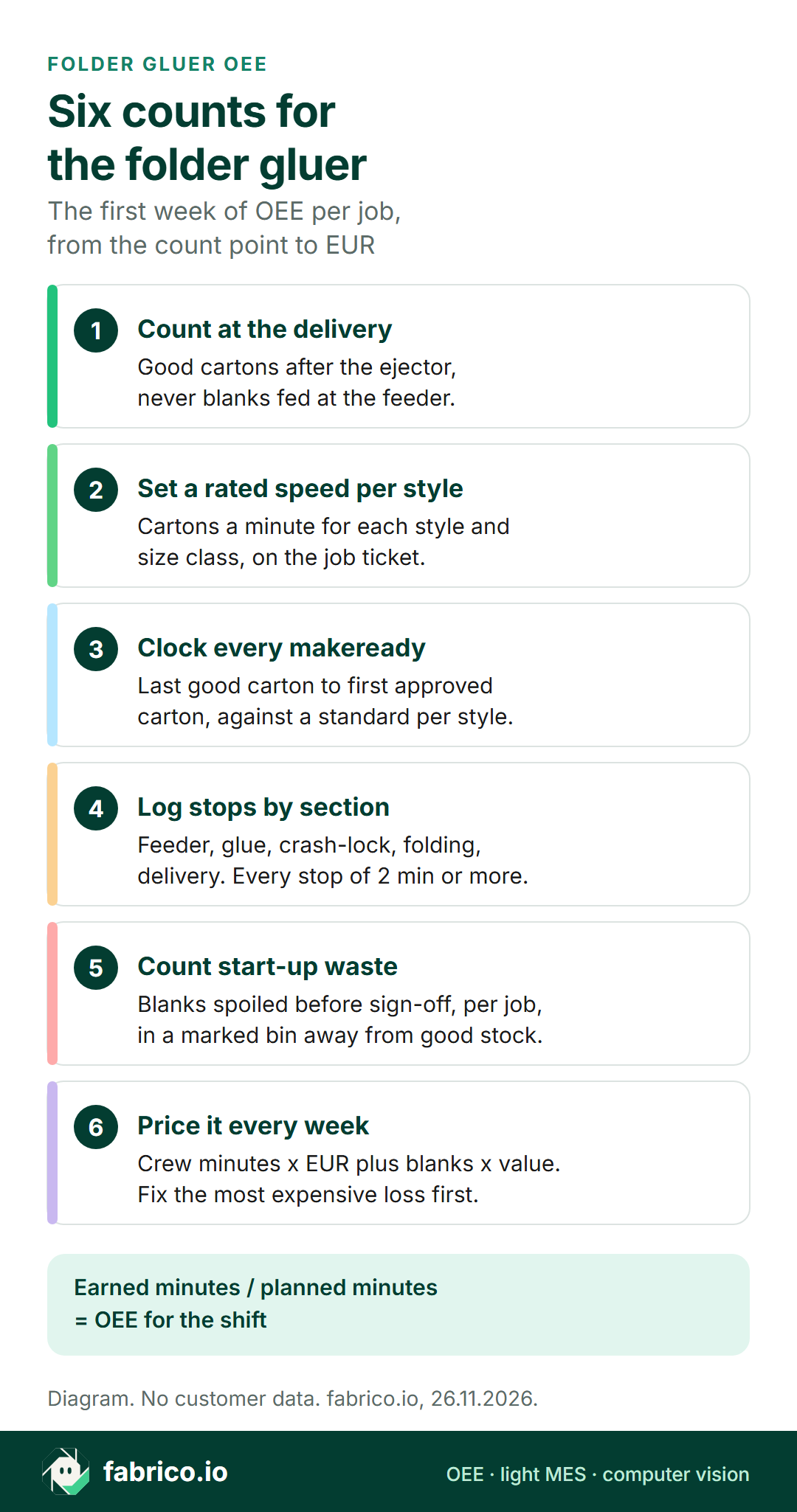
Text version of the diagram
- Count at the delivery: good cartons after the ejector, never blanks fed at the feeder.
- Set a rated speed per style: cartons a minute for each style and size class, written on the job ticket.
- Clock every makeready: last good carton to first approved carton, against a standard per style.
- Log stops by section: feeder, glue, crash-lock, folding and delivery, every stop of 2 minutes or more.
- Count start-up waste: blanks spoiled before sign-off, per job, in a marked bin away from good stock.
- Price it every week: crew minutes x EUR plus blanks x their value, then fix the most expensive loss first.
After a week, sort the losses by EUR, not by count. A rare 20-minute crash-lock fault can cost more than fifty 15-second misfeeds. Pick the top loss, name its owner, and check the same count a week later.
Decision: stopwatch, spreadsheet or OEE software for the gluer
The makeready work is the same whichever way the numbers are collected. In the example, a study with four people for three days is 96 hours x EUR 51.3 = EUR 4,924.80 of crew time (the days are a sample figure).
If the 45-minute gain holds, that study pays back on the makeready overrun alone in EUR 4,924.80 / EUR 153.90 = 32 shifts, about half a month on three shifts. There are four ways to collect the numbers that show whether it held.
| Option | Cost | Fits | Misses |
|---|---|---|---|
| Paper makeready and stop log | Operator and supervisor time | One gluer, the first month | Short stops, misfeeds, accuracy after week two |
| Machine counter plus spreadsheet | Engineer hours every week | A gluer with a readable delivery counter | Stop reasons at the machine, a live view |
| OEE or light MES software from machine signals | Ask the vendor for a price per line per month | Several gluers, or a gluer that is the bottleneck | Needs a run signal and a count at the delivery |
| Camera counting where no signal exists | Ask the vendor for a price per line per month | An older gluer without a usable counter | Counts output; carton quality still needs its own checks |
OEE or light MES software reads the gluer's run, stop and count signals from the machine PLC or an added sensor, takes stop reasons from the operator at the machine, and shows OEE by shift as it happens.
What you see: a shift timeline, unclassified time waiting for a reason, and the operator's line-down screen, on sample lines. Book a demo.
Plays from YouTube. Google may set cookies when you press play. Privacy policy.
For a gluer, the test is whether the software holds a rated speed per style, clocks makeready against a standard and keeps start-up waste apart from rejects. For the wider buying view, compare OEE software for printing and converting, OEE software for corrugated box plants and MES for packaging manufacturers.
The basics are in OEE software, and camera counting in computer vision for packaging converters.
Who should pick which:
- One gluer, short runs, no data yet: a paper log and a stopwatch makeready study for four weeks, then decide with real numbers.
- Several gluers with readable counters: a spreadsheet to prove the count points, then software when the weekly sums take an engineer's day.
- A gluer that is the plant's bottleneck, or quotes that depend on makeready cost: software from the start, with losses priced in EUR.
- An older gluer with no usable counter: a camera at the delivery to count output, plus stop reasons entered by the operator.
Questions to ask a software vendor:
- Can a rated speed be held for each carton style, and each job compared against it?
- Where is output counted: good cartons after the ejector, blanks fed, or both?
- Can makeready be tracked against a standard time, from last good carton to first approved carton?
- Can operators choose a stop reason at the gluer in a few taps, with reasons by section?
- Are short stops under the logging threshold taken from the machine signal?
- Can start-up waste and rejects be recorded by product and reason?
- Can losses be priced in EUR from each product's price and margin?
Where Fabrico fits
- OEE by machine, line and shift in real time, from the gluer's PLC or a Fabrico IoT device with sensors.
- Changeovers tracked against a standard time, so each makeready shows its overrun.
- Micro-stops from the machine signal; the operator chooses the stop reason at the machine in a few taps, from a reason list set up for the gluer (feeder misfeed, double sheet, glue skip, crash-lock fault, delivery jam).
- Scrap recorded by product and reason, so start-up waste and glue skip ejects stay apart.
- With the selling price and margin of each product entered, losses are priced in money and stops are ranked by financial impact.
- Where a gluer has no usable count signal, the camera add-on counts output. Pricing is one quote per plant by machines and modules (pricing).
Fabrico is made by the publisher of this article.
Sources, accessed 26.11.2026: Eurostat, Labour cost levels by NACE Rev. 2 activity (lc_lci_lev); EUR-Lex, Regulation (EC) No 1935/2004 on food contact materials, consolidated text; EUR-Lex, Commission Regulation (EC) No 2023/2006 on good manufacturing practice for food contact materials; ECMA, European Carton Makers Association, About ECMA; ECMA, GMP Guide 2.1 for folding cartons in contact with food; Pro Carton, The carbon footprint of carton packaging 2025, executive summary; Keyser, Severin and Geiger, Setup time reduction with SMED in a corrugated box plant, Journal of Applied Research on Industrial Engineering 9(2), 2022; WKO Fachverband PROPAK, PROPAK-Industrie zunehmend unter Druck, 2026; EU-OSHA, Musculoskeletal disorders.
Frequently asked questions
How do you calculate OEE on a folder gluer?
Convert each job's good cartons to rated minutes (good cartons divided by the rated cartons a minute for its style), add the jobs and divide by planned minutes. In this article's example, 213.84 earned minutes in 450 planned minutes is 47.5%.
Is makeready planned downtime or an OEE loss?
Count it as an availability loss inside planned time, with its own stop reason and a standard per style. Taking it out of planned time hides what short runs cost.
What is a good makeready time for a folder gluer?
No single figure fits every gluer, style and board. Set a standard per style from the plant's own clocked makereadies, then cut it step by step by moving work before the stop.
What causes double sheets on a folder gluer feeder?
Blanks still joined at the nicks or carrying stripping waste from the die-cutter, warped or slippery blanks, a gate set for the wrong board thickness and worn feed belts. Count doubles by die-cut job and board lot to find the owner.
What causes glue skips on folding cartons?
Clogged nozzles, low glue pressure, glue that is too thick, and varnish or print on the glue flap. A skip that reaches the customer can stop the brand's cartoning line, so log each one by reason.
Should start-up waste count in OEE?
Blanks spoiled before the first approved carton belong to makeready time. Count them per job and price them as material, apart from the quality rate; rejects after sign-off are quality loss.
How do short runs affect folder gluer OEE?
Each makeready is shared by fewer cartons. In the example, a 5,000-carton straight-line run spends 62.5% of its gluer time in makeready and carries EUR 27.54 of makeready cost per 1,000 cartons.
See what makeready and feeder stops cost on your gluer. The demo shows OEE by machine, line and shift, changeovers against a standard time, stop reasons picked at the machine and losses priced in EUR.
Latest from our blog







Real Fabrico tiles, sample data.