
Energy-to-Yield Ratio: In glass and ceramics, OEE resolution is a direct financial proxy for energy efficiency; unrecorded downtime is a literal waste of fuel and overhead.
Functional Integrity: Boards must transition from "fixing machines" to preserving the functional integrity of furnaces and finishing lines to prevent catastrophic margin erosion.
From Record to Action: Unifying real-time performance tracking with maintenance execution is how you verify that your fixed assets are meeting their intended valuation.
Why is OEE resolution critical in Glass and Ceramics manufacturing?
In energy-intensive continuous flow operations, OEE resolution provides machine-validated proof that your high-heat assets are converting energy into salable yield.
When data is aggregated or manual, the "Resolution Gap" masks the micro-stops and cooling variances that act as a structural tax on the organization's Return on Invested Capital (ROIC).
For the CEO and Board, an unmonitored furnace or tempering line is a strategic liability.
Robert C. Hansen identifies this as the foundation of the "Hidden Factory."
This represents the revenue potential that is lost because legacy "Systems of Record" cannot capture the millisecond speed losses that precede functional decay.
Fabrico acts as the operational layer required to bridge this divide, ensuring your profitability is governed by evidence rather than optimistic shift reports.
| Strategic Metric | Fragmented Legacy (The Risk) | Fabrico Unified Action (The Standard) |
| Data Fidelity | Subjective: Filtered manual shift logs | Validated: Direct Machine Connectivity |
| Loss Resolution | Aggregated: Misses unrecorded micro-stops | Absolute: Captures 100% of yield loss |
| Asset Evaluation | Static: Based on linear book value | Dynamic: Based on functional integrity |
| Maintenance Link | Siloed: Departments act independently | Native: OEE diagnostics trigger cures |
| Diagnostic Layer | None: Vague anecdotal RCA | Visual Intelligence: "Zoom-In" context |
| Governance Mode | Local: Site-by-site technical habit | Global: Master Standardized Templates |
Strategic leaders know that the most profitable unit is the one produced with the least amount of process deviation.
In glass tempering and ceramics processing, unrecorded micro-stops are the primary drivers of unmanaged technical debt.
Robert C. Hansen’s framework identifies that the true cost of these losses is often underestimated by 300%.
Establishing machine-to-cloud connectivity allows you to eliminate the "Subjectivity Tax" of manual entry.
It ensures that your strategic capital decisions are based on absolute truth.
This allows the Board to fund expansion through recovered revenue capacity rather than new debt.
To achieve world-class results, leadership must master the Value Fulcrum.
Hansen’s framework identifies that ROIC is maximized only when maintenance intensity perfectly supports maximum effective runtime.
In a fragile high-heat environment, maintenance is often treated as an "expense" to be cut during production surges.
This defensive mindset creates unrecorded speed losses that mask the impending functional collapse of high-value equipment.
By linking performance diagnostics to technical execution, the platform ensures that "Bad Actor" assets are stabilized.
This ensures technical intensity is focused on preserving function (revenue generation) rather than just fixing broken parts.
The manufacturing skills gap is a systemic threat to valuation in the ceramics sector.
When technical expertise is siloed, the "Reliability Moat" around your plants walks out the door with retiring staff.
Standardization is how you prove to shareholders that your results are a repeatable system.
By deploying master templates and digital standard procedures, leadership converts tribal knowledge into an enterprise-wide digital asset.
This ensures that every facility adheres to the same Smith & Hinchcliffe RCM standards.
Standardization ensures consistent product quality and predictable EBITDA across every territory.
In the boardroom, a miss in throughput targets is often explained away as "unavoidable material variability."
Without visual evidence, the Board is forced to accept these subjective excuses for poor utilization.
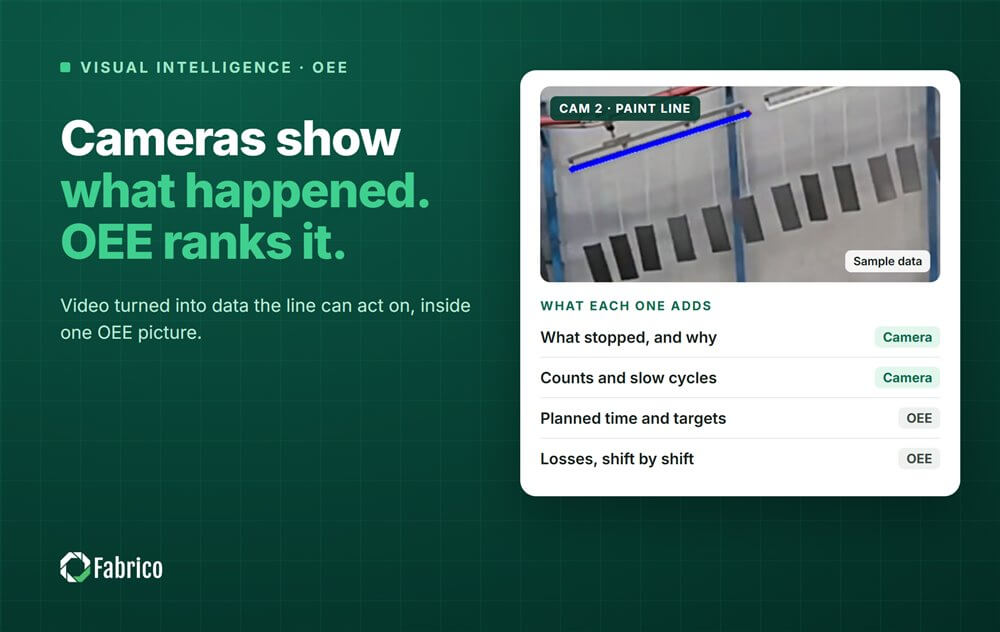
Integrated visual diagnostic tools identify the visual "Root Cause" of inefficiencies traditional sensors miss.
Leadership can see the exact circumstances of a performance drop or a manual intervention in any plant globally.
This transparency allows the Board to direct capital toward fixing the system rather than blaming the workforce.
It provides a level of accountability that turns the "Hidden Factory" into a visible, solvable set of improvement tasks.
Strategic leaders are building today for a future where production flow is self-stabilizing and automated.
However, industrial intelligence cannot protect your valuation if your portfolio data is currently unstructured or "dirty."
Consolidating on a unified platform today ensures that your organization owns the high-resolution, validated dataset required for future intelligence.
You move from "reporting on the gap" to "automating the alignment" across your entire global portfolio.
On our future roadmap, we are developing advanced AI-driven optimization agents for automated schedule refinement.
We are also working on intelligent assistant modules designed to provide technicians in any site with expert troubleshooting guidance.
Running machine data and maintenance in one platform now ensures you are ready for the next decade of maintenance management excellence.
See how Fabrico unifies OEE and maintenance in one platform.
Request a demo









 Login
Login
 Blog
Blog