

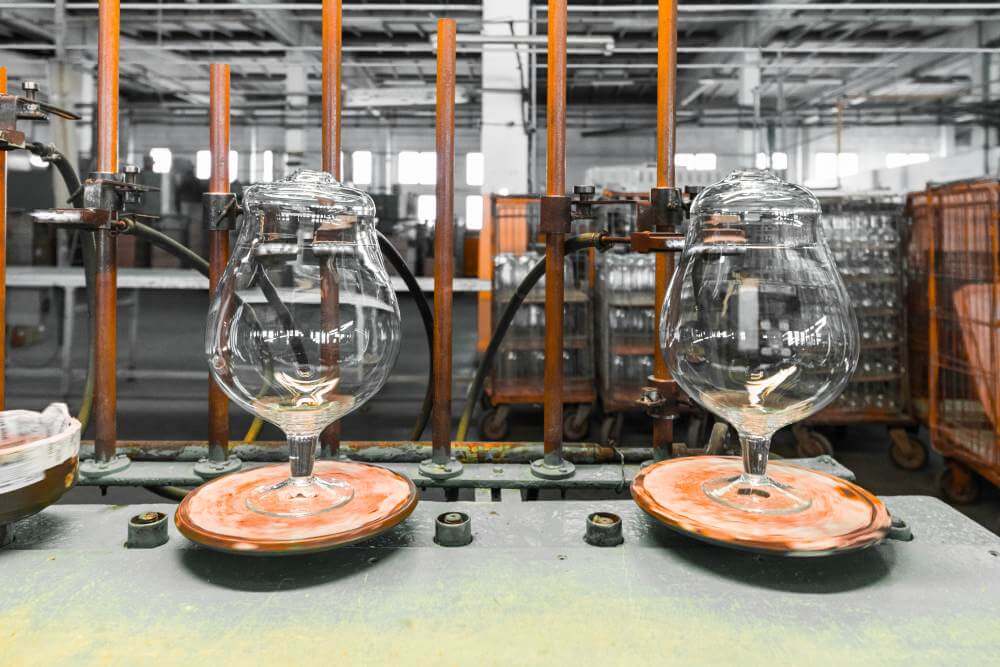

Hot End vs. Cold End: Glass manufacturing is two worlds. The "Hot End" (Furnace) needs process stability. The "Cold End" (Cutting/Inspection) needs mechanical reliability. OEE tools must bridge this gap.
Yield is King: In glass and ceramics, "Performance" (Speed) rarely fluctuates. The OEE killer is "Quality" (bubbles, cracks, optical distortion).
See how Fabrico unifies OEE and maintenance in one platform.
Book a demoCullet Tracking: Effective software must track not just that a part was scrapped, but why,and ensure the "Cullet" (recycled glass) is accounted for in the material loop.
Top Picks: We review Fabrico, Siemens, Bucher Emhart (Symbology), Aveva, and Vorne.
Glass and Ceramics manufacturing is an industry of extremes.
At the "Hot End," you are managing a volcano.
A continuous furnace running at 1,500°C that cannot stop for 10 years. Here, OEE is about Process Stability and Energy Efficiency.
At the "Cold End," you are managing a high-speed race.
Cutting, tempering, and packaging glass at breakneck speeds. Here, OEE is about Mechanical Availability and Handling Efficiency.
Standard manufacturing software often breaks when trying to handle both. It treats the furnace like a machine that can be "turned off" (it can't), or it ignores the fragile nature of the product.
To master OEE in Glass/Ceramics, you need software that connects the Physics of the melt with the Mechanics of the packing line.
Here are the 5 best OEE software tools for the Glass and Ceramics industry.
Fabrico excels at the "Cold End" of the plant, the cutting lines, inspection stations, and packaging robots.
While the furnace runs steadily, the downstream equipment is prone to micro-stops: conveyors jamming with broken glass, suction cups failing on handling robots, or cutting wheels dulling.
Fabrico links OEE directly to Mechanical Maintenance to prevent these interruptions.
Key Features for Glass:
Computer Vision Integration: Connects to inspection cameras to auto-log defect types (stones, bubbles, scratches). Fabrico visualizes where in the lehr the defect originated.
Consumable Tracking: Tracks the life of cutting wheels and molds, triggering maintenance before quality degrades.
Cullet Management: Allows operators to easily tag waste as "Hot Return" or "Cold Scrap," helping to calculate the true yield.
Maintenance Workflows: If a handling robot drops a sheet, Fabrico triggers a "Clean & Inspect" task to ensure no shards damage the next sheet.
Best For: Glass plants focused on maximizing yield and reliability in the Cold End.
Siemens is the standard for the "Hot End."
Their PCS 7 (DCS) and Opcenter (MES) solutions control the physics of the melt.
They monitor the gas-to-air ratio, the tank level, and the temperature profiles.
For OEE, Siemens focuses on Energy per Ton. It helps you correlate efficiency losses with energy spikes.
It is incredibly powerful for the Process Engineer who needs to optimize the melt, but it is often too complex for the packaging supervisor at the end of the line.
Best For: Integrated control of the Furnace and Batch House.
If you make glass bottles (Container Glass), Bucher Emhart is likely the manufacturer of your IS (Individual Section) machines.
Their software suite (Symbology) is purpose-built for the IS machine.
It tracks the efficiency of every "Section" and every "Gob." It can tell you that "Section 4 is producing 5% more defects than Section 2."
This level of granularity is impossible with generic OEE tools. It is a closed ecosystem, but for bottle makers, it is the gold standard.
Best For: Container Glass manufacturers using IS machines.
Aveva PI System is widely used in float glass and ceramic tile plants.
It acts as the "Black Box" recorder for the factory.
Glass manufacturing is sensitive to time delays. A temperature spike in the furnace now might cause a bubble in the glass 4 hours later.
Aveva PI handles this Time-Lag Analysis perfectly. It allows engineers to overlay Quality data (from the Cold End) with Process data (from the Hot End) to find root causes.
Best For: Data-heavy plants needing deep root cause analysis across time lags.
Vorne is the "Scoreboard" solution often found at the very end of the line, Palletizing.
Once the glass is cut, inspected, and wrapped, it becomes a discrete package.
Vorne helps the packaging team keep pace. It displays "Pallets per Hour" and tracks the downtime of the strappers and wrappers.
It doesn't care about the furnace temperature; it only cares about the throughput of the final stage. It is simple, effective, and cheap.
Best For: Monitoring the final Packaging / Palletizing stage.
Which tool fits your zone?
| Feature | Fabrico | Siemens | Bucher Emhart | Aveva (PI) | Vorne |
| Zone Focus | Cold End (Processing) | Hot End (Furnace) | Forming (IS Machine) | Data (Plant-wide) | Packaging (End of Line) |
| Primary OEE Loss | Mechanical Downtime | Energy & Process | Section Efficiency | Correlation | Speed Loss |
| Maintenance Link | Native (CMMS) | Limited | Maintenance Module | None | None |
| Quality Link | Vision Integration | Process Control | Gob Control | Time-Lag Analysis | Count Only |
| User | Maintenance & Ops | Process Engineers | IS Operators | Data Scientists | Packers |
In Glass and Ceramics, you need a strategy for both ends of the plant.
Use Siemens or Aveva to keep the furnace stable and efficient.
But once the glass hardens and moves to the Cold End, the challenge shifts to mechanical reliability. This is where Fabrico shines.
By integrating OEE with Maintenance, Fabrico ensures that your cutters, grinders, and robots are healthy enough to handle the fragile product without breaking it.
See how Fabrico handles defect tracking and equipment maintenance in glass plants.
Book a Demo with Fabrico Today
Curious what honest, real-time OEE looks like on your floor?
Watch a 15-min demo

















 Login
Login
 Blog
Blog