Key takeaways
A manufacturing AI assistant, sometimes called a shop floor copilot, is an AI chat interface connected to your production systems. Instead of opening dashboards and filtering charts, you ask a question: "what cost us the most output yesterday" or "which machine stopped most this week", and the assistant answers from the actual event data.
The critical word is grounded. A general purpose chatbot answers from what it learned on the internet. A manufacturing assistant answers from your lines: this stop, at this time, on this machine, during this order.
Typical questions a grounded assistant handles well:
These are the questions supervisors already ask each other every morning. The difference is the answer arrives in seconds, with evidence.
| Question | Generic chatbot | Manufacturing AI assistant |
|---|---|---|
| Where do answers come from? | General training data | Your machine, camera, and sensor events |
| Can it cite evidence? | Rarely | Timestamps, machines, and orders behind every answer |
| Does it know your plant? | No | Yes, that is the whole point |
| Best use | Drafting text, general knowledge | Explaining losses, comparing lines, finding patterns |
The assistant is the top layer of an AI OEE software stack. Underneath it sits the data layer: AI cameras counting units and catching stops, IoT sensors reading vibration and temperature, and PLC connections where machines expose clean signals.
That layer is what makes answers trustworthy. If micro-stops are not captured, the assistant cannot explain performance loss, which is why continuous AI production monitoring comes first and the chat interface second. Fabrico ships both together: the AI assistant sits on the same live data the OEE dashboard uses, next to an AI zoom-in that highlights where inefficiencies cluster.
Data stops being gatekept. A line lead who would never build a pivot table will happily ask a question in chat. The number of people who can act on production data grows from a few analysts to everyone.
The daily meeting gets shorter and sharper. Instead of debating whose recollection of yesterday is right, the team starts from the same answer, with the events listed. Our guide to micro-stops shows why memory based reporting misses the biggest losses.
New people ramp faster. Asking "what usually causes downtime on this line" is a faster education than a binder of shift notes.
An assistant cannot fix bad inputs. If ideal cycle times are wrong, its performance answers will be wrong too, just faster. It explains current and past losses; it does not predict equipment failure, which is a separate discipline with its own data demands. And it complements the OEE fundamentals, it does not replace knowing them.
If you want to ask these questions about one of your own lines, book a Fabrico demo and bring a real problem from last week.
It is an AI chat interface connected to live production data. You ask questions about OEE, downtime, performance, or quality in plain language, and it answers from recorded events on your lines.
No. Dashboards remain the shared picture of the plant, and analysts still own deep investigations. The assistant removes the queue in front of simple questions and gives more people direct access to the data.
Reliable counts, stop events, and cycle times, captured by cameras, sensors, or PLC connections. The quality of its answers tracks the quality of that capture.
Yes, and that is much of the value. Plain language questions need no training beyond knowing what you want to ask.
Ask every vendor this question directly. Fabrico is built in the EU and keeps production data under EU data residency.
See how Fabrico unifies OEE and maintenance in one platform.
Request a demo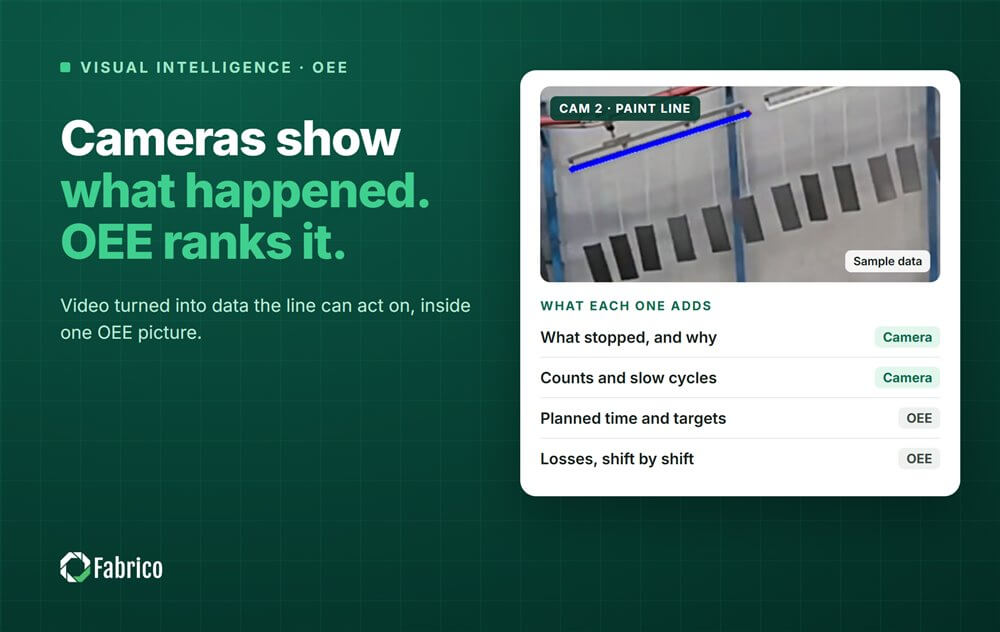






 Login
Login
 Blog
Blog