Login
 Blog
OEE for Forging Lines: Billet Heating, Press Cycle and Rejects

Key takeaways
- On a forging line the ideal rate is set by the slowest step for the part, often the heater or the transfer, not the press stroke rate.
- Count finished forgings, not blows or strokes.
- Die changes and die preheat on the press are Availability losses; preheat off the press instead.
- Flash and scale are material yield, not OEE Quality: a forging with normal flash is a good part.
- Rejects found after heat treatment or crack testing belong back to the shift and the die that forged them.
The induction heater is pushing billets, the press is ready, and the pyrometer diverts three billets in a row as too cold. The press waits, the transfer waits, and the shift sheet will say nothing, because nothing broke. Forging lines lose a lot of time in small gaps like this, and OEE on a forging line has to look there first.
This guide is for plant managers, production managers and manufacturing engineers running press or hammer lines. It covers which machine sets the ideal rate, how to book billet heating, die changes and die preheat, why flash and scale stay out of the Quality factor, and how to bring rejects from inspection back into the number.
Where the time goes on a forging line
A typical hot forging line runs from the billet saw or shear to the heater, a pyrometer check that diverts billets out of temperature, descaling, the press or hammer with its stations (upsetting, blocker, finisher), then the trim press that cuts off the flash. A robot, a manipulator or an operator with tongs moves the part between stations. After the line come cooling, heat treatment, shot blasting and inspection.
| Station | Typical stops and losses | OEE factor |
|---|---|---|
| Saw or shear | Blade change, no bar stock, billet length out of tolerance | Availability |
| Heater | Coil or power fault, cooling water fault, billets diverted as too hot or too cold | Availability, Performance |
| Descaling | Blocked nozzles, scale left on the billet | Performance, Quality |
| Press or hammer | Part stuck in the die, die lube spray fault, overload trip, die crack | Availability, Performance |
| Transfer | Gripper or manipulator fault, dropped part | Performance |
| Trim press | Part not seated, trim die wear, flash not cut clean | Availability, Quality |
| Die change and preheat | Die swap, shut height, trim die, transfer fingers, heat-up | Availability |
| Start-up | First forgings off while dies and settings come in | Quality |

Which machine sets the ideal rate
On a press line the press stroke rate is often not the limit. The heater has a throughput for each billet size and temperature, the transfer and the trim press have their own times, and the line can only run as fast as the slowest of them for that part number. That slowest step is the ideal rate for the line.
Set it per part number, from the design rate or the best stable rate held over long runs, never a good day's average. A heavier billet heats slower, so the same line has different ideals for different parts. Our article on starvation and blocking explains how a slow step upstream shows up as waiting downstream.
Count finished forgings out of the trim press, not blows or strokes. A hammer may need several blows per part and a multi-station press needs a few strokes to fill its stations at start. On a hammer worked by hand, use the agreed standard rate for the part and measure output against it by shift. Measure the process, not the forger.
Billet heating losses
The heater causes three kinds of loss. A heater fault stops the line: that is Availability, and it should be coded to the heater, not the press, or the press gets the blame. Billets diverted for temperature leave empty slots while the line keeps running: that is Performance, and the divert count is worth tracking on its own.
The third is what a press stop does to the heater. Depending on the heater, billets in the coil are held, pushed out or scrapped when the press stops for long. Add those billets to the stop that caused them, so a long press stop carries its full cost.
Heating the line up at shift start, inside planned production time, is an Availability loss with its own reason.
Die changes and die preheat
A die change means removing the die set, mounting the new one, setting shut height on a mechanical press, aligning, connecting the die lube spray, changing the trim die and the transfer fingers, preheating, then forging and checking the first parts. Each minute with the press stopped is an Availability loss.
Dies go in hot. A die preheated on the press keeps the line stopped while it heats; a die preheated in an oven or on a heating station before the change does not. That move from internal to external setup, plus staging the trim die and fingers before the last part of the old job, is the core of reducing changeover time.
Give die changes three reason codes: planned job change, worn die and broken die. Decide once whether planned changes sit inside planned production time, and keep that rule on every line.
Flash, scale and yield
Flash is designed in. The billet is heavier than the part, the excess flows into the flash gutter and the trim press cuts it off. A forging with normal flash is a good forging, so flash is not an OEE Quality loss. The same goes for scale lost from a heated billet.
Both still cost money, as material. Track them in a yield figure, billet weight in against forging weight out, priced at material cost. Watch for abnormal flash: a billet cut too heavy, a worn die or die shift all show up there first. Deep scale pits on the part are different: that forging is a reject and goes into Quality.
Rejects after inspection
Some defects are visible at the press, such as underfill or a part broken in trim. Many are not: laps, folds, cracks and die shift often show up after heat treatment, shot blasting, crack testing or dimensional checks, a shift or more later. If those rejects never return to the forging line, its Quality reads high.
Book them against the shift and the die that made them, and report two Quality figures: at the press and final. A reworked part, ground or straightened, is not a first-time good part. Our guide to the OEE Quality factor covers how to count rework.
A worked shift on one press line
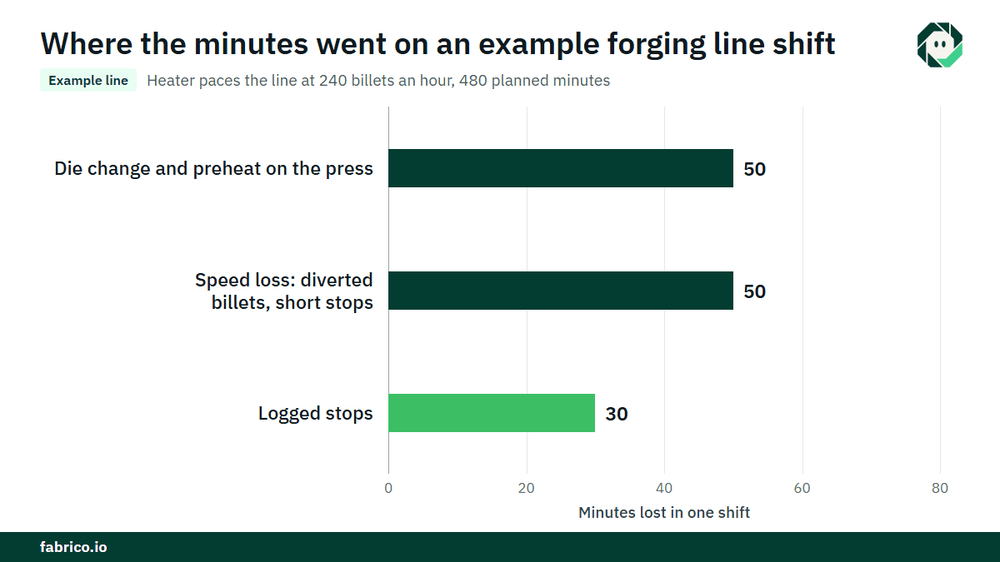
Sample line (illustrative numbers, not a customer): on this part the heater is the slowest step at 240 billets an hour, so the ideal time per forging is 15 seconds. Planned production time is 480 minutes.
- Die change and preheat on the press took 50 minutes and logged stops 30. Run time is 480 minus 80 = 400 minutes. Availability is 400 / 480 = 83.3%.
- The line made 1,400 forgings. At 15 seconds each that is 21,000 seconds, or 350 minutes of ideal time. Performance is 350 / 400 = 87.5%. Of the 50 lost minutes, 60 diverted billets account for 15 (60 x 15 seconds); short stops make up the rest.
- At the press, 30 forgings were scrapped at start-up and visual check, leaving 1,370. Quality at the press is 1,370 / 1,400 = 97.9%.
- OEE at the press is 0.833 x 0.875 x 0.979 = 71.4%. Check: 1,370 x 15 seconds = 342.5 minutes, and 342.5 / 480 = 71.4%.
- Crack testing after heat treatment rejects 40 more. Final good is 1,330, final Quality 95.0%, and final OEE 1,330 x 15 seconds = 332.5 minutes, 332.5 / 480 = 69.3%.
- At a contribution of $4.00 a forging, €4.00 in a euro plant, the 50 minutes of Performance loss are 200 forgings, $800 (€800) a shift. The die change on the press is another 200 forgings, $800 (€800). The 40 cracked forgings add 40 x $4.00 = $160 (€160), plus heat treatment and blasting already spent.
Separately, if the billet weighs 2.2 kg and the forging 1.8 kg, 1,400 forgings leave 560 kg of flash and scale a shift. That is a real cost, but it belongs in the yield figure. The contribution figures become cash only if the extra forgings sell or save overtime, so agree that rule with your controller.
What each data source sees
| Source | What it tells you | What it misses |
|---|---|---|
| Press signal and part counter | Strokes, parts, when the press stopped | Why, and whether the heater or transfer caused it |
| Heater signals | Heater faults, diverted billets | What happened at the press |
| Operator input | Stop reasons, scrap counts | Short stops nobody halts to enter |
| Camera on the press and transfer | A clip as evidence of a stuck part, a dropped forging, a late billet | Cracks and laps inside or under scale |
| Inspection | Cracks, laps, die shift, dimensions | Which shift and die, unless parts are marked |
Where the press signal only says stopped, a camera watching the press and the transfer adds the evidence. The software suggests a likely reason and the operator confirms it in one tap. Common mistakes: the press stroke rate as the ideal, blows counted as parts, flash booked as scrap and heater stops coded to the press.
Where Fabrico fits
Fabrico is a computer vision enabled Manufacturing Performance Platform. On a forging line it starts with OEE and light MES: automatic downtime logging from the press and heater signals, OEE live by line and shift, and losses priced in money, so heater gaps, die changes and rejects sit on one list.
- The operator confirms the reason for a stop in one tap.
- A camera clip as evidence for a stop, where a camera watches the press or the transfer.
- Losses ranked by money, so the costliest part number or stop type comes first.
- One view across plants if you forge in more than one.
- When a stop is a breakdown, a work order to the right technician with its cost.
Machines connect through a PLC, a Fabrico IoT device or a camera, as described on our machine connectivity page, so an older press or hammer can still be measured. You start on one line, with a baseline and a decision date agreed in advance. Each plant gets a quote after a review of its lines.
Frequently asked questions
How do you calculate OEE for a forging press?
Multiply Availability, Performance and Quality, with the ideal time per forging taken from the slowest step on the line for that part, and good forgings counted after the trim press and, for a final figure, after inspection.
Is flash a quality loss in OEE?
No. Flash is designed into the process and a forging with normal flash is good. Track flash and scale as material yield, and treat abnormal flash as a warning sign.
How do you measure OEE on a forging hammer?
Count finished parts, not blows. Set the ideal from the agreed standard rate for the part, and log stops and their reasons as on a press. Measure the process, not the forger.
Should die preheat count as downtime?
Preheat on the press, with the line stopped, is part of the die change and an Availability loss. Preheat in an oven before the change is external setup and costs no press time.
How does OEE compare with a press shop?
The method is the same as in stamping press operations, but forging adds the heater as a pacing machine and inspection results that arrive late.
See your forging line's losses in a demo
Bring one line, one part number and your current shift report. We will show where the minutes go between heater, press and trim, and what they cost.
Latest from our blog