


 Login
 Blog
OEE for Pasta Production: Press, Dryer, Die Changes and Packing

Key takeaways
- Measure the press and dryer in kg an hour at the press's rated rate per shape; give packing its own OEE when storage silos sit in between.
- A die or shape change costs the stop, the start-up scrap after it and any gap it leaves in the dryer.
- The dryer runs for hours behind the press: a problem in it shows up long after the cause, so charge each loss to the station that caused it.
- Start-up scrap, checking, white spots and broken pasta are quality losses, even when they are reground.
- Where a packer or spreader PLC says only 'stopped', a camera clip shows what happened and the operator confirms the reason.
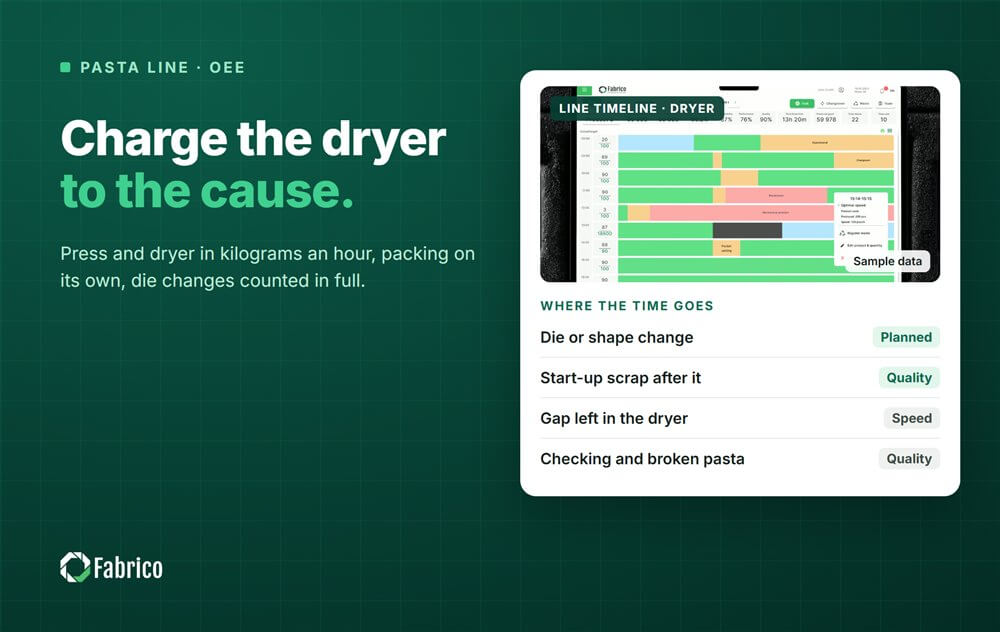
The press on the short pasta line gets a new die for fusilli at 13:00. The change takes half an hour, then the first dough through the new die has white spots and the wrong colour until vacuum and temperature settle, and that product goes to scrap. Hours later, the dryer delivers the first good fusilli to the silos. The OEE report shows one die change and nothing about the scrap.
Pasta lines are continuous: dosing, mixing, the press and a dryer that holds product for hours, with packing often running separately from storage silos. This guide covers where to measure OEE on long and short pasta lines, the usual stops, die changes, the dryer, start-up scrap and quality, packing, and a worked shift with the losses priced.
Where to measure OEE on a pasta line
Semolina and water, and eggs for egg pasta, are dosed into a mixer, and the press pushes the dough under vacuum through a die. On a short pasta line a knife at the die face cuts the shapes, a shaker pre-dryer firms the surface and a belt dryer takes the moisture down. On a long pasta line a spreader hangs the strands on rods that travel through the pre-dryer and dryer, and the strands are cut to length after drying. Both end in storage silos or rod stores, and packing draws from them.
Measure the press and dryer as one line in kg an hour of dried pasta, at the press's rated rate for each shape. The rate comes from the design or a tested maximum for that die, not a good week. Because silos decouple packing from the press, packing gets its own OEE in packs a minute.

Stops by station
| Station | Typical stops | OEE factor |
|---|---|---|
| Dosing and mixer | Semolina supply, water dosing out of range, mixer faults | Availability, or starving the press |
| Press | Die pressure high from a blocked die, vacuum loss, dough temperature out of range | Availability; off-spec dough is quality |
| Spreader (long pasta) | Rods jamming, strands breaking or falling off the rods | Availability and quality |
| Pre-dryer and dryer | Climate out of range, belt or rod transport faults, rods falling inside | Availability, or speed loss when the press is slowed |
| Stripper and cutter (long pasta) | Blade wear, rods not released, breakage at the cut | Availability; broken strands are quality |
| Packing | Film splice, weigher bridging, carton magazine empty, long goods not aligned at the infeed | Availability for long stops, Performance for micro stops |
A press that stops does not simply restart. The dough in the screw and die has to come back to the right state, and the first product after a long stop often goes to scrap. Log the stop and the start-up loss separately, so both show.
Die changes and shape changes
A shape change means a new die, on short pasta a new knife setting, and often new dryer settings and a different pack format. Some presses can change the die with a short stop, others need a long one. Measure the change from the last good kg of the old shape to the first good kg of the new one, so the start-up scrap sits inside the changeover and is not hidden in Quality alone.
Much of a die change is open to SMED: clean and inspect the next die before the change, have it at the press, preset the knife, and write down the settings for each shape. Record a standard time per change and log each minute over it with a reason. Die washing and line cleaning set by the plant's hygiene rules get their own codes: measure them and never shorten them to lift OEE.
The dryer as a long process
The dryer holds product for hours, so it is both the longest buffer and the slowest feedback loop on the line. A dough problem at the press shows up as checking or breakage only when the pasta leaves the dryer, long after the cause. A dryer fault forces the press to slow or stop, even though the press is fine. Charge each loss to the station that caused it, not to the one where it appeared.
A shape change can also leave the dryer partly loaded while the new product moves through, and a dryer running below its loading is a speed loss even when nothing stops. Compare kg out of the dryer with the press's ideal rate hour by hour; our guide to OEE performance shows how to separate speed loss from micro stops.
Start-up scrap and quality
Quality is good kg over kg made. The losses on a pasta line: start-up scrap after a press start or a die change, white spots from poor vacuum, checking (fine cracks) from a drying profile that does not suit the shape, broken long pasta at the spreader, cutter and packer, short pasta out of size, and product with moisture outside the range. Fresh dough scrap and dried broken pasta are often reground and used again; they are still quality losses, because the line spent time making them. Our guide to start-up and shutdown losses covers how to measure them.
Moisture matters twice. Pasta dried below its target sells less water, so the same semolina gives fewer kg to sell, and OEE does not show it. Track final moisture against target next to OEE.
Packing pasta
Packing runs from the silos, so its stops do not stop the press until the silos fill. Short pasta goes through multihead weighers into bags or cartons; long pasta needs weighers and infeeds built for long goods, where strands that are not aligned cause jams and breakage. Most stops are short: a film splice, product bridging in the weigher, a carton magazine empty. Count them from the machine's state, not from a paper log.
Overfill is the packing loss OEE misses. A bag or carton above the declared weight still counts as good, so track average pack weight per weigher and price the difference, as in our guide to giveaway and overfill.
Data sources and the camera
The press PLC gives kg an hour, screw speed, vacuum, dough temperature and die pressure; the dryer gives temperature, humidity and transport state; silo levels show how far packing is behind. Packing machines give state, stops and counts, the checkweigher gives rejects, and quality gives moisture checks. The operator gives the reason in one tap.
Where a spreader or packer PLC says only 'stopped', a camera at the station keeps a clip of what happened: rods jammed, strands on the floor, a carton caught at the infeed. The software suggests a reason, the operator confirms it, and the clip stays with the stop as evidence.
A worked shift on a short pasta line
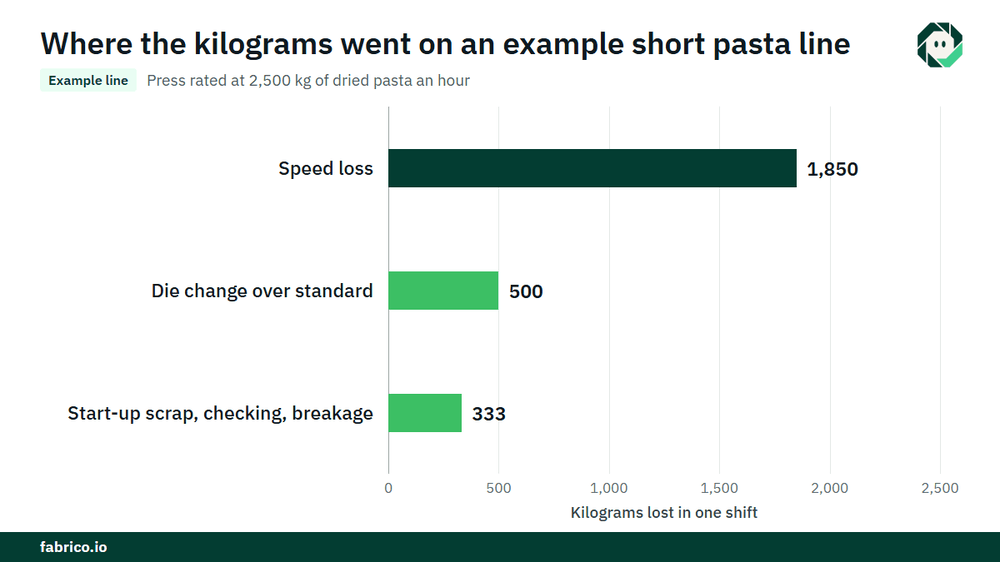
Sample line (illustrative numbers, not a customer): a short pasta press rated at 2,500 kg of dried pasta an hour for this shape. Planned production time is 480 minutes.
- Die change: 30 minutes, against a standard of 18. Press stops over three minutes: 6 minutes. Total 36 minutes.
- Run time = 480 minus 36 = 444 minutes. Availability = 444 / 480 = 92.5%.
- Ideal output: 7.4 hours x 2,500 = 18,500 kg. Made: 16,650 kg, with the press run below rate while the dryer climate was out of range. Performance = 16,650 / 18,500 = 90.0%.
- Start-up scrap, checking and breakage: 333 kg. Good: 16,317 kg. Quality = 16,317 / 16,650 = 98.0%.
- OEE = 0.925 x 0.900 x 0.980 = 81.6%. Check: 16,317 / 2,500 = 6.527 hours, or 391.6 minutes, and 391.6 / 480 = 81.6%.
Now price it. The speed loss is 18,500 minus 16,650 = 1,850 kg. The die change overrun is 12 minutes, or 500 kg at rated rate. If the line is sold out and a kg of pasta carries $0.40 of contribution (€0.40 in a euro plant), the speed loss costs $740 a shift and the overrun $200. Over 600 shifts a year that is $444,000 and $120,000, or €444,000 and €120,000. Our guide to the hidden factory shows how to turn those kg into a capacity case.
Mistakes plants make in pasta production
- Measuring OEE at the packer and calling it the line's OEE, while the silos hide the press losses.
- Starting the die change clock at the die swap instead of at the last good kg.
- Charging dryer-caused stops to the press, or press defects to the dryer.
- Counting reground scrap as good output.
- Using one ideal rate for all shapes and dies.
Where Fabrico fits
Fabrico is a computer vision enabled Manufacturing Performance Platform. On a pasta line it starts with OEE and light MES: automatic downtime logging at the press, the dryer, the spreader and the packers, and OEE live by line and shift.
- The operator confirms the reason in one tap, so a die change, a vacuum loss and a dryer fault stay apart.
- A camera clip as evidence for a stop where a camera watches the station, such as a long pasta spreader or a packer infeed.
- Losses priced in money and ranked by money, so speed loss, die change overruns and start-up scrap compare in dollars or euros.
- One view across plants for groups running several pasta lines.
- For a breakdown, a work order to the right technician with its cost.
Recipes, drying profiles and hygiene records stay with the plant's own systems and procedures. You start on one line, with a measured baseline and a decision date agreed in advance. Each plant gets a quote after a review of its lines.
Frequently asked questions
How do you calculate OEE on a pasta line?
Availability is run time over planned production time. Performance is kg of dried pasta made over what the press's rated rate for that shape allows in the run time. Quality is good kg over kg made. Multiply the three.
How long should a pasta die change take?
There is no standard time: it depends on the press, the die and what else changes with the shape. The SMED target is a single-digit number of minutes for the part done with the machine stopped. Start by measuring your own changes against a standard.
Is start-up scrap an Availability or a Quality loss?
The time the press is stopped is Availability. The product made after the restart that does not meet spec is Quality. Measuring the changeover to the first good kg keeps both in view.
Should packing have its own OEE on a pasta line?
Yes, when storage silos sit between the dryer and packing. The press and dryer then run on their own timing, and packing has its own planned time, rate and stops.
Can a camera help on a long pasta spreader?
Where a camera watches the spreader, it keeps a clip of what happened when the line stopped, such as rods jamming or strands falling. The software suggests a reason and the operator confirms it.
See your pasta line's losses in a demo
Bring the stops, die changes and rates from one pasta line, and we will show the losses priced in money, by shift.








Real Fabrico tiles, sample data.