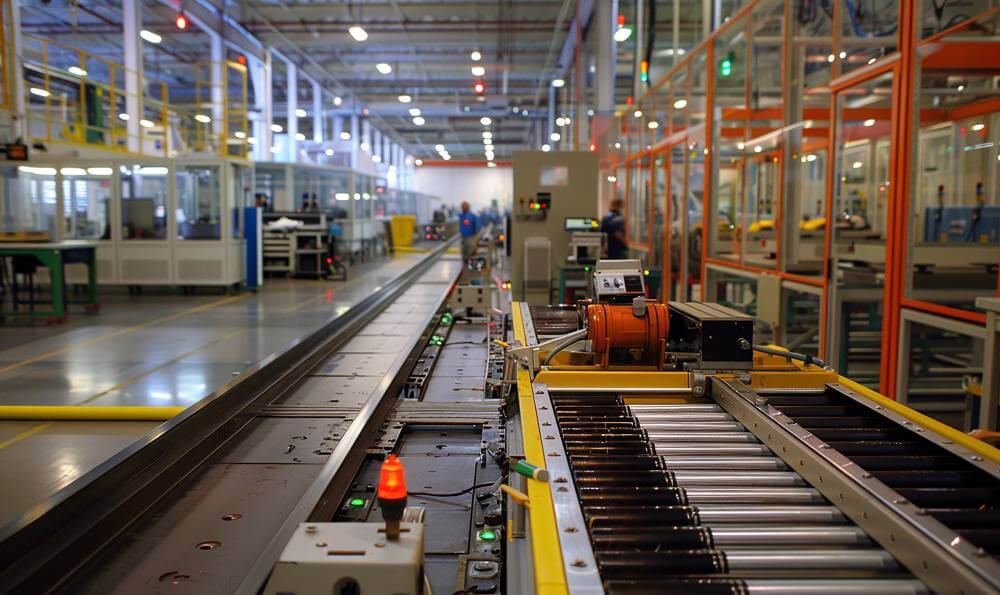

Paced withdrawal is the disciplined practice of releasing work into a value stream at fixed time increments, called pitch, by pulling leveled kanban from a heijunka box on a repeating schedule.
Instead of dumping a full shift of orders onto the floor at once, a runner (often called the water spider or material handler) collects work in small, timed batches so the line receives a steady heartbeat of demand.
This turns an uneven order book into a predictable rhythm, which is the whole point of production leveling. Done well, paced withdrawal exposes problems within minutes rather than at the end of a shift.
Paced withdrawal sits at the intersection of two lean ideas: leveling the mix and volume of production (heijunka), and pacing the release of that work to takt. The heijunka box is the physical or digital device that holds the plan. The withdrawal loop is the routine that executes it.
Every pitch interval, a runner walks to the box, removes the kanban cards or work instructions loaded in the current time slot, and delivers them to the pacemaker process.
The key word is steady. The line does not decide its own pace, and the schedule does not arrive as one giant push. Work is metered out at the same cadence, over and over, so that flow, inventory, and staffing all stabilize around a known drumbeat. This makes paced withdrawal a close cousin of a pull system, where downstream consumption authorizes upstream work.
A classic heijunka box is a grid of pigeonholes. Columns represent time slots (the pitch increments across a shift). Rows represent product types or part numbers. A scheduler loads kanban cards into the slots so that both the volume and the mix are spread evenly across the day rather than clustered.
The result is a visual, self-explaining plan. Anyone can glance at the box and see whether the floor is ahead, on pace, or behind. That transparency is why heijunka pairs so naturally with a kanban system.
Pitch is the amount of takt time bundled into one withdrawal cycle. Takt time alone (say 30 seconds per unit) is too fine to manage physically, so you multiply it by a practical pack quantity to get a manageable interval. Pitch is the rhythm at which the runner empties one column of the box.
The formula is simple:
Pitch is what makes the withdrawal loop tick. Every pitch interval, one column is pulled and delivered, so the physical loop and the leveled plan stay locked together.
Consider a single shift of 8 hours with two 15-minute breaks, so 450 minutes of available time, which is 27,000 seconds. Daily customer demand is 900 units across three products: 450 of A, 300 of B, and 150 of C.
With a 20-minute pitch across 450 minutes, you get roughly 22 or 23 columns per shift. Total containers needed = 900 / 40 = 22.5, so about 23 pulls.
Loading the mix by ratio (A:B:C is 3:2:1), a repeating interleaved pattern per cycle might read A, B, A, C, A, B, keeping every product present through the day rather than batched. Every 20 minutes the runner empties the next column, delivers 40 pieces of work to the pacemaker, and returns the emptied kanban.
If a column is not cleared on time, the delay is visible immediately, which is exactly the early-warning signal leveling is designed to produce.
The loop only works if the pace is protected. A few disciplines keep it honest:
Uptime discipline matters just as much as scheduling discipline. A pitch of 20 minutes assumes the pacemaker is running when the runner arrives. Unplanned stops break the rhythm and force catch-up batches, which is precisely what leveling tries to eliminate.
Tracking overall equipment effectiveness and reliability metrics such as MTBF and MTTR tells you whether your equipment can actually hold a steady pitch. Preventive work scheduled through a CMMS keeps the pacemaker available so the box can be emptied on time.
Paced withdrawal shines in repetitive, mixed-model production with reasonably stable demand and short changeovers. It struggles when changeover times are long (leveling the mix then costs too much), when demand is wildly erratic, or when the product mix has thousands of low-volume variants.
In those cases teams often level volume first and mix later, or apply leveling only to the highest-running families identified through an ABC analysis or Pareto analysis.
Mapping the current state with value stream mapping before you set pitch is the surest way to know whether a heijunka box will help or just hide the real constraint.
Paced withdrawal lives or dies on whether the pacemaker is actually running at pitch, and that requires trustworthy, real-time data. Fabrico is the real-time data foundation: it monitors production and OEE live, so you can see the moment a pitch interval is missed instead of discovering it at shift end.
Its computer vision option reads cycles and stops even on machines with no PLC, which is common on the older equipment that often sits inside a leveled stream.
When a stop threatens the rhythm, Fabrico's field-ready CMMS turns it into a work order, schedules preventive maintenance to protect uptime, and tracks spare parts, all built in the EU with EU data residency.
Fabrico gives you the measured pace and equipment availability the heijunka discipline assumes; the leveling logic and scheduling rules remain yours to design.
Takt time is the demand rate for a single unit: available time divided by customer demand. Pitch is takt time multiplied by a pack-out quantity, giving a larger, more manageable interval at which you withdraw a container of work from the heijunka box. Takt sets the underlying pace; pitch sets the practical withdrawal cadence.
Either works. A physical pigeonhole box is cheap, visual, and self-explaining on the floor, which is why many teams start there. A digital board can level a wider mix, integrate with live production data, and update automatically. The mechanics are identical: leveled work is released in fixed pitch increments regardless of whether the cards are cardboard or on a screen.
The withdrawal loop stalls: the runner arrives but the pacemaker has not produced the expected work, so the column cannot be cleared on schedule. This is by design a loud, immediate signal rather than a hidden problem. The fix is fast recovery plus protecting uptime through proactive maintenance so stops that break the rhythm become rare.
Ready to see whether your pacemaker can actually hold a steady pitch? Book a Fabrico demo and watch real-time OEE, live stop detection, and a field-ready CMMS keep your leveled schedule on rhythm.
See how Fabrico unifies OEE and maintenance in one platform.
Request a demo





















 Login
Login
 Blog
Blog