





 Login
 Blog

Net quantity and the ℮ mark: how to set the filler target weight

In short
- Three rules: the batch average is not below nominal, few packs fall below nominal minus the tolerable negative error, and no pack falls below nominal minus twice that error.
- For 500 g: the tolerable negative error is 15 g, so the limits are 485 g and 470 g.
- The target follows σ: the wider the filler's spread, the higher the target weight has to be.
- Example in numbers: on a 500 g line every 1 g of spread costs 109.2 EUR per shift, about 55,000 EUR a year.
- Spread first: tighten σ, then lower the target. Doing it the other way round drives up checkweigher rejects.
Prepackages carrying the ℮ mark must pass three rules: the average net quantity of a batch is not below nominal, the share of packs below nominal minus the tolerable negative error is small, and no pack is below nominal minus twice that error.
The filler's target weight is nominal plus a safety margin that grows with the filler's spread (standard deviation, σ).
This guide covers the rules, the error table, who inspects in Bulgaria and how to calculate the target. Then it works through a 500 g line: the cost of giveaway in EUR, and checkweigher rejects as an OEE quality loss.
The three rules of the average system
Council Directive 76/211/EEC covers prepackages of equal nominal quantity from 5 g to 10 kg or 5 ml to 10 l. It is known as the average system: the law does not require every pack to reach nominal. It judges the batch as a whole.
Annex I of Directive 76/211/EEC (EUR-Lex, consolidated text) (accessed 26.11.2026) sets three requirements:
- Average rule: the actual contents are not less, on average, than the nominal quantity.
- T1 rule: the share of packs with a negative error above the tolerable one is small enough for the batch to pass the reference test.
- T2 rule: a pack with a negative error above twice the tolerable one may not bear the ℮ mark.
The international recommendation OIML R 87:2016 (accessed 26.11.2026) puts numbers on it: a homogeneous group of packs holds no more than 2.5% with a T1 error, and none with a T2 error.
What T1 and T2 mean
- A T1 pack: weighs less than nominal minus the tolerable negative error, but not less than nominal minus twice the error. For 500 g that is between 470 g and 485 g.
- A T2 pack: weighs less than nominal minus twice the error. For 500 g that is below 470 g. It may not bear the ℮ mark.
- Below nominal but above T1: say 490 g on a 500 g pack. It is legal, provided the batch average is at least 500 g.
The tolerable negative error table
The table is point 2.4 of Annex I to the directive. Percentage values are rounded up to the nearest 0.1 g or 0.1 ml. The limit columns are worked out for one example nominal from each row.
| Nominal quantity (g or ml) | Tolerable error | T1 limit | T2 limit |
|---|---|---|---|
| 5 to 50 | 9% of nominal | 50 g: 45.5 g | 50 g: 41 g |
| 50 to 100 | 4.5 g | 100 g: 95.5 g | 100 g: 91 g |
| 100 to 200 | 4.5% of nominal | 200 g: 191 g | 200 g: 182 g |
| 200 to 300 | 9 g | 250 g: 241 g | 250 g: 232 g |
| 300 to 500 | 3% of nominal | 400 g: 388 g | 400 g: 376 g |
| 500 to 1,000 | 15 g | 500 g: 485 g | 500 g: 470 g |
| 1,000 to 10,000 | 1.5% of nominal | 5 kg: 4,925 g | 5 kg: 4,850 g |
OIML R 87 adds rows above 10 kg (150 g for 10 to 15 kg, and 1% above 15 kg), but the directive stops at 10 kg. For a 500 g pack both tables give 15 g: 3% of 500 g and the fixed 15 g coincide.
How an inspector tests a batch
The reference test is in Annex II of the directive. It matters for set-up because it shows how the rules are applied to real production: hour by hour, not over the year.
- Batch size: when packs are checked at the end of the line, a batch equals the line's maximum hourly output. Otherwise it is capped at 10,000 packs.
- T1 check: a double sampling plan. Packs below the T1 limit are counted and compared with the plan's acceptance numbers.
- Average check: the sample mean must clear a threshold built from the nominal, the sample size, the sample standard deviation and the Student t value at 0.995.
Example: a line at 50 packs a minute makes 3,000 packs an hour. That falls in the 501 to 3,200 row of the double sampling plan.
- First sample of 50: up to 2 packs below T1 accept the batch, 5 or more reject it.
- With 3 or 4 below T1: a second sample of 50 is drawn. Up to 6 of the 100 accept, 7 or more reject.
- The average: checked on a sample of 50, because the batch is above 500.
The practical consequence: every hour of output is its own batch. A good shift does not cover a bad hour.
The law in Bulgaria and who inspects
The information sheet from DAMTN on labelling quantities (accessed 26.11.2026), the Bulgarian State Agency for Metrological and Technical Surveillance, says the requirements come from the Measurements Act and the Ordinance on prepackaged quantities of products (NPOKP).
- Scope: packs of equal nominal quantity from 5 g to 10 kg or 5 ml to 10 l inclusive, plus packs of varying quantity sold by mass.
- Labelling: the nominal quantity in kg, g, l, cl or ml, followed by the unit and, for equal quantities, the ℮ mark.
- The ℮ mark: at least 3 mm high, in the same field of vision as the nominal quantity. Its shape is in Annex 7 of the ordinance.
- Liquids: in units of volume. Everything else: in units of mass.
The duty to self-check comes from the act. In the text of the Measurements bill as tabled in the National Assembly (accessed 26.11.2026), Article 61 requires the producer to check net quantities by the criteria, methods and instruments set in the ordinance.
As Article 62 of the same text reads, the producer applies the conformity mark when its own checks confirm conformity, and takes corrective action when they do not. Check records are kept and shown on request. The numbering in the act as now in force may differ, so the current text should be read in the State Gazette.
The EU portal Your Europe on the ℮ mark (accessed 26.11.2026) explains that no authority issues the mark. The packer applies it, provided it uses suitable measuring equipment, runs quantity checks and keeps a record of them.
Who inspects and what they find
Checks are run by DAMTN's Chief Directorate Metrological Supervision. According to the DAMTN annual report for 2025 (accessed 26.11.2026):
- 829 batches of equal-quantity packs and 1,759 variable-quantity packs were checked;
- 2,822 non-conforming products were withdrawn from sale, 2,755 of them at producers;
- 8 producers were inspected on site, including dairy, meat, confectionery, flour and wine;
- themed retail checks covered milk and dairy, sugar and chocolate products, coffee, nuts and dried fruit.
The report says on-site visits to producers follow doubts raised in retail or complaints from the public. In other words, a doubt raised on the shelf can bring the inspector to the plant.
How to set the filler's target weight
The target weight is where the filler is set: nominal plus a margin. The margin depends on how widely pack weights scatter around the mean. The measure for that is the standard deviation, σ.
The WELMEC guide for packers, WELMEC 6.4 (2015) (accessed 26.11.2026), gives the rule. The target is the greatest of three values:
- the nominal quantity;
- the T1 limit plus 1.96 × σ;
- the T2 limit plus 3.72 × σ.
The 1.96 factor means no more than 2.5% below T1. Some countries use 2.05, meaning no more than 2%. WELMEC adds a warning: once σ exceeds half the tolerable negative error, it has to be compensated for.
The legal minimum for a 500 g pack
At 500 g the T1 limit is 485 g and T2 is 470 g. Here is the legal target at different spreads:
- σ 2 g: 485 + 3.9 = 488.9 g; 470 + 7.4 = 477.4 g. Target: 500 g.
- σ 4 g: 485 + 7.8 = 492.8 g; 470 + 14.9 = 484.9 g. Target: 500 g.
- σ 8 g: 485 + 15.7 = 500.7 g. Target: 500.7 g.
- σ 10 g: 470 + 37.2 = 507.2 g. Target: 507.2 g.
- σ 12 g: 470 + 44.6 = 514.6 g. Target: 514.6 g.
Above roughly 7.7 g of spread the law itself starts pushing the target up. With a large σ the T2 rule decides, not T1: one pack under 470 g is a bigger risk than a few under 485 g.
Why lines fill above the legal minimum
The legal minimum assumes the mean sits exactly on target. On a real line it moves: at start-up, with a new raw material lot, as the hopper level changes. So the mean of every hour has to stay above nominal, not just the mean of the shift.
Some plants also add an internal rule: the checkweigher rejects everything below nominal, to avoid retailer claims. The reject limit is then 500 g, not 485 g. The target becomes nominal plus about 2σ if roughly 2.3% rejects are accepted.
Check exactly where the checkweigher's reject limit sits. If it is at nominal, it is stricter than the law. Every gram between the internal rule and the law is paid for in product, so the choice should be deliberate and written down.
The price of one gram of spread: a 500 g line
The numbers below are an example, not a customer's data. The line fills 500 g packs (rice, pasta or snacks, say) under an internal rule: the checkweigher rejects everything below 500 g. The target is nominal plus 2σ, which keeps rejects at about 2.3%.
Inputs
- Speed: 50 packs a minute.
- Run time: 420 minutes per shift, so 50 × 420 = 21,000 packs per shift.
- Product cost: 2.60 EUR/kg.
- Shifts: 2 a day, 21 days a month, so 42 shifts a month and 504 a year.
Filler with a 4 g spread
- Target: 500 + 2 × 4 = 508 g.
- Giveaway per pack: 508 - 500 = 8 g.
- Per shift: 8 g × 21,000 = 168,000 g = 168 kg.
- In money: 168 kg × 2.60 EUR = 436.8 EUR per shift.
- Per month: 436.8 × 42 = 18,345.6 EUR. Per year: 436.8 × 504 = 220,147.2 EUR.
Filler with a 2 g spread
- Target: 500 + 2 × 2 = 504 g.
- Giveaway: 4 g per pack.
- Per shift: 4 g × 21,000 = 84 kg, or 84 × 2.60 = 218.4 EUR.
- Per month: 218.4 × 42 = 9,172.8 EUR. Per year: 218.4 × 504 = 110,073.6 EUR.
The difference is 218.4 EUR a shift, 9,172.8 EUR a month and 110,073.6 EUR a year. In this example, if the spread holds at 2 g, half of the product given away stays in the plant.
The rule of thumb from the example
Every 1 g of σ lifts the target by 2 g. On this line that is 2 g × 21,000 = 42 kg per shift: 109.2 EUR a shift, 4,586.4 EUR a month and 55,036.8 EUR a year. That is the budget any fill-stability measure is weighed against.
The law is not the problem in either case. At a 508 g target and σ 4 g, a pack below 485 g sits 5.75σ under the mean: in practice, none. The 508 g mean is above nominal. The money goes on spread and on the internal rule, not on what DAMTN requires.
Giveaway as a cost line of its own is covered in giveaway and overfill as a hidden quality loss.
Checkweigher rejects as an OEE loss
Giveaway does not show in OEE: the pack is good and counts. Packs the checkweigher throws out are a quality loss, though. For the method, see checkweigher rejects in OEE and the wider frame of OEE quality.
| Option | Target | Rejects per shift | OEE quality | Giveaway per shift |
|---|---|---|---|---|
| σ 4 g, target +2σ | 508 g | about 478 (2.3%) | 97.7% | 436.8 EUR |
| σ 2 g, target +2σ | 504 g | about 478 (2.3%) | 97.7% | 218.4 EUR |
| σ 4 g, target 504 g | 504 g | about 3,332 (15.9%) | 84.1% | 218.4 EUR |
The third row is the wrong road. Lower the target without tightening the spread and giveaway halves, but rejects rise almost sevenfold. At 50 packs a minute, 3,332 packs are about 66.6 minutes of line time per shift, against 9.6 minutes for 478 rejects.
Checkweigher rejects are often reworked: the pack is cut open and the product goes back. Film, label and labour are lost, and in OEE it stays a first-pass quality loss. For the link to overall scrap, see scrap rate.
Where the spread on a line comes from
σ is not a fixed property of the filler. It depends on what happens on the line during the shift. These are the usual causes and how to spot them in the data.
- Start-up after a stop: in the first minutes after downtime the product in the hopper has settled or cooled. Weights jump. If rejects pile up after stops, the problem is the restarts, not the filler.
- Density change: a new raw material lot, different moisture, different particle size. On volumetric fillers the weight follows density directly.
- Hopper level: a full hopper and a near-empty one put different pressure on the doser. Without level control the mean moves with the refill cycle.
- Speed changes: a faster line leaves less dosing time. Some fillers give a different mean at a different speed.
- Changeover: a new format, product or film. The first packs after a changeover are often off target until the set-up settles.
On vertical form-fill-seal machines the problem is often combined: filler and bagger stop together. More on those losses in VFFS machine OEE, and for liquids in filler and capper stops.
What to watch every shift
- Mean and σ every hour: from the checkweigher or a manual sample. WELMEC 6.4 calls an hourly check good practice.
- Rejects by reason: underweight, overweight, empty, bad seal. Different reasons have different roots.
- Rejects after a stop: how many packs are thrown out in the first 10 minutes after each stop.
- Rejects after a changeover: the same after a product or format change.
- Raw material change: time and lot number, so a jump in σ can be tied to a delivery.
- Target adjustments: who moved the target, when and by how much. Without this nobody can say why the mean drifted.
WELMEC 6.4 also names the risk: a deviation found more than an hour after it began generally means the whole hour of output has to be quarantined and corrected.
Decision: how to control fill weight on the line
There are five common approaches. They are not exclusive: most lines combine two or three. Checkweigher and filler prices depend on the quote, so the cost column shows what is paid and when it pays back in the example above.
| Approach | What it solves | Cost | For whom |
|---|---|---|---|
| Manual sampling and a verified scale | Mean and σ every hour | Scale plus about 5 min of labour an hour | Slow lines, few SKUs |
| Checkweigher alone | 100% check, rejects below the limit | Quote; does not cut σ | Medium and high speed |
| Checkweigher with feedback to the filler | Corrects drift in the mean | Quote plus integration | Costly product, many shifts |
| Filler recalibration routine | Stable start-ups and changeovers | Shift time, no capital | Every line, first step |
| OEE and shift data | Which stops and changeovers drive rejects | Subscription by machines and modules | Plants with several lines |
Who should pick which
- One slow line, cheap product: hourly manual sampling plus a start-up routine. Capital will not pay back if 1 g of σ is worth little.
- Fast line, costly product: a checkweigher with feedback. In the example each gram of σ is 55,036.8 EUR a year, so the budget is clear.
- Rejects that jump for no visible reason: shift and reason data first. If the jumps come from start-ups and changeovers, a new checkweigher will not fix them.
- Several lines and SKUs: compare lines on the same measure: rejects by product and reason, plus the loss in EUR.
The budget rule: in this example, a measure that cuts σ by 1 g pays back within a year if its full yearly cost is under 55,036.8 EUR and the lower σ holds. On a cheaper product or a slower line the ceiling falls in proportion.
Questions for a checkweigher or filler supplier
- What standard deviation does the checkweigher give at this line's speed and pack format, measured over 20 weighings of one pack?
- What accuracy class is it, and what is the zone of indecision in dynamic weighing?
- How does it feed a correction back to the filler, and how fast does it react to drift in the mean?
- What happens at a product change: do the target and limits switch with the recipe?
- How is the record of checks that the law requires kept, and in what form can it be shown to an inspector?
- How is in-service performance checked, and how often does the maker advise it?
- What spread does the filler give with a full and a near-empty hopper, and on restart after 10 minutes of downtime?
How to get started
The first step costs nothing: measure the real σ of every filler. Then compare the internal rule with the law and put the giveaway in EUR. Only then does lowering the target make sense.
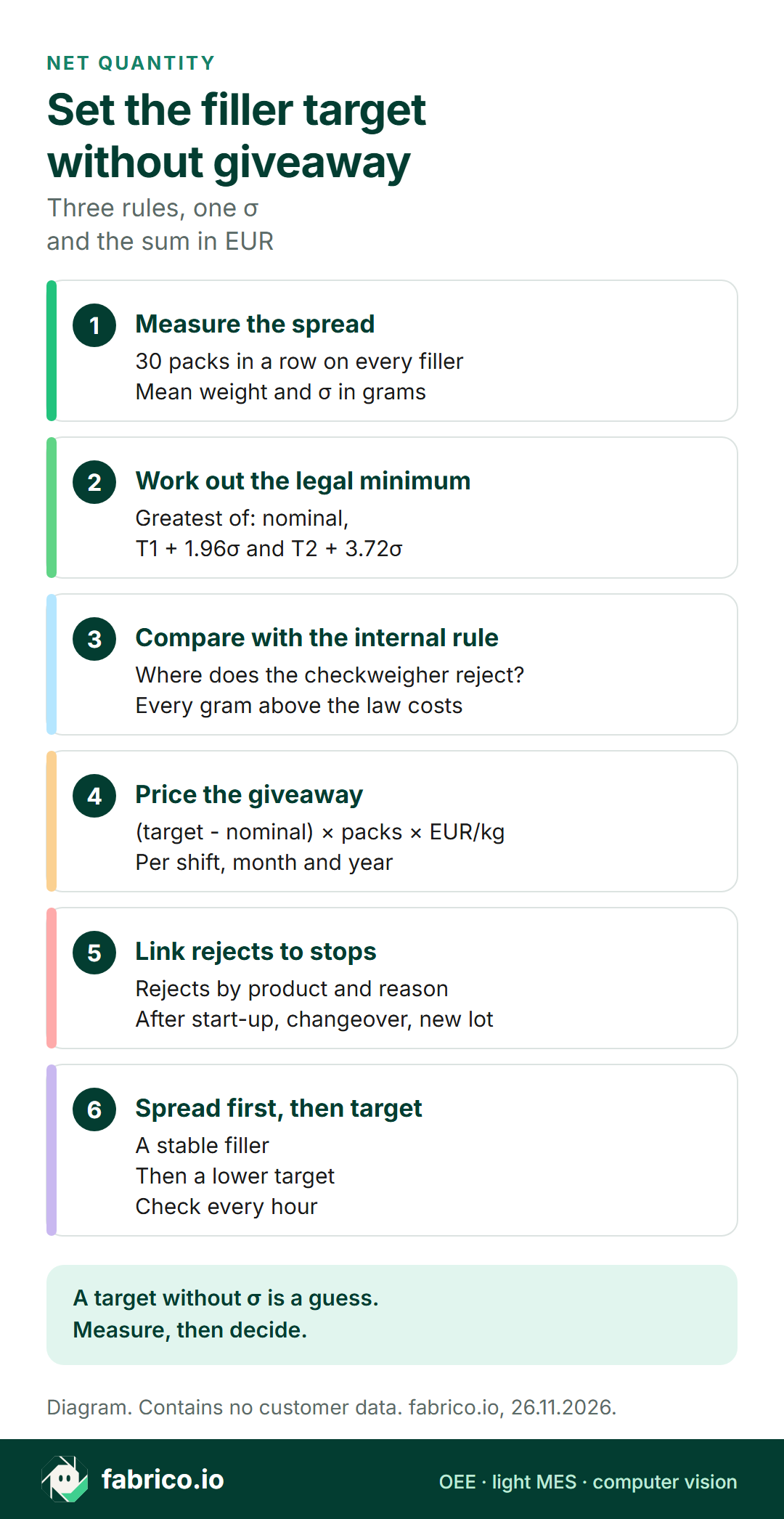
Text version of the diagram
- Measure the spread: 30 packs in a row on every filler, mean weight and σ in grams.
- Work out the legal minimum: the greatest of nominal, T1 + 1.96σ and T2 + 3.72σ.
- Compare with the internal rule: where the checkweigher rejects and how many grams above the law that costs.
- Price the giveaway: (target minus nominal) × packs × EUR/kg, per shift, month and year.
- Link rejects to stops: rejects by product and reason, after start-ups, changeovers and raw material changes.
- Tighten the spread, then the target: a stable filler first, then a lower target with an hourly check.
A good rule for the first month: one line, one SKU, data every hour. The giveaway figure from that line is usually enough to decide whether the next step is a checkweigher with feedback or better start-ups first.
Where Fabrico fits
Fabrico does not weigh packs or control the filler: weights and σ stay in the checkweigher and the samples. Fabrico is an OEE platform and light MES with OEE. It shows OEE by machine, line and shift, logs scrap by product and reason, stops with the reason the operator picks, and changeovers against a standard time.
That shows whether checkweigher rejects follow start-ups, changeovers or one particular shift. The Financial impact module prices losses in money per SKU and ranks stops by financial impact. Pricing is one quote per plant, by machines and modules: pricing.
Frequently asked questions
Is the ℮ mark mandatory?
No. According to Your Europe the mark is voluntary, but once it is applied the packs must pass the directive's three rules. The net quantity still goes on the pack without it.
Can a pack weigh less than nominal?
Yes, as long as no more than the allowed share falls below nominal minus the tolerable negative error and the batch average is at least nominal. A pack below twice the error may not bear the ℮ mark.
What is the tolerable negative error for 500 g and for 1 kg?
For 500 g it is 15 g, giving a T1 limit of 485 g and T2 of 470 g. For 1,000 g it is also 15 g under the table (the 500 to 1,000 g row), giving 985 g and 970 g.
How often should fill weight be checked on the line?
The directive sets no frequency, but WELMEC 6.4 calls it good practice to assess the mean and the counts below T1 and T2 every production hour. A deviation found more than an hour late usually means quarantining that hour's output.
Does giveaway count in OEE?
No. A pack above nominal is good and counts in quality. Giveaway is a money loss outside OEE, while checkweigher rejects are a quality loss inside it.
Who inspects producers in Bulgaria?
DAMTN's Chief Directorate Metrological Supervision. Its 2025 report says on-site checks at producers mostly follow doubts from retail checks and complaints from the public.
Does the checkweigher have to be verified?
Actual contents must be measured with a legal and suitable measuring instrument. WELMEC 6.4 also explains how a non-verified checkweigher can be used, but the target then has to compensate for the extra uncertainty.
See which stops and changeovers drive rejects on your line. The demo shows OEE by machine, line and shift, scrap by product and reason, and losses in EUR per SKU.
Latest from our blog






Real Fabrico tiles, sample data.