





 Login
 Blog
Regrind in injection moulding: how much to add without losing money

In short
- There is no single safe percentage: the share of regrind or recyclate you can run without losing money differs for every part family. Measure it on the presses instead of setting one cap for the plant.
- Four weeks are enough: 0%, 15% and 30% on 4 presses running one part family, with control presses every week and shift data on scrap, short shots, cycle time and stops.
- The money sits in the cycle, not in the pellet: in the example, 15% earns +479 EUR per press per month while 30% loses 3,448 EUR. The slower cycle and extra stops eat the resin saving.
- In-house regrind does not count toward PPWR, as Article 7 reads: from 2030 only recycled content from post-consumer plastic waste counts. Regrind lowers cost; recyclate delivers compliance.
- The decision is a cap per part family: plus rules for drying, sorting lots and the point where you stop the test.
How much regrind or recycled resin can you run in injection moulding without losing money? Not 10% and not 20% for the whole plant. The answer is a separate cap for each part family, measured on your own presses, because threaded closures, thin-wall tubs and crates tolerate recycled material very differently.
A four-week test at 0%, 15% and 30%, read from shift data, gives you that cap in EUR per press per month. Below: the deadlines that make the question urgent, what the material changes in the process, the test itself, a worked example and the questions to put to your supplier.
Why recycled content is rising now
Three things converge over the next four years: a law with fixed percentages, a limited supply of good recyclate, and buyers who ask for the share in the request for quotation.
Regulation (EU) 2025/40 on packaging and packaging waste (PPWR) has been in force since 11 February 2025. It applies from 12 August 2026, according to the European Commission's packaging waste page (accessed 26.11.2026). Article 7 sets the minimum recycled content of the plastic parts of packaging.
| Date | What happens | Legal basis |
|---|---|---|
| 2025 | PET beverage bottles: at least 25% recycled plastic, averaged per Member State | Directive (EU) 2019/904, Art. 6(5) |
| 11.02.2025 | PPWR enters into force | European Commission |
| 12.08.2026 | PPWR starts to apply | European Commission |
| 31.12.2026 | Commission adopts the method to calculate and verify recycled content | PPWR, Art. 7(8) |
| 1.01.2028 | Commission assesses the need for derogations from the targets | PPWR, Art. 7(12) |
| 1.01.2030* | First mandatory shares per packaging group | PPWR, Art. 7(1) |
| 1.01.2040 | Second, higher shares | PPWR, Art. 7(2) |
* By 1 January 2030 or 3 years after the implementing act under paragraph 8 enters into force, whichever is later.
The Single-Use Plastics Directive (Directive (EU) 2019/904, Art. 6(5), EUR-Lex, accessed 26.11.2026) already requires 25% for PET beverage bottles from 2025 and 30% for all beverage bottles from 2030.
| Plastic packaging | From 2030* | From 2040 |
|---|---|---|
| Contact-sensitive, PET (excluding beverage bottles) | 30% | 50% |
| Contact-sensitive, other plastics | 10% | 25% |
| Single-use plastic beverage bottles | 30% | 65% |
| All other plastic packaging | 35% | 65% |
Source: Regulation (EU) 2025/40, Art. 7(1) and 7(2), EUR-Lex (accessed 26.11.2026). "Contact-sensitive" means packaging for products under the regulations listed in Art. 3(49): food, feed, cosmetics, medicines, medical devices and a few others.
What counts and what does not
- It counts only when the recycled content comes from post-consumer plastic waste, meaning waste from plastic products that have been placed on the market (Art. 3(48) and Art. 7(1) and 7(3)).
- It does not count when it is your own regrind: sprues and rejected caps never reached the market. The Commission's calculation method under Art. 7(8) is still due; check it once adopted. Regrind cuts your resin bill but does not raise your PPWR share.
- An average, not every cap: the share is calculated as an average per manufacturing plant and year, per packaging type and format. A different cap per part family is not a problem in itself, as long as the plant's yearly average for that packaging type and format reaches the target.
- Exemptions: among them packaging for medicines and medical devices, compostable packaging and plastic parts below 5% of the weight of the whole packaging unit (Art. 7(4) and 7(5)). Check where your closure falls.
The supply of good recyclate is not growing
Circular plastics made up 15.4% of European plastics production in 2024, around 8 million tonnes, with no growth since 2022, according to Plastics Europe, Plastics: the fast Facts 2025 (accessed 26.11.2026).
The EU generated 16.2 million tonnes of plastic packaging waste in 2024, according to Eurostat's packaging waste statistics (accessed 26.11.2026). The Commission page above puts the recycled share at 42.4%, against a 55% target for 2030 under the Packaging Waste Directive.
What that means on the shop floor: demand for good-quality recyclate will grow faster than supply, and lots will vary. Run the test with your supplier's real material, not with a trade-fair sample.
What regrind and PCR change in the process
Every change in the material shows up on the floor as a specific kind of scrap or stop. The lab measures the cause; the press shows the effect. The test below measures the effects, because those are what cost money.
| Change | What you see at the press | What to log |
|---|---|---|
| Melt flow (MFR) | Short shots or flash, unstable injection pressure | MFR from the lot certificate |
| Lot-to-lot spread | Scrap changes when the lot changes | Lot number on every shift |
| Moisture | Splay, bubbles, brittle parts | Dryer temperature and dew point |
| Contamination | Black specks, gels, blocked filter or nozzle | "Contamination" scrap, cleaning stops |
| Colour | Grey or yellow tint, streaks | "Colour" scrap per lot |
| Dimensions | Thread, tamper band or shrinkage out of tolerance | Sample measurements per shift |
Melt flow. Regrind has been through the barrel at least once, its chains are shorter, and its melt flow usually rises. The standard method for MFR and MVR of thermoplastics is ISO 1133-1:2022 (BSI catalogue entry for ISO 1133-1:2022, accessed 26.11.2026). Ask for the MFR of every lot, measured to that method.
A study by the Technical University of Liberec and the Technical University of Kosice looked at how to detect thermally degraded recycled material in polypropylene. Melt flow index was the most suitable method (Běhálek et al., Materials, 2021, DOI 10.3390/ma14030552, accessed 26.11.2026).
The authors warn that short-term properties can look normal while degraded material shortens the life of the part.
For functional parts such as crates or technical components, add an ageing test to the trial. Four weeks on the floor will not catch it.
Lot-to-lot spread. With post-consumer recyclate the risk lies more in the spread than in the average. The Institute for Plastics Processing (IKV) at RWTH Aachen University studied six consecutive monthly lots of HDPE recyclate from household waste (Fischer et al., Polymers, 2025, DOI 10.3390/polym17131828, accessed 26.11.2026):
- MFR differed by 53% between lots, from 1.79 to 2.74 g/10 min at 190 °C.
- Injection pressure differed by around 10% to 20%, depending on the part.
- Every lot contained some PP, in varying amounts.
- Part dimensions did not differ in a statistically significant way.
The lesson: one week on one lot tells you nothing about next month. Log the lot number and the certificate MFR on every shift.
Moisture. PET and PA absorb moisture and are dried before moulding, because water in the melt breaks their chains. PP and HDPE take up very little, but recyclate can carry moisture from washing. If splay or bubbles appear only with recyclate, check drying before you give up on the share.
Contamination and colour. Foreign polymers, gels and black specks block filters and nozzles and cause cosmetic scrap. Recyclate from mixed streams is not reliably white: on white or clear parts, colour can set the cap before dimensions do.
Dimensions. Different flow and different shrinkage move dimensions. On closures that means the thread and the tamper band; on thin-wall food tubs, the lid fit and stacking. Measure samples to the same plan on every press.
The 4-week test, step by step
The test compares shares on the same presses with the same part family and keeps control presses running every week. You need 4 presses on one part family and data by shift.
How cycle time drifts in injection moulding in general is covered in OEE for injection moulding; here the only question is the difference between shares.
- Pick one part family and 4 presses. One mould or identical moulds, one resin, similar presses. Note which cavities are blocked and keep them that way for the whole test.
- Set the limits before the first shift. For example: scrap no more than 0.5 points above the control, cycle time no more than 2% longer, no dimension out of tolerance on a functional feature. Written down in advance, the limits settle the argument after the test.
- Week 1: 0% on every press. This gives you the noise: how much scrap and cycle time move from shift to shift with no change in material at all.
- Week 2: presses A and B at 15%, C and D stay at 0%. C and D are the control for the same week: same calendar, same crews, same humidity in the hall.
- Week 3: A and B at 30%, C and D at 15%. That way 15% runs on two pairs of presses, and 30% starts on the pair that has already shown how it reacts.
- Week 4: A and B back to 0%, C and D at 30%. The return of A and B shows whether the presses and moulds drifted on their own over the month.
- Leave out the transition. Do not count the first 30 minutes after a ratio change: the barrel, hopper and dryer need to purge the previous blend.
- Compare by shift, not by weekly totals. One week of 3 shifts over 5 days gives 15 shifts per share per press: enough points to see whether a difference rises above the noise.
What to log on every shift
- Press, mould and active cavities.
- Share of regrind or recyclate: from the dosing unit or the run sheet.
- Lot number of the virgin resin and of the recyclate, plus the MFR from the certificate.
- Shots, good parts and scrap by reason: short shot, flash, sink, warp, black specks, colour, dimension.
- Average cycle time and the longest cycle in the shift.
- Stops by reason and minutes: blocked filter or nozzle, hopper bridging, cleaning, lot change.
- Every setting change: who, when, what (pressure, temperature, hold, speed).
- For PET and PA: dryer temperature and dew point.
Calculate scrap the same way on every press: rejected parts divided by all parts produced. If the formula differs between shifts, settle how to calculate the scrap rate before you start.
How to keep the comparison fair
- One recyclate lot per week, if the supplier can set it aside. If not, log the lot change as an event.
- One quality plan on all presses: same sampling frequency, same gauges, same people measuring.
- Crews rotate on the normal roster, not by press. If one crew always runs press A, the difference may be the crew, not the material.
- No mould repairs or changeovers during the test unless something breaks. A breakdown is logged and that shift drops out of the comparison.
If the setter raises injection pressure to stop short shots at 30%, scrap falls, but the difference has not gone away. It has moved into the setting and into extra load on the mould. The logged change is part of what that share costs.
If your presses already feed OEE software for injection moulding, shots, stops and scrap by reason are already there by shift. All you add is the share on each run. If they do not, the test also works with a paper form and a stopwatch, with more transcription errors.
Worked example: 12 presses, 4 on one closure family
The numbers are an example for the calculation, not a customer's data. Swap in your own prices, cycle times and scrap.
- A plant with 12 injection moulding presses. 28 mm HDPE closures for laundry and dishwashing detergent bottles run on 4 of them.
- 32-cavity hot runner mould, 3.0 g per closure, cycle time 7.0 s at 0%.
- 3 shifts of 7 hours of running time (25,200 s), 22 days a month: 66 shifts a month, 792 a year.
- Virgin HDPE 1.35 EUR/kg, recyclate offer 1.15 EUR/kg, selling price 9.00 EUR per 1,000 closures.
- The presses are fully booked: every closure lost is a closure not sold.
The family is for detergents on purpose. For food and cosmetics the packaging is "contact-sensitive": for HDPE the 2030 target is 10% instead of 35%. Recyclate for food contact must also come from a process under Regulation (EU) 2022/1616 (see the supplier questions). The test is the same; only the limits are tighter.
Here is what the four weeks show, averaged per shift per press:
| Per shift | 0% | 15% | 30% |
|---|---|---|---|
| Cycle time, s | 7.0 | 7.0 | 7.5 |
| Extra stops, min | 0 | 0 | 12 |
| Shots | 3,600 | 3,600 | 3,264 |
| Closures | 115,200 | 115,200 | 104,448 |
| Scrap, % | 1.0 | 1.3 | 3.0 |
| of which short shots, points | 0.2 | 0.3 | 1.6 |
| Good closures | 114,048 | 113,702 | 101,315 |
| Resin, kg | 345.6 | 345.6 | 313.3 |
| Blend price, EUR/kg | 1.35 | 1.32 | 1.29 |
| Resin cost, EUR | 466.56 | 456.19 | 404.21 |
| Revenue, EUR | 1,026.43 | 1,023.32 | 911.84 |
| Revenue minus resin, EUR | 559.87 | 567.13 | 507.63 |
| Difference vs 0%, EUR | 0 | +7.26 | -52.24 |
How each line is built:
- Shots = running time / cycle time. At 0% and 15%: 25,200 s / 7.0 s = 3,600. At 30%: (25,200 - 720) s / 7.5 s = 3,264.
- Closures = shots × 32 cavities: 115,200 and 104,448.
- Good closures = closures × (1 - scrap): 115,200 × 0.99 = 114,048; 115,200 × 0.987 = 113,702; 104,448 × 0.97 = 101,315.
- Resin = all closures, scrap included, × 3.0 g: 345.6 kg and 313.3 kg.
- Blend price = 0.85 × 1.35 + 0.15 × 1.15 = 1.32 EUR/kg; 0.70 × 1.35 + 0.30 × 1.15 = 1.29 EUR/kg.
- Revenue = good closures × 9.00 EUR / 1,000. The shift result is revenue minus resin.
The difference per shift, carried to month and year:
| Difference vs 0% | 15% | 30% |
|---|---|---|
| Per press per shift | +7.26 EUR | -52.24 EUR |
| Per press per month (66 shifts) | +479 EUR | -3,448 EUR |
| Per press per year (792 shifts) | +5,750 EUR | -41,374 EUR |
| 4 presses per year | +23,000 EUR | -165,496 EUR |
Where the money goes at 30%
The resin saving is 0.06 EUR/kg: on 345.6 kg that is about 20.74 EUR per shift. The loss comes from 12,733 fewer good closures per shift: about 6.7% from the slower cycle, 2.9% from the extra stops and 2 points of extra scrap.
A break-even rule at these prices: every 1,000 good closures lost costs about 5.13 EUR (9.00 EUR revenue minus 3.87 EUR of resin). The 30% blend pays only if you lose fewer than about 4,000 good closures per shift, which is about 3.5% of output.
Three questions the example raises
- What if the recyclate costs the same as virgin? At 1.35 EUR/kg for both, 15% loses 3.11 EUR per shift: about 205 EUR per press per month and 2,463 EUR a year. That is the cost of compliance, not a loss from a bad process. Know it before the price talk with your customer.
- What if the presses have spare hours? Then lost closures are made up in extra hours instead of lost as sales. The cost of the slower cycle becomes machine time at your hourly rate, and 30% may come out cheaper than in the example.
- What does the test itself cost? 30% runs for 60 shifts (2 presses × 15 shifts in week 3 and the same in week 4): 60 × 52.24 = 3,134 EUR. 15% brings 60 × 7.26 = 436 EUR. Net, the test costs about 2,700 EUR, against 165,496 EUR a year for running 30% on the whole family without a test.
To price the extra stops at 30% on your own presses, use the cost of downtime calculator.
Reading the results
Four weeks give you a table by shift. The decision takes three steps, in this order.
- Compare with the noise from week 1. If scrap at 0% swings between 0.7% and 1.4% from shift to shift, a 0.3-point difference at 15% is not a difference.
- Compare with the control in the same week, not with week 1. If the control also got worse, the cause is shared: humidity, the virgin resin lot, a crew.
- Do the money as in the example: resin saved minus good parts lost, per press per month.
Then turn each result into an action:
| If you see | Decision |
|---|---|
| Scrap and cycle within the limits, money positive | That share is the family's cap. Go higher only with a new measurement. |
| Short shots rise when the lot changes | A narrower MFR window in the specification, or lots sorted by MFR, then repeat the week. |
| Splay, bubbles | Drying, or a check of moisture in the recyclate. Repeat before you reject the share. |
| Black specks, blocked filters | A stricter contamination limit at the supplier. Do not raise the share. |
| Cycle time rises, scrap does not | The money decides: work out the break-even as in the example. |
| Thread, tamper band or lid out of tolerance | Stop. This share is not for this family. |
When to stop the test at once
- A dimension out of tolerance on a functional feature in two samples in a row.
- Two shifts in a row above the scrap limit you set before the test.
- Any doubt about compliance on food-contact packaging.
- A customer claim on a lot from the test.
Stop the share, not the press: put it back on the last share that passed the limits and carry on with the others.
The cap holds after the test only if someone keeps watching scrap by family and lot every week. If you already run OEE software, set up a separate view for the test family and compare it with the week 1 figures.
Three routes and who should pick which
| Option | Cost to the plant | Best for |
|---|---|---|
| One cap for the whole plant | No test. You lose money where families could take more and take risks where they take less. | A small plant with 1-2 families and no customer pressure |
| A cap per family after a 4-week test | About 2,700 EUR net for the test in the example | A plant with several families that must reach a PPWR target |
| Investment for a higher share: dosing, drying, filtration, sorting | Per quote. Payback is the EUR per press per month from the test | When the test points to a clear cause and volumes are high |
The share and the lot need to sit next to scrap and cycle time without copying figures from three places.
That is a job for MES for plastics injection moulding: the share comes in with the order, cycle and scrap come from the press. If you also mould rPET preforms, the same logic applies to stretch blow moulding OEE.
Questions for your recyclate supplier
Ask them before the test and get the answers in writing. They decide whether four weeks of results will still hold next year.
- What MFR window do you commit to for each lot, under which ISO 1133-1 conditions, and do you put the measured value on the certificate?
- What share of the material comes from post-consumer plastic waste, and can you prove it per lot under EN 15343? The standard sets out traceability of recycled plastics and the basis for calculating recycled content (BSI catalogue entry for EN 15343, accessed 26.11.2026).
- For food-contact packaging: which technology and which process under Regulation (EU) 2022/1616 (EUR-Lex, accessed 26.11.2026) produced the recyclate, and what does the EU register show for it?
- What are your contamination limits for foreign polymers (for example PP in HDPE), gels and black specks, and how do you measure them?
- What is the moisture at delivery, and what drying do you recommend?
- How large is one lot, and can you set aside a single lot for the whole 4-week test?
- What colour range and odour do you commit to, and how is a colour claim settled?
The test on one page
The diagram below puts the test into six steps. Print it and pin it next to the presses for the four weeks, so that every shift works in the same order.
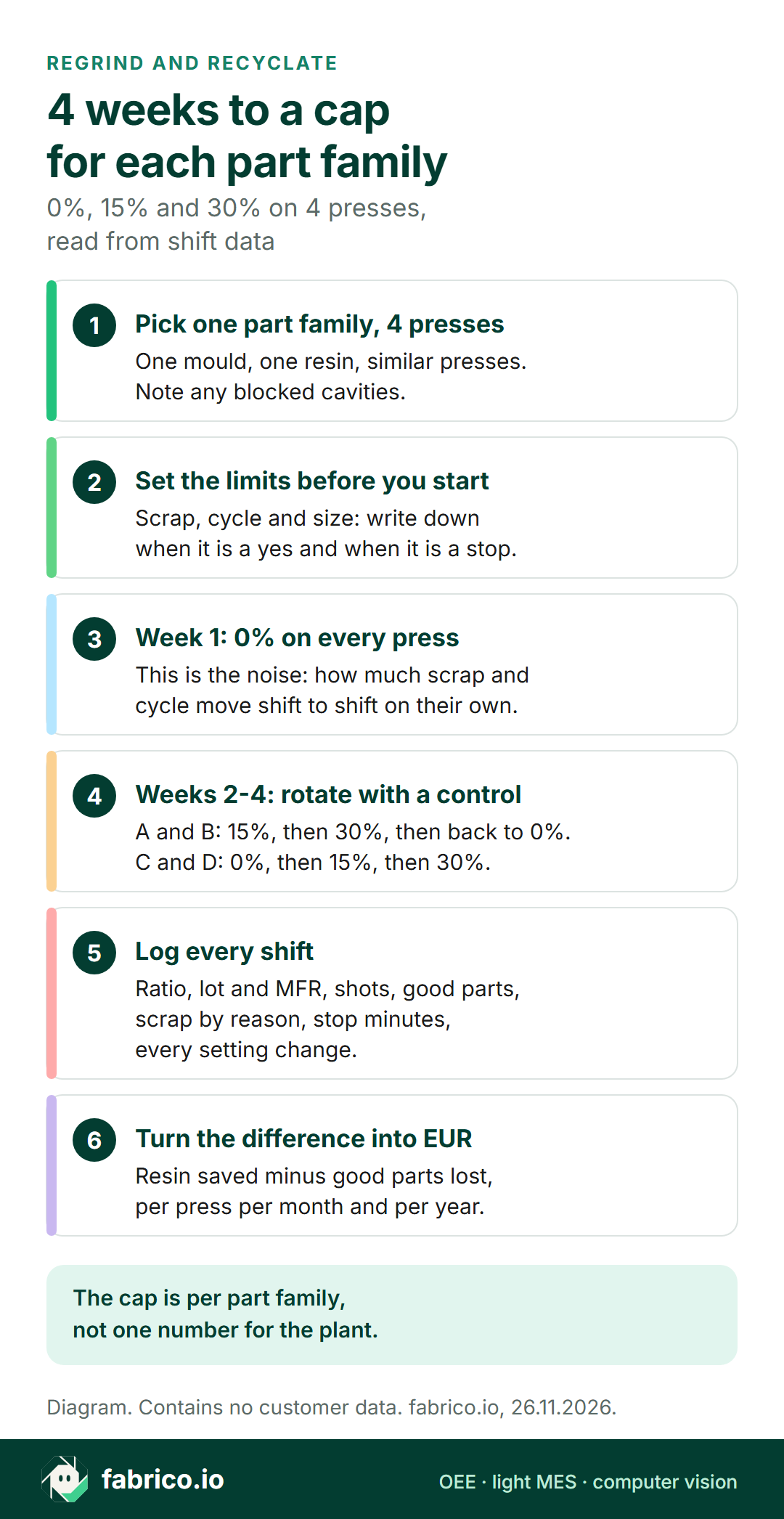
Text version of the diagram
- Pick one part family and 4 presses: one mould, one resin, similar presses; note blocked cavities.
- Set the limits for scrap, cycle time and dimensions before the first shift.
- Week 1: 0% on every press, to see the noise from shift to shift.
- Weeks 2-4: A and B at 15%, then 30%, then back to 0%; C and D at 0%, then 15%, then 30%.
- Log every shift: share, lot and MFR, shots, good parts, scrap by reason, stop minutes and every setting change.
- Turn the difference into EUR: resin saved minus good parts lost, per press per month and per year. The cap is per part family, not one number for the plant.
Where Fabrico fits
Fabrico is an OEE platform and light MES. In this test it covers the press data:
- it counts shots or parts from the press signal, through the line PLC or a Fabrico IoT device;
- it shows output per hour against the ideal rate (the speed loss) and OEE by machine and shift, with stop reasons chosen by operators in a few taps;
- it logs scrap by product and reason and prices losses in EUR (Financial impact module).
Fabrico does not measure melt flow, moisture or the regrind share. The plant enters the share for each run in the run sheet or the ERP and compares it with scrap and speed loss by press and shift.
See how that looks as a light MES and how it is quoted by machines and modules on the pricing page.
Frequently asked questions
How much regrind is safe to add in injection moulding?
There is no single percentage for all parts. Test 0%, 15% and 30% for four weeks on one part family and take the share at which scrap and cycle time stay within your limits and the EUR difference is positive.
Does in-house regrind count toward the PPWR targets?
Not under the wording of Article 7: only recycled content from post-consumer plastic waste counts, and your own scrap was never placed on the market. Regrind lowers your resin cost but does not raise your share.
When do the recycled content targets for plastic packaging apply?
From 1 January 2030, or 3 years after the calculation method under Article 7(8) enters into force, whichever is later. For PET beverage bottles, 25% has applied since 2025 under Directive (EU) 2019/904.
Why does scrap rise when the recyclate lot changes?
Lots differ. In an RWTH Aachen study, the melt flow of six monthly lots of HDPE recyclate differed by 53%. Log the lot number and the certificate MFR on every shift.
Do I need to dry regrind and recyclate?
PET and PA always need drying. PP and HDPE usually do not, but if splay or bubbles appear only with the recyclate, check its moisture.
What does the 4-week test cost?
In the example in this article, about 2,700 EUR net, mostly from the 30% shifts. Against that stands a loss of more than 165,000 EUR a year if the same share went onto 4 presses without a test.
Can I use recyclate in food-contact closures?
Recycled plastic for food contact must come from a process under Regulation (EU) 2022/1616. Ask the supplier for the process and its register entry, and agree the test with your food safety lead.
See scrap and speed loss by press and shift, in EUR. The demo shows how shots are counted from the press signal, how scrap is logged by reason and how losses are priced in EUR.
Latest from our blog





Real Fabrico tiles, sample data.