





 Login
 Blog

Tube bending OEE: setups, scrap and money per CNC bender cell

In short
- Measure the cell, not just the bender: tube supply, loading, bending, end forming and unloading. Each step leaks time in its own way.
- Setup decides everything in small batches: with a 24 min setup and a 38 s cycle, a batch of 50 parts loses 43% of its time to die changes alone.
- The first piece is scrap: springback correction after a die change counts as setup, and discarded trial parts count as quality loss.
- Example in EUR: a cell at 62.6% OEE loses 624 EUR a shift against its ideal rate. Cutting setup from 24 to 15 min is worth about 41,100 EUR a year in this example.
- Old bender with no signal: a camera at unloading counts finished parts, and the operator picks the stop reason and the scrap type.
Tube bending OEE is measured per cell and per shift: availability (how much of the planned time the machine actually bends), performance (how fast against the ideal cycle of the part) and quality (how many parts pass inspection first time).
In small-batch work on a CNC tube bender, setup can be the biggest loss: the bend die, clamp die, pressure die, mandrel and wiper die for every part number.
After setup come waiting for tubes from the saw or tube laser, hand loading, and scrap: wrinkles, ovality, cracks and wrong angles from springback. This article gives a setup vs batch size table, a worked example in euros and questions for choosing a system.
It is written for plants that bend metal furniture frames, exhaust and seat tubes, copper tubes for HVAC and refrigeration, and bicycle or fitness frames. The sector is large: Eurostat lists fabricated metal products (Division 25) among the three largest EU manufacturing divisions by employment in 2023 (Eurostat, Businesses in the manufacturing sector, accessed 26.11.2026).
Demand swings hard. In Bulgaria, the national statistics institute reports that the production index for fabricated metal products (C25) rose 15.7% in June 2026 over May, yet stood 7.0% below June 2025 (NSI Bulgaria, Industrial production indices, June 2026, accessed 26.11.2026). Swings like that bring smaller, more frequent orders, and more setups.
The bending cell in 5 steps, and what paces it
A tube bender rarely works alone. The pace of the cell is set by the slowest step of the shift, and that is often not the bending. If the saw sends tubes in lots of 200 once an hour, the bender waits even when it is free.
- Tube supply: cut blanks from the saw or tube laser, on a cart or in a magazine.
- Loading: by hand or from a magazine. When long tubes are loaded by hand, the operator is part of the cycle.
- Bending: rotary draw bending with a mandrel, by a program with several bends and rotations.
- End forming or cutting: expanding, reducing, piercing, sometimes on a separate machine.
- Unloading and inspection: a fixture, gauge or measuring table, then into a pallet or bin.
| Step | Where time leaks | What to log | Signal source |
|---|---|---|---|
| Tube supply | Bender waits for blanks | Minutes of "Waiting for tubes", which part number | Operator stop reason |
| Loading | Slow manual cycles, hunting for a tube | Actual cycle against ideal | PLC or IoT device on the cycle signal |
| Bending | Setup, micro-stops, mandrel lubrication | Start and end of setup, stop reason | Machine controller, operator stop reason |
| End forming | Separate setup, queue between machines | Waiting between steps, end scrap | PLC or IoT device, operator stop reason |
| Unloading and inspection | Scrap: wrinkles, ovality, cracks, angle | Scrap count by type and part number | Camera counts finished parts; scrap entered by the operator |
The signal rule is simple. If the bender's controller gives a cycle-complete signal, it is picked up through the PLC or a small IoT device.
If the machine is old and has no usable signal, a camera over the unloading point counts finished parts. The stop reason always comes from the person at the machine, in a few taps on a tablet.
If the same shop runs press brakes, the logic is similar but the losses differ. The sheet metal side is covered in OEE for press brakes, and blank supply from the laser in OEE for laser cutting.
One shift of the cell, minute by minute
Here is one shift of 450 planned minutes from the example below. The machine bends for 331 min. The rest goes to setups, waiting for tubes, other stops and time spent on parts that end up as scrap.
The green bar includes slow cycles. They never show up as a stop, yet in the example they cost about 50 min a shift. That is why availability alone is not enough: performance against the ideal cycle has to be visible too.
Setup minutes and batch size
The top search results for tube bending OEE do not show this table. It shows how much of a batch's time the setup eats when the cycle is 38 s per part. The maths: bending time = parts × 38 s; setup share = setup ÷ (setup + bending time).
| Batch | Bending | Share lost to a 24 min setup | Availability at 24 min | Availability at 12 min |
|---|---|---|---|---|
| 20 parts | 12.7 min | 65.5% | 34.5% | 51.4% |
| 50 parts | 31.7 min | 43.1% | 56.9% | 72.5% |
| 100 parts | 63.3 min | 27.5% | 72.5% | 84.1% |
| 300 parts | 190.0 min | 11.2% | 88.8% | 94.1% |
Availability here counts setup only. Waiting for tubes and other stops pull it lower still. Two conclusions for a production manager:
- Below 100 parts, setup matters more than machine speed. A faster bender with a 24 min setup loses to a slower one with a 12 min setup.
- Halving setup is worth as much as doubling the batch. A batch of 50 at 12 min (72.5%) matches a batch of 100 at 24 min (72.5%).
Measure setup from the last good part of the old batch to the first approved part of the new one. That way it includes the die change, loading the program, trial bends and sign-off. If the clock stops earlier, at the first bend, the corrections vanish from the numbers.
SMED fits exactly here: split internal work (machine stopped) from external work (preparation while the machine is still bending).
In a case study at a medium-sized foundry, the authors describe removing unneeded activities, converting internal tasks to external ones, and simplifying and standardising the rest (Singh and Khanduja, IJPPM 59(1), 2010, DOI 10.1108/17410401011006130, accessed 26.11.2026). More on the method in SMED and quick changeover.
First-piece checklist (springback)
After bending, the tube springs back slightly and the angle comes out smaller than programmed.
A study of rotary draw bending of a 6 mm titanium alloy tube found that the change in wall thickness during bending is the strongest factor in its springback model: accounting for it cut the prediction error by 41.2-45.3% (Zhan et al., Journal of Materials Processing Technology 236, 2016, accessed 26.11.2026).
The shop-floor takeaway is practical: every new lot of tubes with a slightly different wall or strength may need a new correction. The checklist below cuts the number of trial bends.
- Part number, program and program version match the job card.
- The dies belong to the set for this diameter and radius: bend, clamp, pressure, mandrel, wiper.
- The tube lot certificate is at the machine: grade, dimensions, wall.
- The springback correction is taken from the last good batch of the same part number.
- The mandrel is lubricated and its position checked.
- The first part is checked on the fixture: angles, planes, lengths between bends.
- The number of trial parts and the final correction are written on the card for next time.
Safe setup. Regulation (EU) 2023/1230 on machinery applies from 14 January 2027. Its Annex III requires that adjustment and maintenance can be done while the machine is at a standstill, and that fixed guards can be removed only with tools (EUR-Lex, Regulation (EU) 2023/1230, accessed 26.11.2026). A faster setup must never bypass the guards.
Worked example: OEE and lost euros for one cell
These numbers are an example, not a customer's data. The cell bends a seat frame from steel tube, rotary draw with a mandrel, loaded by hand. Swap in your own value for any line.
| Input | Value |
|---|---|
| Planned time per shift | 450 min (480 min less a 30 min break) |
| Ideal cycle (load, bend, unload) | 38 s per part |
| Setups | 3 per shift × 24 min = 72 min |
| Waiting for tubes from the saw | 18 min |
| Other stops | 14 min |
| Parts bent | 468 |
| Scrap | 9 trial + 14 process = 23 parts |
| Contribution per good part | 2.35 EUR (example input) |
Availability. Stops: 72 + 18 + 14 = 104 min. Run time: 450 - 104 = 346 min. Availability = 346 ÷ 450 = 76.9%.
Performance. Ideal time for 468 parts: 468 × 38 s = 17,784 s = 296.4 min. Performance = 296.4 ÷ 346 = 85.7%.
Quality. Good parts: 468 - 23 = 445. Quality = 445 ÷ 468 = 95.1%.
OEE = 76.89% × 85.66% × 95.09% = 62.6%. Check: 445 good parts × 38 s = 16,910 s, divided by 27,000 s of planned time, also gives 62.6%. The full formula is in how to calculate OEE.
What one minute is worth
At an ideal cycle of 38 s, the bender makes 60 ÷ 38 = 1.579 parts a minute. At 2.35 EUR contribution, one minute is worth 1.579 × 2.35 = 3.71 EUR. The 445 good parts equal 281.8 min of ideal time, so the lost minutes are 450 - 281.8 = 168.2 min.
| Loss | Minutes per shift | EUR per shift |
|---|---|---|
| Setups | 72.0 | 267 |
| Slow cycles | 49.6 | 184 |
| Waiting for tubes | 18.0 | 67 |
| Scrap (23 parts × 38 s) | 14.6 | 54 |
| Other stops | 14.0 | 52 |
| Total | 168.2 | 624 |
The gap to 100% OEE is 624 EUR a shift. With 2 shifts and 21 working days that is 42 shifts and 26,208 EUR a month, and over 12 months (504 shifts) 314,496 EUR. No cell reaches 100%, so treat this figure as a ceiling, not a target.
Faster setups or grouped die sets: the money
- Setup from 24 to 15 min. That frees 3 × 9 = 27 min. At the same performance and quality: 27 × 1.579 × 85.7% × 95.1% = 34.7 good parts. That is 81.55 EUR a shift, 3,425 EUR a month and 41,101 EUR a year.
- Grouping by die set. Two batches in a row with the same diameter and radius: one full setup becomes a partial 9 min change (clamp die and program only). That frees 15 min and 2 trial parts: 21.3 good parts, 50.06 EUR a shift, 2,103 EUR a month, 25,230 EUR a year.
That holds in this example, and only if the gain holds. The two measures do not simply add up, because grouping reduces the number of full setups the faster change applies to.
Tube bending scrap modes and what to log
Bending scrap is OEE quality loss. What matters is logging it by type, not as one "scrap" bucket. Each type points to a different cause and a different person to fix it.
| Scrap type | What it looks like | Possible cause | What to log |
|---|---|---|---|
| Wrinkling | Waves on the inside of the bend | Wiper die, mandrel, pressure | Count, part number, which bend |
| Ovality and flattening | Cross-section no longer round | Mandrel position, tight radius | Count, measured ovality |
| Cracking | Crack on the outside of the bend | Material, thin wall, tight radius | Count, tube lot |
| Wrong angle | Angle outside the fixture tolerance | Springback, new tube lot | Count, correction, trial or process |
| End scrap | Wrong flare or length | End forming setup | Count, which machine |
Cracking and flattening can come from the tube, not the bender. ISO 8492 describes a flattening test that shows whether a round metal tube can take plastic deformation and can reveal defects, for tubes up to 600 mm outside diameter (ISO 8492:2013, Metallic materials: Tube: Flattening test, accessed 26.11.2026).
For precision cold drawn steel tubes with no weld seam, up to 380 mm, EN 10305-1 sets tight dimensional tolerances and a maximum surface roughness (BSI, BS EN 10305-1:2016, accessed 26.11.2026). If scrap jumps with a new tube lot, compare the certificate with the standard you ordered before touching the program.
Two rules for logging:
- Trial parts separately. Mixed with process scrap, they hide whether the problem is the setup or process stability.
- Rework is not a good part. A part that is re-bent by hand counts as quality loss, because it did not pass first time.
The camera counts finished parts at unloading. It does not assess wrinkles, ovality or angle. The scrap type is chosen by the operator or inspector on the tablet at the cell.
Small batches and order sequencing
Small batches are here to stay: metal furniture and spare parts come in tens. If the batch cannot grow, the number of full setups can still shrink by sequencing the orders.
- Group by tube diameter. A diameter change means nearly the whole die set plus the mandrel.
- Then by bend radius. The same radius often lets the bend die stay on.
- Then by material and wall. That carries the springback correction from batch to batch.
- Check against tube supply. Tubes for the next 2 batches should be cut before the bender finishes the current one.
The plan is made in the ERP or in the planner's spreadsheet. An OEE system does not plan. It supplies the measured values that make the plan realistic: actual setup time per die set, actual cycle per part number, and how often the cell waits for tubes.
If the cell stops for 1-2 min at a time for mandrel lubrication or a tube stuck in the magazine, those stops pile up. How to catch them is covered in micro-stops.
Ways to measure: who should pick which
There is no single right option. The choice depends on the number of cells, the age of the machines, and whether the loss should be visible in money. The costs below are derived from the time each option takes, because hardware and software prices vary by supplier.
| Option | Cost (derived) | For whom | What it misses |
|---|---|---|---|
| Paper sheet per shift | 10 min of operator time per shift: about 7 h a month at 2 shifts and 21 days | One cell, the first 4 weeks | Slow cycles, exact minutes, history |
| Shared spreadsheet | The sheet plus about 1 h a week of data entry | 2-5 cells, stable part numbers | Real-time data, entry discipline |
| Counts from the controller or PLC | One-off integrator hours and a short machine stop to connect | Newer CNC benders with a cycle signal | Stop reasons, scrap types |
| OEE / light MES system | A quote per plant by machines and modules | Several cells, old and new machines, a need for money by reason | The plan: it stays in the ERP or spreadsheet |
A yardstick from the example: one minute recovered per shift is worth 3.71 EUR, or 1,870 EUR a year over 504 shifts. An option that recovers 10 min a shift justifies up to about 18,700 EUR a year of cost on this cell.
If the shop also runs welding cells, system choices are compared in OEE software for metal fabrication and welding. The full feature picture is on the OEE and light MES system page.
Questions to ask an OEE system vendor
- How is setup counted: from the last good part to the first approved part, or to the first bend?
- Can a standard setup time be set per die set or per part number?
- How is the ideal cycle set when part numbers have different numbers of bends?
- What happens with a machine that has no usable signal: does a camera count finished parts, and how is the count checked?
- How many taps does the operator need to pick a stop reason and a scrap type?
- Is the loss visible in euros by product and by reason?
- Who maintains the reason list and the standards after go-live: the plant or the vendor?
The first month on one bending cell
Start with one cell and 4 weeks. The goal of the first month is not a high OEE but accurate data: the exact minutes lost to setup and to waiting for tubes.
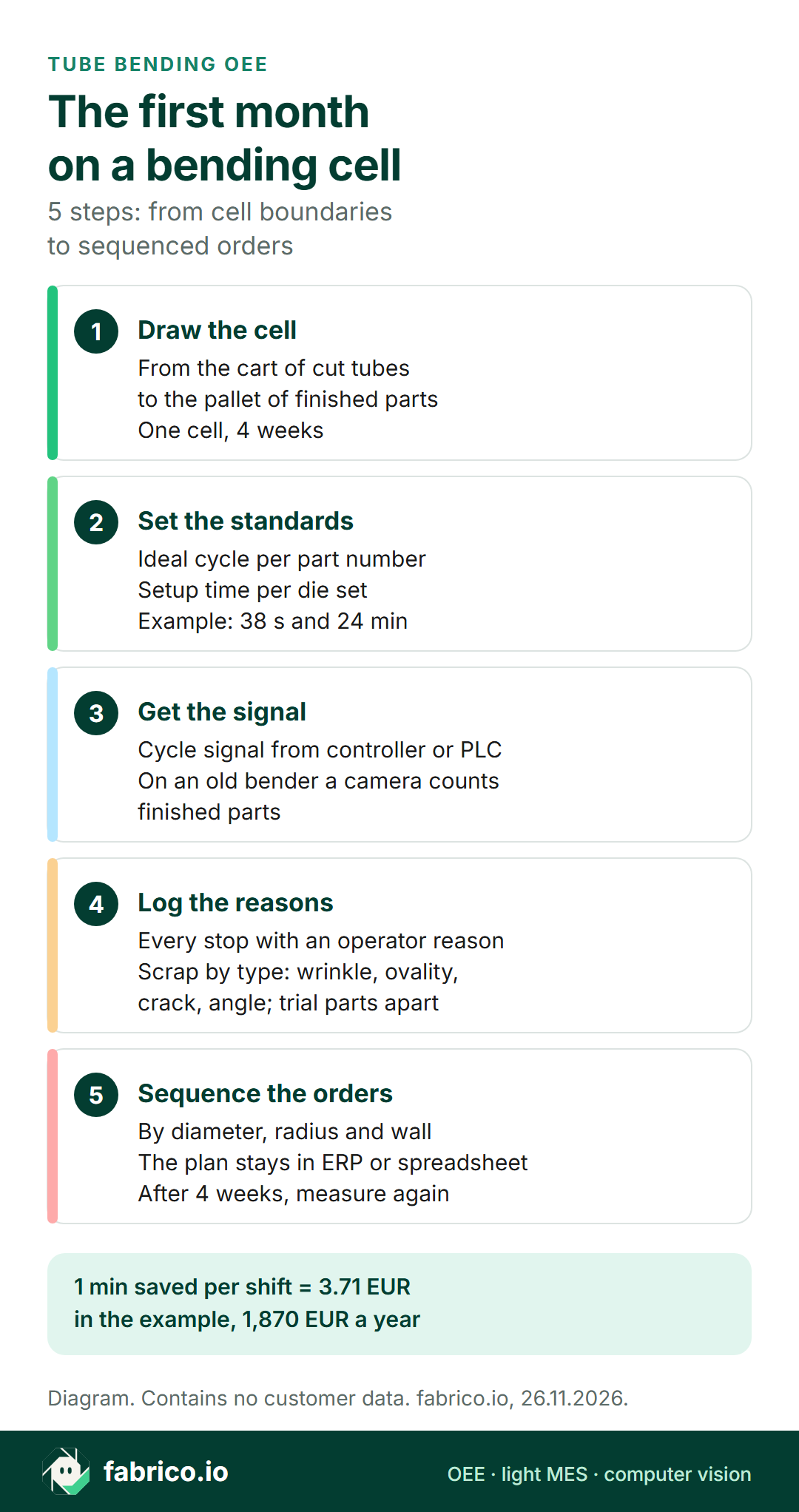
Text version of the diagram
- Draw the cell: from the cart of cut tubes to the pallet of finished parts.
- Set an ideal cycle per part number and a standard setup time per die set.
- Connect the cycle signal from the controller or PLC; on an old bender a camera counts finished parts.
- The operator logs the reason for every stop and the scrap type, trial parts separately.
- After 4 weeks, sequence orders by diameter and die set and measure again.
After the first month, pick one loss from the euro table and work on that one only. In the example it is setup: 267 EUR a shift.
Where Fabrico fits
Fabrico is an OEE platform and light MES. It shows OEE live by machine, line and shift. Operators pick the stop reason in a few taps, changeovers are tracked against a standard time, and scrap is recorded by product and reason. Losses are priced in money per product, and stops are ranked by financial impact.
Machines connect through the PLC or an IoT device. Where a camera covers the cell it counts output, and the minute of a stop is opened from the shift timeline and streamed on request, not stored. More on the camera in camera-based output counting, and on cost in pricing.
Frequently asked questions
How is OEE calculated on a tube bending machine?
OEE = availability × performance × quality. Simpler still: good parts × ideal cycle ÷ planned time. In the example, 445 × 38 s ÷ 27,000 s = 62.6%.
Are setup trial parts scrap?
Yes. The time until the first approved part is setup, and discarded trial parts are quality loss. Log them separately from process scrap.
Which ideal cycle should be used when parts have different numbers of bends?
Set an ideal cycle per part number, from the program or from timing the best stable cycle. One machine-wide speed hides the losses on complex parts.
How large must a batch be for the setup to pay?
It depends on the setup minutes. At 24 min and a 38 s cycle, a batch of 100 loses 27.5% of its time to setup, and a batch of 300 loses 11.2%.
Can a camera count parts from an old tube bender?
Yes, a camera over the unloading point counts finished parts when the machine has no usable signal. It does not assess quality: the scrap type is entered by the operator.
Is waiting for tubes from the saw a loss of the bender?
In the bender's OEE it is availability loss, because the machine is planned and not running. Log it under its own reason so it is clear the fix lies in tube supply, not the bender.
See where your bending cell loses minutes. The demo shows live OEE by machine and shift, stop reasons, and changeovers against a standard time.
Latest from our blog








Real Fabrico tiles, sample data.