


 Login
 Blog
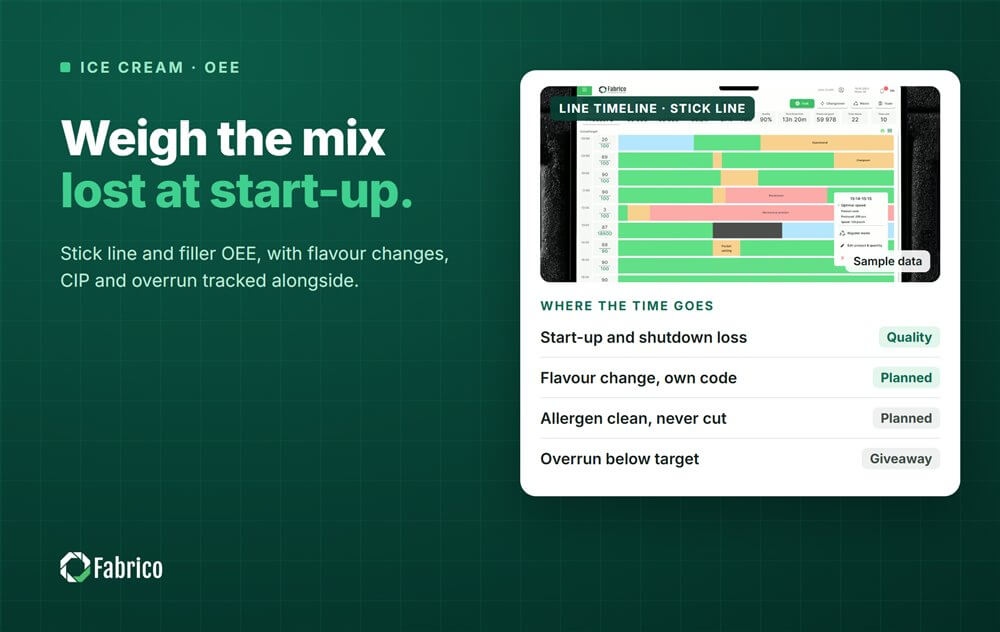
OEE for Ice Cream Production: Freezers, Stick Lines and Start-up Loss

Key takeaways
- Measure line OEE at the machine that paces the line, often the filler or stick line, in units a minute at its rated speed per product.
- Product lost at start-up, at flavour changes and at shutdown is a quality loss: count it in units and weigh the mix.
- Flavour changes and CIP get their own codes; allergen cleans are measured and never shortened.
- Overrun below target gives mix away even when the count looks fine: track it next to OEE.
- Where a filler or wrapper PLC says only 'stopped', a camera clip shows what happened and the operator confirms the reason.
The stick line starts at 06:00 after the night CIP. For the first minutes the freezer draws product at the wrong overrun, too soft to hold on the stick, and the first rows go to waste. The same happens after each flavour change. At the end of the shift the OEE report shows a good Availability figure and a Quality loss nobody can explain.
Ice cream production joins a batch mix plant, a continuous freezer, fast filling or stick lines, a hardening tunnel and packing in the cold. This guide covers how to measure OEE on that chain: the ideal rate, stops by station, flavour changeovers and cleaning, start-up loss, overrun, and a worked shift with the losses priced.
The ice cream line and where the time goes
Mix is blended, pasteurised, homogenised and aged in tanks, batch work upstream of the line. The continuous freezer whips air into the mix and freezes part of the water; the share of air added is the overrun. Inclusions such as fruit, nuts or chocolate pieces are dosed after the freezer. The product then goes to its forming line: a cup or tub filler, a cone line that sprays the cone with chocolate before filling, or a stick line that extrudes and cuts the product or fills moulds, inserts sticks and often dips the products in coating. A hardening tunnel takes the product to storage temperature before wrapping, cartoning and the cold store.
The time goes in three places: changeovers and cleaning, stops at the forming and wrapping machines, and product lost while the freezer settles. The mix plant rarely stops the line, but when mix is not released in time, the freezer waits.

Where to measure and the ideal rate
Measure line OEE at the machine that paces the line for that product. On a stick line that is the stick line itself: rows a minute times products per row. On a cup line it is the filler, on a cone line the cone filler. The freezer is sized to feed it; if it cannot for a product with heavy inclusions, the freezer sets the rate for that product.
Set the ideal rate per product from the rated speed, not from a good day, and count in units at the end of the line. Give the mix plant its own view: tanks released on time against plan. It is not part of the line's OEE, but it explains starved time.
Stops by station
| Station | Typical stops | OEE factor |
|---|---|---|
| Mix plant | Mix not released, ageing tank not ready | Starving the freezer |
| Continuous freezer | Overrun or draw temperature out of range, pump or dasher faults | Availability; off-spec product is quality |
| Ingredient feeder | Inclusions bridging in the hopper, feeder empty | Availability or speed loss |
| Cup and cone filler | Cone or cup magazine empty, lid feed jams, cones breaking | Availability for long stops, Performance for micro stops |
| Stick line | Stick inserter jams, products dropping off the stick, coating bath temperature | Availability and quality |
| Hardening tunnel | Tunnel temperature, tray or belt transfer faults | Availability; heat shock is quality |
| Wrapper and cartoner | Film splice, product out of pitch, carton magazine empty | Availability, or blocking the line |
Most forming and wrapping stops are short and cleared by the operator. Those micro stops belong in Performance, counted from the machine's state rather than a paper log; our guide to micro stops covers thresholds and causes.
Flavour changeovers, cleaning and start-up loss
A flavour change on the same base mix can be a flush: the new mix pushes the old one out of the freezer, and the mixed product in between is lost. A change to or from an allergen, such as nuts, needs a validated clean. The daily CIP of the freezer and mix lines is a third kind of stop. Give each its own code. Never shorten a validated clean or a CIP to lift OEE: measure it and keep it apart from breakdowns, as our guide to allergen changeover validation explains.
The start-up product deserves the most attention. After each start and each flavour change, the freezer needs time to reach the right overrun and draw temperature, and what it makes in that time is waste. At the end of a run, mix left in the lines is pushed out and lost too. Count those units as quality losses and weigh the mix lost, because the loss repeats with each change. Our guides to start-up and shutdown losses and reducing changeover time show where to begin: prepare the next mix in time, plan the flavour order within the plant's cleaning rules, and record a standard for each change.
Quality: overrun, weight, sticks and cones
Quality is good units over units made. The usual losses: start-up and flush product, products off the stick or with broken sticks, broken or soggy cones, coating defects, deformed products after a slow transfer to the hardening tunnel, and packs rejected for weight or seals.
Overrun needs its own watch. Ice cream is sold by volume and made from mix by weight. Run the overrun below target and each pack holds more mix than it should, which is giveaway the good count never shows. Run it above and packs can come out under weight. Track overrun and pack weight next to OEE.
Hardening and packing in the cold
The hardening tunnel is a long buffer, like any freezer. A stop at the stick line leaves a gap that reaches the wrapper much later, and a wrapper stop leaves product waiting where it should not warm up. Charge starved and blocked time to the machine that caused it. Ice build-up in the tunnel slows it the same way it slows a spiral freezer, so log extra defrosts with a reason.
Packing has its own short stops: condensation on cold product, film behaving differently in the cold, cartons not gluing on cold surfaces. Log 'waiting for cold store' as its own reason when pallets cannot leave the packing hall.
Data sources and the camera
The freezer PLC gives mix flow, air flow, draw temperature and motor load; the filler or stick line gives state and counts; the hardening tunnel gives temperatures; the checkweigher gives rejects. Overrun checks come from quality. The operator gives the reason in one tap.
Where a filler or wrapper PLC says only 'stopped', a camera at the station keeps a clip of what happened: a cone jammed in the dispenser, a product off its stick, a pack caught at the wrapper infeed. The software suggests a reason, the operator confirms it, and the clip stays with the stop as evidence.
A worked shift on a stick line
Sample line (illustrative numbers, not a customer): a stick line rated at 250 sticks a minute, 25 rows of 10, for this product. Planned production time is 480 minutes, in peak season when the plant is sold out.
- Two flavour changes by flush: 30 minutes. Stick inserter and wrapper stops over three minutes: 18 minutes. Run time = 480 minus 48 = 432 minutes. Availability = 432 / 480 = 90.0%.
- Ideal output: 432 x 250 = 108,000 sticks. Made: 97,200. Performance = 97,200 / 108,000 = 90.0%.
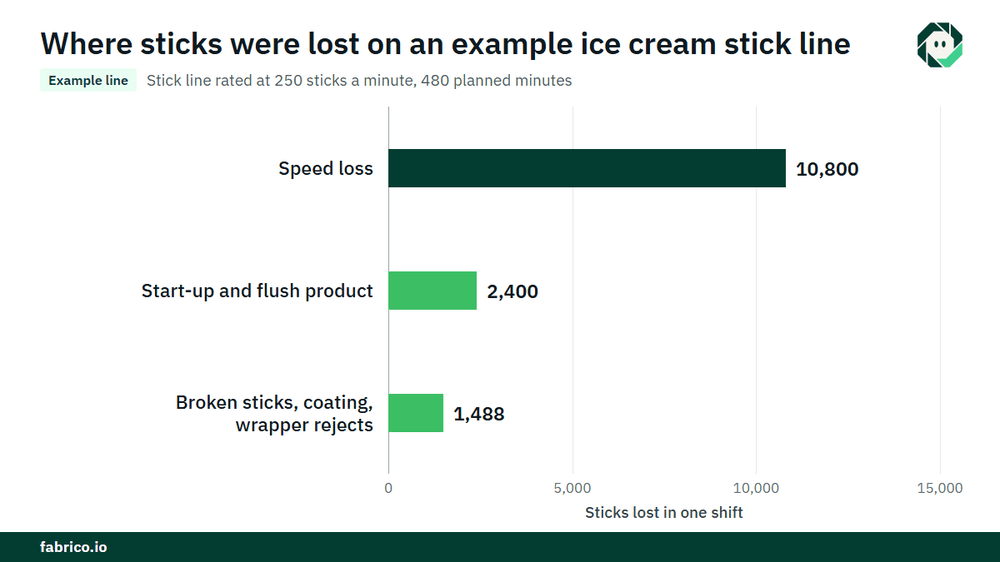
- Rejects: start-up and flush product 2,400; broken sticks, coating and wrapper rejects 1,488. Total 3,888. Good: 93,312. Quality = 93,312 / 97,200 = 96.0%.
- OEE = 0.900 x 0.900 x 0.960 = 77.8%. Check: 93,312 / 250 = 373.2 minutes at ideal rate, and 373.2 / 480 = 77.8%.
Now price it, with the pricing rule agreed with the plant's controller. The speed loss is 108,000 minus 97,200 = 10,800 sticks. In a sold-out week at $0.08 of contribution a stick (€0.08 in a euro plant), that is $864 a shift. The 2,400 start-up and flush sticks cost at least their variable cost of mix, coating, stick and film, say $0.10 each (€0.10), so $240 a shift. Over 300 peak-season shifts that is $259,200 and $72,000, or €259,200 and €72,000. Off season, when lost output can be made up, the speed loss is worth much less; the start-up loss is not, because the product is gone either way. See contribution margin per line hour for the method.
Mistakes plants make in ice cream production
- Counting start-up and flush product as good because it left the freezer.
- Booking a wrapper stop as a stick line problem, or the other way round, across the hardening tunnel.
- Using one ideal rate for all products on a stick line.
- Ignoring overrun because OEE looks fine.
- Shortening a validated allergen clean or a CIP to save minutes in peak season.
Where Fabrico fits
Fabrico is a computer vision enabled Manufacturing Performance Platform. In an ice cream plant it starts with OEE and light MES: automatic downtime logging at the freezer, the filler or stick line and the wrapper, and OEE live by line and shift.
- The operator confirms the reason in one tap, so a flush, a CIP and a stick inserter jam stay apart.
- A camera clip as evidence for a stop where a camera watches the station, such as a cone filler or a wrapper infeed.
- Losses priced in money and ranked by money, so start-up loss and speed loss compare in dollars or euros.
- One view across plants for groups with several ice cream sites.
- For a breakdown, a work order to the right technician with its cost.
Mix recipes, pasteurisation records and cleaning records stay with the plant's own systems and procedures. You start on one line, with a measured baseline and a decision date agreed in advance. Each plant gets a quote after a review of its lines.
Frequently asked questions
How do you calculate OEE on an ice cream stick line?
Availability is run time over planned production time. Performance is sticks made over what the rated rows a minute times products per row allow in the run time. Quality is good sticks over sticks made. Multiply the three.
Is start-up product a quality loss in OEE?
Yes. Product made while the freezer settles after a start or a flavour change was not good the first time. Count it as a reject and weigh the mix lost, so the cost of each change is visible.
Does overrun affect OEE?
Not directly. A pack with too little air still counts as good, but it holds more mix than it should, which is giveaway. Track overrun next to OEE and price the extra mix.
How should CIP be treated in ice cream OEE?
Give it its own code. Whether it sits in planned time or counts as an Availability loss is a plant rule; either way, measure it, keep it apart from breakdowns and never shorten it.
Where should OEE be measured on an ice cream line?
At the machine that paces the line for that product, usually the filler or the stick line, in units at the end of the line. Keep station data for the freezer, the hardening tunnel and the wrapper under it.
See your ice cream line's losses in a demo
Bring the stops, flavour changes and rates from one ice cream line, and we will show the losses priced in money, by shift.








Real Fabrico tiles, sample data.