


 Login
 Blog
OEE for Sauce and Condiment Lines: Hot Fill, Piston Fillers, Cleans

Key takeaways
- Set the ideal rate per SKU: viscosity, particles, fill volume and container all change how fast a piston filler can run.
- On hot fill lines, product temperature is the gate. Time waiting for product at temperature is a start-up loss with its own code, often caused upstream.
- Viscous product strings from the nozzles and fouls necks, caps and labels. Those short wipes are a Performance loss nobody logs.
- A validated allergen clean is never shortened. The minutes to win are before it starts and between its end and the first good jar.
- The PLC says the capper stopped. A camera over the filler and capper keeps a clip of what was on the neck.
The allergen clean finished at 14:10 and the line was released at 14:25. The first jar at full speed left the capper at 14:55. On the OEE report the whole afternoon reads as one changeover, and the meeting the next morning will talk about how long allergen cleans take. The clean ran to its validated time. The thirty minutes after it did not have to happen.
Sauce and condiment lines, from ketchup and mayonnaise to pasta sauce, dressings and mustard, mix three hard things: product that is hot, product that is thick, and frequent changes between recipes that carry different allergens. Each one changes how OEE should be measured, on top of the basics in our guide to OEE for food and beverage.
This guide covers the line, the ideal rate, hot fill, viscous product, the typical stops, changeovers and cleans, quality losses, data sources and a worked shift.
Where the time goes on a sauce line
Product comes from the kitchen through a pipe or a balance tank to the filler. On a hot fill line it is held at temperature and recirculates back if it drops below the set value. A piston filler, rotary or inline, doses each jar or bottle through nozzles with a shut-off to control drips. Glass jars get a lug cap, often with steam under the cap to draw a vacuum; squeeze bottles get a screw or flip-top cap, sometimes with an induction seal. Hot filled packs pass an inverter or a cooling tunnel, then the labeller, the coder, the checkweigher, metal detection or an X-ray for glass, and the case packer.
The time goes to start-up waits for product temperature, nozzle wipes, capper jams, cap supply, label faults, glass breakage and, above all, changeovers.

The ideal rate per SKU
A piston filler's speed depends on what it fills. A thick sauce with pieces needs a slower stroke and wider valves than a smooth dressing. A larger jar needs a longer stroke. One ideal rate for the line would make the thin SKUs look slow and the chunky ones look impossible.
Set the ideal per SKU and container, from the OEM rating for that product or the best speed the line holds for a full hour on it. Keep the list under change control, so nobody lowers a SKU's ideal to make a bad week look better.
Hot fill: temperature is the gate
On a hot fill line, the product must reach the filler at or above the plant's set fill temperature. Where that temperature is a critical control point in the plant's HACCP plan, it has a critical limit: a minimum or maximum value a parameter must be held to (FDA HACCP principles). That limit is never moved to win OEE.
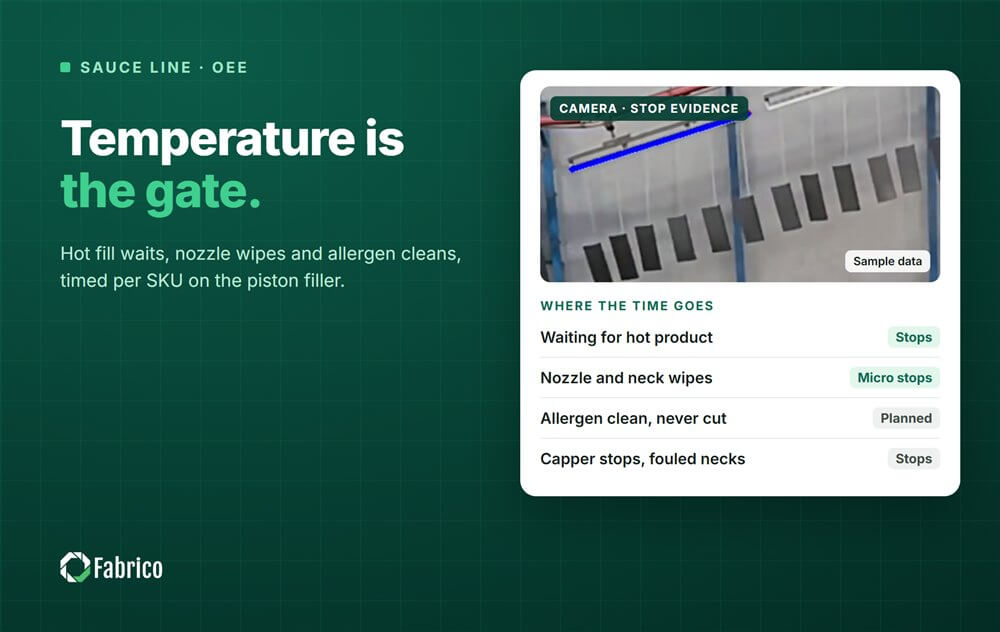
What OEE can do is make the waiting visible. After a clean or a long stop, product recirculates until it is at temperature, and jars filled too cool go to reject. Give that wait its own code, product not at temperature, and record where it came from. Often the cause is upstream, in the kitchen or the heat exchanger, so the filler is starved rather than down. Our guide to cutting start-up and shutdown losses covers how to track the ramp.
Viscous product on piston fillers
Thick product does not stop cleanly at the end of a fill. It strings from the nozzle and leaves a tail on the jar neck, where it fouls the cap thread, the seal and later the label. Operators stop to wipe nozzles and necks, a few seconds at a time, many times a shift. Air pockets in viscous product give light fills, and pieces in a chunky sauce can hold a valve open.
None of this looks like a breakdown. The stops are short, the cause is the product, and they land in Performance unless they are counted. Give nozzle wipes and neck cleaning their own codes, and look at them by SKU: a change of nozzle, shut-off setting or product temperature often fixes one recipe without touching the others.
Typical stops and their causes
| Station | Typical stop or loss | Usual cause | OEE factor |
|---|---|---|---|
| Product supply | Filler waiting, product recirculating | Below fill temperature, kitchen late, low level | Availability, often caused upstream |
| Piston filler | Nozzle wipes, light fills, valve blocked | Stringing, air in product, pieces | Performance, Quality |
| Capper | Jam, torque fault, no vacuum | Product on the neck, cap chute empty, steam setting | Availability, Quality |
| Cooling tunnel or inverter | Outfeed full | Tunnel capacity, downstream stop | Availability, charged downstream |
| Labeller | Label skewed or missing | Sauce on the container, label stock, set-up | Performance, Quality |
| Glass handling | Breakage | Jar defects, jams, impacts | Availability, Quality |
Glass breakage on a jar line triggers the plant's own breakage procedure, and that procedure runs as written. OEE records the time it took; it does not ask anyone to shorten it.
Changeovers, flushing and allergen cleans
Sauce lines have three kinds of change. A size change swaps change parts on the filler, capper and labeller. A product change without an allergen issue needs the product path flushed: hopper or bowl, pistons, valves and nozzles. An allergen change, for example from a recipe with egg or mustard to one without, needs the validated clean and whatever verification the plant's procedure requires.
The validated clean is never shortened, and OEE should never be used as a reason to. The minutes to win are around it: parts and tools staged before the line stops, the next product ready at temperature, labels and caps for the next SKU at the line, and a clean restart to the first good jar. The order of production matters too, because fewer allergen transitions in the plan mean fewer validated cleans. Our guides to allergen changeover validation and line clearance cover both sides.
Whether changeovers count inside planned production time or outside it, set a standard per type and treat every minute over the standard as a loss with a reason. Our guide to planned and unplanned downtime definitions explains the rule.
Quality losses on a sauce line
The rejects are easy to name: light jars, jars with no vacuum or a cap that is not on straight, wrong cap torque, labels that are skewed or smeared, jars filled below temperature at start-up, and glass scrapped under the breakage procedure. Each one counts against Quality. A jar that is wiped and sent round again is not a good jar first time.
Overfill passes as good. It does not show in OEE, but on a thick product with a generous target it is real money, and the checkweigher average shows it.
What each data source sees
- The PLC gives the filler and capper states, alarms and counts, and often the product temperature at the filler.
- The checkweigher and reject counters give the weights and rejects.
- A camera over the filler and capper shows what an alarm cannot: the tail of sauce on a neck, a cap going on crooked, a jar down in the starwheel. The clip is the evidence for the stop.
- The operator confirms the reason.
A worked shift with an allergen change
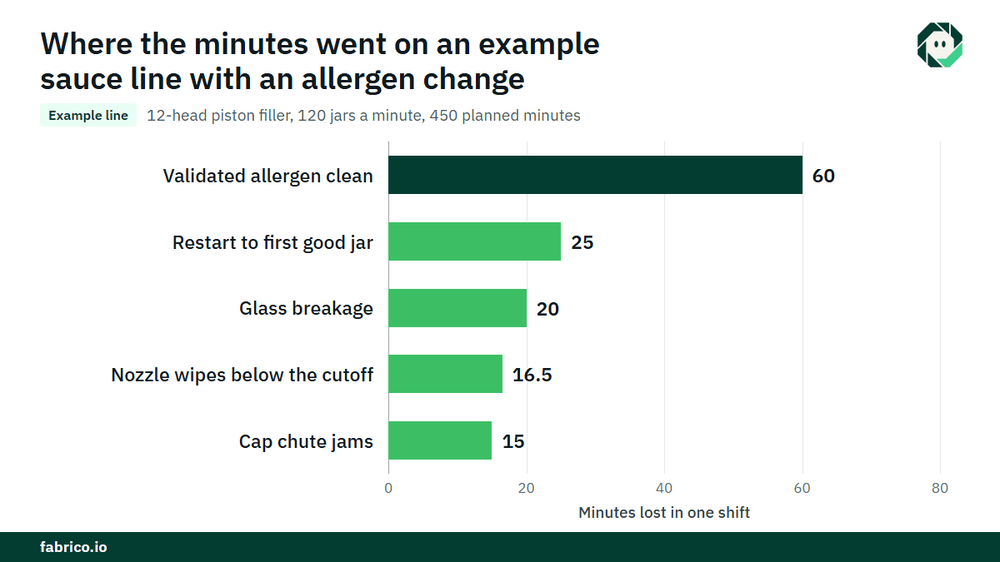
Sample line (illustrative numbers, not a customer): a 12-head piston filler on a hot fill line with an ideal rate of 120 jars a minute for this SKU. The shift has 450 minutes of planned production time, so 54,000 jars are possible. This plant counts changeovers inside planned production time.
Stops above the 2-minute cutoff: the validated allergen clean, 60 minutes, logged as its own code; the restart to the first good jar at rated speed, 25 minutes, mostly product recirculating to temperature; cap chute jams, 15 minutes; and one glass breakage handled under the procedure, 20 minutes. Downtime is 120 minutes, run time 330, so Availability = 330 / 450 = 73.3%.
At 120 a minute, 330 minutes should give 39,600 jars. The counter shows 37,620, so Performance = 37,620 / 39,600 = 95.0%. The 1,980 missing jars are 16.5 minutes at full rate, almost all nozzle wipes below the cutoff.
Rejects are 752 jars, so the good count is 36,868 and Quality = 36,868 / 37,620 = 98.0%. OEE = 0.7333 x 0.9500 x 0.9800 = 68.3%. Check: 36,868 good jars out of 54,000 possible is 68.3%.
Price it at a contribution of $0.25 a jar, €0.25 in a euro plant. The 25-minute restart is 25 x 120 = 3,000 jars, or $750 (€750): that is the loss to attack. The 60-minute clean is 7,200 jars, $1,800 (€1,800), and the only honest way to reduce it is fewer allergen transitions in the plan, never a shorter clean.
Where Fabrico fits
Fabrico is a computer vision enabled Manufacturing Performance Platform. On a sauce line it starts with OEE and light MES: automatic downtime logging from the machine signal and OEE live by line and shift, so the restart after a clean is recorded separately from the clean itself.
The operator confirms the reason in one tap, so product not at temperature, nozzle wipes and cap jams each get their own code. Where a camera watches the filler and capper, a camera clip is kept as evidence for a stop. The camera suggests the reason, the operator decides.
Losses are priced in money and ranked by money, so the restart minutes and the nozzle wipes carry a figure. A breakdown becomes a work order to the right technician with its cost. One view across plants compares the same SKU on different lines, and you start on one line with a decision date agreed in advance.
Each plant gets a quote after a review of its lines.
Frequently asked questions
How do you calculate OEE on a sauce filling line?
Set the ideal rate per SKU and container. Availability is run time over planned production time, Performance is the jar count over run time times the ideal rate, and Quality is good jars over all jars filled. Multiply the three.
Should allergen cleans count against OEE?
That depends on your rule for changeovers, and either rule works if it is written down. What matters is that the validated clean is logged as its own step, never shortened, and that the restart after it is measured separately.
How do you reduce changeover time on a sauce line?
Stage parts and tools before the stop, have the next product ready at temperature, bring the next SKU's caps and labels to the line, and plan the order of products to need fewer allergen cleans. Then measure the restart to the first good jar.
Why does a piston filler lose speed on thick sauces?
Thick product needs a slower stroke, strings from the nozzles and traps air. The result is short stops to wipe nozzles and necks, and light fills, which together pull Performance and Quality down.
See your sauce line's losses in a demo
Bring one shift with a changeover from your filler and capper. We will show where the restart, the wipes and the rejects sit, and what each costs.








Real Fabrico tiles, sample data.