


 Login
 Blog
MES for Packaging Manufacturers: Printing, Converting, Corrugated

Key takeaways
- A packaging converter needs an MES to follow jobs and rolls through printing, laminating, slitting and converting, and to show where press time and material go.
- Full MES functions for converters include job tracking, roll tracking and genealogy, waste and material tracking, quality records, scheduling and machine performance.
- Start with production data and OEE on the constraint machine, usually the printing press or the corrugator, measured in metres or sheets against the ideal speed for each job.
- Make-ready is two losses: stopped time and running waste. Measure both.
- Light MES puts machine OEE and make-ready first; roll genealogy belongs where a customer requires it.
The 8-colour flexo press is on its second job change of the shift. Plates and sleeves come off, a new anilox goes in, inks are matched to the customer's standard, registration is brought in, and the press runs more than a thousand metres of waste before the first sellable metre. Downstream, the slitter waits for its parent roll and the pouch line is short of film. The ERP knows the order. Nobody knows what the make-ready cost. That is the gap an MES for packaging manufacturers has to close.
This guide covers what a converter needs from an MES, the functions, which to start with, how to measure OEE on presses, slitters and corrugators, light MES against a full suite, how to choose and the common mistakes.
What a packaging converter needs from an MES
Converters run chains of machines, each with its own unit of output. A flexible packaging plant prints (flexo or gravure), laminates, cures, slits and rewinds, then makes bags or pouches. A corrugated plant runs a corrugator, with single facers at the wet end and a slitter-scorer, knife and stacker at the dry end, then flexo folder-gluers and die-cutters. A folding carton plant prints sheets, die-cuts them and glues them.
Three things make converting different. Every job is different: substrate, width, colours, die. Material is a large share of cost, so waste per job matters as much as time. And rolls move between departments, so a parent roll from the laminator becomes several child rolls at the slitter.
So the MES has three jobs: follow each job and roll through the plant, prove what went into what where customers require it, and show where machine time and material go.

The MES functions a converter can use
ISA-95 places the MES at Level 3, between the machine controls and the ERP. In converting its functions look like this:
| Function | What it does in a converting plant | Where it usually starts |
|---|---|---|
| Production data collection | Speed, metres or sheets, states and stops per machine | The constraint machine, first |
| Performance analysis (OEE) | OEE per machine and job, make-ready time, losses ranked | The same machine, first |
| Job tracking | Each order through print, laminate, slit and convert | When planners chase the floor for status |
| Roll tracking and genealogy | Parent roll to child rolls, film and ink lots to the shipped lot | Where food or pharma packaging customers require it |
| Waste and material tracking | Waste and consumption per job against the estimate | When quotes drift from actuals |
| Quality records | Colour measurements, seal tests, board tests per job | Where customers ask for evidence |
| Scheduling | Job order by colours, substrate and width to cut make-ready | When make-ready dominates the shift |
Where the time goes on presses, slitters and corrugators
- Printing press: plate and sleeve changes, anilox changes, ink changes and colour matching, registration drift, doctor blade changes, web breaks, splice failures at the unwind, drying problems.
- Laminator: adhesive changes and mixing, coating weight adjustment, wrinkles, roll changes.
- Slitter rewinder: knife and width set changes, core loading, roll unloading and labelling, waiting for parent rolls.
- Bag and pouch machines: seal bar temperature, film tracking, zipper or spout feed, punch and fold problems.
- Corrugator: order changes in width and flute, paper reel splices, glue problems, warp.
- Die-cutters and folder-gluers: die changes, feeder jams, glue faults, waste stripping.
Make-ready is the big one, and it has two parts: the minutes the press stands still for plates, sleeves and anilox, and the metres it runs as waste while colour and registration come in. Our guides to changeover time and start-up and shutdown losses cover both.
Start with production data and OEE on the constraint
Pick the machine that limits shipments, often the press or the corrugator. Measure output in its own unit: metres for a web press, laminator or slitter, sheets or boxes for a folder-gluer, square metres or linear metres for a corrugator.
- Availability: run time over planned production time. Job changes, roll changes, web breaks and waiting for material are stops with their own codes.
- Performance: metres made against the ideal speed for that job and substrate, not the press's maximum. A heavy laminate and a thin film do not run at the same speed. See rate loss on high-speed lines.
- Quality: good metres over total metres. Make-ready waste and defect waste are not good.
The data comes from the machine signal and line speed or encoder (state and metres), the operator, who confirms a stop reason in one tap, the waste weighed or counted per job, and a camera where a station needs evidence of what happened during a stop the machine reports only as "stopped".
What one shift of make-ready costs
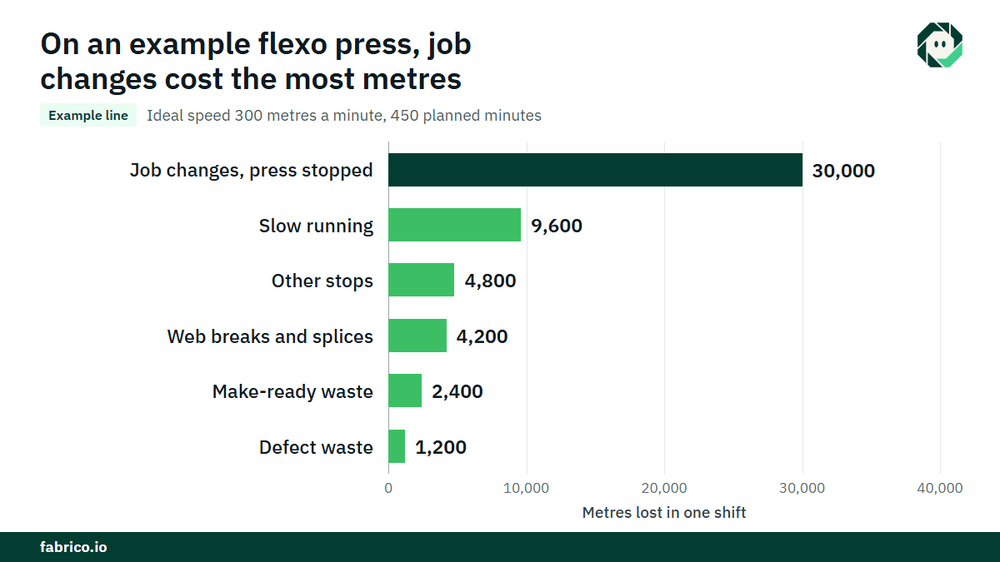
Sample line (illustrative numbers, not a customer): a flexo press with an ideal speed, for this job, of 300 metres a minute. The shift is 480 minutes with a 30 minute break, so planned production time is 450 minutes. Two job changes stopped the press for 100 minutes, web breaks and splices for 14, other stops for 16, so run time is 320 minutes.
- Availability = 320 / 450 = 71.1%.
- Ideal metres = 320 x 300 = 96,000. The press ran 86,400. Performance = 86,400 / 96,000 = 90.0%.
- Make-ready waste was 2,400 metres and defect waste 1,200, so good metres are 82,800. Quality = 82,800 / 86,400 = 95.8%.
- OEE = 0.711 x 0.900 x 0.958 = 61.3%. Check: 82,800 / 300 = 276 minutes of ideal time, and 276 / 450 = 61.3%.
In 450 minutes the press could run 135,000 metres. It made 82,800 good ones, so 52,200 were lost. At a contribution of $0.05 a metre (€0.05 in a euro plant), that is $2,610 a shift.
| Loss on the press | Metres lost | Value a shift |
|---|---|---|
| Job changes, press stopped (100 minutes) | 30,000 | $1,500 |
| Web breaks and splices (14 minutes) | 4,200 | $210 |
| Other stops (16 minutes) | 4,800 | $240 |
| Slow running | 9,600 | $480 |
| Make-ready waste | 2,400 | $120 |
| Defect waste | 1,200 | $60 |
| Total | 52,200 | $2,610 |
The 3,600 waste metres also cost substrate and ink: at $0.03 a metre (€0.03), another $108. Over 480 shifts a year the lost contribution is $1,252,800, or €1,252,800 in a euro plant. Job changes are about 57% of it, which is why make-ready is the first target.
Light MES vs full MES for a converter
A full converting MES follows jobs and rolls through every department, links parent and child rolls to film and ink lots, tracks waste and consumption against the estimate, records quality tests and schedules jobs to cut make-ready. Converters serving food and pharma brands often need roll genealogy, and there it is the right tool.
A light MES is the same Level 3 layer in a different order: machine data, make-ready and OEE first, on the constraint, then more machines and functions where they are needed. It gives the real make-ready times and running speeds by job that estimating and scheduling later need. Sequencing jobs by shared colours and widths is the next step; see sequencing by changeover cost.
Many converters end up with both: roll genealogy where customers require it, OEE and make-ready data on every key machine.
How to choose an MES for packaging manufacturing
- Ask for OEE in your unit: metres, square metres, sheets or boxes, with the ideal speed set per job and substrate.
- Split make-ready into stopped time and running waste, per job.
- Code roll changes, splices and web breaks separately, so they do not hide in "other".
- Ask how it reads old machines: line speed, an encoder, a run signal, a camera where there is none.
- Keep the ERP or print MIS interface small: job numbers in, actuals out.
- Agree the start: one constraint machine, a baseline and a decision date agreed in advance.
Mistakes converters make with MES
- Using the press's maximum speed as the ideal for every job.
- Counting make-ready metres as good, so Quality hides the waste.
- Measuring time but not waste, when material is a large share of cost.
- Averaging OEE across a corrugator, a folder-gluer and a die-cutter with different units and speeds.
- Buying roll genealogy for every line when one customer needs it.
- Comparing crews instead of jobs and machines. Measure the process, never the person.
Where Fabrico fits
Fabrico is a computer vision enabled Manufacturing Performance Platform. In a converting plant it is a light MES with OEE and downtime first, starting on one constraint machine.
- Automatic downtime logging from the press, laminator, slitter or corrugator signal.
- The operator confirms the reason in one tap: job change, roll change, web break, waiting for material.
- A camera clip as evidence for a stop, where a camera watches the station.
- Losses priced in money and ranked by money.
- OEE live by line and shift, and one view across plants.
- As the last step, a stop coded as a breakdown becomes a work order to the right technician, with its cost.
In MESA terms that is data collection, performance analysis and, as the last hop, maintenance management. Machines connect through a PLC, a Fabrico IoT device or an AI camera. Fabrico is not an ERP and not a full MES suite: it does not do scheduling, job routing, roll genealogy, material tracking or traceability.
Two named results: ABB, 20% less downtime; Ficosota, OEE from 53% to 60% and 23% more good output. Each plant gets a quote after a review of its lines.
Frequently asked questions
What is an MES for packaging converters?
Software between the machines and the ERP that follows jobs and rolls through printing, laminating, slitting and converting, records machine states, speed and waste, and shows why output or margin fell short.
How do you calculate OEE on a flexo printing press?
Availability is run time over planned time. Performance is metres printed over metres possible at the ideal speed for that job. Quality is good metres over total metres, with make-ready waste counted as not good. Multiply the three.
Is make-ready waste a Quality or a Performance loss?
The stopped minutes of a job change are an Availability loss. The metres run as waste while colour and registration come in are a Quality loss. Track both per job.
Does a corrugated plant need a full MES?
Only where customers require roll or lot genealogy and order-level records across the plant. Where lost output is the main cost, start with OEE and order changes on the corrugator or the constraint converting line.
See your press's losses in a demo
Bring one press or corrugator and its make-ready notes. We will show where its time and material go and what each loss costs.






