


 Login
 Blog
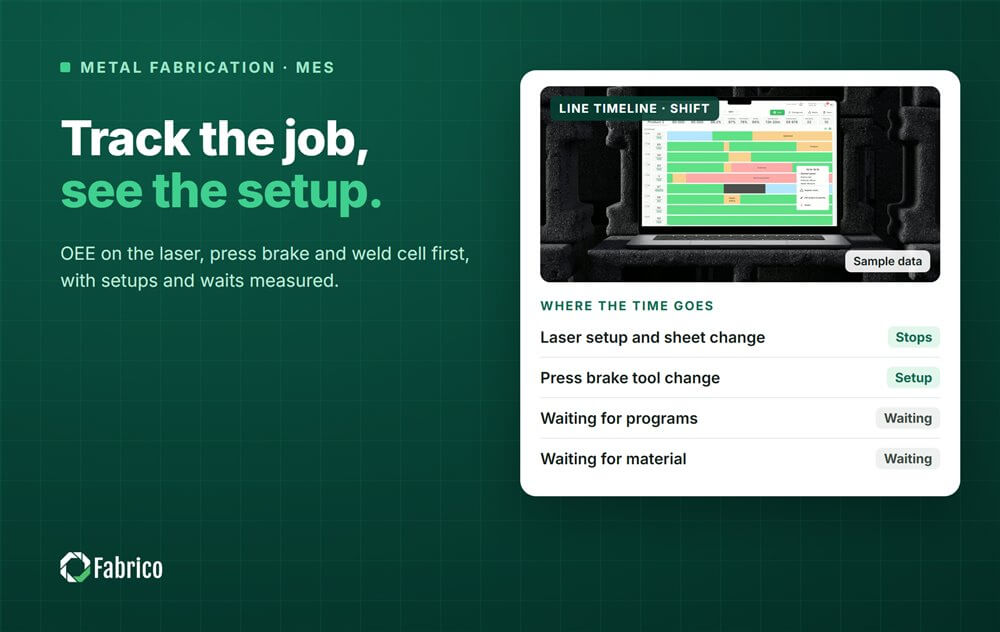
MES for Metal Fabrication: Job Shops, Routings and Setups

Key takeaways
- A job shop needs an MES to answer two questions: where is each job, and where did the machine time go.
- Full MES functions in fabrication include job tracking against routings, dispatch lists, scheduling, labour booking, document control, quality records and machine data.
- Start with production data and OEE on the constraint machines, usually the laser, the press brake or a robot weld cell.
- In high-mix work, setups and waiting for programs or material are often the biggest losses, and the machine signal shows how long each one lasts.
- Light MES puts machine OEE and downtime first; full job tracking and scheduling come when the setup and run times are known.
Tuesday, 10:15, in a sheet metal job shop. The fiber laser sits idle with a loaded table, waiting for a nest that engineering has not released. The press brake is on its third tooling setup of the morning. A welded frame waits by the inspection bench, and the paper traveller says "in process". An MES for metal fabrication has to show where each job is and where the machine time went.
This guide covers what a fabrication shop needs from an MES, the functions, which to start with, how to measure OEE when every job is different, light MES against a full suite, how to choose and the mistakes that cost the most.
What a fabrication shop needs from an MES
A job shop lives on high mix and low volume. A typical routing runs cut (laser, punch or saw), deburr, bend, weld, machine, paint or powder coat, assemble, inspect. Hundreds of open jobs share the same work centres, and each job has its own drawing, program and setup.
That gives three needs. The office needs to know where each job is, so promise dates hold. Engineering needs real setup and run times, so quotes stop drifting from actuals. The floor needs to know why the expensive machines are not cutting or bending, so the bottleneck gets more hours.
Some customers add a fourth: material certificates and heat numbers carried from the sheet or bar to the shipped part. That is a traceability requirement, and it belongs to the systems built for it.

The MES functions a job shop can use
ISA-95 places the MES at Level 3, between the machine controls and the ERP. In fabrication its functions look like this:
| Function | What it does in a fab shop | Where it usually starts |
|---|---|---|
| Production data collection | Machine states, part counts and stop times from laser, brake, weld cell and CNC | Constraint machines, first |
| Performance analysis (OEE) | Availability, Performance and Quality by machine and shift, losses ranked | Constraint machines, first |
| Job tracking and routings | A digital traveller: which operation each job is at | When promise dates keep slipping |
| Dispatching and scheduling | Which job runs next at each work centre | When setup and run times are known |
| Labour booking | Hours booked to each job for job costing | When quotes drift from actuals |
| Document control | The right drawing and program revision at the machine | Where wrong revisions cause scrap |
| Quality and material records | First-article results, inspection data, heat numbers | Where customers require them |
Job tracking and scheduling are only as good as the times fed into them. Production data from the machines is what makes those times real.
Where the time goes on a laser, a brake and a weld cell
- Laser cutting: waiting for a released nest, sheet not at the machine, material and gas changes, nozzle changes, protective window cleaning, pierce problems on thick plate, unloading and sorting parts.
- Press brake: tooling setups (punches, dies, back gauge), program loading, first-bend angle correction, waiting for cut parts, handling of large parts.
- Robot weld cell: fixture changes, part fit-up problems, torch cleaning, wire changes, waiting for parts from the brake.
- CNC machining: fixture setup, tool offsets, program prove-out, first-article inspection, tool breakage.
- Paint or powder line: colour changes, hanging and unhanging, rework after a coating defect.
Setups are the big one. SMED splits a setup into internal steps, which need the machine stopped, and external steps, which can be done while it runs. Staging the next sheets, presetting brake tools and releasing programs ahead of time move work out of the machine's time. More in our guide to OEE for metal fabrication.
Start with production data and OEE on the constraint
Do not try to measure every machine first. Pick the one that limits shipments, often the laser or the brake. A lost hour there is a lost hour for the shop; a lost hour on a machine with spare capacity is not.
OEE = Availability x Performance x Quality. On a constraint machine in a job shop:
- Availability: run time over planned production time. Count setups, waiting for program and waiting for material as stops with their own codes, not as planned time.
- Performance: the ideal cycle changes with every job, so use the program time. On a laser, the CAM system gives a cutting time per nest; on a brake, the estimate gives a standard time per bend. Performance is ideal time of parts made over run time.
- Quality: good parts over total parts, with first-off scrap and rework counted as not good.
The data comes from the machine signal (run, stop, fault), from the controller where it reports program and part counts, from the operator, who confirms a stop reason in one tap, and from a camera where a station has no usable signal and the stop needs evidence. Where a machine offers OPC UA for Machinery, its item states separate a fault (OutOfService) from waiting for an order or a changeover (NotExecuting). See also why spindle time is not OEE.
What one shift on the laser costs
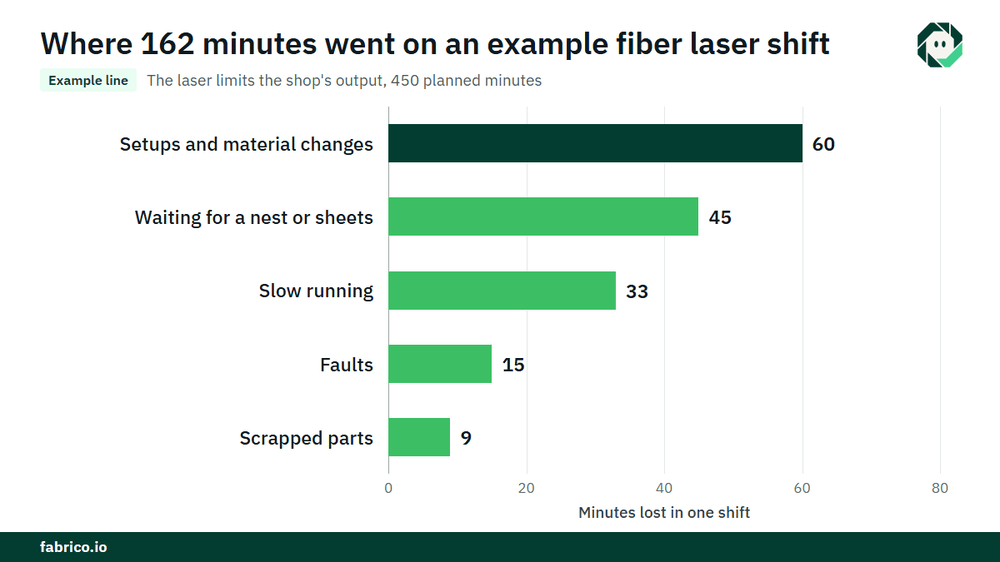
Sample line (illustrative numbers, not a customer): a fiber laser that limits the shop's output. The shift is 480 minutes with a 30 minute break, so planned production time is 450 minutes. Stops add up to 120 minutes, so run time is 330 minutes. The program times of the parts it cut add up to 297 minutes, and 9 minutes' worth of those parts were scrapped.
- Availability = 330 / 450 = 73.3%.
- Performance = 297 / 330 = 90.0%.
- Quality = (297 minus 9) / 297 = 288 / 297 = 97.0%.
- OEE = 0.733 x 0.900 x 0.970 = 64.0%. Check: 288 minutes of good parts over 450 planned minutes = 64.0%.
Price the laser at its contribution per constraint hour, not a machine-hour rate with depreciation. At $180 an hour (€180 in a euro plant), a minute is worth $3. The shift lost 450 minus 288 = 162 minutes, so $486.
| Loss on the laser | Minutes | Value |
|---|---|---|
| Setups and material changes | 60 | $180 |
| Waiting for a nest or sheets | 45 | $135 |
| Faults | 15 | $45 |
| Slow running (330 minus 297) | 33 | $99 |
| Scrapped parts | 9 | $27 |
| Total | 162 | $486 |
Over 480 shifts a year that is $233,280, or €233,280 in a euro plant. The 45 minutes of waiting are a flow problem in the office, not a machine problem, and much of the setup time can become external work.
Light MES vs full MES for a job shop
A full MES for fabrication tracks each job through its routing, builds dispatch lists and schedules, books labour per operation, controls drawings and programs, and holds quality and material records. In many shops part of this already sits in the ERP. Getting it all live across every work centre is a large project, and it depends on setup and run times the shop often does not have yet.
A light MES is the same Level 3 layer in a different order: machine data, downtime reasons and OEE on the constraint first, on one machine or cell, then more machines and functions where they are needed. It gives the real setup times, waiting times and run times that scheduling later needs.
For a single shop with paper travellers, that order makes sense. IoT Analytics reports that 54.4% of small and medium manufacturers still run production on paper or spreadsheets.
How to choose an MES for metal fabrication
- Name the constraint and ask to see OEE and downtime on that machine first.
- Check how it sets the ideal time when every job is different: program time, standard time per bend or per weld.
- Ask for setup and waiting codes that separate internal setup, external setup, waiting for program and waiting for material.
- Ask how it reads old machines: controller data, a simple run signal, a camera where there is no signal.
- Keep the ERP interface small: job numbers in, actuals out.
- Agree the start: one constraint machine, a baseline and a decision date agreed in advance.
Mistakes fabrication shops make with MES
- Averaging OEE across machines with different ideal rates. Report each constraint on its own.
- Hiding setups in planned time. In high mix, setup is often the largest loss.
- Running every machine flat out. By Kingman's formula, queue time grows with u / (1 minus u): 4 at 80% utilisation, 9 at 90%, 19 at 95%. High utilisation belongs at the bottleneck only.
- Buying a scheduler before knowing real setup times, then scheduling on guesses.
- Turning labour booking into surveillance. Measure the process, never the person.
Where Fabrico fits
Fabrico is a computer vision enabled Manufacturing Performance Platform. In a fabrication shop it is a light MES with OEE and downtime first, starting on one constraint machine.
- Automatic downtime logging from the laser, brake, weld cell or CNC signal.
- The operator confirms the reason in one tap: setup, waiting for program, waiting for material, fault.
- A camera clip as evidence for a stop, where a camera watches the machine.
- Losses priced in money and ranked by money.
- OEE live by line and shift, and one view across plants.
- As the last step, a stop coded as a breakdown becomes a work order to the right technician, with its cost.
In MESA terms that is data collection, performance analysis and, as the last hop, maintenance management. Machines connect through a PLC, a Fabrico IoT device or an AI camera. Fabrico is not an ERP and not a full MES suite: it does not do job routing, scheduling, dispatching, labour booking, genealogy or traceability.
Each plant gets a quote after a review of its lines. If you run CNC machines, see our review of OEE software for CNC machine shops.
Frequently asked questions
What is an MES for a job shop?
Software between the machines and the ERP that tracks jobs through their routings, records machine time and stops, and shows why the shop did or did not hit its promise dates. Which functions it covers varies a lot between products.
How do you calculate OEE when every job is different?
Use the program or standard time of each job as the ideal. Performance is the ideal time of parts made over run time, Quality is good parts over total, Availability is run time over planned time.
Which machines should a fabrication shop measure first?
The constraint: the machine that limits shipments, often the laser, the press brake or a robot weld cell. Measure its setups, waiting time and faults before anything else.
Does a small job shop need an MES?
It needs real machine times and stop reasons. A light MES on the constraint gives those without a full job tracking and scheduling project; the rest can follow when the data is there.
See your constraint machine's losses in a demo
Bring your laser or press brake and its current downtime notes. We will show where its time goes and what each loss costs.






