






 Login
 Blog

Why MES Implementations Fail (and What a Lightweight Alternative Looks Like)

Is your MES implementation taking so long? Usually the cause is scope, not software: too many departments, too many interfaces, and no result promised before the full go-live. The causes repeat so reliably that they amount to a checklist, and avoiding them points to a different way of buying execution software altogether.
Quick answer: MES projects fail for organizational reasons before technical ones: scope defined by committee, value promised at the end of a long rollout instead of along the way, operators treated as data-entry labor, and integration ambitions that make the ERP project look small.
The lightweight alternative inverts each: start on one line, deliver a measurable result in weeks, make the operator's job easier on day one, and integrate only what the use case needs.
The five failure modes
1. The everything-scope. Classic MES selection gathers requirements from every department, producing a specification only a multi-year program can satisfy. The project's size then becomes its main risk: sponsors change, budgets tire, and the plant that needed help in Q1 is still attending workshops in Q4 of next year.
2. Value at the end. When the first measurable benefit arrives after go-live of everything, the project spends two years consuming credibility and none earning it. Momentum is a resource; big-bang designs spend it all upfront.
3. The operator as sensor. Systems designed in conference rooms make the floor feed them: more screens, more clicks, more codes. Operators respond rationally by feeding them garbage, and the MES becomes an expensive fiction generator. Any execution system that adds net work to the operator's shift will be defeated by the operators, and they will be right.
4. Integration maximalism. Bidirectional real-time sync with ERP, quality, WMS and the historian, before the first line is live. Every interface is a project; ten interfaces are a hostage situation.
5. Customization instead of adoption. When the tool bends to every existing habit, the plant pays enterprise prices to digitize its current chaos. The point was to change how work happens, not to laminate it.
What lightweight actually means
Not less capable: differently sequenced. A lightweight execution layer starts where the money is (usually OEE visibility and the loop from stop to fix), starts on one line, proves a measurable result on that line first, and expands line by line on the strength of that result. Our guide to light MES maps what such a system covers and what stays in the ERP.
Operator interactions are seconds, not minutes, and replace paperwork rather than adding to it. ERP integration is scoped to what the use case needs: orders, BOM and materials in, actuals out, nothing else until something else earns its keep.
There is a quiet beneficiary in this sequencing: the continuous improvement team, which gets honest line data in weeks instead of after the program, converting the kaizen pipeline from anecdote and staged observation into evidence.
Full MES depth (genealogy, enforced routings, regulated e-records) gets added where the product and the customer demand it, not everywhere by default.
Stalled now: stop, shrink or continue
If your MES project is late, run this test this week. Use what you can show on the floor, not what the plan says.
| What you can show | Decision | Next step |
|---|---|---|
| A line is live, operators use it, and the rest of the scope has a date and an owner. | Continue | Protect the scope. Add nothing until the next line is live. |
| Nothing measurable is live, but you have a hard need such as traceability or order control. | Shrink | Pick one line, one result and one date. Freeze the rest until that is delivered. |
| Nobody can name the result, and the main pain is lost time on the lines. | Stop adding scope | Pause the rollout and run the four checks for light MES vs full MES. |
Money already spent is not a reason in any of the three rows.
How to tell which kind of project a vendor is selling you
Ask three questions. How long until the first line is live and measuring? (Days and weeks are answers; quarters are a warning.) What will the operator do differently, and does it take more time or less than today? And what is the exit question of the pilot: which measurable result, by which date, decides go or no-go? Vendors with good answers welcome the questions. The others will talk about workshops.
Plan for the real MES implementation cost, time, and team up front.
Frequently asked questions
What percentage of MES projects fail?
Published failure rates vary wildly with the definition of failure, from budget overrun to outright abandonment, and most figures trace back to vendor or analyst surveys. More useful than any percentage: the failure modes above are documented, repeatable and avoidable.
Do we need a full MES or is OEE software enough?
It depends on regulatory and traceability requirements. High-mix regulated production needs MES depth; many plants get the majority of the value from honest OEE, connected maintenance and light execution first, and add depth where demanded.
How long should an MES implementation take?
The first measurable value should arrive in weeks on one line. Plant-wide rollouts legitimately take longer, but a program whose first benefit is more than a quarter away is carrying avoidable risk.
We are midway through a struggling MES rollout. Restart or push through?
Neither; narrow. Pick the one line where the pain is worst, define a single measurable result and a date, and deliver that before touching the rest of the scope. Programs are rescued by shrinking to a win, not by pushing a failing scope harder, and the sunk cost is not a strategy.
Is a lightweight system a dead end for growth?
Only if it lacks the depth to grow into. The right question is sequencing: can it start small and add execution depth per line and per product where needed, rather than forcing everything everywhere first.
We sell Fabrico, a light MES that rolls out line by line: about 1 month to install and connect devices, and 3 to 4 months for a full rollout. Job dispatching, BOMs, routings and genealogy stay in your ERP.
See how Fabrico unifies OEE and maintenance in one platform.
Request a demoRelated articles
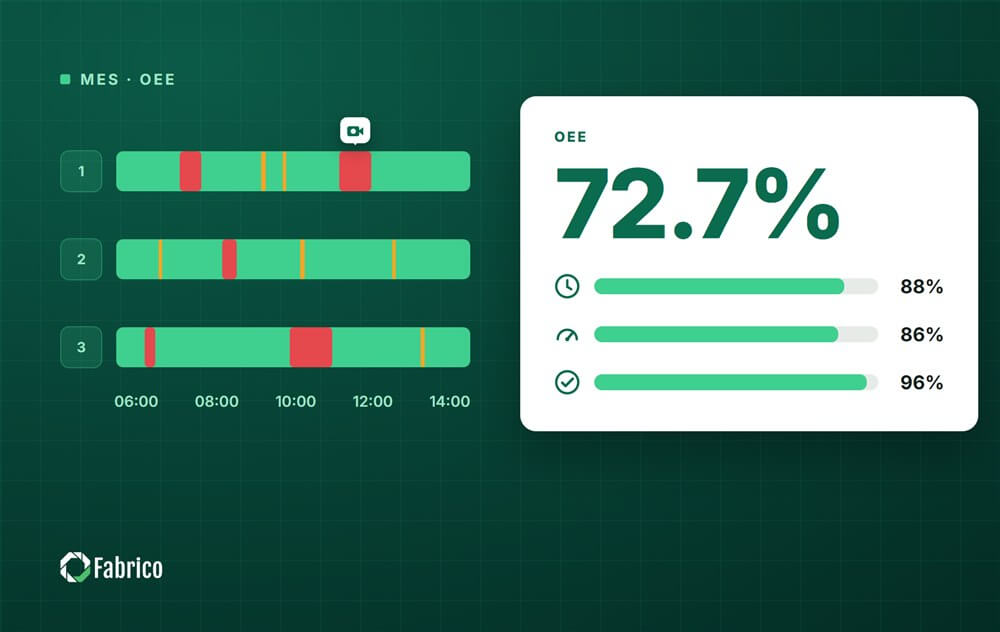
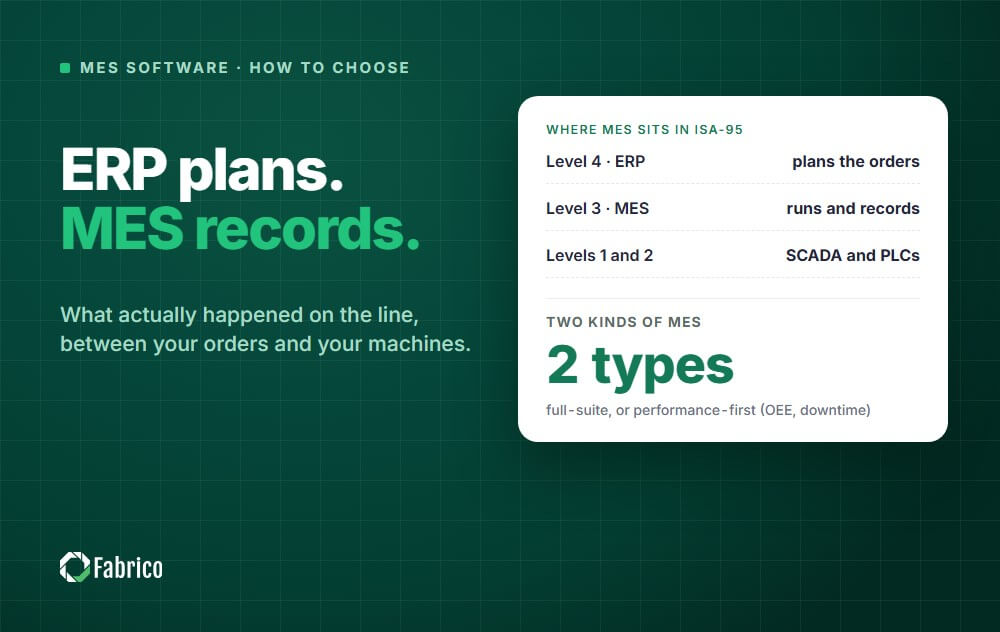












Real Fabrico tiles, sample data.