


 Login
 Blog

Fabrico vs FORCAM: Mid-Market vs Enterprise OEE Platform

Fabrico and FORCAM approach production visibility from two different directions. FORCAM is a German-engineered manufacturing execution system (MES) and industrial IoT platform built for enterprise discrete manufacturing.
Fabrico is a focused platform that pairs computer-vision-verified OEE with a native, field-ready CMMS, so the loop from detected loss to completed work order closes inside one system. The right choice depends less on a feature checklist and more on the scale of program your plant actually needs.
What FORCAM focuses on
FORCAM (today FORCAM ENISCO) has a long track record in enterprise shop floor management. Its platform covers machine data acquisition, production data collection, detailed OEE analytics, and production steering, offered in modular form and deployable in the cloud or on premise.
It publicly lists major automotive and discrete manufacturers among its customers, and its projects are typically delivered as vendor-led implementations that span multiple plants and integrate with ERP systems such as SAP. For a global manufacturer standardizing an MES layer across many sites, that depth is exactly the point.
You can read our full FORCAM FORCE review for a deeper look.
What Fabrico focuses on
Fabrico concentrates on the loss-to-action loop. Computer vision catches the micro-stops, manual interventions, and idle time that sensor and PLC data alone can miss, and verifies what the machines report. The integrated CMMS then turns detected losses into work orders, mobile maintenance execution, and a documented fix history.
It is available standalone or unified as one platform, is EU-hosted and GDPR-native, and is designed so a mid-market plant can connect its machines in about a month, with the full OEE rollout with hardware taking 3 to 4 months. Practical starting points are covered in our guide on how to improve OEE.
The real difference: program scale, not feature counts
An enterprise MES rollout is an organizational program: requirements phases, integration workstreams, and vendor-led implementation across sites. That model fits companies with a central manufacturing IT function and a multi-year digitalization roadmap. Fabrico's model is deliberately lighter: connect the lines, verify the data with vision, and put maintenance execution on the same platform from day one. Both models are valid; they solve for different situations.
Fabrico capability snapshot
| Capability | Fabrico |
|---|---|
| Real-time OEE monitoring | Full Six Big Losses breakdown |
| Machine connectivity | Siemens, Allen-Bradley, Mitsubishi and other common EU PLCs |
| Computer vision / video RCA | Inefficiencies Zoom-In |
| Integrated CMMS | Native, field-ready mobile |
| OEE event to work order | Automated, native |
| Data hosting | EU-hosted, GDPR-native |
When a FORCAM-style MES makes sense
Choose a full MES suite when you are standardizing production IT across many plants, need deep production steering and ERP-integrated order management, and have the internal team and timeline to run an enterprise implementation program.
When Fabrico makes sense
Choose Fabrico when the immediate goal is trustworthy OEE and a closed maintenance loop on real production lines, when maintenance execution and production visibility should live in one system, and when you want results this quarter without a heavyweight integration program. To see it against your own lines, book a Fabrico demo.
Frequently Asked Questions
Is Fabrico a full MES like FORCAM?
No, and it does not try to be. Fabrico focuses on verified OEE and integrated maintenance execution. FORCAM is positioned as a modular enterprise MES covering production steering and broader manufacturing IT.
Can Fabrico and an MES coexist?
Yes. Plants commonly run Fabrico for verified OEE and maintenance execution alongside ERP or MES layers that handle orders and planning.
How long does a Fabrico rollout take?
For OEE with hardware, installing and connecting the devices takes about 1 month, and the full rollout takes 3 to 4 months; the built-in CMMS needs no hardware and works from the start. Timelines depend on line count and connectivity.
See how Fabrico unifies OEE and maintenance in one platform.
Request a demoRelated articles

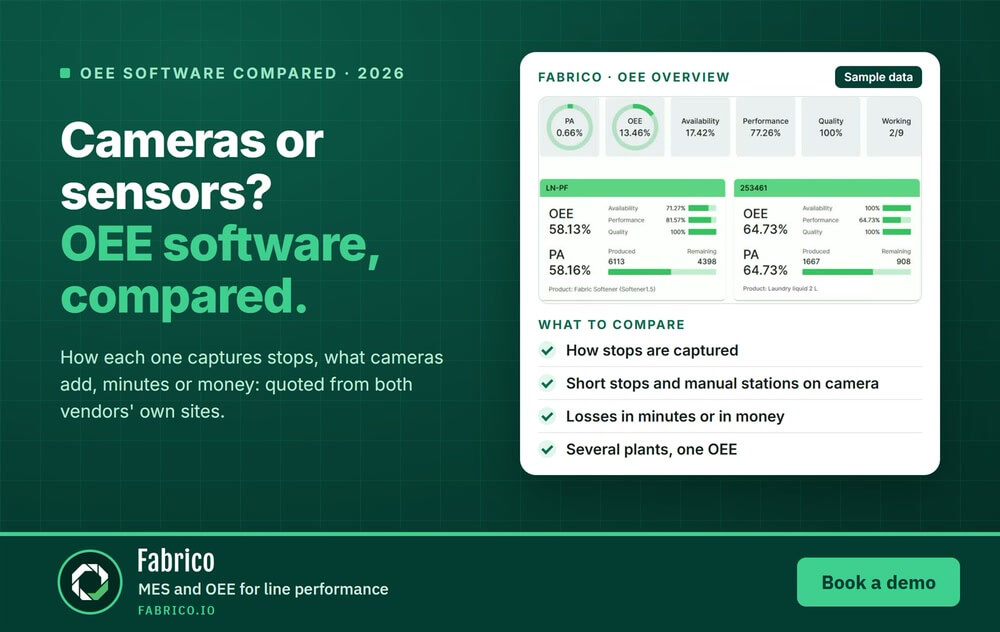


Real Fabrico tiles, sample data.