


 Login
 Blog

Invisible AI Alternatives: Assembly Analytics, Inspection or OEE

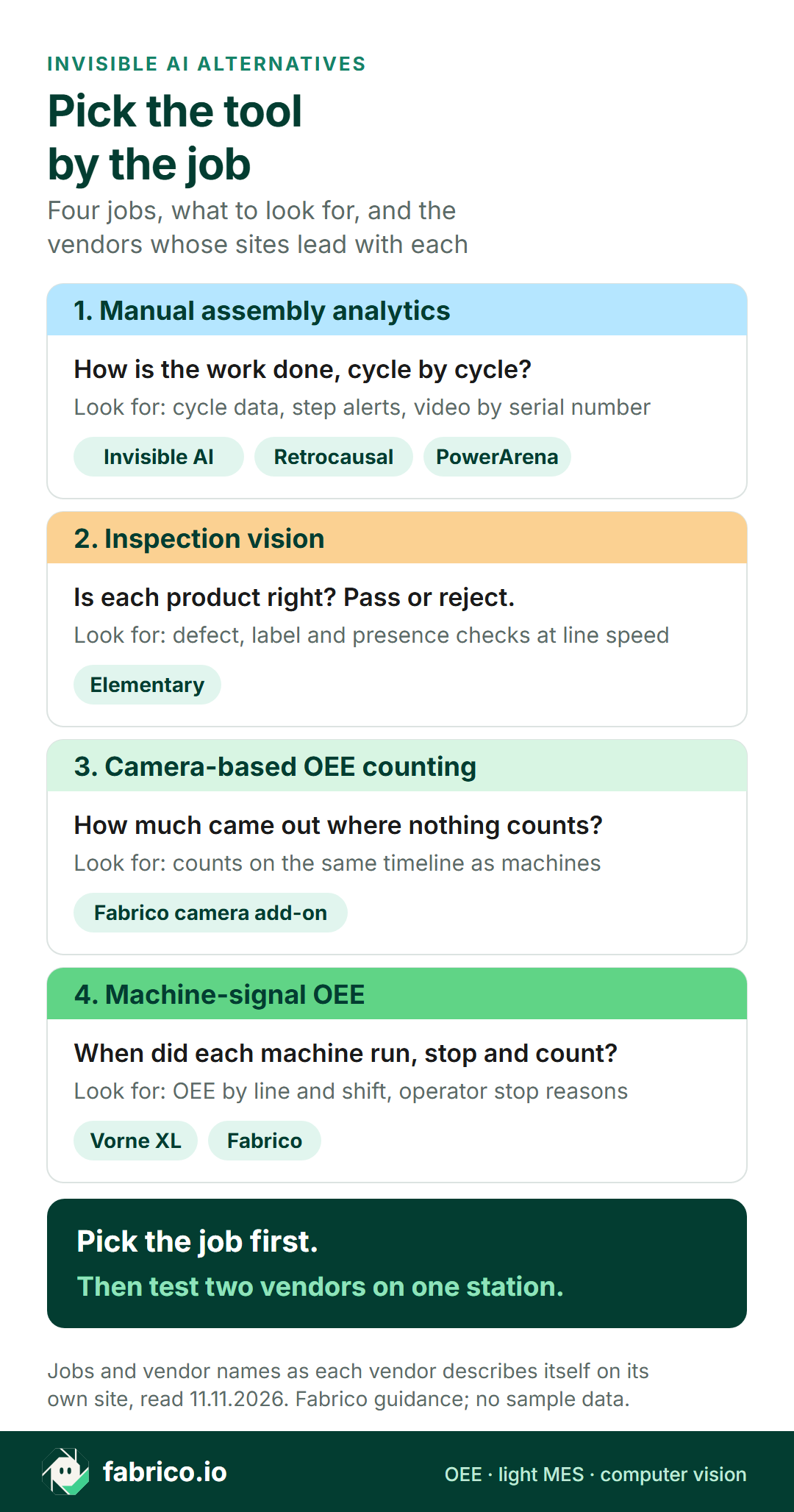
In short: the right Invisible AI alternative depends on the job you need done. For cycle-level data on manual assembly, look at Retrocausal or PowerArena. For checking each product, look at an inspection system such as Elementary. For output counts, stops and OEE, look at Fabrico or Vorne XL.
- Invisible AI sells a Vision Execution System for manual assembly. Its own edge devices, with 3D cameras, capture data on every cycle, on premise by default.
- Assembly video analytics, inspection vision, camera-based OEE counting and machine-signal OEE are four different jobs. Many plants need only one or two.
- Fabrico measures OEE and downtime from machine signals, with AI cameras as an add-on to count output at stations without one. Fabrico does not time or verify manual work steps.
- Every vendor fact here is as of 11.11.2026, per that vendor's own site, linked in place. Fabrico wrote this page, so test our claims like any vendor's.
An industrial engineer asks why one assembly station runs over takt on nights. A plant manager asks how many good units the line made, and where the stop minutes went. Both might search for Invisible AI alternatives. They need different tools.
This page sorts the options by that job. For a wider field, see our comparison of computer vision OEE software, and for cameras that act on the line, our Cerrion alternatives.
What Invisible AI does, per its own site
Every point below is as of 11.11.2026, per Invisible AI's site.
- The product. A Vision Execution System that captures cycle-level data across every station, so industrial engineers can find, check and spread improvements.
- Hardware. Its edge devices contain an Intel RealSense 3D camera and an NVIDIA AI chipset.
- Where it runs. It deploys entirely on premise, per its homepage. Its FAQ adds that it can run in the cloud for enterprise customers, though it does not recommend that. Its security page says video processing and storage happen on the edge, up to 3 months and 2 TB per device.
- What it measures. Its production page links cycle times, throughput and wait time to video, and sends alerts for line stoppages and andon pulls. Its continuous improvement page splits each cycle into work, wait, pick, walk, stand and unknown.
- Quality and safety. Its quality page lists auto-detection of micro-stops, missed steps and downtime against a gold standard you set. Its safety page says its sensors track 17 body joints in 3D for ergonomics.
- Integrations. MES systems, PLC controllers, torque guns, andons, wearables and Kepware, per its FAQ.
- New. Its homepage banner announces Studio, a new experiment: upload shop-floor video and AI sketches the standard work.
- Industries and company. The industries on its site are automotive and aerospace. Its company page names co-founder Eric Danziger as CEO and says it has raised a Series A round. In July 2025 its blog said it was working to acquire nFlux, a maker of AI co-pilots for manual assembly, subject to final approvals.
Its customer quotes with ROI figures are vendor-reported, so we leave them out.
When Invisible AI is the right pick
Keep it on your shortlist if most of these are true:
- Your main loss is in manual assembly, and engineers need data on every cycle.
- You want time study categories and missed-step alerts from fixed cameras.
- Your IT team wants video to stay inside the plant.
- Your products are close to the automotive and aerospace use cases on its site.
Four jobs that all get called computer vision
Vendors use the same words for different things. Sort them by the question each one answers.
For the split between inspection and OEE cameras, read label and code vision vs an OEE camera. For what a camera can and cannot measure at a hand station, read computer vision OEE for manual assembly.
Invisible AI alternatives compared
As of 11.11.2026, per each vendor's own site. Invisible AI is the first row, for reference.
| Tool | Its site leads with | Cameras or input | Where it runs |
|---|---|---|---|
| Invisible AI (reference) | Cycle-level data on manual assembly | Its own edge devices with 3D cameras | On premise; cloud for enterprise, per FAQ |
| Retrocausal | Step guidance, time studies, ergonomics | Most webcams, PoE and GigE cameras | Edge PC plus cloud portal, or on premise |
| PowerArena | Assembly line data, line balancing, poka-yoke | Video cameras, IoT sensors, MES | Data can stay on premise |
| Elementary | Inspection: defects, labels, presence | Its own lighting, cameras, controllers | Edge, plus a cloud platform |
| Vorne XL | Standalone OEE device, scoreboard, reporting | Photo-eye, relay, PLC or switch | Device inside your firewall, optional cloud |
| Fabrico | OEE and light MES, camera counts as add-on | Machine signal, plus AI cameras on request | Cloud, on web, iOS and Android |
Want to see the OEE side of this table on your own line? Book a demo, and bring the list of stations on one line with what each can signal today.
1. Retrocausal: step guidance and time studies on cameras you choose
Retrocausal is based in Redmond, Washington, and sells three AI copilots for manual work. As of 11.11.2026, per Retrocausal's site:
- Assembly Copilot tracks the individual steps of an assembly process and gives operators audible and visual alerts to avoid or fix mistakes. It collects timing data for every cycle and lets engineers replay each cycle on video.
- Kaizen Copilot runs video-based time and motion studies from a single video of a cycle, shot on a smartphone or a webcam, and builds line balancing views such as Yamazumi charts.
- It works with most webcams, PoE and GigE cameras, on a Windows PC at the station, per its homepage.
- Its standard setup is hybrid: live video is processed at the edge, and model training and analytics run in the cloud. An on-premise setup needs at least 25 stations per site.
Compared with Invisible AI: Retrocausal's pages lead with guiding the operator through each step, on cameras you pick. Invisible AI's lead with always-on cycle data from its own 3D devices.
Ask in the demo: how a new product variant gets its model, and who on your side keeps the step definitions current.
2. PowerArena: cycle times and poka-yoke on assembly lines
As of 11.11.2026, per PowerArena's site:
- Its Human Operation Platform (HOP) gives data on manufacturing assembly lines using AI computer vision. Data comes from video cameras, IoT sensors and MES, and digital work instructions show on a screen at each station.
- HOP records line activity and analyzes cycle times for line balancing. It compares current work to a known standard and alerts on potential problems.
- Video can be searched by serial number, and the site says your data can stay on premise.
- The industries on its site are electronics, automotive and smart city crowd management.
Compared with Invisible AI: both target human-intensive assembly with cycle data and traceable video. PowerArena's site puts more weight on electronics and on-screen work instructions.
Ask in the demo: which cameras it uses, and where its servers sit in your network.
3. Elementary: when the real job is inspection
If the job is catching defects before a product ships, that is inspection. As of 11.11.2026, per Elementary's site:
- It sells AI vision inspection: defect detection, label verification of graphics, codes and print quality, sorting, and presence or absence checks.
- Its machine vision system is industrial lighting, cameras and controllers that it says inspect at 1,000+ parts per minute.
- Defect detection runs at the edge, and a cloud platform called QualityOS connects lines and parts.
- Its industry list includes consumer packaged goods and food and beverage, next to automotive, logistics and life sciences.
Compared with Invisible AI: Elementary's pages lead with the product. Invisible AI's lead with how the work is done.
How it links to OEE: an inspection system's reject count can feed the quality part of OEE through the line's reject signal or counter.
4. Vorne XL: a standalone OEE device at the machine
As of 11.11.2026, per Vorne's site:
- XL is a standalone device with I/O to your process, a scoreboard for operators and built-in reporting for managers.
- You hook up one or two sensors, or tap into an existing photo-eye, relay, PLC or proximity switch. Operators can scan down and reject reasons with a barcode scanner.
- XL devices operate within your firewall. XL Enterprise is an optional cloud component, per its homepage.
Compared with Invisible AI: Vorne's pages lead with the machine signal. Invisible AI's lead with people and parts at manual stations.
5. Where Fabrico fits: OEE and light MES, with camera counts
Fabrico is a cloud OEE and light MES platform. It answers the plant manager's question: how much each line made, where the minutes went, and what they cost.
- Where the data comes from: a PLC, sensor or counter on each machine times the stops and counts the output. At the line, the operator picks the stop reason on a phone or tablet.
- What you get: OEE, downtime and losses for each line and shift, priced in money, on web, iOS and Android. See our OEE software guide.
- Cameras, as an add-on: AI cameras count output where a station has no usable signal, such as a hand-packing table, and the team lead logs stops and reasons on a tablet. Any moment on the shift timeline opens as camera video. In the standard setup Fabrico streams that video on request and does not keep a copy.
- Getting data out: REST API, webhooks, Excel or CSV.
- On the roadmap, not live: camera-detected stops, jam zones, and a likely reason offered to the operator to confirm.
- Outside Fabrico's scope: timing or verifying manual work steps, and product inspection.
Custom AI modules for one plant are possible as custom work on request.
See how a camera counts at a manual packing station, and test any camera count, ours included, with how accurate camera OEE is.
Worked example: one manual station, two questions
Here is sample data for one shift at a manual packing station. The numbers are invented to show the arithmetic, not a customer result or a Fabrico screen.
The shift has 480 minutes with a 30 minute planned break, so planned production time is 450 minutes. The ideal rate is 10 packs a minute. The station has no usable signal, so the team lead logs each stop and its reason on a tablet, and an AI camera only counts the packs.
The camera counted 3,600 packs. The team lead logged 54 stop minutes: an 18 minute changeover in hour 3, 28 minutes waiting for material in hour 6, and 8 minutes of short stops.
- Availability: run time is 450 minus 54, or 396 minutes. 396 of 450 is 88.0%.
- Performance: 396 minutes at 10 a minute could make 3,960 packs. The station made 3,600, or 90.9%.
- Quality: the end of line check rejected 72 packs, leaving 3,528 good, or 98.0%.
- OEE: 88.0% x 90.9% x 98.0% = 78.4%. As a check, 3,528 good packs of the 4,500 possible is also 78.4%.
That answers the plant manager. It does not say why some cycles ran slow inside the 396 minutes of run time: the 9.1% performance loss could be slow cycles, a missing part at one step, or an operator still learning the pack.
That second question is the job of a cycle-level tool such as Invisible AI, Retrocausal or PowerArena. Our page on video time study vs camera OEE shows how the two fit together.
Questions to ask any vendor on this list
Put the same questions to every vendor, us included, and bring one real shift from your own line.
| Ask | Why it matters |
|---|---|
| What video is kept, where, for how long, and is it about people? | Your works council and data protection officer will ask this first. |
| Does it give OEE by line and shift, on your definitions? | Or does it send cycle data to a system that does? Both can work. |
| How does a stop become a record? | Look for a start, a length, a reason and the video for that minute, on one timeline. |
| How would a pilot run? | One station, a fixed period, a hand count to compare. Or run a cycle tool and an OEE count on the same station for a week and compare the stop minutes each reports. |
To set up that pilot step by step, use our computer vision OEE pilot plan.
Privacy, works councils and the EU AI Act
Any camera at a manual station sees people at work, whichever vendor you pick, us included. That is why the works council will want a say before the first camera goes up.
Invisible AI sets out its privacy approach on its security page. Ask every vendor on this list, us included, the same three things in writing: what the camera sees, what is kept and for how long, and who can open it.
If you buy in the EU, ask every vendor on this list, us included, how its system fits the AI Act. Annex III, point 4(b) lists as high-risk AI systems those intended to monitor and evaluate the performance and behaviour of persons in work relationships. Ask your legal team whether that applies to your setup.
Fabrico points its cameras at the product to count it, and in the standard setup video is streamed on request, not stored in Fabrico. More automatic masking of people is on the roadmap. See production line cameras without surveillance.
Which one fits your plant
- Cycle data on manual assembly, on premise, from 3D devices: Invisible AI.
- Step guidance and time studies on cameras you choose: Retrocausal.
- Line balancing and SOP alerts on electronics or automotive assembly: PowerArena.
- Defects, labels or missing parts on each product: Elementary or another inspection system.
- A standalone OEE device with an operator scoreboard at each machine or line: Vorne XL.
- Cloud OEE and light MES across machine lines, with camera counts at manual stations and losses in money: Fabrico.
What people ask next
What is Invisible AI?
Invisible AI sells a Vision Execution System for manufacturing. Per its site, its edge devices with 3D cameras capture cycle-level data on manual assembly, run on premise, and link cycle times, line stoppages and andon pulls to video. The industries on its site are automotive and aerospace.
Can I use my own cameras with Invisible AI?
Its FAQ says its system runs on its own AI edge devices, which include 3D cameras and an AI chip. Its homepage also announces Studio, a new experiment where you upload shop-floor video and AI sketches the standard work. If you want to choose your own cameras for live use, Retrocausal's site says it works with most webcams, PoE and GigE cameras.
Is Invisible AI OEE software?
Its site says it helps OEMs boost FPY, OEE and workforce safety, and covers cycle times, throughput and line stoppages. If you need OEE by line and shift on your own definitions, ask whether it calculates that itself or feeds your OEE or MES system.
Does Fabrico verify manual assembly steps?
No. Fabrico measures OEE from machine signals and operator stop reasons. Its AI camera add-on counts output, including at manual stations. For step guidance or time studies, look at Invisible AI, Retrocausal or PowerArena.
Who owns Invisible AI?
Its site names the company as Invisible AI Inc., led by co-founder and CEO Eric Danziger, and says it has raised a Series A round. Its company page lists its investors, among them Van Tuyl, 8VC, K9 Ventures and Sierra Ventures. In July 2025 its blog said it was working to acquire nFlux, subject to final approvals.
What drives the cost of these tools?
The quote depends on the number of stations and lines, cameras or devices, mounting, network, integration and training. Give every vendor the same station list, so you compare like with like.
Want to see the OEE side on one of your lines? Book a demo.
Related articles


Latest from our blog



Real Fabrico tiles, sample data.