


 Login
 Blog
Keyence Vision Alternatives: Smart Cameras, AI Inspection or OEE Cameras

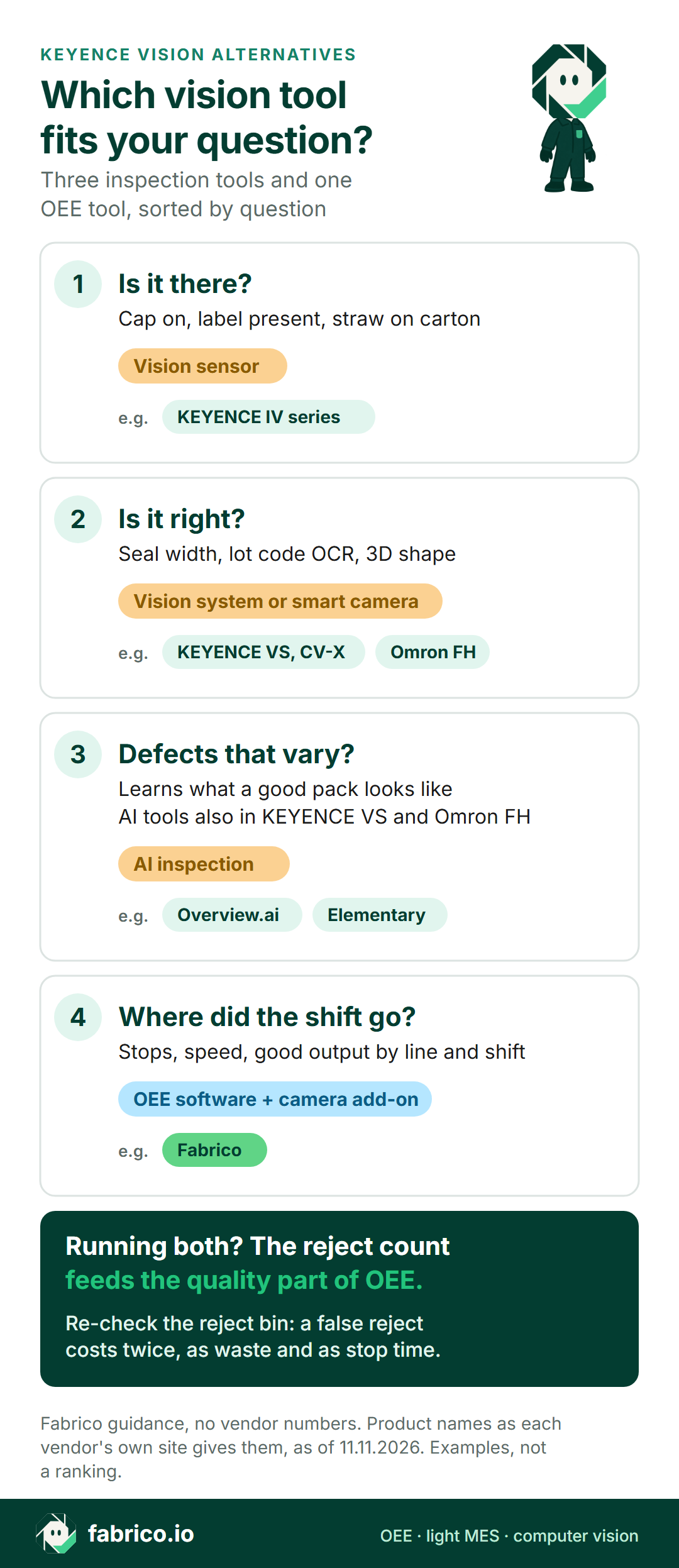
In short: the right Keyence vision alternative depends on the question your camera has to answer. For pass or fail checks on each pack, compare other inspection vendors: Omron for vision systems, or Overview.ai and Elementary for AI inspection. To find out why the line stopped and how much good output it made, look at OEE software such as Fabrico, whose AI camera add-on counts output, on request, where no machine signal can.
- Keyence sells vision sensors (the IV series) and vision systems (VS, VS-G, CV-X, XG-X, VJ and more), with AI and rule-based tools, per keyence.com.
- Its food and beverage packaging page splits the two: sensors for presence checks such as a cap or a label, systems for complex checks such as OCR and 3D defect detection.
- Inspection decides pass or fail for each pack. OEE software measures time, speed and good output for the line. A plant can run both, joined by the reject count.
- Vendor facts come from each vendor's own pages, as of 11.11.2026, linked in place. No prices, no rankings.
A biscuit line runs a vision check after the flow wrapper. The reject bin fills up, the line stops after three rejects in a row, and the shift ends well short of plan. Was it the camera, the wrapper or the packs?
That question has two halves. Is each pack good? And where did the line's time go? Keyence's vision pages describe the first half: an OK or NG judgment, a measured result or a sorted part.
Below: what Keyence sells in machine vision according to its pages, when it fits, and four alternatives grouped by job. Fabrico wrote this page and is one of the four, so test it as you would any vendor's page. Fabrico comes first below because we wrote this page, not as a ranking. Our visual quality control software guide covers the wider field.
What Keyence sells in machine vision (as of 11.11.2026, per Keyence's site)
Keyence's machine vision page splits the range in two. Vision systems run from modular high-speed controllers to all-in-one smart cameras. Vision sensors come with built-in AI. The same page lists Food/Beverage Packaging among the industries it serves. Here is the lineup as its vision systems page and vision sensors page describe it.
| Series | What the page says it does | Setup, per the page |
|---|---|---|
| IV4 and IV sensors | AI presence and difference checks; IV4 counts targets passing inline; character reading | One-click image setup on IV4; OK and NG images on IV3 and IV2 |
| VS smart camera | AI and rule-based tools on one camera; 25 megapixel AI inspection; ZoomTrax lens control (19 lenses) in an IP67 smart camera | A few dozen images for learning, on a general-purpose PC |
| VS-G controller | AI inspection on the controller; 32-core AI engine; built-in storage for traceability | AI tuning by selecting the target image |
| CV-X | Defect, presence, measurement and code reading; names food and packaging | Icon-driven tool catalog |
| XG-X | Customisable system; supports line scan and 3D cameras | Flowchart style programming |
| VJ | GigE cameras and lighting for PC-based vision | Your own software: HALCON, VisionPro, OpenCV and others |
- Food and beverage packaging. Keyence's food and beverage packaging page puts vision sensors such as the IV4 on presence checks, like a cap on a bottle, and vision systems such as the VS on complex work: measurement, several cameras, OCR and 3D defect detection. Its examples include seasoning packets, juice box straws and foreign particles in jelly. Many Keyence sensors and cameras are rated IP67, it says.
- Changeovers. The vision sensors page says the IV4 can save up to 32 detection setups, one per product.
- Data. Vision Database software analyses inspection results from Keyence vision systems, for traceability and system maintenance. The VS Series page shows a table format for yield rate management.
- Support. Its pages describe support from selection to line operations, with on-site instructions.
Ask in the demo: whether each of your stations needs a sensor or a system, and how results and reject counts reach your PLC, MES or OEE system.
When Keyence fits
Put Keyence on your shortlist if most of these hold:
- Each pack needs a pass or fail check at one station: cap, label, seal, tray or lot code.
- You want one supplier for cameras, lenses and lighting. Its vision systems page says the lineup extends to lenses, lighting and peripheral equipment.
Fits plants that want one inspection supplier across many station types, per Keyence's lineup pages.
Inspection camera or OEE camera: which question are you asking?
An inspection camera judges each pack at one point. An OEE count looks at the whole line over the shift. Keyence's food page draws a second line inside inspection, between sensors and systems. The pack versus line split is covered in depth in label and code vision vs an OEE camera.
Keyence and four alternatives at a glance
Vendor facts as of 11.11.2026; each vendor's section below links its own pages.
| Tool | Main job, per its site | Hardware | AI and setup, per its site |
|---|---|---|---|
| Keyence (for reference) | Vision sensors and vision systems | Sensors, smart cameras, controllers; 2D, line scan, 3D | AI and rule-based tools |
| Fabrico | OEE and light MES | Machine signal; AI camera add-on on request | Operator adds stop reasons |
| Omron FH | Inspection and measurement | Controllers, many cameras, line scan | Rule-based tools plus AI defect tools |
| Overview.ai | AI inspection | Own cameras with on-device AI | Training on the camera, browser setup |
| Elementary | AI inspection, cloud quality platform | Own lighting, cameras, controllers | Learns good from the live line |
Want the OEE side shown on a line like yours? Book a demo and bring one shift's stop log and reject count.
Fabrico: OEE next to your vision checks
Fabrico wrote this page. It runs in the cloud as OEE software with light MES. Where a Keyence system judges each pack, Fabrico measures the line's time: stops on connected machines, with their start and duration, the reasons operators add, slow running and good output.
What it does today, per the OEE and MES overview and the camera OEE page:
- Signals first. A PLC, sensor or counter on the machine gives stops and counts; the operator tags the reason at the line on a tablet or phone.
- OEE and downtime by line and shift, with losses shown in money; web, iOS and Android apps.
- The AI camera add-on, on request, counts output at stations without a usable signal, such as hand case packing. With the add-on, click any moment on the shift timeline to open that camera's video; the standard setup streams it on request and keeps no copy in Fabrico.
- Data out via REST API, webhooks, and Excel or CSV export.
- On the roadmap, not live: stop detection by the camera itself, jam zones on the camera view, and a suggested stop reason that the operator confirms.
- Not Fabrico: pack inspection, which stays with your vision system.
A disclosure before one result: Ficosota, a Bulgarian maker of hygiene, tissue and household products, is also an investor in Fabrico (investment announcement). On its 16 lines, OEE went from 53.11% to 59.62% between June and September 2026, and these figures make no camera claim. See the Ficosota story.
Ask in the demo: how Fabrico takes the reject count from your vision system, and how a camera add-on count compares with a hand count at one station.
Fits plants that want stops, speed and good output by line and shift, on lines that mix PLC machines, older machines and manual stations. See our OEE software guide for what to compare.
Omron FH: vision system with AI and rule-based tools
Omron's FH Vision System page (UK site) describes a camera and controller system for inspection, position and orientation, code reading and measurement. As of 11.11.2026, it says:
- AI inspection tools can be added to an existing rule-based setup on the FH Series.
- The AI Defect Inspection tool is set up in three steps: sort images into non-defective and defective, mark the defects, then start the learning.
- In a battery cell example on the page, up to 8 cameras connect to one controller. The FH also takes up to 4 line scan cameras.
- The FH controller can run algorithms built in MVTec's Halcon HDevelop, next to Omron's own.
- The page names automotive, electronics, food and pharmaceutical among the industries for its AI defect tools.
Compared with Keyence: both sell controller-based systems with AI and rule-based tools. Ask each how many cameras one controller takes, and which third-party vision libraries, such as HALCON, run on it or next to it.
Fits plants that want AI tools added to rule-based inspection on one controller, or already build vision in Halcon, per Omron's FH page.
Overview.ai: AI inspection trained on the camera
Overview.ai calls its product "the first Agentic Camera on the factory floor" on its homepage. As of 11.11.2026, the site says:
- AI training and inference run on the device, with no external compute, and production data never leaves the factory floor.
- Each camera is a local networked device, configured from a browser. Native protocols listed include EtherNet/IP, Profinet, Modbus TCP and Node-RED.
- Its industries include packaging manufacturing and food manufacturing.
Compared with Keyence: Keyence's VS page describes learning with a few dozen images on a general-purpose PC; Overview.ai's homepage describes training on the camera. Ask each where a new SKU is trained, who does it, and how reject counts reach your PLC.
Fits plants that want AI models trained and run on each camera, with images kept inside the plant, per Overview.ai's homepage.
Elementary: AI inspection with a cloud quality platform
More in our Elementary alternatives page. Per elementaryml.com, as of 11.11.2026:
- VisionStream learns what good looks like by watching your line, and runs at the edge.
- QualityOS connects every line and every part in one cloud platform, and connects to BI, MES and ERP tools.
- Its food and beverage page says systems can be delivered washdown rated, and that several vision sensors can capture all sides of a part and count good and bad parts.
Compared with Keyence: Keyence's Vision Database analyses inspection results from its vision systems; Elementary's QualityOS is one cloud platform across lines. Ask each how results from several lines come together, and where images are kept.
Fits plants that want inspection results from many lines in one cloud platform, per Elementary's site.
Keyence or an alternative: match the station
- One supplier from simple presence sensors up to 3D and line scan systems: Keyence covers that range, per its lineup pages.
- AI tools added to rule-based inspection, or Halcon algorithms on the controller: Omron FH.
- AI training and inference on each camera, with data kept on site: Overview.ai.
- Inspection results from many lines in one cloud platform: Elementary.
- Stops, speed and good output by line and shift, with the camera add-on counting where no signal can: Fabrico.
For Cognex In-Sight, see our Cognex In-Sight review. For FMCG lines in general, see our computer vision for FMCG buyer's guide.
Worked example: what false rejects cost a flow-wrap line
Sample data for one 8 hour shift on a biscuit flow-wrap line, not a customer's line or a product screen. Planned time is 480 minutes at an ideal 300 packs a minute, so the shift could make 144,000 packs. A vision check after the wrapper rejects bad packs, and the line is set to stop after three rejects in a row. For the wrapper's own stop modes, see flow wrapper OEE.
Stops took 50 minutes: a 25 minute changeover, 13 minutes of film splices and wrapper jams, and six 2 minute stops after runs of rejects. The line ran 430 minutes, so availability is 430 / 480 = 89.6%.
In 430 minutes the ideal is 129,000 packs. The wrapper counted 118,000, so performance is 91.5%.
The vision check rejected 2,400 packs. The shift lead re-checked the reject bin: 1,500 were good packs, and 900 had real defects. Good output is 115,600, so quality is 98.0%. OEE is 89.6% x 91.5% x 98.0% = 80.3%, the same as 115,600 good of 144,000 possible.
In this sample, all six reject-run stops came from runs of false rejects. Of the 28,400 lost packs, 5,100 trace back to the vision settings: 1,500 false rejects and 3,600 packs lost in the stops that runs of rejects triggered. That is about 18% of the loss in this sample. A false reject costs twice: once as a good pack in the bin, and again as stop minutes when a run of them stops the line.
The fix sits with the vision supplier and the quality team: threshold, light, image set. The OEE data shows, shift by shift, whether it paid off. The 900 real defects are the check doing its job. Compare any camera add-on count with a hand count first, as our page on camera OEE accuracy explains.
Questions to ask before you buy
Ask every vendor the same questions, us included, on one real station.
- What will this station decide? Presence, measurement, code or defect. Keyence's food page uses that split to pick a sensor or a system.
- What happens at a SKU change? How many new images, who loads the setup, and whether the line waits.
- What is the false reject rate on our packs? Ask for a test on your own samples, and plan to re-check the reject bin during the pilot.
- Where do results go? A reject signal to the PLC, counts to MES or OEE, images to which server.
- Who sees the images, and for how long are they kept? At hand-pack stations the view includes people, so agree this with the works council first; see line cameras without surveillance.
- What drives the quote? Stations, cameras, lenses, lighting, mounting, software and training. Give every vendor one identical station list.
For the OEE side, see our computer vision OEE pilot plan.
What people ask next
What is the difference between a Keyence vision sensor and a vision system?
Keyence's food and beverage packaging page says vision sensors such as the IV4 Series suit presence checks, like whether a cap or a label is there, and are quick to set up. Vision systems such as the VS Series suit complex checks: high resolution, precise measurement, several cameras, OCR and 3D defect detection.
Can a Keyence vision sensor count output?
Keyence's vision sensors page says the IV4 Series can count targets passing inline in its AI Through Count mode. If you want that count in OEE, ask Keyence how it reaches your PLC or OEE system as a signal, and check it against a hand count for one shift.
How is Fabrico different from Keyence?
Keyence sells vision sensors and vision systems for inspection, per its site. Fabrico measures the line: stops and counts from the machine signal, reasons from the operator, OEE and losses in money by line and shift, and an AI camera add-on, on request, that counts where no signal can. Fabrico does not inspect packs.
Can a Keyence vision system and Fabrico run on the same line?
Yes. The vision system gives a reject signal or count, which OEE software uses for the quality part of OEE; stops and run time come from the machine signal. Agree first what counts as a reject.
How many product setups can a Keyence IV4 sensor store?
Keyence's vision sensors page says the IV4 can save up to 32 detection setups, one per product, and a product change means loading that product's setup. Ask who loads it at a SKU change, and whether the line waits.
Want to see stops, speed and rejects for a line like yours? Book a demo, or ask us a question first.
Related articles



Latest from our blog


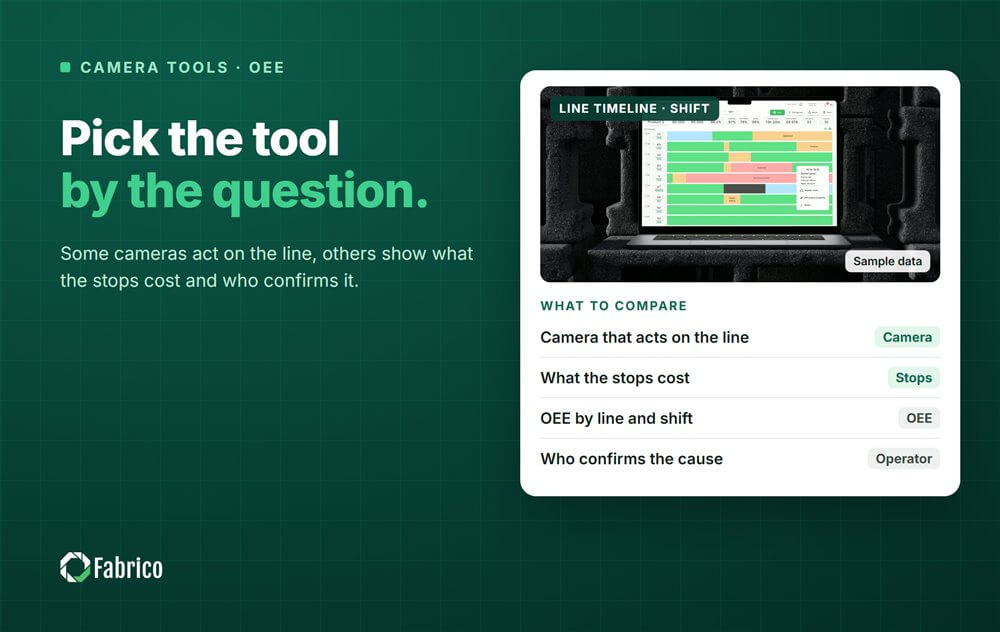
Real Fabrico tiles, sample data.