


 Login
 Blog
Lumicent vs Tractian: Who Should Act on the Alert

In short: Lumicent vs Tractian is a question of who acts on the alert. If finance and leadership want asset risk ranked by what a failure would cost, look at Lumicent first; if the reliability team wants named failure modes and alerts that become CMMS work orders, look at Tractian first. Both put wireless sensors on rotating assets and read them with AI; they rank and route the result differently.
- Price, as published on 15.11.2026: Lumicent lists Essentials from $50 a month per asset and Intelligence from $5,000 a month for one site; Tractian shows no public price, quote on request, with "asset-based pricing".
- Hazardous areas: Tractian's spec page names ATEX and NFPA 70 classes; Lumicent cites FM condition-monitoring approvals. Ask each for a certificate that names your zone.
- Sample tissue converting line: a sensor can reach 39 of 120 stopped minutes a shift; winning back 23 is worth about EUR 364 a shift.
Reliability and plant managers type this pair when a gearbox or an embosser drive has failed without warning and someone has been asked to make sure it does not happen again. Both vendors answer with sensors and AI. The difference shows one step later: whose desk the alert lands on and in what order. Lumicent's pages talk to operations, finance and leadership about consequence. Tractian's pages talk to the maintenance planner about failure modes and work orders. Pick the audience first and most of the comparison follows.
Key takeaways
- Rank the same open alerts both ways in the pilot. The difference in order is the difference in product.
- Lumicent publishes entry prices per asset and per site; Tractian scopes a quote by asset count. Ask both what sensors and gateways add.
- Tissue and paper dust is a fire and explosion hazard, so the sensor certificate belongs in the first meeting, not the purchase order.
- On the sample line, mechanical and maintenance-wait minutes are a third of stopped time; the rest needs line data, not vibration data.
- Price the minutes at a margin taken from a published industry range before anyone builds a business case.
Who acts on the alert: finance or the planner
Lumicent's home page opens with "Decision Intelligence for Physical Operations" and says "It learns what normal looks like, then weighs each deviation by what it would cost." Tractian's home page headline is "Protect Critical Assets. Reduce Operational Risk." and it aims to "Turn reactive maintenance into predictable, data-driven operations through AI-powered hardware and software." Side by side (features read 14.11.2026, prices 15.11.2026):
| Question | Lumicent | Tractian |
|---|---|---|
| Who the pages address | Operations, risk, finance and leadership | Maintenance and reliability teams |
| How alerts are ordered | Six consequence dimensions, from operational to reputational | Failure severity and asset criticality |
| What the AI says | This deviation from normal, weighted by its cost | This failure mode: bearing wear, misalignment, unbalance |
| Where the answer lands | Daily Brief, Lumi Chat, agentic workflows | Work orders with fault, severity and fix filled in, synced to the CMMS |
| Path off the asset | Encrypted edge gateways, out-of-band of control systems | 4G/LTE, "No IT setup, no Wi-Fi needed" |
| Price, as published (checked 15.11.2026) | Essentials from $50 a month per asset; Intelligence from $5,000 a month, one site; Scale by quote (Lumicent pricing) | No public price, quote on request; "Asset-based pricing, scoped to your operation" (its pricing page) |
Then the decision matrix. Choose the rows that match the people who will use the system every day.
| If this is you | Look first at | Why (vendor page) | Prove it in the pilot by |
|---|---|---|---|
| The plant manager must defend spend to a CFO in money terms | Lumicent | Risk scored on six dimensions, financial among them | Having finance read one month of the Daily Brief |
| The planner wants jobs, not dashboards | Tractian | "Work orders write themselves." | Closing one alert as a job in your CMMS, evidence attached |
| Vibration analysts want the failure mode named | Tractian | Signal patterns mapped to failure modes | Naming a known bearing defect on a test asset |
| Forty amber alerts and no one knows which matters | Lumicent | "Prioritize work by consequence instead of alert volume." | Ranking six live alerts and comparing with the planner's order |
| Drives and VFDs trip more often than bearings fail | Tractian | Electrical monitoring for motors and VFDs | A month of drive events against the VFD fault log |
| Managers want to ask questions in plain words | Lumicent | Lumi Chat on asset condition and history | Five questions about last month, each answer checked |
| A budget line needs a list price per asset | Lumicent | Per-asset entry price on its pricing page | A written quote with sensors and gateways itemised |
| Maintenance data must sit in SAP or Maximo | Tractian | SAP, IBM Maximo, Power BI and SQL access | Finding one Tractian job in your ERP with its history |
Price in this decision. Lumicent publishes Essentials "From $50/month per asset" for one site, Intelligence "From $5,000/month" with single-site platform pricing, and a Scale tier "Priced around your footprint"; Tractian publishes no price and quotes on request, saying "Pricing is scoped to your assets" (both checked 15.11.2026). At Lumicent's entry price, twelve monitored assets start at $600 a month; ask both vendors whether sensors, gateways and installation sit inside the figure, and count your own planner and analyst hours too.
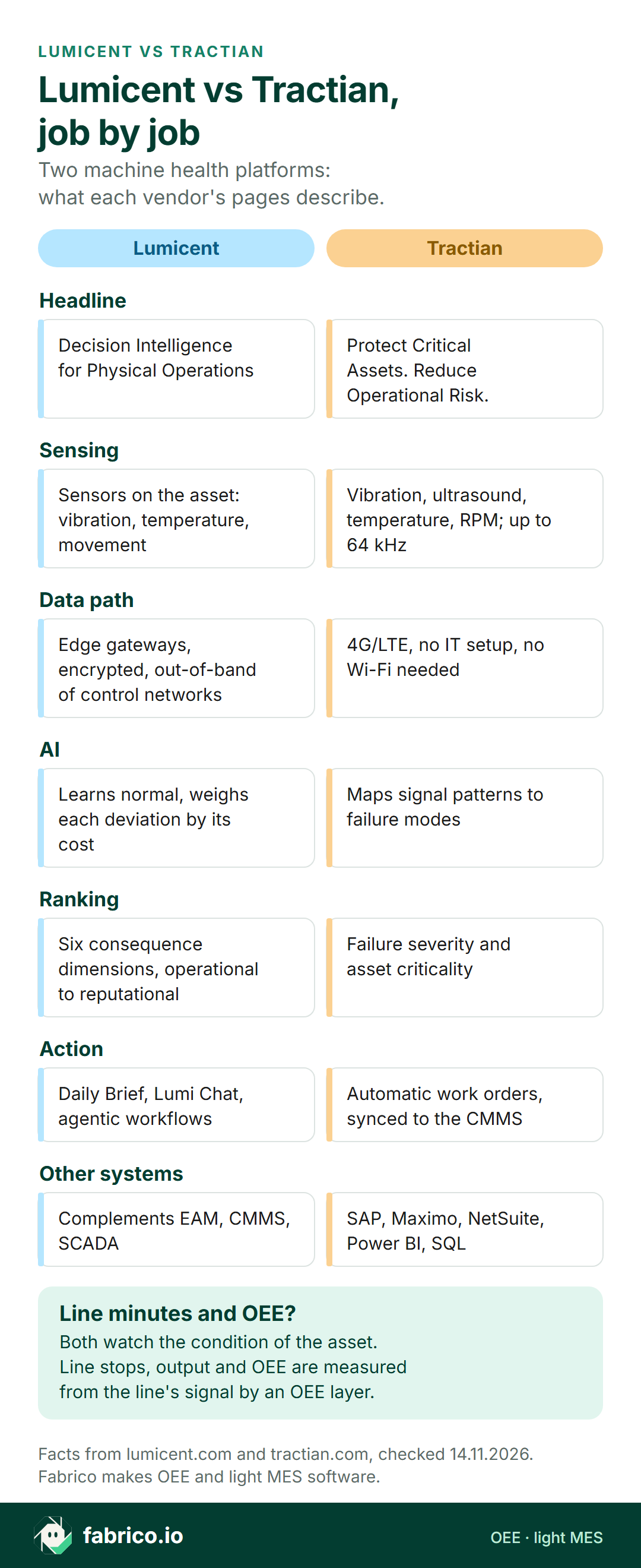
Text version of this infographic
- Headline. Lumicent: Decision Intelligence for Physical Operations. Tractian: Protect Critical Assets. Reduce Operational Risk.
- Sensing. Lumicent: sensors on the asset for vibration, temperature, movement. Tractian: vibration, ultrasound, temperature, RPM, up to 64 kHz.
- Data path. Lumicent: edge gateways, encrypted, out-of-band of control networks. Tractian: 4G/LTE, no IT setup, no Wi-Fi needed.
- AI. Lumicent: learns normal, weighs each deviation by its cost. Tractian: maps signal patterns to failure modes.
- Ranking. Lumicent: six consequence dimensions, operational to reputational. Tractian: failure severity and asset criticality.
- Action. Lumicent: Daily Brief, Lumi Chat, agentic workflows. Tractian: automatic work orders, synced to the CMMS.
- Other systems. Lumicent: complements EAM, CMMS, SCADA. Tractian: SAP, Maximo, NetSuite, Power BI, SQL.
- Line minutes and OEE? Both watch the condition of the asset. Line stops, output and OEE are measured from the line's own signal by an OEE layer.
What each senses and how data leaves the site
Tractian is specific about the device. The condition monitoring page describes sensors that "sample vibration, ultrasound, temperature, and RPM data over 4G/LTE". The sensor specifications page gives a range "From 0 Hz to 64,000 Hz", a battery life "Between 3-5 years on default settings", an IP69K rating, and the note "Sensor base must be glued or screwed to the asset". On the failure detection page, data "is benchmarked against millions of historical machine hours and bearing libraries", and a baseline report with failure-mode assessment follows soon after installation.
Lumicent describes a layer. Its edge sensing page says "Intelligent sensors attach directly to monitored assets", reading characteristics "such as vibration, temperature, movement and other measurable characteristics", and "Secure edge gateways receive their signals and transport encrypted, authenticated data to the Lumicent cloud." The same page says "The sensing layer can operate without connecting directly into SCADA, ERP, MES or other production systems." The vibration page frames the problem as "knowing which changes matter, rather than in collecting more vibration data."
For the OT lead, the two routes are different conversations. A cellular link from each sensor keeps the plant network out of the picture but puts many radios on the floor. An edge gateway concentrates traffic at one box the plant can inspect. Ask each vendor for a drawing of the full data path, then have whoever owns the control network sign it before a sensor is glued on. Tractian also offers an electrical sensor with "Live L1, L2, L3, and neutral readings", which matters on a line where drives fail more often than bearings.
Ranking six open alerts two ways
This is where the products separate. Tractian says "Alerts are ranked by failure severity and asset criticality". Lumicent's consequence intelligence page scores risk on six dimensions (operational, safety, financial, compliance, environmental, reputational) and promises "priority based on what failure could mean". The table applies both ideas, as the vendors describe them, to six sample alerts on a tissue converting line. It is an illustration made up for this page, not output from either product.
| Sample alert | Severity and criticality order | Consequence order | Why the order moves |
|---|---|---|---|
| Unwind stand bearing, vibration rising fast | 1 | 4 | Severe signal, but a spare unwind stand covers a failure |
| Embosser gearbox, slow temperature creep | 2 | 3 | Single point of failure: the line stops with it |
| Log saw main motor, current imbalance | 3 | 2 | Line stop plus an operator safety exposure |
| Core loader vacuum pump, ultrasound peak | 4 | 6 | Standby pump installed; low cost if it fails |
| Packer infeed conveyor drive, mild vibration | 5 | 5 | Buffer ahead of the packer absorbs a short stop |
| Dust extraction fan bearing, early warming | 6 | 1 | Low severity today, but a hot bearing in tissue dust is a fire and compliance risk |
Neither order is wrong. The planner's order fixes the worst machine first; the consequence order fixes the worst outcome first. The dust fan moving from last to first is the kind of shift that justifies Lumicent's approach to a site manager, and the unwind bearing staying at the top is why many planners prefer Tractian's. Run your own six live alerts through both in the pilot and ask your planner and your EHS lead which order they would have chosen.
Hazardous areas: tissue dust and the sensor certificate
HSE's Paper mills: Guidance on fire risk states that "Paper dust presents a very high risk of fire and may, under certain conditions, be explosive", and adds that the problems "are likely to be more extensive in tissue mills" (accessed 15.11.2026). That puts sensors on extraction fans, log saws and embossers near zoned areas.
The European Commission's ATEX page explains that "The ATEX Directive 2014/34/EU covers equipment and protective systems intended for use in potentially explosive atmospheres" (accessed 14.11.2026). Tractian's specification page states "Complies with ATEX, NFPA 70 CL1, CL2, and CL3 (All Division I)." Lumicent's home page shows an FM Approvals mark reading "Class II Certified", and its pricing page says the system is "FM Approved per Approval Standards FM 6510 and FM 6530". FM Approvals describes FM 6510 as a standard for condition monitoring systems on medium voltage switchgear (accessed 16.11.2026), not a hazardous-location standard. An EU site needs equipment marked for its own zone either way. Ask for the certificate of the exact sensor and gateway model, matched to the zone drawing, before the pilot is booked.
What share of a tissue line's stopped minutes a sensor can reach
Treat this section as sample data: the converting line is fictional, built for this page, with no product screen shown. A tissue converting line turns parent reels into toilet rolls: unwind, embosser, rewinder, log saw, packer. A 12 hour shift with 45 minutes of breaks and handover gives 675 planned minutes. The log saw is rated at 500 rolls a minute, so 337,500 rolls are possible. Four weeks of stop logs give this average shift:
| Sample stop cause, average shift | Minutes | Can a condition sensor reach it? |
|---|---|---|
| Embosser bearing and drive faults | 34 | Yes |
| Web breaks at the unwind | 27 | No: process and paper quality |
| Parent reel change | 21 | No: planned work |
| Log saw blade change | 18 | No: wear part on a schedule |
| Core shortage at the rewinder | 15 | No: supply |
| Waiting for a technician | 5 | Partly: planned repairs need fewer call-outs |
| Stopped in total | 120 | 39 at most |
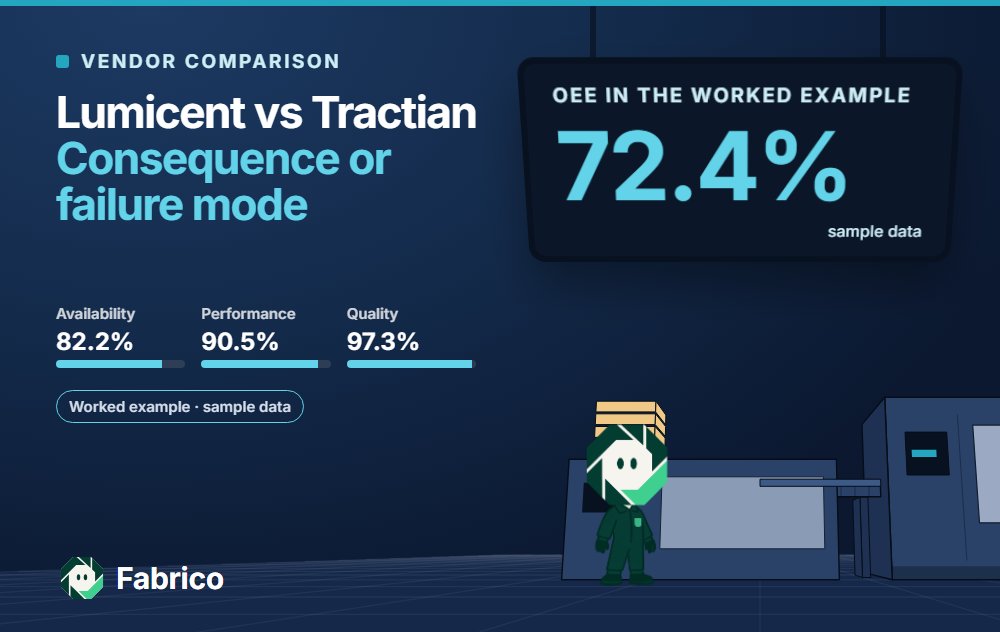
The shift in OEE terms. The line ran 675 minus 120, or 555 minutes: availability 555 / 675 = 82.2%. At 500 rolls a minute those minutes allow 277,500 rolls; the line made 251,000, so performance is 251,000 / 277,500 = 90.5%. Loose winds and bad tail seals rejected 6,800, leaving 244,200 good rolls: quality 244,200 / 251,000 = 97.3%. OEE is 82.2% x 90.5% x 97.3% = 72.4%, the same as 244,200 good of 337,500 possible.
A margin per roll from a published range. Take a sample mill-gate price of EUR 0.30 a roll and value lost output at 12% of it, EUR 0.036 a roll. The 12% lies between the 6.34% pre-tax operating margin and the 17.14% gross margin that NYU Stern's January 2026 margin data by industry reports for 6 US Paper and Forest Products firms (accessed 15.11.2026); with only six firms in the sample, treat it as a sanity check, not a benchmark. Each running minute yields 244,200 / 555 = 440 good rolls, worth EUR 15.84. The 120 stopped minutes cost 52,800 rolls, or EUR 1,900.80 a shift. The 39 a sensor can reach are worth EUR 617.76 of that.
The pilot's hypothesis. Suppose earlier warnings let the crew change embosser bearings in the weekly planned stop, cutting fault minutes on shift from 34 to 14, and that planned repairs cut technician waits from 5 to 2. That is 23 minutes, the number the pilot exists to test. They are worth 23 x 440 = 10,120 rolls, or EUR 364.32 a shift, lifting OEE to about 75.4%. At two shifts a day on 25 days a month, 50 shifts, that is EUR 18,216 a month and EUR 218,592 over 600 shifts a year. The planned-stop labour comes off that figure, at your own rates.
NIST's manufacturing machinery maintenance page explains why the business case usually leans on output rather than repair bills. For US manufacturers in 2016 it estimates that "On average, 45.7 % of machinery maintenance was reactive maintenance", and of $119.1 billion in losses from preventable maintenance issues, "$18.1 billion due to downtime, $0.8 billion due to defects, and $100.2 billion due to lost sales from delays and defects." It also finds the most reactive quarter of plants associated with 3.3 times more downtime than the least reactive quarter (accessed 14.11.2026).
Putting the line's minutes next to the alerts
The 81 minutes no sensor can reach are where Fabrico works. It is OEE software with a light MES that ranks stop causes by lost euros per line and shift; the MES and OEE solution overview describes what it records on a converting line. Fabrico reads run, stop and count from the machine's PLC; see the OPC UA and OEE guide. The practical hand-off with Lumicent or Tractian is a shared timestamp: when an alert says the embosser drive is degrading, the stop log shows whether a stop followed, how long it lasted and what it cost.
A work order opens from a logged stop in one tap, and you can set chosen stop reasons to create that work order automatically as soon as the reason is logged. At the packer, if the machine offers no usable count, the camera add-on counts packs; having the camera suggest a stop reason is on the Roadmap. Where a camera covers the line, the video for the minute of a stop can be opened from the shift timeline; it is streamed on request and not stored. See the computer vision add-on. Fabrico lists no ready connector to either vendor, so line up alert and stop timestamps by hand in the pilot. To see stop causes on a sample line ranked by euros, book a demo.
A week of groundwork before the pilot
- Rank the ten assets that cost most line minutes when they failed last year, not the ten with the biggest repair bills.
- Split stopped minutes on one line into "a sensor could warn" and "it could not", as in the tissue table, using five shifts of stop reasons.
- Price a running minute with good output per minute and a margin inside your industry's published range.
- Pull the zone drawing and send it to both vendors with the asset list, asking for the certificate of each sensor model.
- Choose six live alerts for the ranking test and agree in advance who judges the order: planner, EHS lead or plant manager.
What to ask Lumicent and Tractian
- Which sensor model goes on each asset on our list, and which assets would you leave off?
- Rank these six open alerts and explain the order in words our planner and EHS lead can check.
- What does the quote include: sensors, gateways, installation, connectivity, software, and for how many assets?
- Draw the full data path from sensor to cloud and name what our OT lead must approve.
- Which certificate covers the exact model for our dust zones?
- How does an alert become a job in our maintenance system, and how is the fix verified?
Further reading: Tractian alternatives, vibration analysis basics and machine health monitoring software.
Lumicent vs Tractian: questions from reliability teams
How much do Lumicent and Tractian cost?
On 15.11.2026 Lumicent's pricing page listed Essentials from $50 a month per asset and Intelligence from $5,000 a month, both for one site, with a Scale tier priced by footprint. Tractian's pricing page showed no figure and described asset-based pricing scoped through a quote. Ask both to itemise sensors, gateways and installation.
Which one ranks alerts by business impact?
Lumicent's consequence intelligence page scores risk across operational, safety, financial, compliance, environmental and reputational dimensions. Tractian ranks alerts by failure severity and asset criticality. Give both the same open alerts in the pilot and compare the order with your planner's.
Do the sensors need the plant network?
Tractian's condition monitoring page says its sensors send over 4G/LTE with no IT setup and no Wi-Fi. Lumicent describes encrypted edge gateways and a sensing layer that can run without connecting into SCADA, ERP or MES. Have your OT lead approve either data path first.
Can either be used near tissue or paper dust?
Tractian's specification page names ATEX and NFPA 70 classes, and Lumicent shows FM Approvals Class II certification. HSE guidance treats paper dust as a high fire risk, especially in tissue mills. Match the certificate of the exact model to your zone drawing.
Where does Fabrico fit beside Lumicent or Tractian?
Beside them, on the line. Fabrico records run, stop and count with a stop reason, prices lost minutes in euros and covers the stops a condition sensor cannot reach. Its figures travel onward through a REST API, webhooks and spreadsheet downloads. No ready connector to either vendor is claimed, so match timestamps during a pilot.
Want a sample line's stop minutes ranked by cause and priced in euros? Book a demo.
Related articles







Real Fabrico tiles, sample data.