


 Login
 Blog
Mettler-Toledo Vision Alternatives: Inspection Vendors and OEE Cameras

In short: the right Mettler-Toledo vision alternative depends on the job at the station. For label, code, cap and fill checks on food and pharma packs, compare other product inspection vendors, such as Ishida for seal testing with a label vision option, or Wipotec for X-ray, weighing and optical inspection in one system. To count good output and see why the line stopped, add OEE software such as Fabrico, whose camera add-on counts output where no machine signal can.
- Mettler-Toledo's product inspection range covers checkweighers, metal detection, X-ray, vision inspection and combination systems, per mt.com.
- Its vision pages describe checks on labels, codes, print quality, cap placement and fill level, with faulty packs removed from the line.
- Inspection judges each pack. OEE software measures the line's time, speed and good output. The reject signal joins the two.
- Vendor facts come from each vendor's own pages, as of 12.11.2026 (seal and product pages 13.11.2026), linked in place. No prices, no rankings.
A sauce line fills, caps and labels jars, then runs them past a vision check, a checkweigher and an X-ray unit. Each unit kicks out its own rejects. At the end of the shift the plant manager asks two things. Were the jars right? And why did the line make fewer jars than planned?
Below: what Mettler-Toledo sells in product inspection according to its own pages, when it fits, and three alternatives grouped by job. Fabrico wrote this page and is one of the three, so test it as you would any vendor's page. Fabrico comes first below because we wrote this page, not as a ranking.
What Mettler-Toledo sells in product inspection (as of 12.11.2026, per its site)
Mettler-Toledo's product inspection page lists checkweighers, metal detection, X-ray inspection, vision inspection and combination systems, with quality inspection and monitoring software alongside. Its vision range is for automated quality control of product labeling and packaging in industries such as food, cosmetics and pharmaceutical production. Its vision inspection systems page lists the systems below; each name links its own product page (checked 13.11.2026).
| System | What the page says it does | Cameras, per the page |
|---|---|---|
| V11 Label Inspection | Inspects oriented products from the sides or top for label data and quality defects | 4 smart cameras; side and top |
| V13 Flatpack Label Inspection | Inspects labels on the underside of flat packs; top and side cameras can be added | 4 smart cameras; bottom |
| CV Combination | Weight control and completeness check with label inspection, for all product shapes | 8 smart cameras; 360°, bottom, side, top |
| CMV Combination | Metal detection, weight control and label inspection in one device | 8 smart cameras; 360°, bottom, side, top |
- What the checks cover. Its vision quality control page says one product family verifies label presence, correctness and print quality (OCR/OCV) and confirms cap placement. Label checks on jars, bottles and cans cover product information, lot codes, expiry dates and barcodes. As of 13.11.2026, the vision systems page also names lid and seal inspection for jars and bottles, and its retail packaging X-ray page names detecting product trapped within the seal.
- Fill level. The same page names checkweighing, X-ray inspection and vision inspection for fill level control. Its fill level page adds that an X-ray system can image the contents of a container to measure how much product is present.
- Line integration. The vision systems integrate with PLCs and existing Mettler-Toledo product inspection systems, creating a unified quality control station, per the quality control page. The page also lists reduction of false rejects among its priorities.
- Data. ProdX is described as a complete quality inspection data management system for real-time monitoring and food safety compliance. The vision quality control page says the systems generate a continuous stream of defect data.
- Regulated plants. The page names FDA 21 CFR Part 11 and GMP among the regulations its service teams know.
Ask in the demo: which system fits each station, and how reject counts reach your PLC, MES or OEE software.
When Mettler-Toledo fits
Put Mettler-Toledo on your shortlist if most of these hold:
- Each pack needs a pass or fail check on its label, code, cap or fill.
- You want weighing, metal detection or X-ray from the same supplier. Its product inspection page lists all of them, plus combination systems.
- Floor space is tight. The CV Combination puts weight control and label inspection into one machine, and the CMV Combination adds metal detection in one space-saving device, per the vision page.
Inspection or OEE: which question are you asking?
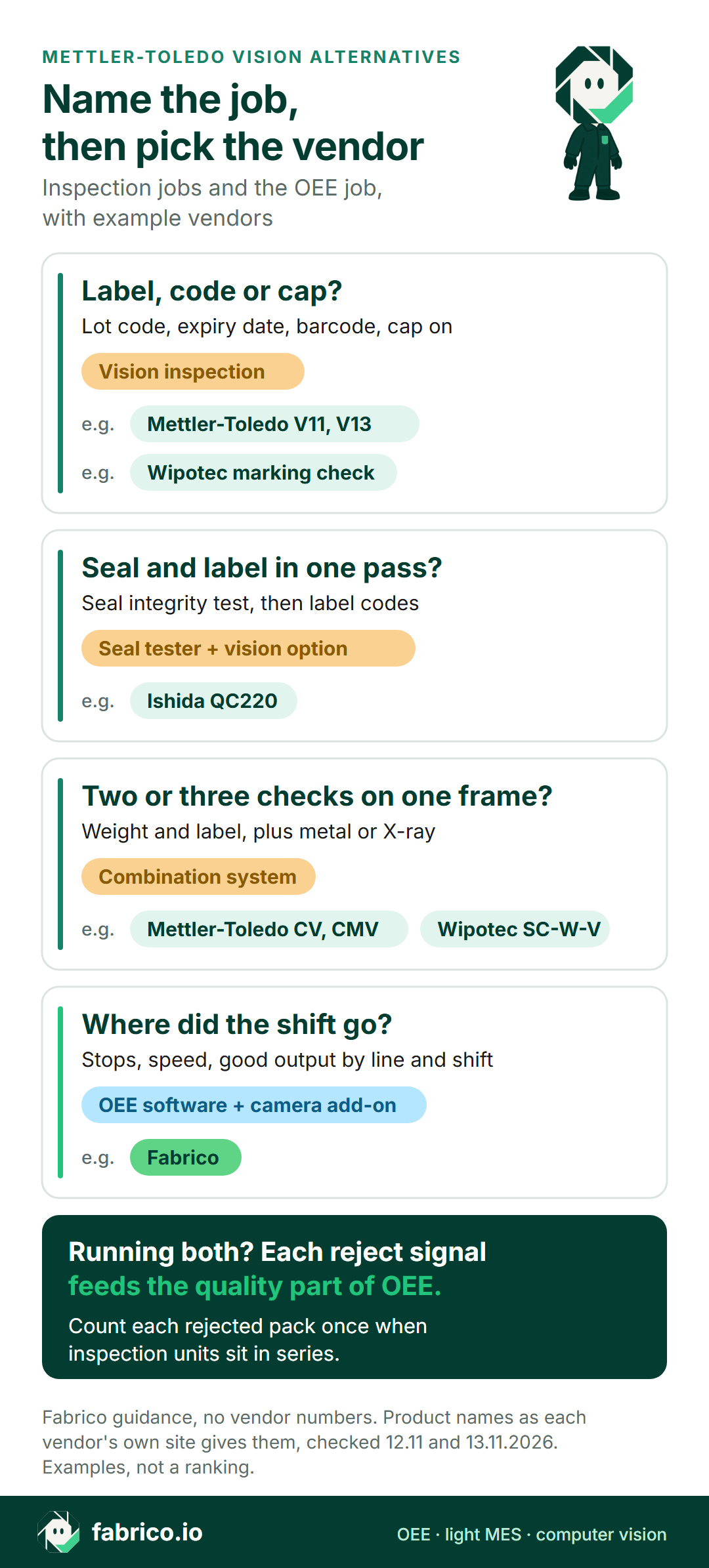
An inspection unit judges each pack at one point on the line. An OEE count looks at the whole line over the shift: how long it ran, how fast, and how many good packs came out. Both jobs can sit on the same line. The figure shows where the reject signal links them. For the pack versus line split in depth, see label and code vision vs an OEE camera.
Mettler-Toledo and three alternatives at a glance
Vendor facts as of 12.11.2026, seal details as of 13.11.2026; each vendor's section below links its own pages.
| Tool | Main job, per its site | Checks named on its pages | Rejects, per its site |
|---|---|---|---|
| Mettler-Toledo (for reference) | Product inspection | Labels, codes, caps, lid seals, fill, weight, metal, foreign bodies | Faulty packs removed from the line |
| Fabrico | OEE and light MES | Stops, speed and good output by line and shift | Reject signal feeds OEE quality |
| Ishida | X-ray, checkweighers, seal testers | Seal integrity; labels, barcodes and 2D codes with the vision option | Up to 4 reject bins on the QC220 |
| Wipotec | X-ray, weighing and optical inspection | Foreign bodies, weight, labels, printed markings, bottle leaks | Faulty product ejected at once |
Want the OEE side shown on a line like yours? Book a demo and bring one shift's stop log and reject counts.
Fabrico: counting good output beside inspection
Fabrico wrote this page. It is cloud OEE software with light MES. Where a Mettler-Toledo system judges each jar, Fabrico measures the line's time: stops on connected machines with their start and duration, the reasons operators add, slow running and good output.
What it does today, per the OEE and MES overview and the camera OEE page:
- Signals first. A PLC, sensor or counter on the machine gives stops and counts; the operator tags the reason at the line on a tablet or phone.
- Rejects into quality. The reject count or signal from each inspection unit, read through the PLC or a counter input, goes into the quality part of OEE.
- OEE and downtime by line and shift, with losses shown in money; web, iOS and Android apps.
- The camera add-on, on request, counts output at stations without a usable signal, such as hand case packing. With the camera add-on, click any moment on the shift timeline to open that camera's video; the standard setup streams it on request and keeps no copy in Fabrico.
- Data out via REST API, webhooks, and Excel or CSV export.
- Roadmap, not live: stop detection by the camera add-on itself, jam zones on the camera view, and a suggested stop reason that the operator confirms.
- Not Fabrico: label, code, cap, fill, seal or foreign body inspection, which stays with your inspection supplier.
Ask in the demo: how Fabrico reads the reject signal from each inspection unit, and how a camera add-on count compares with a hand count at one station.
Fits plants that want stops, speed and good output by line and shift, on lines that mix PLC machines, older machines and manual stations. See our OEE software guide for what to compare.
Ishida: seal testing with a label vision option
Ishida's Ishida Europe site lists X-ray inspection, seal testers and leak detection, and checkweighers in its inspection range. It says its checkweighers are a staple in quality control. As of 12.11.2026, its QC220 Seal Tester page says:
- The QC220 is a seal integrity tester for sealed bags, flow-wrapped trays or lidded trays that do not contain CO2.
- Sensors in the test head detect a rapid drop in pressure, which signals a pack integrity problem and leads to rejection.
- An optional integrated vision system verifies labels: it reads numbers, barcodes and 2D codes, and checks they are legible for retailers and consumers.
- It achieves up to 140 packs per minute, detecting and rejecting packs individually, with up to 4 reject bins for different rework processes.
Compared with Mettler-Toledo: Mettler-Toledo's CV Combination pairs weighing with label inspection; Ishida's QC220 pairs a seal test with label verification. Ask each which checks share one machine, and how each reject bin's count reaches your PLC.
Fits plants that pack trays or flow-wrapped products and want seal integrity and label checks in one pass, per Ishida's QC220 page.
Wipotec: X-ray, weighing and optical inspection in one frame
Wipotec's X-ray and optical inspection page says its X-ray systems scan food for foreign bodies such as metal, glass, stone, dense plastics and bone. As of 12.11.2026, it says:
- The X-ray systems can be expanded with a checkweigher (SC-W), an optical inspection system (SC-V), or both (SC-W-V).
- The SC-W-V combines X-ray inspection, weight control and label inspection in one system.
- The SC-S with Leak Detection is an X-ray detector for bottles with leak and foreign object detection.
- Contaminated products are detected and immediately removed from the manufactured batch.
- Integrated software documents inspection data and results automatically.
Its marking verification page pairs printing with a camera: the printer and camera operate together, and verification should ideally happen immediately after printing. For food, it says the correct best before date and batch number may not be omitted. If the device detects a defect, the product is ejected at once.
Compared with Mettler-Toledo: Mettler-Toledo's CMV Combination joins metal detection, weighing and label inspection; Wipotec's SC-W-V joins X-ray, weighing and label inspection. Ask each which contaminants your product needs checked for, and whether one reject bin or several suit your rework.
Fits plants that want X-ray, weight and label checks on one frame, or code verification right after the printer, per Wipotec's pages.
Mettler-Toledo or an alternative: match the station
- Label, code, print, cap and lid seal checks, with weighing or metal detection from the same supplier: Mettler-Toledo, per its vision and product inspection pages.
- A pressure-based seal integrity test with label verification in one pass on bags, flow-wrapped trays or lidded trays: Ishida QC220 with the vision option.
- X-ray, weight and label inspection in one system, or a camera checking codes right after the printer: Wipotec.
- Stops, speed and good output by line and shift, with the camera add-on counting where no signal can: Fabrico.
For vision sensors and smart vision systems from a vision specialist, see the Keyence vision alternatives page. For food lines in general, see the food manufacturing guide and the FMCG buyer's guide.
Worked example: how inspection rejects feed OEE quality
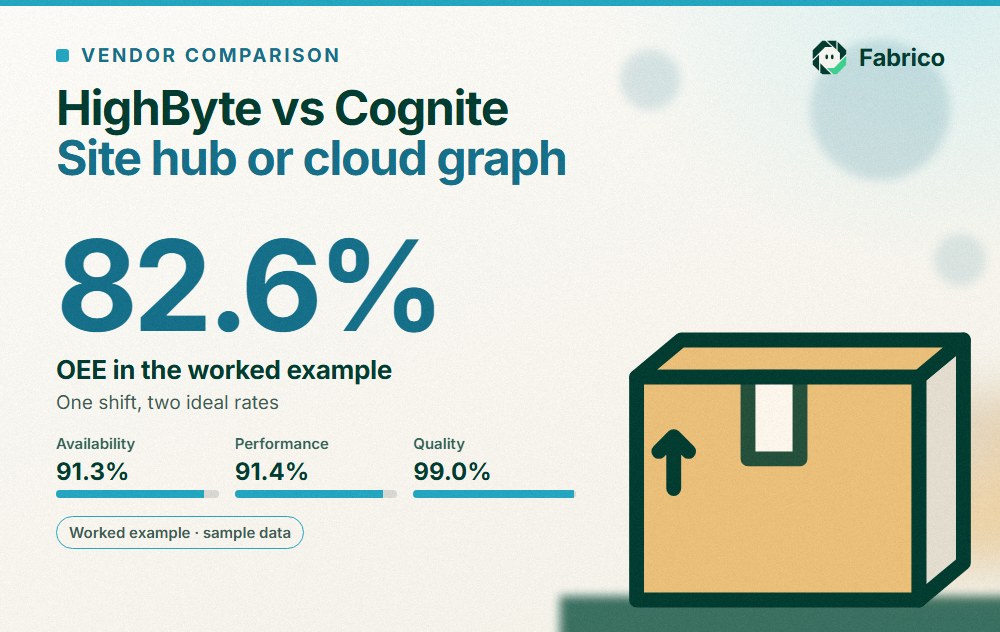
Sample data for one 8 hour shift on a sauce jar line, not a customer's line or a product screen. Planned time is 480 minutes at an ideal 120 jars a minute, so the shift could make 57,600 jars. After the labeller, a vision check, a checkweigher and an X-ray unit each reject jars, and the line is set to stop after a run of rejects.
Availability. Stops took 60 minutes: a 30 minute changeover, 18 minutes of label reel changes and jams, and six 2 minute stops after runs of rejects. The line ran 420 minutes, so availability is 420 / 480 = 87.5%.
Performance. In 420 minutes the ideal is 50,400 jars. The filler counted 46,200, so performance is 46,200 / 50,400 = 91.7%.
Quality. The vision check rejected 520 jars for label or code faults, the checkweigher 310 for low fill, and the X-ray unit 20. That is 850 rejects, each counted once, because a jar removed by the first unit never reaches the next. If operators put a falsely rejected jar back on the line, it passes the filler count once but can be rejected again, so agree whether re-fed jars are counted in total and good output. Good output is 45,350, so quality is 45,350 / 46,200 = 98.2%.
OEE is 87.5% x 91.7% x 98.2% = 78.7%, the same as 45,350 good of 57,600 possible jars.
In this sample, the 850 rejects cost fewer jars than the 12 minutes of stops after reject runs (1,440). A reject can hurt twice: as a jar in the bin, and as stop time when a run of rejects halts the line. The reject counts say nothing about the 4,200 jar speed gap; that needs the machine signal, or a camera add-on count where no signal exists.
False reject settings sit with the inspection supplier and quality team; the OEE data shows shift by shift whether a change paid off. More on counting rejects in checkweigher rejects and OEE quality and OEE quality. Before trusting any camera add-on count, compare it with a hand count, as camera OEE accuracy explains.
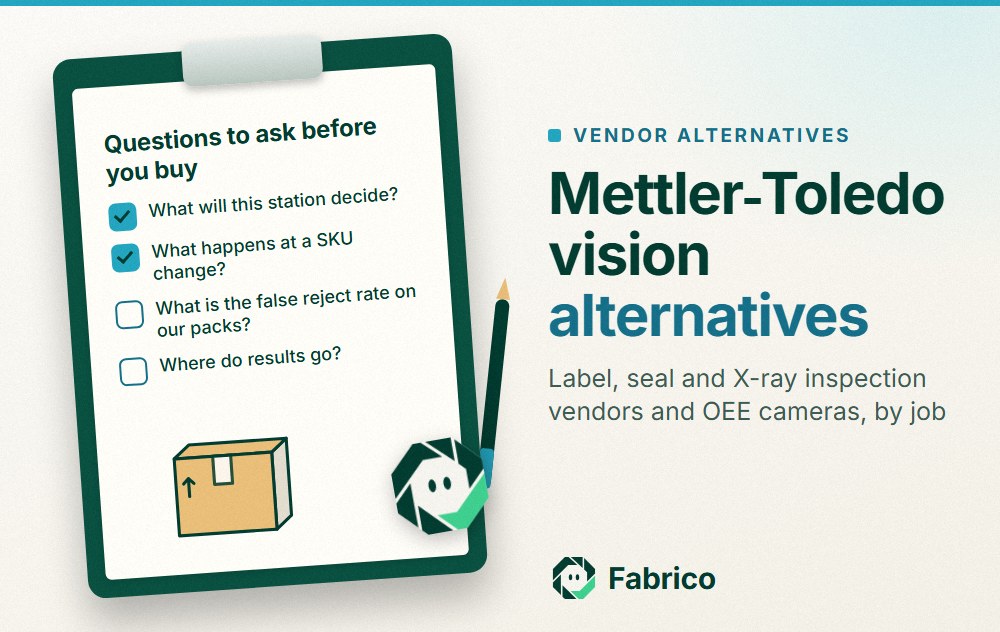
Questions to ask before you buy
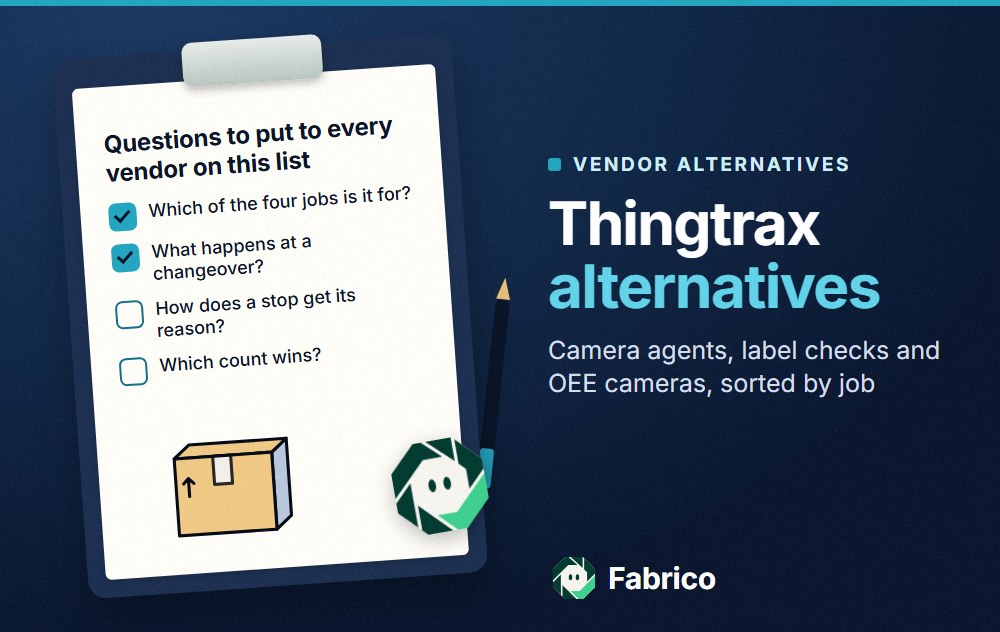
Ask every vendor the same questions, us included, on one real station.
- What will this station decide? Label data, code, cap, fill, seal, weight or contaminants. Name it before you compare.
- What happens at a SKU change? Who loads the new setup, how long the line waits, and how many test packs it takes.
- What is the false reject rate on our packs? Ask for a test with your own samples, and re-check the reject bin during the pilot.
- Where do results go? A reject signal to the PLC, counts to MES or OEE software, images and records to which server.
- How are rejects counted when units sit in series? Agree one rule, so a jar is never counted as two rejects.
- Who sees the images? At manual stations the view can include people, so agree this with the works council first; see line cameras without surveillance.
- Are the offers like for like? Give every vendor one identical station list, with the same checks, packs and reject devices, so the offers cover the same scope.
What people ask next
What does Mettler-Toledo vision inspection check?
Mettler-Toledo's vision pages say its systems verify label presence, correctness and print quality (OCR and OCV), confirm cap placement, and check labels on jars, bottles and cans for product information, lot codes, expiry dates and barcodes. Faulty packs are removed from the production line.
Can Mettler-Toledo combine vision with a checkweigher or metal detector?
Yes, per its vision page. The CV Combination adds weight control and a completeness check to label inspection, and the CMV Combination adds metal detection, weight control and label inspection in one device.
How is Fabrico different from Mettler-Toledo?
Mettler-Toledo sells product inspection equipment: checkweighers, metal detection, X-ray, vision and combination systems, per its site. Fabrico is OEE and light MES software: stops and counts from the machine signal, reasons from the operator, losses in money by line and shift, and a camera add-on, on request, that counts output where no signal can. Fabrico does not inspect packs.
Can inspection rejects feed OEE?
Yes. Each inspection unit's reject signal or count, read through the PLC or a counter input, goes into the quality part of OEE: good count divided by total count. Agree first what counts as a reject, and count each rejected pack once when units sit in series.
Which of these vendors name seal or leak checks?
Per each vendor's own pages: Mettler-Toledo's vision page names lid and seal inspection for jars and bottles, and its retail packaging X-ray page names detecting product trapped within the seal. Ishida's QC220 page describes a seal integrity tester for sealed bags, flow-wrapped trays and lidded trays, with an optional integrated vision system for label verification that reads numbers, barcodes and 2D codes. Wipotec's X-ray page lists an SC-S model for bottles with leak and foreign object detection. Ask each vendor to test your own packs.
Does Fabrico check labels, codes or seals?
No. Label, code, cap, fill and seal checks belong to an inspection system. Fabrico measures the line around it: run time, stops, speed and good output, with the reject count from the inspection system feeding OEE quality.
Want to see stops, speed and rejects on a line like yours? Book a demo, or ask us a question first.





Real Fabrico tiles, sample data.