


 Login
 Blog
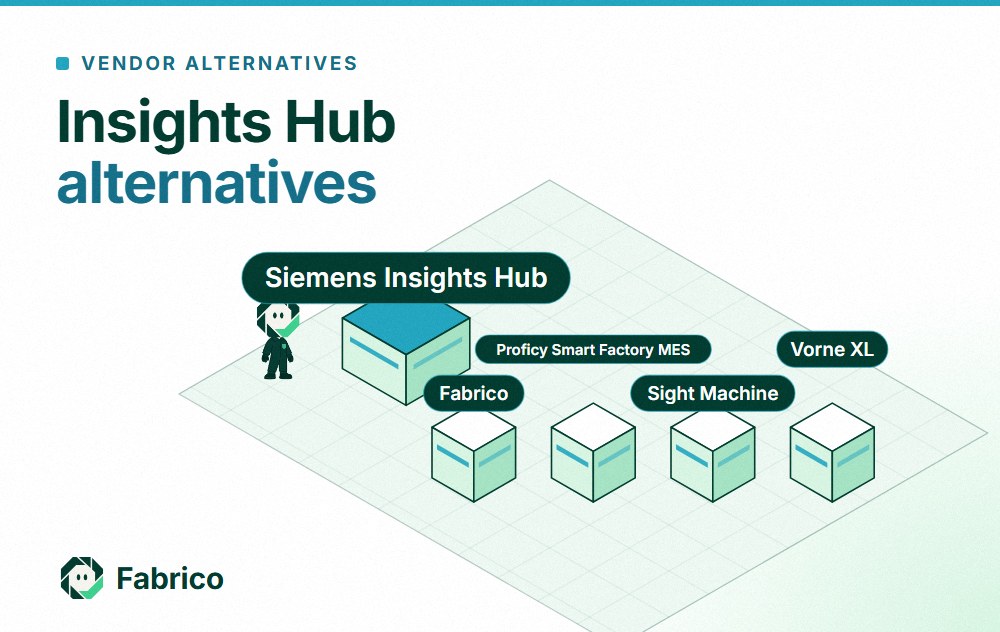
Siemens Insights Hub Alternatives for OEE, Formerly MindSphere

In short: if you are weighing Siemens Insights Hub, formerly MindSphere, mainly to get OEE, the alternatives split into three routes. Other analytics suites, such as Sight Machine and Bosch Manufacturing Co-Intelligence, treat OEE as one app among many. An MES with an OEE module, such as Proficy Smart Factory MES, puts OEE next to orders and genealogy. A dedicated OEE tool, such as Vorne XL or Fabrico, starts from line stoppages, counts and their causes.
- Siemens says MindSphere has evolved into Insights Hub, a suite of AI analytics solutions with an OEE app, energy, maintenance and quality apps, and a Production Copilot.
- The right alternative depends on whether OEE is one use case of many, part of an MES rollout, or the first thing the plant needs.
- Vendor facts carry a link to the source page and the date we read it, 13.11.2026. Nothing here is priced or ranked.
A packaging plant runs Siemens controllers on most lines and still has a MindSphere tenant from an old pilot. Group IT likes one analytics suite for energy, maintenance and quality. The plant manager wants something narrower: OEE for each line and shift, plus the three causes that cost the most output last week.
Those two requests can end in different purchases. Below: what Insights Hub is today, per Siemens, then four alternatives and Fabrico, grouped by how each reaches an OEE figure. Fabrico is one of those options, so its section sticks to what its own product pages state.
What Siemens Insights Hub is today (as of 13.11.2026)
Siemens' Insights Hub page presents it as AI analytics that turn equipment and process data into production insights, and a related link there reads that MindSphere has evolved into Insights Hub. What the page lists, as of 13.11.2026:
- A suite by optimization area. Separate solutions for OEE, energy and resources, asset health and maintenance, and quality, plus the Insights Hub Production Copilot.
- Insights Hub OEE. Automatic OEE measurement for your lines, broken into availability, performance and quality, with a path to the causes in operations.
- Energy. Energy Manager and Energy Optimizer use machine learning to detect consumption issues, support peak shaving and guide equipment shutdown schedules, with scope 1 and 2 emissions in view.
- Maintenance. Asset Health and Maintenance lets teams pick predictive, preventive or reactive strategies by asset criticality.
- Quality. Quality Prediction applies machine learning to process data to flag non-conformances early and recommend parameter settings.
- AI agents. The Production Copilot guides users from issue to root cause to shop floor task, and in Copilot Studio users can write skills of their own.
The page also quotes customer results and analyst placements. We skip those, since the vendor reports them itself.
A question for Siemens: what Insights Hub OEE needs from a line that mixes Siemens and other controllers, and how operators enter stop causes.
To compare like with like, OEE on this page is the KPI defined in ISO 22400-2, which defines OEE among other KPIs, and MES refers to the operations level of the ISA-95 hierarchy, published internationally as IEC 62264-1.
When Insights Hub belongs on the shortlist
- OEE is one item on a longer list, next to energy, maintenance strategy and quality prediction.
- A group team wants one analytics suite across many plants, with AI agents on top.
- You already have a MindSphere tenant and want to carry that work forward.
If the plant mainly wants to know where shift time goes and what it costs, keep reading.
Three routes to an OEE figure
A search for Insights Hub alternatives usually means one of three things: another analytics suite, an MES that includes OEE, or a tool that does OEE first. For the platform question itself, see MES vs IIoT platform.
Insights Hub and five alternatives side by side
Rows paraphrase each vendor's site (read 13.11.2026); the links follow in the vendor sections. Fabrico sits at the top because we wrote the page; the rest follow no order. A row that leaves out a topic only reflects what we read, so check it with the vendor.
| Tool | Route to OEE | Where its data comes from, per its site | Worth asking |
|---|---|---|---|
| Insights Hub (for reference) | OEE app in an AI analytics suite | Equipment and process data | Which sources does the OEE app need? |
| Fabrico | Light MES built around shift time | PLC, sensor device or camera add-on | How are manual stations logged? |
| Proficy Smart Factory MES | OEE module inside an MES | Production context from the MES and historian | Which modules go live first? |
| Sight Machine | Agentic manufacturing platform | Controls, historians, MES, ERP | How are production events defined? |
| Bosch Manufacturing Co-Intelligence | Toolkit with 25+ KPI dashboards | Machine and line productivity data | Which KPIs follow the Bosch Production System? |
| Vorne XL | Edge device for OEE | One or two sensors on the line | Who enters the stop cause? |
Curious how the shift-time route looks in practice? Book a demo with a recent shift report in hand.
Fabrico: a light MES organised around shift time
We make Fabrico: OEE and light MES software that runs in the cloud, organised around the shift timeline: when each line ran, when it stood still, why, and what the lost output was worth. For the packaging plant above, with Siemens controllers and an old MindSphere tenant, this is how the MES and OEE overview maps onto it:
- The Siemens lines. Fabrico reads cycles, stops and output from the PLC; PROFINET, PROFIBUS and OPC UA are among the listed links (machine connectivity). Micro-stops come from the signal, including ones too short for anyone to write down.
- The rest of the floor. Older machines take add-on sensors that feed a Fabrico IoT device. At manual packing steps, the AI camera add-on counts output; video from a picked moment is streamed on request rather than saved in Fabrico (more on the camera add-on).
- The plant manager's three causes. Operators tag the cause on a phone or tablet, and OEE by line and shift carries the lost output in money, so last week's costliest causes come as a sorted list. A stoppage that needs a fix opens a maintenance work order.
- Group IT's suite. An analytics suite can pick up the results over the REST API or webhooks, or from Excel and CSV files, and the multi-plant view compares plants on one screen. ERP links, SAP included, are scoped for each customer.
- Hosting. EU customers are hosted on AWS in Frankfurt.
- Not in Fabrico: your ERP holds job dispatch, BOMs, routings and genealogy. Roadmap, not live yet: a camera add-on that would flag stoppages and offer a probable cause, and production planning with scheduling.
Using the sample shift in the worked example below: a stoppage-only list would send the plant manager after the 25 minute changeover, while the money view puts slow running, worth €312 in that shift, at the top. A one-line pilot on the line with the longest changeovers is a fair test. Siemens users can also read about OEE software with TIA Portal, and the OEE software guide works as a checklist.
Proficy Smart Factory MES: OEE inside a full MES
Proficy now belongs to Velotic. Velotic's launch post explains that the company combines Proficy, from GE Vernova, with ThingWorx and Kepware, from PTC. Its Proficy Smart Factory MES page says, as of 13.11.2026:
- Live OEE with its three factors, plus downtime and production losses, tracked as KPIs automatically.
- Equipment performance and downtime tracked in production context, with predictive analytics to anticipate potential downtime.
- Production managed from work orders and routes through materials, labor and operator activities, with digital genealogy and production records.
- SaaS and on-premises deployment are both offered, with Kubernetes support for cloud-native setups.
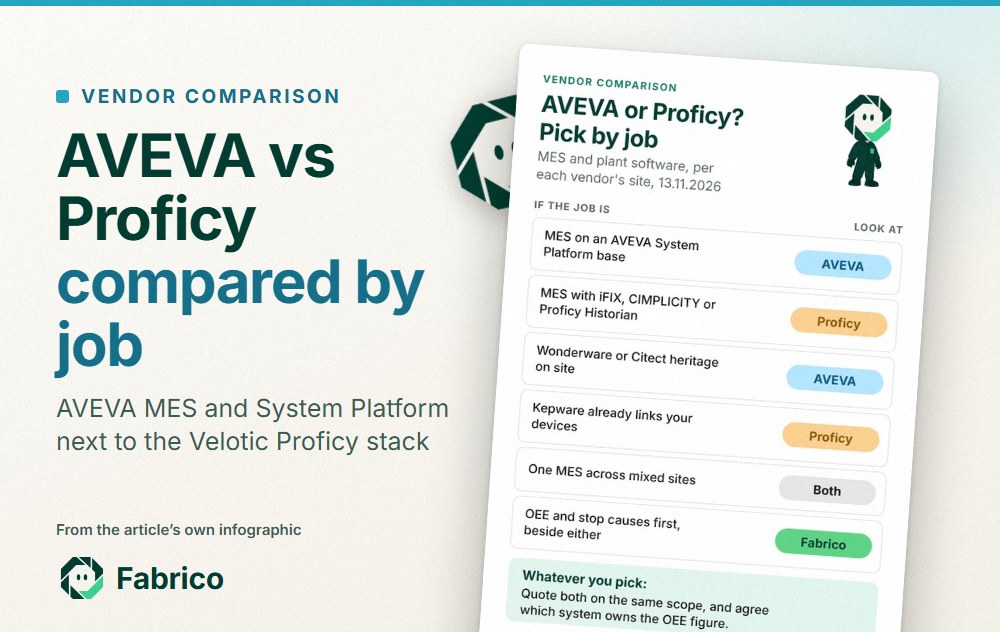
Compared with Insights Hub: both name OEE and downtime. Proficy places OEE inside an MES that also runs orders, routes and genealogy; Insights Hub places it in an analytics suite. See our Proficy alternatives.
Fits plants that want OEE as part of a full MES programme, with orders and traceability in one system.
Sight Machine: an agentic manufacturing platform
Sight Machine's site calls its offer agentic manufacturing, with AI agents that look for more output and less waste. As of 13.11.2026, its home page says:
- A Manufacturing Context Layer links OT and IT systems such as controls, historians, MES and ERP.
- The platform builds one structured model of the plant and converts raw signals into KPIs and production events.
- Agents keep investigating production, find where it can improve and propose how.
- Its manufacturing intelligence is published as an MCP server, so other agents in the company can use it.
Compared with Insights Hub: both put AI agents on top of plant data. Sight Machine's page leads with its plant model and agents rather than separate apps per topic. Our Sight Machine review goes further.
Fits groups that already run controls, historians and an MES and want an AI layer that models the plant across them.
Bosch Manufacturing Co-Intelligence: shopfloor KPIs from a manufacturer
Bosch Connected Industry now presents its offer as Manufacturing Co-Intelligence. On 13.11.2026, bosch-connected-industry.com forwarded to manufacturing-co-intelligence.com, where Bosch Connected Industry describes collaboration between people, machines and agentic AI. What its pages say:
- Its Shopfloor Performance Insights page offers more than 25 pre-configured KPI dashboards and an overview of machine and line productivity.
- KPI calculations follow the Bosch Production System, and users can build their own dashboards without complex configuration.
- The wider Smart Operations Toolkit adds condition monitoring, process monitoring with anomaly detection and a digital daily leadership routine, and names improved OEE among its goals.
- Its about page says the solutions are developed and validated in real factories, and that Bosch's experience spans 230 plants worldwide.
Compared with Insights Hub: both come from large industrial groups and pair KPI apps with AI agents. Bosch's pages tie the KPI logic to its own production system.
Fits groups that want ready KPI dashboards built on a manufacturer's production system, next to condition and process monitoring.
Vorne XL: an OEE device on the line
Vorne's XL page describes XL as a fully integrated edge computing device, wired to one or two sensors, such as a photocell, to capture counts and cycles. Its OEE software page states, as of 13.11.2026:
- A few sensors on the line let the system collect downtime, cycle times and rejects without manual entry.
- Data is sorted into availability, performance and quality, and into the Six Big Losses.
- Plant floor scoreboards and real-time reports keep operators focused on shift targets, with Pareto charts and alerts for follow-up.
Compared with Insights Hub: Vorne XL is a device per line that does OEE first; Insights Hub is an analytics suite with OEE as one solution. See Fabrico vs Vorne XL.
Fits plants that want an OEE scoreboard on each line, fed by a few sensors.
Which Insights Hub alternative fits your plant
- OEE as one app in an AI analytics suite, with energy, maintenance and quality apps: Siemens Insights Hub.
- OEE inside a full MES with orders, routes and genealogy: Proficy Smart Factory MES.
- An AI layer that models the plant across existing systems: Sight Machine.
- Ready KPI dashboards from a manufacturer's production system: Bosch Manufacturing Co-Intelligence.
- A sensor-fed OEE scoreboard on each line: Vorne XL.
- Downtime causes and lost output priced per line and shift, while the ERP keeps orders: Fabrico.
Routes can be combined: an analytics suite keeps energy and quality, and a light MES owns shift time and sends its results across. That split is covered in light MES vs full MES. Packaging lines in food or consumer goods? Start with computer vision for FMCG manufacturing.
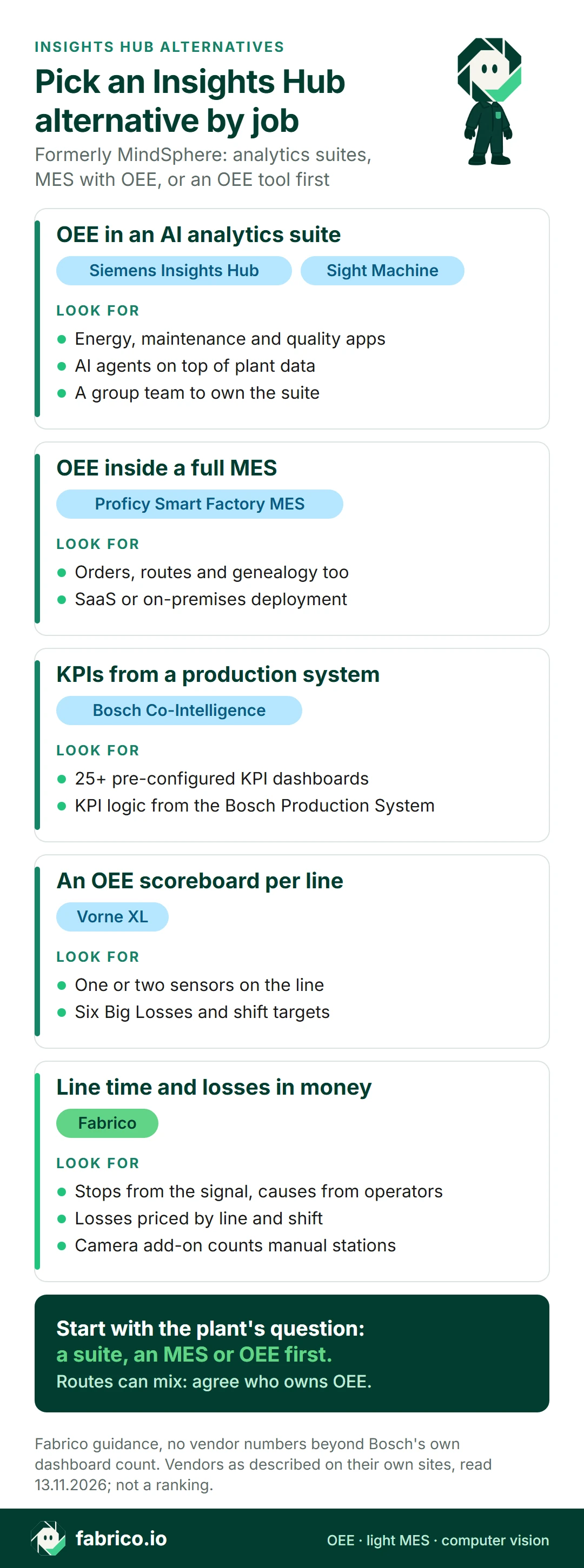
Text version of this infographic
Pick-by-job card for Siemens Insights Hub alternatives: OEE in an AI analytics suite (Siemens Insights Hub, Sight Machine), OEE inside a full MES (Proficy Smart Factory MES), KPIs from a production system (Bosch Co-Intelligence), an OEE scoreboard per line (Vorne XL), and line time and losses in money (Fabrico). Closing note: start with the plant's question, a suite, an MES or OEE first.
Worked example: the biggest loss was not a stoppage
The figures here are made up to show the method. Picture an 8 hour shift on a filling line, not drawn from any customer or product screen. Planned shift time comes to 450 minutes once the 30 minute break is out. At full speed the filler makes 40 units a minute. To put money on the losses, assume a sample margin of €0.20 per unit.
Stoppages took 60 minutes: a 25 minute changeover, a 20 minute filler jam and 15 minutes waiting for material. Run time is therefore 390 minutes, and availability is 390 over 450, 86.7%. At full speed, 390 minutes allow 15,600 units. The line made 14,040, so performance is 90.0%.
Rejects took 420 of those, leaving 13,620 good units and a quality rate of 97.0%. OEE is 86.7% x 90.0% x 97.0% = 75.7%, which matches 13,620 good units against the 18,000 the planned time allows.
Now price it. Slow running cost 1,560 units, or €312, more than any single stoppage. A screen that lists stoppage time alone would put the changeover first; pricing all loss buckets puts speed first. Whichever tool you choose, check that it prices slow running and rejects as well as stoppages. The formula is in OEE calculation.
Questions for every vendor, Fabrico included
Pick one typical line and run through this list with each supplier.
- Which route is it? An app in a suite, a module in an MES, or a dedicated OEE tool.
- What feeds the OEE figure? PLC tags, a historian, sensors, cameras or operator entry, and how a station without any signal is handled.
- Who supplies the stop cause? An operator screen, machine fault codes or an AI suggestion, and which of these is live today.
- How are changeovers, breaks and slow running counted? Ask for the written rule as well as the screen.
- How do results leave the system? API, export or a data platform, and in what format.
What buyers ask next
Is MindSphere still sold, or is it Insights Hub now?
Siemens' Insights Hub page says MindSphere has evolved into Insights Hub, and it offers MindSphere users a path forward. If you run a MindSphere tenant, ask Siemens what carries over.
Does Siemens Insights Hub include an OEE application?
Yes. Siemens lists Insights Hub OEE among its solutions. Per the page, it measures line OEE automatically, splits it into availability, performance and quality, and helps trace the causes in operations.
What can replace Insights Hub if OEE is the main goal?
That depends on the route. Sight Machine and Bosch Manufacturing Co-Intelligence are other analytics suites. Proficy Smart Factory MES puts OEE inside an MES. Vorne XL and Fabrico start from line stoppages, counts and causes.
How does Fabrico differ from Insights Hub?
Siemens describes Insights Hub as a suite of AI analytics solutions, OEE among them. Fabrico is a light MES organised around shift time: it takes stoppages and counts from the machine and causes from the operator, then reports OEE and the value of lost output for each line and shift, with repair work orders tied to the machine.
Does Fabrico work with Siemens PLCs?
Fabrico connects over standard industrial links, PROFINET, PROFIBUS and OPC UA among them. A machine with no usable controller can take a Fabrico IoT device with sensors instead. Confirm your controller models in the demo; the connection route is agreed machine by machine.
Can Fabrico sit next to Insights Hub?
Yes. Insights Hub can go on running energy, maintenance or quality apps. Fabrico handles stoppages, causes and shift time, and sends results onward through its REST API and webhooks. Settle early which of the two publishes the OEE number of record.
Want to see the money view of OEE? Book a demo with a line like yours in mind, or send us your questions.
Related articles

Latest from our blog


Real Fabrico tiles, sample data.