


 Login
 Blog

Machine Vision Software for Manufacturing OEE: 2026 Comparison

Key Takeaways
-
The PLC blind spot: Traditional sensors tell you that a machine stopped, but they rarely tell you why. Computer Vision fills this gap by "watching" the line 24/7.
-
The action gap: Many vision tools stop at video and dashboards. Check how a stop and its reason reach the people who fix it.
-
The Contenders: We compare Fabrico, Cerrion, Almetra, Invisible AI and Retrocausal by what each vendor says it does, how it gets its data and where it runs.
Sensors are great, but they are blind.
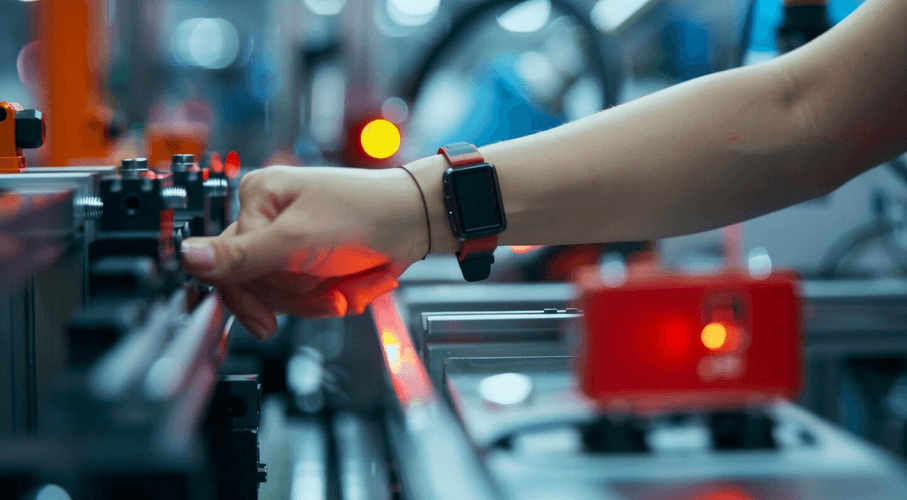
A PLC can tell you that the conveyor motor stopped. It cannot tell you that it stopped because a bottle fell over, because the operator was away from the station, or because a pallet of raw material was empty.
That missing context is where computer vision helps: a camera shows what happened at the moment of the stop, so the reason can be recorded instead of guessed.
The tools below all put cameras on the shop floor, but they do different jobs. Some feed camera events into OEE and downtime tracking. Others are vision platforms you use to build your own inspection or detection. This comparison sticks to what each vendor says about its own product, checked on the vendors' sites in October 2026.
Computer vision OEE software at a glance
| Product | Stated focus, per the vendor | How data gets in, per the vendor | Where it runs, per the vendor |
| Fabrico | MES and OEE platform with maintenance (CMMS) built in; cameras are one data source | PLC, IoT sensor or camera; operators add the stop reason | Cloud |
| Cerrion | Video AI agents that detect process and quality issues on production lines | Existing or Cerrion-provided cameras, plus equipment and MES signals | Not stated on its site |
| Almetra (formerly Deltia) | Factory intelligence platform that combines line video with machine and IT data | Cameras plus PLC, MES and ERP data | Compact models close to the line |
| Invisible AI | Vision Execution System that records every production cycle | Its own edge devices with a 3D camera | On-premises, no cloud required |
| Retrocausal | Copilots for manual and semi-automated assembly, time studies and ergonomics | Webcams, PoE and GigE cameras, smartphone video | Edge PC with a cloud portal, or on-premises |
1. Fabrico
What it is: a cloud MES and OEE platform with maintenance management (CMMS) built in. Computer vision is one of its data sources, next to the PLC and IoT sensors.
What it covers
-
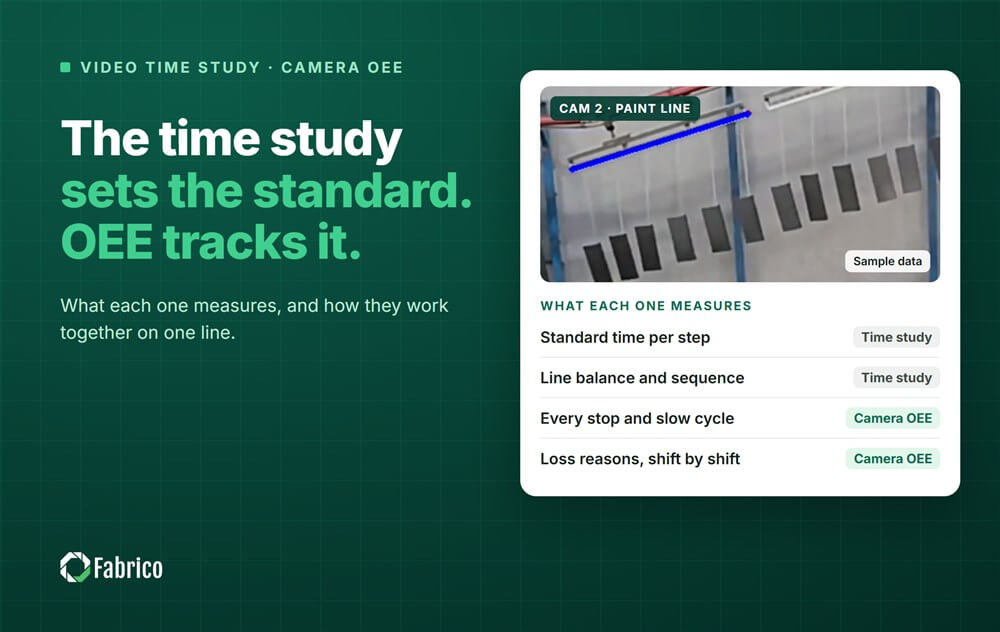
One OEE calculation: camera counts land on the same timeline as PLC and sensor data, so lines connected in different ways can be compared side by side.
-
The stop and its reason in one place: when a line stops, the footage, the machine record and the operator's reason sit in one place, connected with work orders and machine states.
-
Data handling: a data processing agreement sets out how your data is handled under GDPR.
How fast it starts
Installing the devices and connecting the machines takes about one month. Full rollout across the lines you choose takes 3 to 4 months.
Things to consider
Fabrico is built around OEE, downtime and maintenance. If your team wants a toolkit to train its own inspection models, look at the general vision platforms further down.
2. Cerrion
What Cerrion highlights: AI agents that watch production video in real time, detect process and quality issues and alert the team. Its site names OEE tracking and lists line blockages, conveyor stops and microstops among the events it detects.
How data gets in: Cerrion says its agents plug into existing or Cerrion-provided cameras and connect to equipment and MES systems.
Best suited to, per the vendor: food and beverage, glass, tableware, wood processing and consumer goods.
Things to consider: Cerrion presents itself as a video AI layer. Check how its events reach your OEE reporting and maintenance records if those live in other systems.
3. Almetra (formerly Deltia)
What Almetra highlights: a factory intelligence platform that captures line video and combines it with machine, MES and ERP data. Its site lists real-time OEE tracking, PLC and video based downtimes, micro-stop detection and a cycle time deviation agent, on automated and manual lines.
How data gets in: cameras mounted as operational sensors, with workstation and overhead views, combined with PLC, MES and ERP data. Almetra says its models run close to the production line.
Best suited to, per the vendor: automotive, electronics, industrial equipment, medical devices, food and beverage, packaging, pharmaceuticals and consumer goods.
Things to consider: Deltia renamed itself Almetra in 2026, so older reviews and case studies use the old name.
4. Invisible AI
What Invisible AI highlights: its Vision Execution System records every production cycle and turns it into searchable cycle data with linked video. Its site mentions OEE, downtime, cycle times, throughput and wait time, with a focus on manual assembly.
How data gets in: its own edge devices, each with a 3D camera and on-device AI computing. Invisible AI says no cloud integration is required and the system can run fully on-premises.
Best suited to, per the vendor: automotive OEMs and suppliers, and aerospace.
Things to consider: the vendor describes its own edge devices with a 3D camera; ask whether your existing cameras can be used.
5. Retrocausal
What Retrocausal highlights: copilots for manual and semi-automated assembly (Assembly Copilot), time studies and line balancing (Kaizen Copilot) and ergonomics (Ergo Copilot). It guides operators step by step to prevent mistakes and records timing data for every cycle.
How data gets in: most webcams, PoE and GigE cameras on a Windows PC; Kaizen Copilot works from smartphone video.
Best suited to, per the vendor: automotive, medical devices, aerospace and defense, appliances and electronics.
Things to consider: Retrocausal's site talks about cycle time, downtime and mistake-proofing; ask how it reports OEE if you need OEE across automated machines too.
General vision platforms: inspection and custom models
Some well-known names in computer vision are platforms for building your own inspection and detection models:
-
Cognex VisionPro: PC-based vision software for building custom inspection, measurement and code-reading applications with industrial cameras.
-
LandingAI LandingLens: a no-code platform to label images and train deep-learning models, mainly for visual inspection and defect detection, in the cloud or on an edge PC.
-
Roboflow: a developer platform to label data, train models and run them on camera streams, in the cloud, on-premises or on edge devices.
Spot AI sits in between: a video AI platform led by security and safety, with an AI Operations Assistant that compares work against your SOPs on the IP cameras you already have.
Drishti, listed in many older comparisons, is no longer an independent vendor, and its website is offline.
Which one fits
-
Choose Fabrico if you want OEE and downtime from cameras and machine data in one calculation, with stops connected to work orders and machine states.
-
Look at Cerrion, Almetra or Invisible AI if you want a video AI layer for your lines, and check how its events reach your OEE and maintenance records.
-
Look at Retrocausal for operator guidance, time studies and line balancing on manual stations.
-
Look at Cognex, LandingLens or Roboflow if your team wants to build its own inspection models.
Book a demo to see computer vision OEE on your own line.
Frequently asked questions
What should computer vision software for OEE actually do?
Three things, in order: produce a trustworthy count, separate a real stop from a normal pause, and attach a reason to that stop. Anything that only shows a live video wall is a monitoring tool, not an OEE instrument.
Does it work on manual assembly, not just automated lines?
Manual and semi manual areas are usually where it pays back fastest, because they are the parts of the plant with no controller to read. A camera can measure a hand build station that would otherwise report nothing but an end of shift tally.
How long does a vision based OEE setup take to go live?
It depends on how stable the view is and how many stations you cover. With Fabrico, installing the devices and connecting the machines takes about one month, and the full rollout 3 to 4 months. The slow part is agreeing what to measure, not mounting the camera.
How do you validate that the counts are correct?
Run the camera against a known truth for a few shifts: a manual tally, a downstream counter, or the packing record. Accept the system only when the two agree within a tolerance you set beforehand. Do not skip this step, it is what makes the number defensible later.
Do you have to replace your current OEE system?
No. Vision is a data source. It can feed the OEE calculation you already run, which is usually the least disruptive way to add it. Book a demo to see it against your own line setup.
Machine vision software is not the camera
Buyers comparing machine vision software often end up comparing hardware datasheets instead. The camera decides what can be seen. The software decides whether seeing it changes anything.
- Detection scope. Ask which event classes ship working on day one, and which need a training round on your own line.
- Where the event lands. The useful question is not accuracy in isolation, it is whether a detection becomes a work order, an OEE loss reason, or just a log line.
- Model ownership. Confirm whether your team can add a new part or defect class without a vendor engagement.
- Reviewable footage. Ask whether an operator can open the clip behind a flagged event. That is the difference between a number and a root cause.
To see this on your own lines, look at Fabrico's camera-based OEE software, which puts camera events and machine data in one OEE timeline.
Turn downtime into a number your team can actually act on.
Request a demoContact usRelated articles


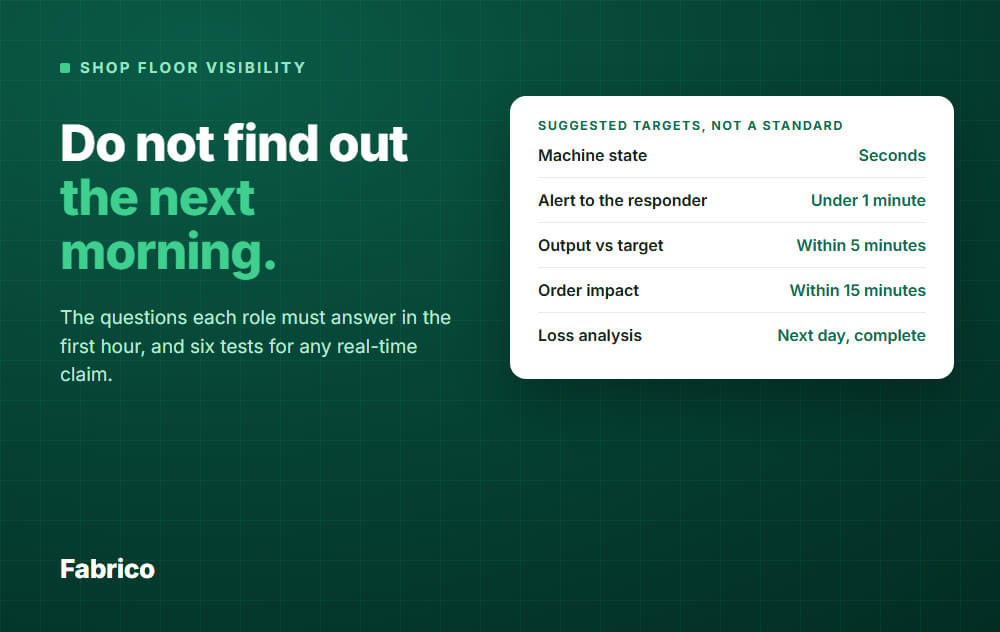
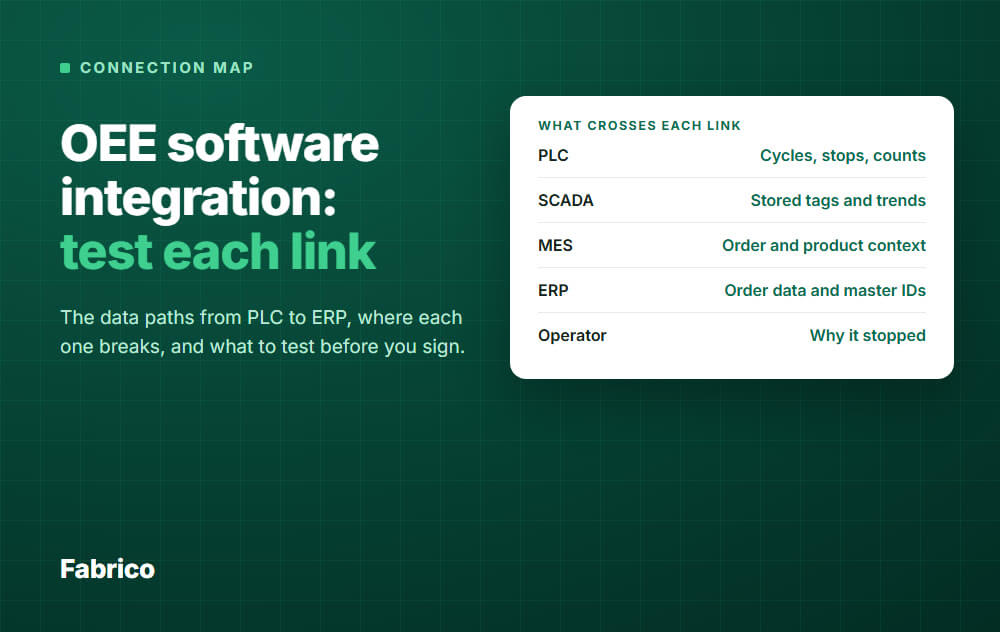
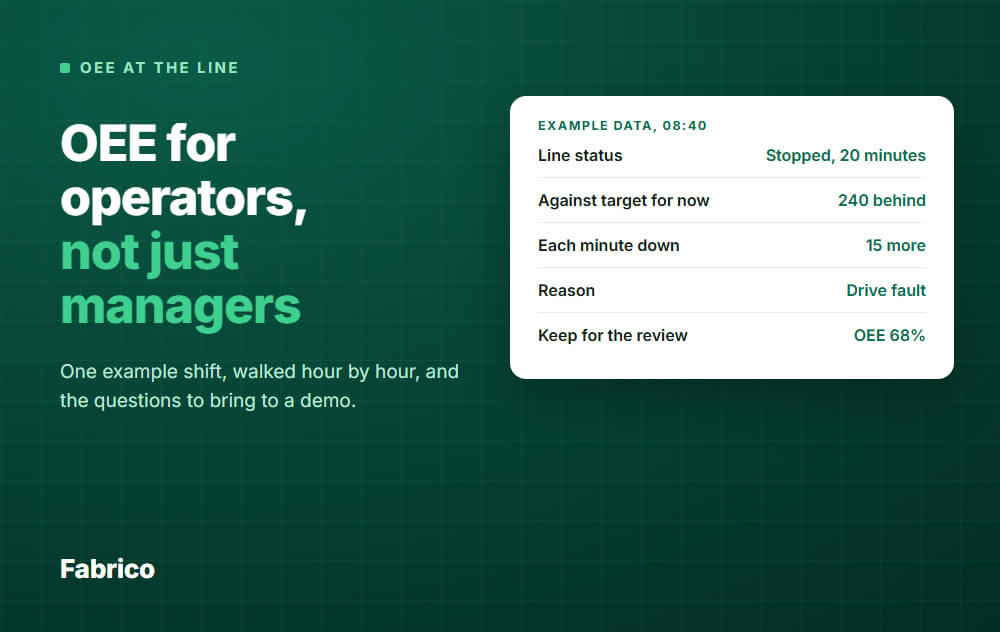


Real Fabrico tiles, sample data.