


 Login
 Blog
Computer Vision for Egg Packing: Where an OEE Camera Fits

In short: computer vision for egg packing means two separate systems. The grader's own inspection modules find cracks, dirt, leakers and blood, while an OEE camera counts packed output and gives you the video for any stop at the packers, the hand-pack lane and the palletizer.
- Crack, dirt, leaker and blood detection are inspection options sold by grader makers such as Moba and Sanovo. Fabrico does not do them.
- The grader already counts eggs at full speed. Measure OEE there, and put cameras downstream, where packs and cases leave the lanes.
- The best first camera is usually over the hand-pack lane, which nothing counts, or the case and pallet area, where stops get blamed on the grader.
- Fabrico builds OEE from machine signals and the stop reasons operators enter. Its camera add-on counts output and opens the video for any moment; in the standard setup, video is streamed on request, not stored in Fabrico.
An egg grader is already full of sensors. It weighs every egg, and with the right options it checks each one for cracks, dirt, leakers and blood before the egg reaches a packing lane.
So when someone offers an egg packing centre "computer vision", ask which job they mean. Inspecting the egg is the grader maker's work. Counting what gets packed, and showing why the line stopped, is a different job for a different camera.
Written for packing centre managers and engineers weighing up camera and OEE software. For the OEE rules first, such as grader-level OEE in eggs, size mix and downgrades, read OEE for egg grading and packing. Here we cover cameras.
We sell Fabrico. Treat what we say like any vendor's pitch, and check it.
Egg inspection and OEE cameras: who does which job
Grader makers sell inspection as options on the grader. The spec sheet for Moba's Omnia PX lists an Egg Inspector for leakers and dirt, a Shell Inspector for cracks and shell strength, and a Blood Detector. Moba also says it now offers AI in vision weighing, egg inspection and crack detection on two of its larger models, in a PX+ version it says is only available in a limited region.
Methods differ from maker to maker. Sanovo notes that most crack detection systems today rely on an acoustic measurement, and sells a vision-based crack and leak module, the VisionAI Detector, rated at 288,000 eggs per hour.
Either way, these modules are part of the grader. The grader maker sets them up, tunes them and supports them. Fabrico does not inspect eggs, and it does not change what the grader decides.
| Job | Grader's inspection | OEE camera |
|---|---|---|
| Weighing and size grading | Yes, its main job | No |
| Cracks and shell strength | Yes, crack detection option | No |
| Dirt and leakers | Yes, inspection option | No |
| Blood | Yes, blood detection option | No |
| Counting packs at a hand-pack lane | Not its job | Yes |
| Showing why a packer or palletizer stopped | No | Video for that moment |
| Counting cases on the belt to a hand-built pallet | No | Yes, where nothing else counts |
The two systems share one number: the downgrade count. If the grader gives a count of eggs taken out, OEE software can use it, but only as a number. The grader's crack detector can't tell you whether an egg cracked in the hen house or on your loader. That split is a rule you set, and the egg OEE guide covers it.
Where an egg packing centre loses time
Egg packing runs against the calendar. Under the EU egg marketing rules, Commission Delegated Regulation (EU) 2023/2465, Class A eggs must be graded, marked and packed within 10 days of laying, as Ireland's food safety authority, FSAI, sets out. Eggs that miss it become Class B, which go to industry, not to shoppers.
The flow never stops either. The European Commission counts more than 350 million laying hens in the EU, producing close to 6.7 million tonnes of eggs a year. Hens lay every day, so a lost hour at the grader becomes eggs waiting in the cooler, and the oldest of them closer to the 10-day limit.
At grader speed, a few minutes is a lot of eggs. Moba lists its Omnia PX graders from 45,000 to 255,000 eggs an hour. At 255,000 an hour, a five minute stop leaves 21,250 eggs waiting.
Infeed: farm belts and tray loaders
Eggs arrive on belts from in-line houses, or on trays and pallets from other farms. A loader or destacker feeds the grader. A jam here starves the whole grader, and the grader's signal shows only that eggs stopped arriving.
The grader and its lanes
When a lane backs up, the grader can't drop eggs there. On the Omnia, for example, Moba says the extra eggs are diverted or stay in the buffer for one more revolution. What your grader does when several lanes are full at once is a question for its maker.
That is why lane stops belong on the same timeline as the grader. If the grader controller shares lane status, it tells you which lane was full. Video for that minute tells you why: a carton jam, a lid that did not close, or an empty magazine.
Packers and customer changes
Each lane ends in a packer that fills and closes cartons or trays, often with a printer or labeller for the customer's pack. Retail, food service and own-brand packs can all run on one grader, sometimes on neighbouring lanes.
A customer change on one lane is a stop for that lane, and maybe a slowdown for the grader. Give it its own reason and a standard time, so overruns are visible.
The hand-pack lane
If your centre has a lane or table for outsize eggs, specials, re-packs or trays for bakeries, it is probably the one station nothing counts. People pack there by hand, and the count is a tally or a guess from the pallet.
That is the clearest case for an OEE camera in an egg packing centre. It counts packs or trays at the lane outfeed, so the lane's output joins the line's numbers.
Cases, stackers and pallets
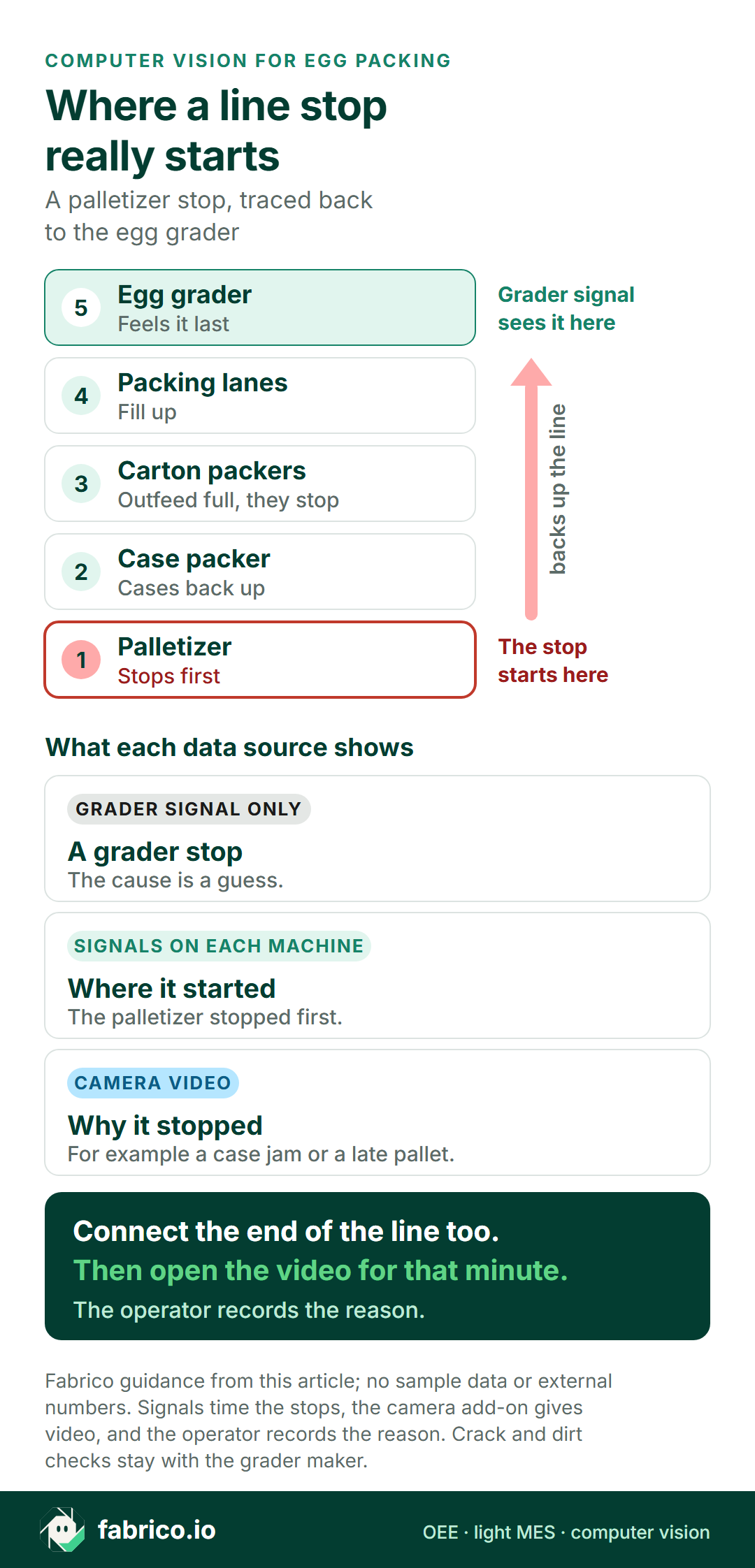
Packed cartons go into cases or onto trays, then a stacker and a palletizer build the load. When the palletizer stops long enough to fill the buffers, cases back up, then the packers, then the lanes, then the grader.
The grader's signal sees its own stop, not the cause three machines away. For where cameras go at that end, see case packer downtime on camera and palletizer downtime on camera.
Line map: from farm belt to pallet
Here is a typical egg packing centre, with the system that owns each job. The dashed box is the grader and everything built into it.
Read the map in three zones. The grader and its inspection modules belong to the grader maker. The loader, packers, case packer, stacker and palletizer have signals that time their stops. The hand-pack lane has nothing, and that is where a camera count does the most.
Camera, signal or operator at each egg packing station
A first pass for each grader line. For more detail by machine type, see camera or sensor by machine.
| Station | Counts and stops from | Where a camera helps |
|---|---|---|
| Farm belt, loader | Loader signal | Video for loader jams |
| Grader | Grader run signal and egg count | Not for counting |
| Crack, dirt, blood checks | The grader's inspection modules | None. Downgrade counts feed OEE |
| Carton and tray packers | Packer signal per lane | Video when the fault code is vague |
| Hand-pack lane | Nothing, or a tally | Counts packs or trays |
| Case packer, stacker | PLC run state | Video to tell own stops from blocked |
| Palletizer, wrapper | PLC run state | Video for the first cause |
In every row, the reason for a stop comes from a person. The signal says when and for how long. The operator says why, with the video to check.
Want to see the map drawn for your own centre? Book a demo and bring your grader model and lane count.
Worked example: one shift at a 90,000 egg an hour grader
This is sample data for one shift at a grader rated at 90,000 eggs an hour, which is 1,500 a minute. It describes no real centre, and it is not a product screen.
Planned time was 450 minutes, and the grader's signal timed 60 minutes of stops. Availability is 390 of 450 minutes, 86.7%. Performance is 538,200 eggs counted of 585,000 ideal, 92.0%. Eggs the line itself broke came to 3,200, so quality is 535,000 of 538,200, 99.4%.
OEE is 79.3%, the same as 535,000 good eggs of the 675,000 possible. Eggs that arrived cracked or dirty stay out of quality and are reported by flock, as the egg OEE guide sets out.
Now the camera question. Of the 60 stop minutes, 32 started after the lanes: 18 at the palletizer and 14 at the case packer. The grader saw them as its own stops. If only the grader is connected, those minutes get booked as "grader" or "lanes full". With the case packer and palletizer signals on the same timeline, you see where each stop started, and the video shows why, such as a case jam or a late pallet.
At 1,500 eggs a minute, 32 minutes is 48,000 eggs, or about 133 cases of 360 eggs. The eggs still need packing, on overtime or on the next shift. That is capacity the centre paid for and did not use, and it is the number to show whoever owns the end of line.
Cameras in an egg room: dust, wash-down and the grader's optics
Egg rooms are dusty, and graders get washed down. An OEE camera needs a housing that survives both, and a lens someone checks on a schedule.
Mount it over the packers, the hand-pack lane or the pallet area. Keep it, and any extra light, well away from the grader's inspection modules, so it can't disturb the grader maker's own cameras and lighting. Ask the grader maker before you fix anything on or near the grader.
A sensible start is one camera over the hand-pack lane and one over the pallet area. Plan the install around your biosecurity rules, like any contractor visit. Our guide to how many cameras a line needs helps size the rest.
Questions to ask any vendor of computer vision for egg packing
Ask every vendor the same questions, and ask us too. Bring a week of grader reports and one shift's tally from the hand-pack lane.
| Ask | How to test the answer |
|---|---|
| What does it need from the grader? | Ask what it reads from the grader controller, and how it would count eggs and time stops if the grader maker won't share data. |
| Which count is the line's count? | Expect eggs at the grader. Ask how packs and cases turn back into eggs for each pack format. |
| Can it count the hand-pack lane? | Film a run of trays, count it by hand, and compare. |
| How does it split a lane stop from a grader stop? | Take one real lane jam and see what the grader's OEE shows. |
| Who gets blamed when the palletizer stops? | Pick one real stop and ask which machine the report names first. |
| Where do downgrades go? | Ask how line-made breakage is kept apart from eggs that arrived cracked. |
| Who can watch the video, and is it kept? | Ask for the retention rule and the access list in writing. |
| What does a fair pilot look like? | One grader, one month, and a weekly hand count at the hand-pack lane. Agree it before you sign. |
Our guide to running a computer vision OEE pilot has a plan you can adapt.
Privacy at the hand-pack lane
The hand-pack lane and the pallet area are where people work closest to a camera. In many European centres, employee representatives will want a say before it goes up, so bring them in first.
- Point it at the trays and cases. The count needs the packs, not faces.
- Put the video rule in writing. Fabrico's standard setup streams video on request and does not keep it in Fabrico.
- Name the purpose. Counting output and giving video of stops, never scoring the people on the lane.
Masking people in view automatically, beyond what exists now, is roadmap work, so ask us to show today's state. For the wider approach, see production line cameras without surveillance.
How Fabrico does it in an egg packing centre
Fabrico is a cloud OEE and light MES platform. Here is what it does in an egg packing centre today, and what it leaves to others.
- Grader and packers: stops and counts come from the machine signal, such as the grader's run signal and egg count where the controller shares them, or a sensor on a packer. The operator adds the stop reason on a tablet or phone.
- OEE and losses: by line and shift, with losses shown in money, on the web, iOS and Android.
- Camera add-on: AI cameras count output, including at a hand-pack lane with no signal. Open the camera video for any moment on the shift timeline. Video is streamed on request and not stored in Fabrico in the standard setup.
- Data out: REST API, webhooks, and Excel or CSV export.
- Roadmap: camera-detected stops, jam zones, and a camera that proposes a likely stop reason for the operator to confirm. None of it is live today.
- Not Fabrico: crack, dirt, leaker and blood detection, weighing and grading, and checks on printed codes. They stay with the grader and its maker. For packing plans and order scheduling, ask us in the demo.
For a wider look at what the platform covers, see the Fabrico OEE overview. Put the same eight questions to us as to everyone else. If a camera fits your hand-pack lane or pallet area, ask to see the count and the video on a line like yours.
What egg packers ask next
Can Fabrico's camera detect cracked or dirty eggs?
No. Crack, dirt, leaker and blood detection are inspection jobs for the grader's own modules, supplied by the grader maker. Fabrico's camera sits downstream: it counts packs and cases, and opens the video for any moment on the shift timeline.
Will a camera disturb the grader's own inspection?
It should not, as long as it hangs over the packers, the hand-pack lane or the pallet area, clear of the inspection modules and their lighting. Agree the mounting points with your grader maker first.
Do we need a camera on every packing lane?
Usually not. Automatic packers have signals, so start with the stations that have none, like a hand-pack lane, and with the pallet area, where stops get blamed on the wrong machine.
Can the camera check the code printed on each egg?
No. Checking printed codes is inspection, so ask your grader maker or printer supplier. The OEE camera counts packs and shows the video for stops.
Does Fabrico keep the camera video?
In the standard Fabrico setup, video is streamed on request and not stored in Fabrico. Ask every vendor the same question, and get the answer in writing for your employee representatives.
What drives the cost of computer vision in an egg packing centre?
The number of graders, lanes and cameras, the mounting, the network in the egg room, and training. Send every vendor the same station list, with your grader model, so the quotes line up.
Want to see the count and the video on a grader line like yours? Book a demo.
Related articles













Real Fabrico tiles, sample data.