


 Login
 Blog
Ectobox Alternatives: Built-For-You MES, Ignition Modules or Ready-Made

In short: the right Ectobox alternative depends on whether you want an MES built for you, assembled from modules, or bought ready-made. Ectobox describes itself as an IIoT and MES integrator that builds systems on Inductive Automation's Ignition platform. The alternatives here are Ignition with your own team or another integrator, Sepasoft's MES modules, Tulip's composable apps, and Fabrico's packaged OEE and light MES.
- Ectobox implements off-the-shelf and custom IIoT and MES solutions for manufacturers in North America, per its FAQ.
- Its Built-For-You MES runs on Ignition, and its pages describe a unified namespace as the central data hub.
- The real decision is ownership: who builds the system, who maintains it, and who defines OEE.
- Facts about each vendor are taken from its own site on 13.11.2026, with links in place. There are no prices, no verdicts and no ranking.
Picture a plant with a dozen filling and packing lines, a mix of PLC brands and an ERP that handles orders well. The operations director wants OEE by shift. The IT lead likes open technology and dislikes lock-in. Someone has already had a call with an integrator, and the proposal is a custom MES on Ignition.
Before signing, it is worth seeing the other ways to get there. This page sets Ectobox next to four alternatives, grouped by who builds and maintains the system. We make Fabrico, which is one of them, so the list carries no rank.
What Ectobox is (as of 13.11.2026, per ectobox.com)
Ectobox calls itself an industrial intelligence solutions company for U.S. manufacturers (about page). Its FAQ says it started over 20 years ago as a custom software development shop and is now an IIoT and MES integrator, implementing off-the-shelf and custom IIoT and MES solutions for manufacturers in North America. As of 13.11.2026, its pages say:
- Built-For-You MES. The home page says Ectobox builds an MES on Inductive Automation's Ignition development platform, with the features the customer chooses. It also lists systems integration for MES, SCADA and historians, plus consulting.
- Unified namespace. Machines and systems publish and subscribe to data in a central hub, which Ectobox describes as one version of the truth.
- Plant floor products. The about page lists OEE and downtime tracking, production scheduling, hardware and edge devices.
- Machine data. Per the FAQ, it first reads data from software that comes with the machine, or from its PLC or controller. Next come RS-232, I/O and external sensors, and manual entry on a digital device is the last resort.
- How projects run. Plan, Pilot, Scale, using a Vanilla Scrum method, and a Digital Transformation Maturity Assessment to set the roadmap (working with Ectobox).
- Industries. Medical device, chemical and machine shops have their own pages; the home page also names food and beverage, mining, plastics and rubber, and metals.
Ectobox's pages also cite customer results, such as a downtime cut on a pilot; those are vendor-reported, so we leave them out.
Worth asking Ectobox: who owns the code and the Ignition project after go-live, and how OEE rules are written down.
When an integrator-built MES makes sense
- Your process is unusual and packaged software would need many workarounds.
- You already run Ignition for SCADA or HMI and want MES screens on the same platform.
- You want a unified namespace across PLCs, historians and business systems, designed by people who do that daily.
- You have, or will hire, people who can own an Ignition project once the integrator steps back.
If those fit, an integrator is a sound route, and our page on when a light MES is not enough explains why. If OEE by shift is the first goal, look at the other routes too.
Built for you, assembled, or ready-made
All three routes can measure OEE and downtime. They differ in who writes the logic and who carries it after launch. A custom build fits your process closely, and you own the result, including its upkeep. A module platform gives you tested building blocks that still need configuring. A packaged product ships with its rules and updates, and you adapt your setup to it. Our machine builders vs systems integrators article covers the integrator side.
Ectobox and four alternatives at a glance
This is our reading of each vendor's site on 13.11.2026; the sources sit in each section further down. No row outranks another, and brief cells reflect table width, nothing more. The Ectobox row is the reference, and Fabrico comes next because this page is ours.
| Option | What you get, per its site | Who builds it | Ask the vendor |
|---|---|---|---|
| Ectobox (reference) | Built-For-You MES on Ignition | Ectobox, as integrator | Who owns the project later? |
| Fabrico | Cloud OEE and light MES | Fabrico, a packaged product | How are stop reasons set up? |
| Ignition | Server platform for SCADA, IIoT and MES | Your team or an integrator | Which modules does OEE need? |
| Sepasoft MES | MES modules built on Ignition | Your team or a certified integrator | Which modules come first? |
| Tulip | Composable apps and OEE tracking | Your engineers, with optional services | Who maintains the apps? |
Want to compare a ready-made OEE system with a custom build? Book a demo and bring the integrator's scope.
Fabrico: ready-made OEE and light MES
We make Fabrico, so read this as our own description. For the plant in the opening, with a dozen filling and packing lines and mixed PLC brands, the difference from an integrator build shows in the first weeks: nobody writes screens. Fabrico is a cloud OEE product and a light MES that the team configures. What that looks like, per the Fabrico overview page:
Getting the data. Lines with a PLC report cycles, stops and output through it, over the protocols on our connectivity page. An older capper without a usable PLC gets a Fabrico IoT device with external sensors. A hand-pack table with no signal can have its output counted by AI cameras, sold as an add-on; video for a moment on the shift timeline is streamed when someone opens it and, in the standard setup, not stored (camera add-on).
What the operations director sees. Stops arrive with a start time and a duration, short stops apart from long ones, and operators pick the cause from the plant's own reason list on a phone or tablet. Availability, performance and quality update live by line and shift, with the losses in money. If a stop needs a repair, a technician opens a work order from it on the same machine record.
What the IT lead gets. A REST API and webhooks, Excel or CSV export, and an ERP connection scoped per customer. Job dispatching, BOMs, routings and genealogy stay in the ERP, and there is no custom code base to own. EU customers are hosted on AWS in Frankfurt.
A first line, illustrated. Sample numbers, not a customer: say line 4 loses about 35 minutes a shift to short labeller jams that never reach the paper log. In Fabrico they show up as short stops and performance loss, priced in money next to the changeover the shift report already mentions. That is the overview's second move, measuring one line's losses in money; the third is acting on the two or three costliest causes. Devices connected in about a month; full rollout in 3 to 4 months. A one-line pilot is a common start, and our OEE software guide explains the category.
Ignition: the platform, with your team or another integrator
Ectobox builds on Ignition, so the closest alternative is Ignition itself, built by someone else. Inductive Automation's Ignition page says, as of 13.11.2026:
- Ignition is server software that acts as a hub for the plant floor and talks to equipment of any brand, model or platform, as well as SQL databases.
- It is cross-platform and built on SQL, Python, OPC UA and MQTT.
- The Ignition Designer bundles a component library, data binding, drawing and scripting tools for building industrial applications for desktops, industrial displays and mobile screens.
- The site lists MES among its solutions and runs an integrator program with a Find an Integrator directory.
Compared with Ectobox: same platform, different builder. You can keep the platform and choose the people, including your own engineers. Our Ignition OEE review looks at the OEE side.
Fits plants that want Ignition and prefer to pick the integrator, or to build skills in-house.
Sepasoft: MES modules on Ignition
Sepasoft sells MES software built on the Ignition platform. Its home page says, as of 13.11.2026:
- The Sepasoft MES Suite provides control, traceability and documentation of the transformation of raw materials into finished goods in real time.
- Its modules include OEE Downtime, Batch Procedure, Track and Trace, SPC, Settings and Changeover, and an Interface for SAP ERP, plus Finite Scheduling.
- It scales from a single site to a global enterprise, with production data synchronised across MES servers.
- Integrators can get certified, and an Integrator Directory lists them.
Compared with Ectobox: both sit on Ignition. Sepasoft provides ready MES modules that an integrator or your team configures; Ectobox builds a system around your requirements, using off-the-shelf or custom parts.
Fits plants that want Ignition with tested MES modules rather than screens written from scratch.
Tulip: composable apps, built by your engineers
Tulip describes a composable platform where teams build apps, agents and automations (tulip.co). Its OEE tracking page says, as of 13.11.2026:
- OPC UA and MQTT connections are native, so most modern machines and PLCs connect directly; older equipment connects through edge hardware.
- When a line stops or OEE drifts out of target, an automation can send an Andon-style alert to the right person.
- Tulip tracks production on fully manual assembly lines, capturing step timing and cycle times from guided workflows.
- Its home page says dedicated solution engineers design, build and deploy first solutions alongside the customer's team.
Compared with Ectobox: Tulip's pages put the building in your engineers' hands, with Tulip's own services as an option; Ectobox's put an integrator in charge of the build. Our Tulip alternatives page goes further.
Fits plants that want engineers on staff to build and change apps themselves.
Which Ectobox alternative fits
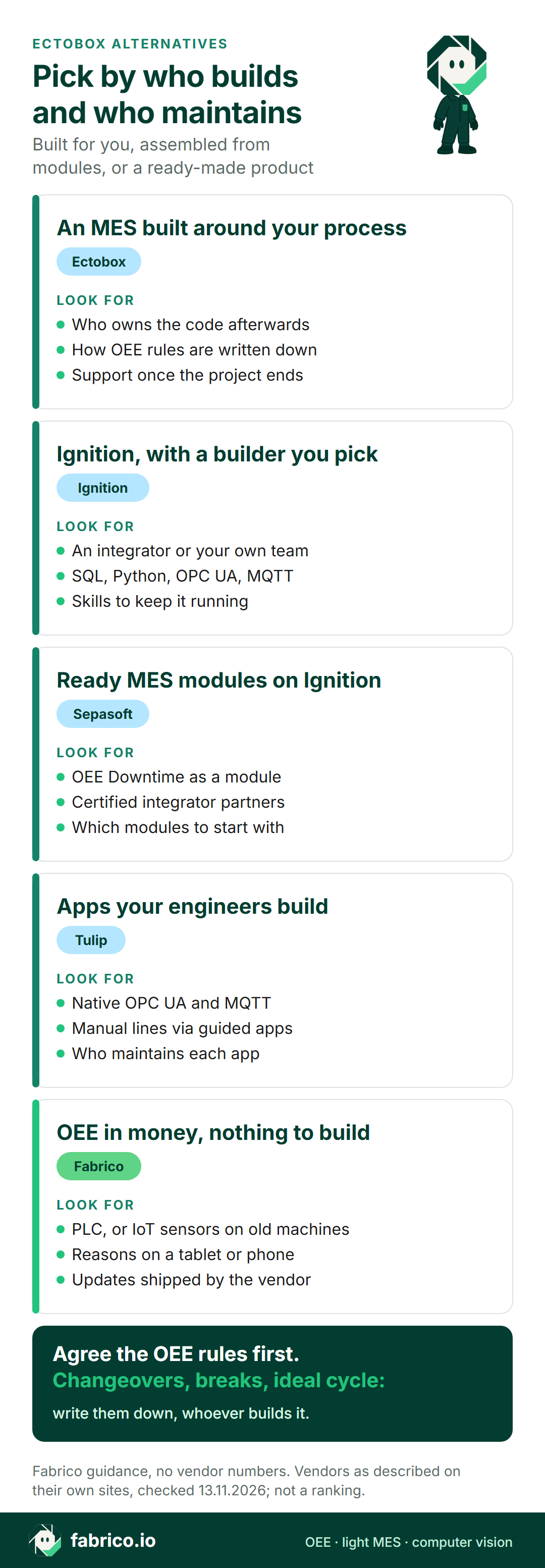
- An MES designed and built around your process by an Ignition integrator: Ectobox.
- Ignition, with a builder you choose or your own team: Ignition.
- Ready MES modules on Ignition, configured by a certified partner: Sepasoft.
- Apps your engineers build and change, one use case at a time: Tulip.
- OEE and downtime by cause from a ready-made cloud product, with losses in money: Fabrico.
A custom MES can also run next to a packaged OEE layer, as long as just one of them publishes OEE. Read light MES vs full MES for how the work divides. Plants making food, drinks or household goods can begin with our FMCG computer vision guide.
Worked example: one shift, two OEE rules
Made-up numbers for one 450 minute shift on a filling line; no customer data and no product screen. The ideal cycle is 0.5 minutes a unit. There was a 40 minute changeover and 50 minutes of other stops. The line made 640 units, and 624 were good.
Rule A counts the changeover as a loss. Run time is 450 minus 90, or 360 minutes, so availability is 80.0%. In 360 minutes the ideal is 720 units; 640 gives performance of 88.9%. Quality is 624 / 640 = 97.5%. OEE is 69.3%, the same as 624 x 0.5 / 450.
Rule B treats the changeover as planned downtime, so planned time drops to 410 minutes. Availability becomes 360 / 410 = 87.8% and OEE 76.1%, or 312 / 410.
Neither rule is wrong, but the 6.8 point gap matters when lines or sites are compared. In a custom build, someone has to write that rule into the code. A packaged product ships with a default you should check. See OEE calculation for the formula.
Questions for any route before you commit
Ask the same things of an integrator, a platform vendor and a product vendor, us included.
- Who owns the result? Code, project files, data model and documentation.
- Who changes a screen or adds a reason code next year, and how long it takes.
- How is OEE defined? Changeovers, breaks, ideal cycle per product.
- How are updates handled? Platform upgrades, security patches, testing.
- What if the builder steps away? Can another partner or your team take over?
- How does data leave? API, database access or exports, and to which ERP.
Our MES buyer checklist has a longer list.
What people ask next
What does Ectobox do?
Per its FAQ, Ectobox is an industrial intelligence solutions company and an IIoT and MES integrator. It implements off-the-shelf and custom IIoT and MES solutions for manufacturers in North America, including a Built-For-You MES on Inductive Automation's Ignition platform.
Is Ectobox a software product or a service?
Its pages describe services first: systems integration, consulting and a Built-For-You MES on Ignition. The about page also lists plant floor products such as OEE and downtime tracking, production scheduling and edge devices.
Can I build an Ignition MES without Ectobox?
Yes. Inductive Automation runs an integrator program with a Find an Integrator directory, Sepasoft lists certified integrators for its MES modules, and some plants build with their own engineers. Ask each option who maintains the project after launch.
How is Fabrico different from an integrator-built MES?
Fabrico is a ready-made cloud product for OEE and light MES. You set up machines and reason codes rather than commissioning a build: the PLC or an IoT device supplies stops and counts, operators add the reason, and OEE and losses in money appear by line and shift.
Does Ectobox connect to older machines?
Its FAQ says it first reads data from the machine's software, PLC or controller, then uses RS-232, I/O and external sensors where needed, with manual entry on a digital device as the last resort.
Why do two systems show different OEE for the same line?
Usually because of rules, not maths: whether changeovers count as planned time, how breaks are handled and which ideal cycle is used. Write the rules down before go-live, whoever builds the system.
See Fabrico in a demo before an Ignition build scope is signed, or ask a question through our contact page.
Related articles

Latest from our blog


Real Fabrico tiles, sample data.