


 Login
 Blog
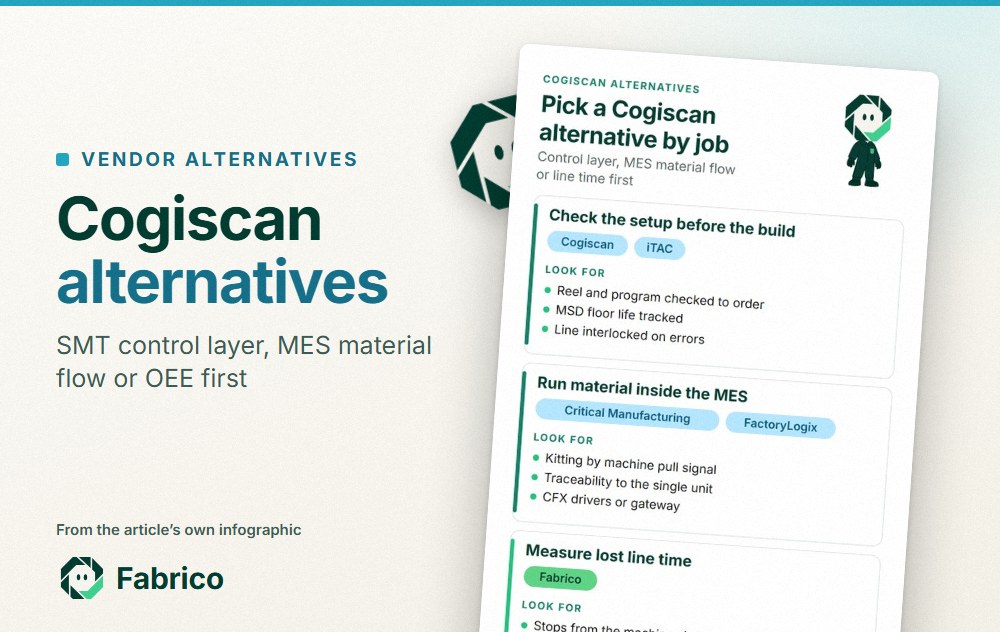
Cogiscan Alternatives: SMT Track, Trace and Control or OEE First

In short: the right Cogiscan alternative depends on whether you need to stop the wrong reel, or to measure the minutes the line lost. For setup checks, material control and board traceability, compare Cogiscan with the SMT functions of MES platforms such as iTAC, Critical Manufacturing and FactoryLogix. If the question is where line time goes, Fabrico measures it as a light MES with OEE, next to whichever control layer you keep.
- Cogiscan describes track, trace and control for electronics plants: machine connectivity, process control, traceability and analytics.
- Founded in Canada in 1999, it joined Dürr through iTAC Software AG in 2021, and iTAC's site lists it among the iTAC group companies, so iTAC is part of the same group, not an independent rival.
- This page sorts the options by moment: before the board is built, or while and after the line runs.
- Facts about each vendor are quoted from its own site on 13.11.2026 and linked where they appear; no prices, no ranking, no verdicts.
An EMS plant runs five SMT lines with machines from four brands. Its quality lead wants every reel verified before it is loaded and every moisture-sensitive part tracked against its floor life. Its operations lead asks a different question: how many minutes did line 2 wait for reels last week, and how does that compare with changeovers?
Cogiscan's pages address the first question. Next: what Cogiscan is, three platforms that reach the same ground by other routes, and Fabrico for the second question. Fabrico wrote this page, so it is not ranked. For a full electronics MES shortlist, see our FactoryLogix alternatives page; this one is about the connectivity and control layer.
What Cogiscan is (as of 13.11.2026, per Cogiscan's site)
Cogiscan's about page dates the company to 1999 in Canada and says Dürr Systems AG acquired it via iTAC Software AG in 2021. Its home page describes a track, trace and control solution for PCBA manufacturing. What its pages say, as of 13.11.2026:
- Connectivity. Co-NECT, which Cogiscan calls a standalone, neutral connectivity interface, runs on placement machines, SPI and AOI systems, stencil printers, reflow ovens and storage towers, over CAMX, CFX, SECS/GEM or a machine maker's own interface. It can be deployed on its own or combined with higher-level ERP, MES, IIoT or AI systems (connectivity page).
- Setup checks. Its control page says each changeover is checked against the work order: program, feeders, materials and tools must match before production may start. If an operator loads the wrong reel, an expired part or an unverified program, the TTC platform stops production from going ahead.
- Moisture-sensitive parts. Its MSD page describes tracking floor life, enforcing MSD rules, tracking reels and trays that hold MSDs, and integration with smart storage towers.
- Traceability. Up to Level 4 under the IPC standard, with searches for PCBAs by material date code, lot or supplier (traceability page). TTC Check extends it to manual and offline stations.
- Analytics. Factory Insights covers KPIs from site OEE to individual machines, with thresholds and alerts (analytics page).
Its testimonials quote downtime and setup results; those are the vendor's own numbers, so they are left out here.
Ask in the demo: which machine models in the station list have adapters today, and how Factory Insights defines a stop and the ideal rate for OEE.
When Cogiscan is the right pick
- Wrong-reel and wrong-program errors reach the line, and you want the line interlocked before a board is built.
- MSD control is manual, with floor life tracked on labels or spreadsheets.
- Customers ask for board-level traceability, searchable by component lot or supplier.
- You keep your MES or ERP, and want a neutral connectivity layer across machine brands next to it.
If most are true, a track, trace and control layer matches the problem. When the open question is lost line time, continue below.
Control before the build, or measurement after it
Shortlists for Cogiscan often mix tools that act at different moments. A control layer acts before a board is built. An OEE layer records what happened to line time. Our guide to IPC-CFX and Hermes on SMT lines covers how machines share the data both need.
Comparison table: Cogiscan and four alternatives
The rows paraphrase each vendor's pages as of 13.11.2026, with links in the sections that follow. Fabrico is listed first because this is our page, not because of any rank. Thin cells only mean the pages said little, so ask the vendor.
| Tool | What it does, per its site | Material and setup, per its site | Demo question |
|---|---|---|---|
| Cogiscan (for reference) | Connectivity, process control, traceability, analytics | Setup checked against the work order; MSD control | Alone or next to an MES? |
| Fabrico | OEE and light MES | Waits for material logged as a stop reason | How are short stops shown? |
| iTAC | MES/MOM suite with SMT.Edge | Material and machine status tracked | Which modules overlap Cogiscan? |
| Critical Manufacturing | Electronics MES with material logistics | Kitting by machine pull; FIFO or FEFO for MSD | Which drivers come off the shelf? |
| FactoryLogix (Aegis) | Electronics MES | Pull-based replenishment | Gateway alone or full MES? |
Bring a week of changeover and downtime records to a demo, and we will walk through how Fabrico shows SMT line time with them.
Fabrico: the minutes the line lost, by cause
Fabrico wrote this page. It is a cloud-based OEE and light MES platform. Where Cogiscan checks the setup before a board is built, Fabrico measures the line while it runs: when it stopped, for how long, why, and what it cost. Per our MES and OEE overview:
- Machine data, three ways. From the PLC, from a Fabrico IoT device with external sensors on older machines, or from AI cameras, an add-on, at manual steps. Protocols include OPC UA, Modbus, PROFINET, MQTT and EtherNet/IP (machine connectivity).
- Stops with reasons. Connected machines report when a stop started and how long it lasted, and short stops are detected from the signal and reported apart from long ones. Operators tag the cause, such as waiting for a reel or a feeder error, from your own list of reason codes.
- OEE by machine, line and shift, with losses measured in money, on the web, iOS and Android.
- The camera add-on counts output at manual stations, such as hand assembly. In the standard setup, video from the camera add-on is streamed on request, not stored in Fabrico (how the camera add-on works).
- Maintenance built in. When a stop needs a repair, a technician opens a work order from the stop, on the same machine record.
- Data out. REST API, webhooks and Excel or CSV export. A connection to SAP or another ERP can be scoped per customer.
- Rollout. Devices connected in about a month; full rollout in 3 to 4 months.
- Not part of Fabrico: setup verification, MSD control and component genealogy stay in your control layer, MES or ERP. Roadmap, not live: production planning and scheduling.
Ask in the demo: how a placement line is measured against its bottleneck, and how material waits show up next to changeovers.
Fits plants that want lost minutes ranked by cause and priced by line and shift, with or without a control layer in place. EU customers are hosted on AWS in Frankfurt. Quoted per plant. Start with a one-line pilot. See our OEE software guide.
iTAC: a MOM suite from the same group
Cogiscan belongs to the iTAC group inside Dürr: iTAC describes itself as independent within the Dürr group, and its home page names DUALIS, Cogiscan and Accevo among the companies of the iTAC group. From iTAC's pages, as of 13.11.2026:
- The home page presents one MES/MOM platform covering planning, production control, quality, maintenance and traceability.
- iTAC.SMT.Edge links equipment of mixed makes and ages and creates a two-way connection between machines and systems (SMT.Edge page).
- iTAC.TR.Service, part of the iTAC.MOM.Suite, assigns every component its own serialized identifier, so single parts can be traced (traceability page).
- Its electronics page calls process interlocking one of the most important issues in electronics production.
Compared with Cogiscan: both connect mixed SMT equipment and trace to the single part. iTAC's pages describe a full MOM suite; Cogiscan's describe a layer that can run alone or next to an MES.
Fits plants that want the control layer and the MES from one group, as one suite.
Critical Manufacturing: material flow inside the MES
On its electronics manufacturing page, as of 13.11.2026, Critical Manufacturing describes:
- Kits delivered to the line on live pull signals from the machines.
- Warehouse picking that puts time-sensitive and MSD material first, under FIFO or FEFO rules.
- Connect IoT drivers for SECS/GEM, OPC-UA, IPC-CFX, MQTT and Fuji Nexim, among others.
- Component UIDs traced at board or panel level.
Compared with Cogiscan: both handle MSD material and board-level traceability. Critical Manufacturing puts them inside a full MES that also covers NPI; Cogiscan offers them as a layer next to the MES you run.
Fits plants that want material flow, traceability and execution in one MES.
FactoryLogix: electronics MES and a standalone PLC gateway
FactoryLogix is Aegis Software's MES for OEMs, EMS providers and contract manufacturers, per its electronics page. On 13.11.2026 its pages described:
- Level-4 component traceability: tracking down to the single unit rather than the lot.
- Pull-based replenishment of material for high-mix lines.
- The Aegis PLC Gateway, which links to PLCs through OPC UA, maps raw tags to event-based IPC CFX messages by configuration, and can be deployed without FactoryLogix (connectivity page).
Compared with Cogiscan: both offer connectivity that can run without their own MES. Aegis's gateway starts from PLC tags; Co-NECT starts from SMT machine adapters.
Fits plants that want an electronics MES, or a CFX gateway for PLC-driven equipment, from one vendor.
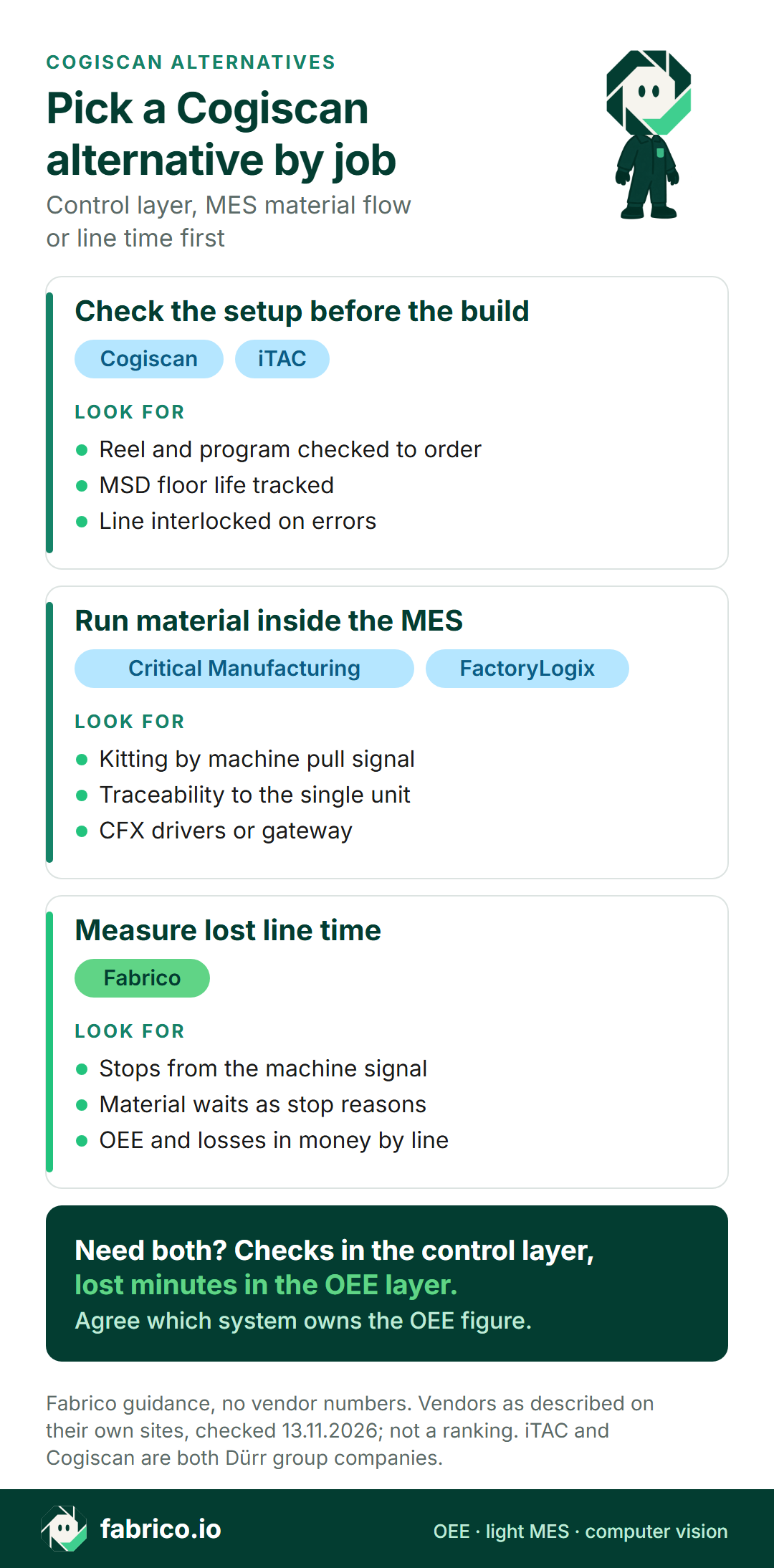
Which Cogiscan alternative fits your plant
- Setup checks, MSD control and Level 4 traceability as a layer next to your MES: Cogiscan.
- The same group's full MOM suite, with SMT machine integration: iTAC.
- Material pull, MSD rules and traceability inside one MES: Critical Manufacturing.
- An electronics MES with a standalone PLC-to-CFX gateway: FactoryLogix.
- Lost minutes by cause, with OEE for each line and shift, beside any of the above: Fabrico.
For more on the time side, see how to reduce SMT changeover time and OEE in electronics manufacturing.
Worked example: how many minutes did the line wait for material?
Made-up numbers for one 8 hour shift (450 planned minutes) on a high-mix SMT line: sample data, invented for this page, with no customer figures. The placement machine paces the line at an ideal 0.5 minutes a panel.
Stops took 90 minutes, so run time was 360 minutes and availability 80.0%. In 360 minutes the ideal is 720 panels. The line built 666, so performance is 92.5%.
Eighteen panels went to rework, leaving 648 good: quality is 97.3%. OEE is 80.0% x 92.5% x 97.3% = 72.0%, the same as 648 good panels x 0.5 minutes over 450 minutes.
Material-related stops, the reel and kit waits plus feeder errors, took 32 of the 90 minutes. A control layer is built to stop the wrong reel from being loaded. An OEE layer shows how long the line waited for the right one, shift after shift, next to the 48 minutes of changeovers. See OEE calculation for the formula.
What to ask each vendor
Pick one typical SMT line and send every vendor, including us, this list.
- Which moment is it for? Checking the setup before the build, tracing each board, or measuring line time.
- Which of our machines connect today? By brand and model, and by which interface: CFX, CAMX, SECS/GEM, a vendor interface or a PLC.
- Where does a material wait show up? As a stop reason, an alert, or both.
- Which OEE math? Ask which machine on an SMT line sets the ideal rate and how changeover time is counted.
- Who owns genealogy? The control layer, the MES or the ERP.
- Who maintains the machine adapters? When a machine is replaced or its software changes, who updates the connection.
What people ask next
Who owns Cogiscan?
Its about page gives Canada, 1999, as its origin and 2021 as the year Dürr Systems AG acquired it via iTAC Software AG. iTAC's site lists Cogiscan in the iTAC group of companies.
Is Cogiscan an MES?
Cogiscan describes machine connectivity, process control, traceability and analytics for electronics plants. Its Co-NECT interface can be deployed on its own or combined with ERP, MES, IIoT or AI systems, so it can sit next to an MES.
What are the main Cogiscan alternatives?
For the same group's full suite, iTAC. For material control and traceability inside an MES, Critical Manufacturing or FactoryLogix. For lost line time and OEE next to any of them, Fabrico's light MES.
Does Cogiscan track MSD floor life?
Its MSD page describes tracking floor life, enforcing MSD rules, tracking reels and trays that hold MSDs, and integration with smart storage towers.
How is Fabrico different from Cogiscan?
Cogiscan checks the setup and traces boards, per its site. Fabrico measures line time instead: the signal marks when the line stopped, the operator says why, and losses are priced by line and shift. Setup verification and genealogy stay in your control layer, MES or ERP.
Can Fabrico run next to Cogiscan?
Yes, with a clear split. Setup checks, MSD data and genealogy stay in the control layer; stops, reasons and line time live in Fabrico. Settle which one reports OEE.
Want SMT line OEE shown in Fabrico? Book a demo or send us a question.
Related articles


Latest from our blog




Real Fabrico tiles, sample data.