





 Login
 Blog
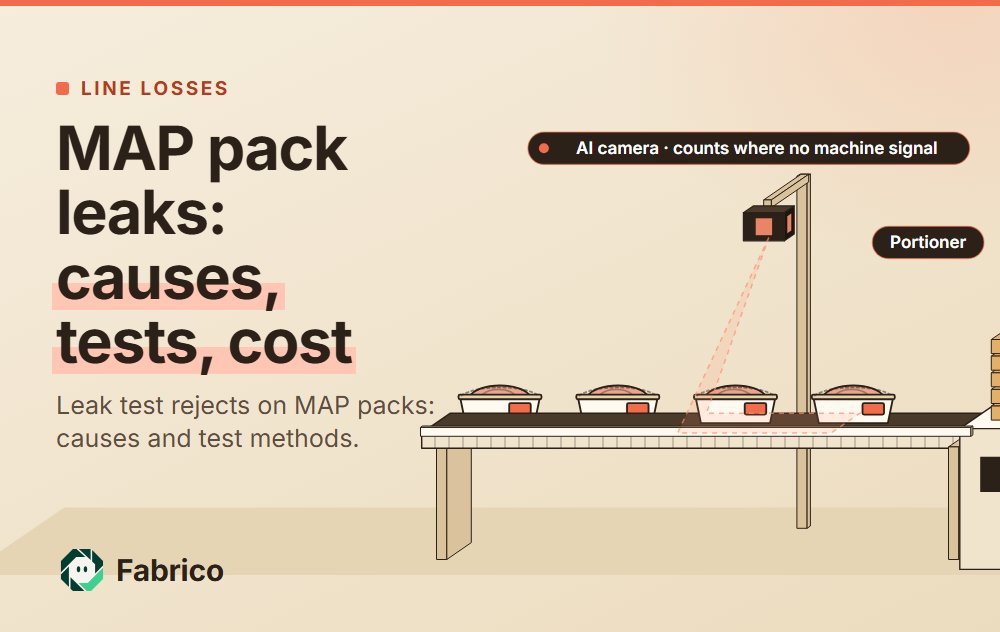
MAP Pack Leak Test Rejects: Causes, Test Methods and Cost

In short
- Check the seal first: product on the flange, a seal tool off temperature or short of pressure, a worn gasket, a film that does not suit the tray, wrinkles or a puncture.
- Each test sees a different leak: a water bath shows gross leaks in a sample, vacuum decay tests without opening the pack, headspace O2 and CO2 checks show gas loss, and an inline tester checks every pack at line speed.
- Re-test before you scrap: an inline reject is a suspect, not a leaker. Keep cleared packs, reworked packs and lost product apart, each with its own reason.
- Count them in two OEE factors: leakers are quality loss; an unplanned stop to clean the seal tool is availability loss.
- The money: on a sample chicken fillet line in Hungary, 1.0% leak rejects and three seal-tool cleans a shift cost EUR 140.52 per shift, EUR 6,183 a month and EUR 74,195 a year.
MAP pack leak test rejects are sealed trays that fail a leak or gas check: bubbles in the water bath, a pressure rise in a vacuum chamber, headspace oxygen out of range, or a reject from an inline leak tester. Check the seal before the film.
Look for these causes: product on the flange, a seal tool running too cool or with too little pressure, a worn seal gasket, a lidding film that does not suit the tray, wrinkles in the seal and punctures. A gas flush fault looks like a leak on the analyser but is not one.
The fix starts with a re-test rule, a cause check at the tray sealer and a reject count by cavity. Then price the loss in euros and choose between more sampling, an inline tester or both. One chicken fillet line in Hungary runs through every step below; the same steps work for cheese and salad trays.
Leaker, gross leak, false reject: the words to agree first
Agree these five words before anyone counts:
- Leaker: a sealed pack with a path for gas. It may be a channel through the seal, a pinhole in the lid or a crack in the tray wall.
- Gross leak: a leak large enough to show as a stream of bubbles in a water bath, or as a pack that goes soft within minutes.
- Slow leak: a small leak that passes the bath but lets air in over hours or days. It shows up later as headspace gas drifting toward air, or as early spoilage.
- False reject: a good pack that a tester rejected. It passes a re-test and can be sold.
- Headspace fail: the seal holds, but the gas mix was wrong from the start. The cause is the gas flush or the fill, not the seal.
Each word has its own owner: leakers go to maintenance and production, false rejects to whoever owns the tester, headspace fails to the gas supply and the sealer settings.
A review from the University of Twente and TU Delft calls the seal area the most problematic part of a food package for keeping gas and moisture where they belong (Ilhan et al., Packaging Technology and Science, 2021). That is where the floor checks below start.
Leak test methods compared: what each one finds
No single test finds every leak. The table sorts the common methods on a MAP tray line by what they find, how much of the output they cover and whether the pack survives.
| Method | Finds | Speed and coverage | Pack survives? | Cost class |
|---|---|---|---|---|
| Water bath under vacuum (bubble emission) | Gross leaks in packs with headspace gas; shows where the hole is | Offline, a few packs an hour | Wet pack, normally scrapped | Low: bench kit |
| Internal pressure bubble test | Gross leaks in trays and pouches | Offline, a sample | No: a needle enters the pack | Low: bench kit |
| Vacuum decay | Leaks as a pressure rise in a sealed chamber; pass or fail | Offline or at-line, a sample | Yes | Medium: ask the supplier |
| Headspace analyser with a needle | O2 and CO2 out of target; gas lost through slow leaks | Offline, a sample | No: needle hole | Low to medium |
| Laser headspace through the film | O2 or CO2 inside the pack without opening it | At-line, a sample | Yes | Ask the supplier |
| Inline trace-gas leak tester | Leaks in every pack at line speed | Inline, every pack | Yes | High: ask the supplier for a price per line |
| Operator squeeze and look | Soft packs, wrinkles, product in the seal | Every pack, by eye | Yes | Labour only |
Three ASTM standards describe the offline methods. ASTM D3078 covers gross leaks in flexible packs that hold a headspace gas, using a vacuum chamber and an immersion fluid, and warns that small leaks may be missed.
ASTM F2096 pressurises the pack from inside through a needle, so it destroys the pack. Its stated sensitivity is down to 250 µm, with an 81% probability.
ASTM F2338 is the vacuum decay method and does not open the pack. It lists hole sizes by package type, for example 50 µm in the wall of a non-lidded tray and 5 µm for rigid nonporous packages, and its result is a plain accept or reject.
What inline testers miss
The Twente and Delft review says sampling-based destructive tests alone cannot give total process control, and that the gas leak detection methods most relevant next to packing machines show detection limits of 10 to 25 µm.
It adds a speed warning: at an output of 60 packs a minute, pinholes under 10 µm cannot be found with standard trace-gas testers. An inline tester shrinks the sample problem; it does not remove the need for an offline method that shows where the hole is.
Headspace O2 and CO2: reading the gas as a leak signal
EU law treats the gas in a MAP tray as a food additive. Regulation (EC) No 1333/2008 defines packaging gases as gases other than air put into a container before, during or after the food goes in (Regulation 1333/2008, Annex I).
Its Annex II lists carbon dioxide (E 290), argon (E 938), nitrogen (E 941) and oxygen (E 948) among the authorised additives. The mix itself is a product decision. In a TU Munich study, fresh poultry was packed in 70% O2 with 30% CO2, or 80% O2 with 20% CO2 (Dold et al., Foods, 2022).
Gas readings tell two different stories, depending on when they are taken:
- Right after sealing: a reading off target points to the gas flush, the gas supply or a dwell time that is too short. The seal may be fine.
- Hours or days later: a mix drifting toward air (21% O2, almost no CO2) on packs that read right at sealing points to a slow leak.
- Against a baseline: set the alarm from good packs measured over the same hours, so normal drift is not called a leak.
The needle analyser is the common bench tool, but it puts a hole in the pack. Non-destructive options exist. Lund University researchers showed diode laser spectroscopy measuring gas inside packs of minced meat and bread through the package (Lewander et al., Applied Physics B, 2008).
The TU Munich poultry study compared non-destructive O2 and CO2 devices with destructive needle sampling and found comparable precision in most cases. For a QA team, that means fewer destroyed packs is a realistic target, after a trial on its own trays.
Why MAP trays leak: causes and floor checks
Start from what the floor sees, then run the cheapest check first. Every row ends with an owner, because a leaker problem with no owner can turn into a longer bath test or a slower line.
| Cause | What the floor sees | Floor check | Owner |
|---|---|---|---|
| Product in the seal: juice, fat, fibres, leaves, crumbs | Leakers after fast loading or on wet product | Open 5 rejects; look at the flange under a lamp | Production |
| Seal temperature off | Weak seal all round, or thin, burnt film | Probe each cavity; compare with the set point | Maintenance |
| Seal pressure or dwell time too low | Channels at corners; uneven seal print | Check air pressure at the tool and the seal width | Maintenance |
| Worn or cut seal gasket | Leaks at the same spot on the same cavity | Map leaks by cavity; inspect each gasket | Maintenance |
| Film and tray mismatch | Leaks start with a new film or tray batch | Check sealant layer and tray spec; batch numbers on rejects | QA and purchasing |
| Wrinkles and film tracking | Folds in the seal; leaks along one edge | Watch film tension and tracking at the tool | Production |
| Punctures: bone, sharp tray edges, handling | Holes in the lid or tray wall, away from the seal | Find the hole in the bath; walk the tray path | Production and QA |
| Gas flush fault (not a leak) | No bubbles, but gas off target at sealing | Check gas supply, mixer and flush time | Maintenance |
The Twente and Delft review backs the table. Seal quality depends strongly on temperature, time and pressure, and poorly set values end in leaks. Solid particles in the seal can form micro-channels, while higher seal bar pressure can often push liquid out.
It also calls the match between the tray and the sealant layer of the lidding film critical, and notes that creases and wrinkles in the seal can act as capillary channels. A run of leakers that starts with a new film batch is a material question first.
Map leakers by cavity before anything else. A four-cavity tool with one cut gasket can leak on every fourth pack while the other three cavities are perfect. Averaged over the line it looks like a 25% leak rate and a film problem; by cavity it is one gasket change.
True leaker or false reject: the re-test rule
An inline reject is a suspect. Write the rule down, train it, and keep it the same on every shift:
- Hold every reject apart. Rejects go to a marked crate, not straight to the scrap bin, so they can be re-tested.
- Check the tester first. Run a known good pack and a pack with a known hole. A re-test on a tester that has drifted proves nothing.
- Re-test once by the written method. The same tester or a second method such as vacuum decay. A pass makes it a false reject; a fail makes it a confirmed leaker.
- Find the hole. Put confirmed leakers in the bath and note where the bubbles start: seal, corner, lid or tray wall. That location names the cause row.
- Rework or scrap by the procedure. Repacking is allowed only under the plant's written rework rules for time, temperature and hygiene. Anything outside them is scrapped.
- Log every reject. Time, SKU, cavity, re-test result, hole location and cause found.
False rejects on an inline tester have their own causes. Common ones are packs sitting off position in the test head, product or condensation on the outside of the tray, a setting tighter than the validated one, and a low-CO2 gas mix on a tester that senses CO2.
Track the false reject share as its own number. If one reject in four passes the re-test, the tester costs re-test labour on every shift, and the floor starts to distrust it.
How many packs to test offline: the sampling maths
The test frequency comes from the plant's HACCP plan, its validation and the retailer's code of practice. The maths behind any sampling plan is simple and worth showing to the team.
The chance that a sample of n packs holds at least one leaker is 1 minus (1 minus the leak rate) to the power n. For a line that takes 2 packs an hour, 16 a shift:
- At a 1.0% leak rate: 1 - 0.9916 = 14.9%. So about 85 shifts in 100 find no leaker at all.
- At 0.5%: 1 - 0.99516 = 7.7%.
- To be 95% sure of seeing one leaker: about 300 packs at 1.0%, and about 600 at 0.5%.
So offline sampling is good at catching a step change, such as a cut gasket or a bad film reel, and poor at measuring a low, steady leak rate. That is the job of an inline tester or a full reject count.
Two rules make a small sample work harder:
- Sample every cavity. One pack from each cavity of a four-cavity tool finds a cavity that leaks every pack at the first test. Four packs taken at random find it only 68% of the time.
- Sample at the moments of change: start-up, a new film reel or tray batch, a tool change, a seal-tool clean, a setting change, then at a fixed interval.
How leakers and seal-tool cleans count in OEE
Leak test rejects touch quality and availability, and they can inflate performance if rework is counted twice. Agree the rule once, write it into the reason list and keep it the same on every line.
| Event | OEE factor | Count it as |
|---|---|---|
| Confirmed leaker, product repacked | Quality | Rework, reason "leaker, reworked" |
| Confirmed leaker, product scrapped | Quality | Scrap, reason "leaker, scrapped" |
| Reject that passes the re-test | None (good) | Good count; also in the first-pass reject rate |
| Pack destroyed by an offline test | Quality | Scrap, reason "QA leak test sample" |
| Unplanned stop to clean the seal tool | Availability | Stop, reason "seal tool clean" |
| Seal-tool clean in the plan | Planned | Planned at its standard; minutes over it are availability loss |
| Reworked pack sealed a second time | Performance (inflated) | Count it apart, or subtract it |
Watch for three traps. First, a repacked tray goes through the sealer again and adds to the count, so output and performance look better than they were. Count rework apart.
Second, seal-tool cleans hide in "short stops" unless they have their own reason. On wet product they can be the biggest stop on the sealer.
Third, QA samples vanish. A destroyed test pack is real product; give it its own scrap reason so nobody mistakes the sampling plan for a seal problem. The scrap reason code taxonomy shows how to keep such a list short.
Weight rejects follow different rules, covered in checkweigher rejects in OEE quality. The rest of the sealer's losses, from denesting to tool changes, sit in the tray sealer OEE guide.
Worked example: chicken fillets in MAP trays in Hungary
One line in Hungary packs 500 g of fresh chicken breast fillets per MAP tray. A tray sealer runs at 30 packs a minute on two shifts, and an inline leak tester checks every pack after the sealer.
The numbers are an example, not a customer's data. The labour cost is Eurostat's; the rest are sample figures to replace with your own.
| Input | Value | Basis |
|---|---|---|
| Planned production time per shift | 450 min | Sample |
| Packs sealed per shift | 12,000 | Sample: 400 run minutes x 30 a minute |
| Inline leak rejects | 1.0% of packs | Sample |
| Rejects that pass the re-test | 1 in 4 | Sample |
| Confirmed leakers repacked | 2 in 3; the rest scrapped | Sample |
| Re-test time per reject | 0.5 min | Sample |
| Repack time; new tray, film and label | 1.5 min; EUR 0.18 a pack | Sample |
| Seal-tool cleans | 3 a shift, 8 min each, crew of 3 | Sample |
| Value of one 500 g pack | EUR 2.40 | Sample figure, below the KSH retail price |
| Labour cost | EUR 15.60 per hour | Eurostat lc_lci_lev, Hungary, manufacturing, 2025 |
| Shifts | 44 a month, 528 a year | Sample: 2 a day, 22 days a month |
A check on the pack value: the Hungarian statistics office puts the 2025 average consumer price of filleted chicken breast at HUF 2,490 per kg (KSH table 1.1.1.4). That is HUF 1,245 for 500 g.
At Eurostat's 2025 average rate of 397.77 forints per euro (ert_bil_eur_a), that is about EUR 3.13. The retail price includes VAT and the retailer's margin, so the sample plant value is set lower, at EUR 2.40.
What the leak rejects cost a shift
- Inline rejects: 12,000 x 1.0% = 120 packs. One in four passes the re-test: 30 false rejects and 90 confirmed leakers.
- Re-test labour: 120 x 0.5 min = 60 min = 1.0 h. 1.0 x EUR 15.60 = EUR 15.60.
- Repacking: 90 x 2/3 = 60 packs. Labour: 60 x 1.5 min = 90 min = 1.5 h x EUR 15.60 = EUR 23.40. Materials: 60 x EUR 0.18 = EUR 10.80. Together EUR 34.20.
- Product lost: 90 - 60 = 30 packs. 30 x EUR 2.40 = EUR 72.00.
- Seal-tool cleans: 3 x 8 min = 24 min. Crew idle time: 3 people x 24 min = 72 min = 1.2 h. 1.2 x EUR 15.60 = EUR 18.72.
- Total: 15.60 + 34.20 + 72.00 + 18.72 = EUR 140.52 per shift.
The same losses over a month and a year
- Month: EUR 140.52 x 44 = EUR 6,182.88, about EUR 6,183.
- Year: EUR 140.52 x 528 = EUR 74,194.56, about EUR 74,195.
The sampling plan has a cost of its own, kept out of that total. Sixteen destroyed test packs a shift at EUR 2.40 are EUR 38.40 per shift, or EUR 20,275 a year over 528 shifts.
The same shift in OEE terms
- Availability: 24 minutes of seal-tool cleans out of 450 planned minutes is 5.3 points.
- Quality: 90 leakers plus 16 QA samples are 106 packs, 0.88% of 12,000. Quality reads 99.12%.
- First-pass reject rate: 1.0%, including the 30 packs that later passed.
The cleans cost about seven times as many OEE points as the leakers (5.3 against 0.75), yet the leakers cost more money: EUR 121.80 a shift against EUR 18.72. A dashboard that ranks losses by OEE points alone sends the team to the wrong problem.
If the line is sold out, the ranking flips. 24 minutes at 30 packs a minute is 720 packs not made per shift. At a sample margin of EUR 0.25 a pack that is EUR 180 a shift, more than all the leakers together. Use your own margin.
With the re-test rule and one clean
Suppose fill guides keep product off the flange, the tool temperature is checked per cavity at start-up and gaskets are changed on a schedule. Rejects fall to 0.4% and cleans to one a shift:
- Rejects: 12,000 x 0.4% = 48. 12 pass the re-test, 36 are leakers: 24 repacked, 12 lost.
- Re-tests: 48 x 0.5 min = 24 min = 0.4 h x EUR 15.60 = EUR 6.24.
- Repacking: 24 x 1.5 min = 36 min = 0.6 h x EUR 15.60 = EUR 9.36, plus 24 x EUR 0.18 = EUR 4.32. Together EUR 13.68.
- Product lost: 12 x EUR 2.40 = EUR 28.80.
- One clean: 8 min x 3 people = 24 min = 0.4 h x EUR 15.60 = EUR 6.24.
The shift cost falls to EUR 54.96: about EUR 2,418 a month and EUR 29,019 a year. The saving is EUR 85.56 a shift, or about EUR 45,176 a year on one line, if the gain holds.
Decision: more sampling, an inline tester, or both
Measure before buying. Two weeks of a reject log by SKU, cavity, hour and re-test result shows which cause row you are in and how big the loss is. Without it, every option sounds right.
The log is easier to keep when it sits next to stops and output. OEE software or a light MES that counts the inline tester's reject signal from the line PLC shows rejects by SKU, hour and shift beside the seal-tool stops, from machine signals rather than a clipboard.
What you see: a shift timeline, unclassified time waiting for a reason, and the operator's line-down screen, on sample lines. Book a demo.
Plays from YouTube. Google may set cookies when you press play. Privacy policy.
For the wider picture of such systems in this sector, see MES for meat and poultry processing and MES for food manufacturing. Plants comparing tools can start with OEE software for food and beverage.
| Option | What it covers | Cost | Pick it when |
|---|---|---|---|
| Offline sampling only: bath and needle analyser | Gross leaks and gas mix in a sample; shows the hole | Bench kit, plus destroyed packs: EUR 38.40 a shift in the example | Low, steady leak rate on one or two lines |
| Add a non-destructive at-line test | Vacuum decay or laser headspace without opening packs | Ask the supplier for a price | Destroyed samples cost real money |
| Inline tester on every pack | Every pack at line speed, before the case | Ask the supplier for a price per line | High volume, retailer complaints, or a reject rate still above target after the cheap fixes |
| Line software for rejects and stops | Rejects and stops by SKU, hour and shift, priced in money | Ask the vendor for a price per line per month | Before any capital request, and after it to prove the gain |
The worked example gives the budget line. Cutting rejects from 1.0% to 0.4% and cleans from three to one saves about EUR 45,176 a year on one line. In this example, any fix that costs less pays back inside a year, if the gain holds.
Who should pick which
- QA manager: owns the test methods, the sampling plan, the re-test rule and the rework procedure.
- Maintenance lead: owns seal temperature, pressure, gaskets and the standard time for a seal-tool clean.
- Production manager: owns product on the flange, film tracking and what the crew does with a reject.
- Purchasing with QA: own the film and tray specs and every batch change.
- Plant manager: signs capital against the yearly cost from the reject log.
Questions to ask a leak tester supplier
- What hole size does it find on this tray, film and gas mix at this line speed, in a trial on real product?
- What false reject rate does it hold on this pack, and how is a reject re-tested?
- Does it need CO2 in the mix, and what happens on a low-CO2 or nitrogen-only product?
- Does it send a reject signal and a count to the line PLC?
- How is it checked each shift: a reference leak, a test pack, or both?
- Does it squeeze, hold or mark the pack, and can the tested pack be sold?
- How are results and setting changes recorded, and how do they leave the unit?
Six steps to fewer leakers this month
One month is enough to go from a crate of rejects to a cause and a price. The floor card below is the order of work; print it for the sealer.
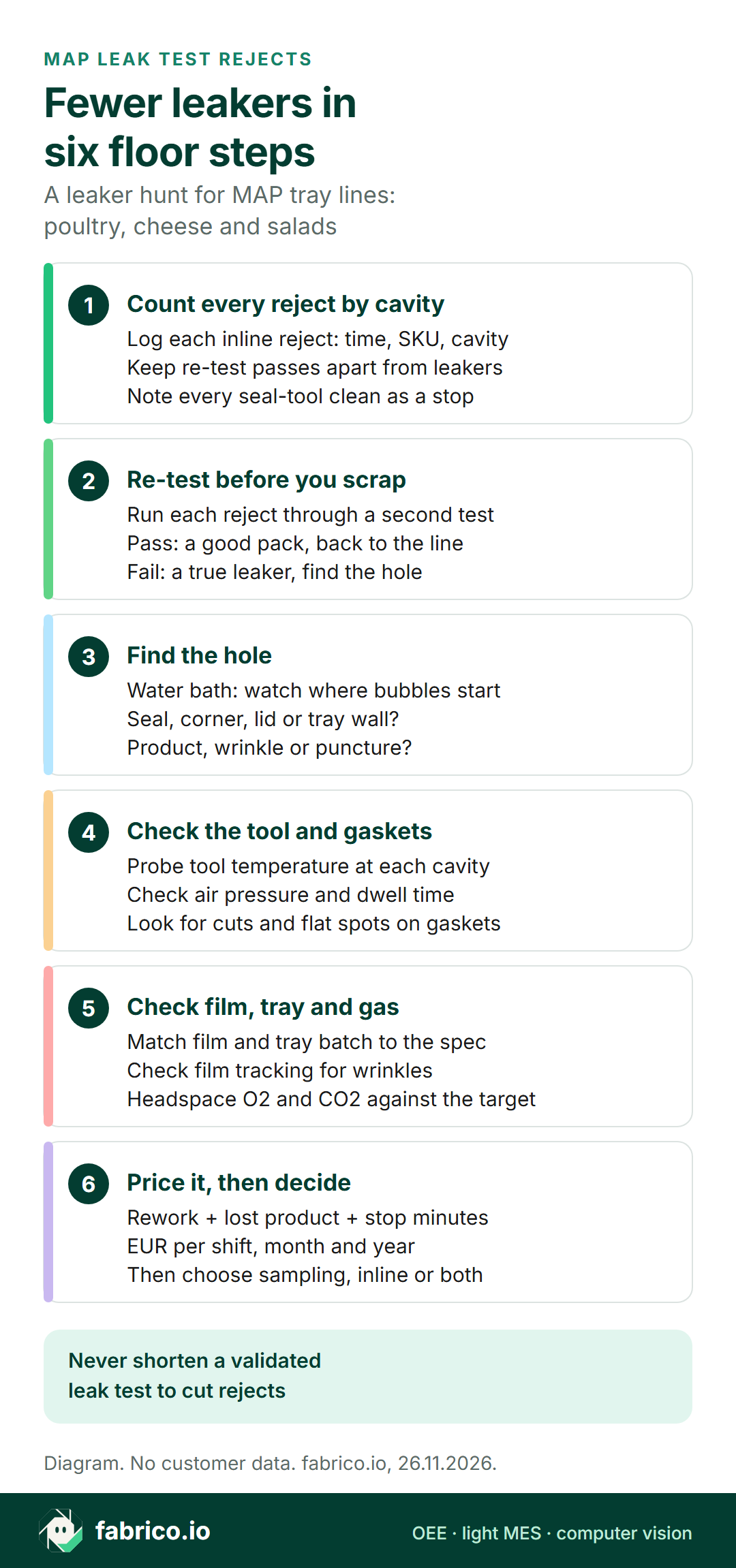
Text version of the diagram
- Count every reject by cavity: log each inline reject with time, SKU and cavity; keep re-test passes apart from leakers; note every seal-tool clean as a stop.
- Re-test before you scrap: run each reject through a second test; a pass is a good pack that goes back to the line; a fail is a true leaker.
- Find the hole: in the water bath, watch where the bubbles start; seal, corner, lid or tray wall; product, wrinkle or puncture.
- Check the tool and gaskets: probe the tool temperature at each cavity; check air pressure and dwell time; look for cuts and flat spots on gaskets.
- Check film, tray and gas: match the film and tray batch to the spec; check film tracking for wrinkles; check headspace O2 and CO2 against the target.
- Price it, then decide: add rework, lost product and stop minutes; express it in EUR per shift, month and year; then choose sampling, inline testing or both.
Never shorten a validated leak test to cut rejects.
Where Fabrico fits
Fabrico is OEE software and a light MES with computer vision. Fabrico is made by the publisher of this article. On this topic it does the counting and the pricing:
- The inline leak tester's reject signal from the line PLC can be counted like any machine signal; where there is none, the reject count can be entered.
- Scrap is recorded by product and reason, so "leaker, reworked", "leaker, scrapped" and "QA leak test sample" stay apart.
- The operator logs a seal-tool clean as the stop reason at the machine in a few taps, set up in the reason list, with planned and unplanned stops kept apart.
- With the selling price and margin of each product entered, losses are priced in money and stops are ranked by financial impact.
- OEE by line and shift from the core machine, with analytics by hour, shift, day, week and month.
Leak test methods, settings and validation stay with QA and the tester supplier. See pricing: one quote per plant, by machines and modules.
Sources, accessed 26.11.2026: ASTM International, D3078-02(2021)e1, Determination of Leaks in Flexible Packaging by Bubble Emission; ASTM International, F2096-11(2019), Detecting Gross Leaks in Packaging by Internal Pressurization (Bubble Test); ASTM International, F2338-09(2020), Nondestructive Detection of Leaks in Packages by Vacuum Decay Method; EUR-Lex, Regulation (EC) No 1333/2008 on food additives, consolidated text of 23.04.2024; Ilhan, Turan, Gibson and ten Klooster, Understanding the factors affecting the seal integrity in heat sealed flexible food packages: a review, Packaging Technology and Science 34(6), 2021, DOI 10.1002/pts.2564; Dold, Kehr, Hollmann and Langowski, Non-destructive measuring systems for the evaluation of high oxygen stored poultry, Foods 11(4), 2022, DOI 10.3390/foods11040592; Lewander, Guan, Persson, Olsson and Svanberg, Food monitoring based on diode laser gas spectroscopy, Applied Physics B 93, 2008, DOI 10.1007/s00340-008-3192-2; Eurostat, Labour cost levels by NACE Rev. 2 activity (lc_lci_lev), Hungary, manufacturing, 2025; Eurostat, Euro exchange rates, annual data (ert_bil_eur_a), Hungarian forint, 2025 average; Hungarian Central Statistical Office (KSH), table 1.1.1.4, annual average consumer prices of selected goods and services.
Frequently asked questions
What is an acceptable leak rate for MAP trays?
There is no one figure for every pack. Set a target per SKU from two weeks of your own reject log, then price it: on the sample chicken line in this article, 1.0% rejects with three seal-tool cleans a shift cost about EUR 74,195 a year, and 0.4% with one clean about EUR 29,019.
Can a leaking MAP pack be repacked?
Only under the plant's written rework procedure, with limits on time, temperature and hygiene set in the HACCP plan. Product outside those limits, or touched by anything it should not have been, is scrapped.
Which leak test finds the smallest leaks?
Vacuum decay to ASTM F2338 lists hole sizes from 5 µm for rigid nonporous packages to 50 µm for tray walls. A water bath finds gross leaks, and a 2021 review warns that standard inline trace-gas testers miss pinholes under 10 µm at 60 packs a minute.
Why do packs pass the water bath and still spoil early?
The bath finds gross leaks only. A slow leak, or a gas mix that was wrong from the start, passes it. Headspace O2 and CO2 checks over time, against a baseline of good packs, show both.
Do leakers count as quality or availability loss in OEE?
Leakers are quality loss, whether repacked or scrapped. An unplanned stop to clean the seal tool is availability loss with its own reason. Count repacked trays once, or output looks better than it was.
How often should MAP packs be leak tested?
The HACCP plan and the customer's specification set it. Sample every cavity at start-up, after a film reel, tray batch or tool change, after a seal-tool clean, and then at a fixed interval.
Does an inline leak tester replace the water bath?
Not on its own. An inline tester gives pass or fail on every pack; the bath shows where the hole is, and that location names the cause. Keep an offline method to check the tester and to find causes.
See leakers and seal-tool stops priced in euros. A demo shows OEE by line and shift from the core machine, scrap by product and reason, and losses priced in money from the prices and margins you enter.
Latest from our blog





Real Fabrico tiles, sample data.