





 Login
 Blog

Metal Detector False Rejects: Causes, Fixes and Cost per Year

In short
- Check the product first: wet, salty, warm or part-frozen food gives a signal that looks like metal. Temperature drift, foil or metallised film, a loose fit in the aperture, vibration and electrical noise come next.
- Separate true from false rejects with a written rule: a locked reject bin, a QA re-pass procedure, test pieces at set times and a reject log by SKU and cause.
- Count them in OEE in two places: destroyed packs are quality loss, minutes lost to a full reject bin are availability loss. Packs cleared on re-pass are good output, not first-pass yield.
- The cost is mostly labour and stops: on a sample sliced ham line in Spain, a 0.5% false reject rate costs EUR 124 per shift, EUR 5,208 a month and EUR 62,496 a year.
- Fix in order: re-learn the product and fix the installation first. Buy a multi-frequency detector or x-ray only when the reject log shows the cheap fixes are done.
Metal detector false rejects are good packs that the detector throws into the reject bin with no metal in them. The first cause to check is the product itself: wet, salty, warm or partly frozen food conducts electricity and gives a signal the detector can read as metal.
The rest come from temperature drift, packaging film or foil, a pack riding off-centre in a large aperture, vibration, ground loops, electrical noise and a sensitivity set tighter than the product allows.
The fix is never to turn the sensitivity down until the bin stays empty. Find the cause with floor tests, log every reject by SKU and cause, price the loss in euros, and only then choose between re-tuning, re-positioning, a multi-frequency detector or x-ray. One sliced ham line runs through every step below.
What counts as a false reject, and why the rate matters
Each time a pack passes the detector head, one of three things happens:
- True reject: the pack holds metal (or a test piece) and goes to the bin.
- False reject: the pack holds no metal and still goes to the bin.
- Missed metal: the pack holds metal and passes. Every other rule on this page exists to prevent this one.
The metal detector false reject rate is simple: false rejects divided by packs inspected, times 100. A line that inspects 16,000 packs a shift and finds 80 good packs in the bin runs at 0.5%.
The stakes sit in law. The EU General Food Law says it plainly: "Food shall not be placed on the market if it is unsafe" (Regulation (EC) No 178/2002, Article 14).
The US FDA treats a hard or sharp foreign object of 7 mm to 25 mm in a ready-to-eat food, or one that needs only minimal preparation, as grounds for regulatory action (FDA CPG Sec. 555.425).
Recalls follow when metal gets through. In 2025 the UK Food Standards Agency issued 65 product recall notices, and 5 of them named possible pieces of metal (count from the FSA food alerts open data).
A 2023 review puts foreign material behind about one in ten food recalls over 20 years (Payne et al., Heliyon). The month-by-month picture is in the foreign material recalls tracker.
That is why false rejects matter beyond their cost. A bin that fills every hour pushes the floor toward the one fix that is not allowed: lowering sensitivity quietly until the rejects stop.
Eight causes of metal detector false rejects
A balanced-coil detector reads the change in its field as a pack passes and compares it with what it learnt for that product. Anything that moves the signal outside the learnt window becomes a reject.
- Product effect. Wet, salty or acidic food conducts. The Heliyon review notes that foods with higher conductivity, "usually due to salt or moisture", interfere with detection. FDA adds that humidity and product acidity "may affect the conductivity of the product and create an interference signal" (FDA Fish and Fishery Products Hazards and Controls Guidance, ch. 20). Cooked ham, cheese, ready meals and brined products sit high on this list.
- Product temperature. The product signal changes as the product warms or cools. A product learnt straight from the chiller drifts toward the threshold as it warms on the line. Part-frozen product is worse: the thawed part conducts, the frozen part does not.
- Packaging. Foil lids, foil trays, metallised film and metal clips give a large signal of their own. A plain plastic MAP pack is easy; a metallised top web changes the setup or the technology.
- Aperture size and pack position. The middle of the aperture is the least sensitive spot, so a large aperture needs more gain for the same test piece, and that gain lifts product signal and noise too. A pack that rides at the edge one time and in the centre the next gives two different signals. FDA also notes that the orientation of a metal object changes whether it is found at all.
- Vibration. Loose rollers, a belt joint with metal fasteners, a reject arm that hits the frame, or a slicer shaking the same frame all move metal near the coils.
- Ground loops and the conveyor. Metal parts that touch and part as the belt runs (rollers, frame bolts, guards) form an intermittent loop. To the detector it looks like metal passing.
- Electrical noise. Drives and their motor cables, radios, phones, welding and a second detector on a nearby frequency all inject noise.
- Sensitivity set too tight. A setting tighter than the validated one, or one setting for every SKU, puts normal product variation over the threshold.
Research on balanced-coil detectors shows why settings per product matter. A Shandong University study used both the amplitude and the phase of the signal to separate metal from strong product effect, where amplitude alone could not (Bai and Dong, Journal of Shandong University, 2017).
Not every pack in the bin is a detector problem. If the reject device fires late or early, it kicks the neighbour of the pack that carried the signal. A test pack left on the line, a broken blade tip or a staple are true rejects that look false until someone opens the pack.
Failure-mode table: symptom, cause, floor test, fix, owner
Start from what the floor sees. Each row ends with a named owner, because a false reject problem with no owner turns into a sensitivity change on night shift.
| Symptom | Likely cause | Floor test | Fix | Owner |
|---|---|---|---|---|
| Rejects climb as product warms during the shift | Temperature drift | Probe the core temperature of each reject; compare with the learn temperature | Re-learn at run temperature; hold product temperature | QA and production |
| Rejects on one SKU only | Product effect of that recipe | Pass 10 known-good packs 3 times each | Own product setting per SKU; validate | QA |
| Rejects with the belt empty | Electrical noise | Run empty for 15 minutes; switch nearby drives and radios on and off | Separate cables, move radios, fix shielding | Maintenance |
| Rejects when a nearby machine starts or the frame is tapped | Vibration or ground loop | Tap the frame and rollers with the belt empty | Insulate rollers, tighten parts, isolate the mount | Maintenance |
| Rejects follow packs that ride at the edge | Pack position and aperture fit | Pass the same pack centred, then at the edge | Guides that centre packs; right-size the aperture | Engineering |
| The kicked pack is not the test pack | Reject timing | Test pack at full line speed; watch which pack leaves | Re-time the reject; check the belt speed signal | Maintenance |
| Rejects jump after a setting or test-piece change | Sensitivity too tight | Compare the setting with the validation record | Restore the validated setting; re-validate | QA |
| Every pack with a foil or metallised layer rejects | Packaging signal | Pass an empty pack | Inspect before packing, or move to x-ray | Engineering and QA |
Run the cheap tests first. An empty belt, a tapped frame and a temperature probe cost minutes, and they split the cases into product, installation or setting before anyone calls the supplier.
How to separate true from false rejects
The rule has to be written, trained and the same on every shift. A workable sequence:
- Locked bin. Every reject lands in a locked bin, and only QA holds the key. Operators never re-feed rejects on their own.
- Check the detector first. Pass the test pieces before any re-pass. A re-pass on a detector that has drifted proves nothing.
- Re-pass by the plant's rule. QA passes each reject a set number of times in set orientations, for example three passes: flat, turned and reversed. One more reject on any pass makes it a confirmed reject.
- Open confirmed rejects. Search the product, keep any metal found and trace it to a source on the line. FDA's seafood guidance lists four options for rejected product: hold and evaluate, rework, destroy, or divert to non-food use.
- Log every reject. Time, SKU, product temperature, re-pass result and cause found. The Heliyon review puts it bluntly: "All metal detector rejects must be investigated and documented."
- Act on a failed test. If a test piece passes undetected, hold everything made since the last good test. A USDA grading procedure says to "retain all product produced since the last acceptable check" (USDA AMS QAD 609, Metal Detection).
Test pieces and how often
Test with separate ferrous, non-ferrous and stainless steel pieces, because stainless steel is the hardest to find. The frequency comes from the HACCP plan and the validation. Two published US procedures show the range:
| Procedure | When to test | Rejected product and reject device |
|---|---|---|
| FDA seafood guidance, ch. 20 | Daily at start, every 4 hours, when processing factors change, at the end | Hold and evaluate, rework, destroy or divert rejected product |
| USDA AMS QAD 609 | At least once every hour | Test strip stays on the line until the reject device diverts it |
| Your HACCP plan | Set by your validation, plus every SKU change | Proven at full line speed at each test |
The USDA procedure also sets a re-test rule for a missed alarm: insert the test strip nine more times, and if the alarm fails on any of them the equipment "is not functioning properly".
Testing the reject device at line speed matters as much as testing the head. A detector that sees metal and kicks the wrong pack is a missed detection.
How to count false rejects in OEE
False rejects touch two of the three OEE factors, plus a hidden third if packs are re-fed. Agree the rule once, write it into the reason list and keep it the same on every line.
| Event | OEE factor | Count it as |
|---|---|---|
| Pack destroyed after re-pass or opening | Quality | Scrap, reason "metal detector reject" |
| Pack cleared on re-pass and sold | None (good) | Good count; also log it in the first-pass reject rate |
| Line stopped because the reject bin is full | Availability | Stop, reason "reject bin full" |
| Cleared pack re-fed before the counting point | Performance (inflated) | Subtract it, or count after the detector |
| QA re-pass minutes | Not in OEE | Labour cost, priced separately |
Watch for two traps. First, a cleared pack that goes back on the belt before the count is counted twice, so output and performance look better than they were. Count at the case packer, or subtract re-fed packs.
Second, the bin-full stop hides inside "short stops" unless it has its own reason. On a busy line it can be the biggest cost of all, as the example below shows.
Keep the reason codes split: "metal reject, cleared", "metal reject, metal found" and "metal reject, destroyed, nothing found". The scrap reason code taxonomy shows how to keep such a list short.
Underweight and overweight packs follow their own rules, covered in checkweigher rejects in OEE quality. Plants comparing tools for this kind of counting can start with OEE software for food and beverage.
Worked example: a sliced ham line in Spain
One packing line in Spain makes 150 g packs of sliced cooked ham in MAP. A thermoformer forms, fills and seals the packs, and a metal detector after the thermoformer inspects them.
The numbers are an example, not a customer's data. The labour cost is Eurostat's; the rest are sample figures to replace with your own.
| Input | Value | Basis |
|---|---|---|
| Packs through the detector per shift | 16,000 | Sample: 400 min run at 40 packs/min |
| Planned production time per shift | 420 min | Sample |
| False reject rate | 0.5% | Sample |
| Rejects that fail re-pass and are destroyed | 1 in 4 | Sample |
| QA re-pass time per reject | 1.5 min | Sample |
| Reject bin capacity; stop per full bin | 20 packs; 5 min | Sample |
| Line crew | 4 people | Sample |
| Labour cost | EUR 28.20 per hour | Eurostat lc_lci_lev, Spain, manufacturing, 2025 |
| Value of one pack | EUR 1.50 | Sample figure |
Cost per shift
- False rejects: 16,000 x 0.5% = 80 packs.
- Re-pass labour: 80 x 1.5 min = 120 min = 2.0 h. 2.0 x EUR 28.20 = EUR 56.40.
- Product written off: 80 / 4 = 20 packs. 20 x EUR 1.50 = EUR 30.00.
- Bin-full stops: 80 / 20 = 4 stops x 5 min = 20 min. Crew idle time: 4 people x 20 min = 80 min. 80 / 60 x EUR 28.20 = EUR 37.60.
- Total: 56.40 + 30.00 + 37.60 = EUR 124.00 per shift.
Per month and per year
Two shifts a day for 21 days is 42 shifts a month, and 12 months is 504 shifts a year.
- Month: EUR 124.00 x 42 = EUR 5,208.
- Year: EUR 124.00 x 504 = EUR 62,496.
The OEE view of the same shift: 20 minutes of bin-full stops out of 420 planned minutes is 4.8 points of availability. The 20 destroyed packs are 0.125% of output, a small quality loss. The first-pass reject rate is 0.5%. The stops are the part a reject-only dashboard misses.
After the fix
Suppose a product re-learn at run temperature and guides that centre the packs bring the rate down to 0.1%. That is 16 false rejects a shift:
- Re-pass labour: 16 x 1.5 min = 24 min = 0.4 h. 0.4 x EUR 28.20 = EUR 11.28.
- Product written off: 16 / 4 = 4 packs x EUR 1.50 = EUR 6.00.
- Bin-full stops: 16 packs never fill a 20-pack bin, so none.
The shift cost falls to EUR 17.28: EUR 726 a month and EUR 8,709 a year. In this example the saving is EUR 53,787 a year, if the gain holds.
If the line is sold out, the stops cost more than idle labour. 20 minutes at 40 packs a minute is 800 packs not made per shift. Multiply by your margin per pack to see the real figure.
Sensitivity vs false rejects: the trade-off
Sensitivity is the smallest test piece the detector finds reliably in the middle of the aperture with the product running. Every step tighter brings the threshold closer to the product's own signal, so the false reject rate rises. Every step looser lets more metal through.
A sphere size alone does not settle it. FDA notes that a detector set for a 2 mm sphere "may fail to detect a stainless steel wire" that is thinner but up to 24 mm long, depending on how the wire lies.
That is why FDA's seafood guidance asks for a validation study across the real range of processing factors and orientations, not a single number on the setting screen.
On the example line, the cost scales almost in a straight line with the rate:
| False reject rate | Rejects per shift | Cost per shift | Cost per year |
|---|---|---|---|
| 0.1% | 16 | EUR 17.28 | EUR 8,709 |
| 0.25% | 40 | EUR 62.00 | EUR 31,248 |
| 0.5% | 80 | EUR 124.00 | EUR 62,496 |
| 1.0% | 160 | EUR 248.00 | EUR 124,992 |
Three rules keep the trade-off safe:
- Validate per SKU at the warmest and coldest product temperature the line really sees, with all three test pieces.
- Never loosen to hide rejects. A setting change needs QA sign-off and a fresh validation record.
- Set an alarm rate. For example, three rejects in ten minutes stops the line for a test-piece check and a look in the bin. A run of rejects is either metal or a fault, and both need a person.
X-ray inspection false rejects
An x-ray system looks at density, not conductivity, so salt, moisture and temperature give no product effect. It can also find glass, stone and dense plastics that a metal detector cannot. Foil packs are one reason to switch.
X-ray inspection false rejects have their own causes:
- Slices that fold or overlap at the edge of the pack, making a dense spot.
- Uneven fill, or product pushed into the seal area.
- Pack edges, tray ribs and clips that read as dense objects.
- Thresholds set tighter than validated, or not reset after a recipe change.
The Heliyon review lists limits too: x-ray systems "sometimes cannot keep up with the manufacturing speed", and the allowed source energy limits their use on thick products. A thin, flat ham pack rarely meets those limits, but a trial on the real product should come before any order.
Decision: re-tune, re-position, multi-frequency or x-ray
Measure before you buy. Two weeks of a reject log by SKU, hour, product temperature and re-pass result shows which row of the failure-mode table you are in. Without it, every option sounds right.
The log is easier to keep when it sits on the same screen as stops and output. OEE software or a light MES that counts the reject signal from the line PLC shows rejects per SKU, hour and shift next to the bin-full stops, from machine signals rather than paper.
What you see: a shift timeline, unclassified time waiting for a reason, and the operator's line-down screen, on sample lines. Book a demo.
Plays from YouTube. Google may set cookies when you press play. Privacy policy.
For the wider picture of such systems on food lines, see MES for food manufacturing.
| Option | What it fixes | Cost | Pick it when |
|---|---|---|---|
| Re-learn and re-tune per SKU | Product effect, temperature drift | Internal QA and technician hours | Rejects follow SKU or product temperature |
| Fix the installation | Noise, vibration, ground loops | Internal and electrician hours | Rejects happen with the belt empty |
| Change aperture or pack position | Off-centre packs, oversized aperture | Guides: internal; new head: ask the supplier for a price | Rejects follow where the pack rides |
| Multi-frequency detector | Strong product effect left after a re-learn | Ask the supplier for a price per line | Wet, salty product still rejects after the first three fixes |
| X-ray | Foil packs, stubborn product effect, glass or stone risk | Ask the supplier for a price per line, plus radiation safety duties | Packaging or the hazard list rules out a metal detector |
The worked example gives the budget line. Cutting false rejects from 0.5% to 0.1% saves EUR 53,787 a year on one line. In this example, any fix that costs less than that pays back inside a year, if the gain holds. Run the same sum on your own reject log before asking for capital.
Who should pick which
- QA manager: owns validation, the re-pass rule and any setting change. Picks re-learn and re-tune.
- Maintenance lead: owns noise, vibration, grounding and reject timing.
- Engineering: owns aperture, pack guides and any capital request for a new detector or x-ray.
- Plant manager: signs capital against the cost per year from the reject log.
Questions to ask the detector or x-ray supplier
- What false reject rate will the unit hold on this SKU at its warmest run temperature, after a trial on the real product?
- Which ferrous, non-ferrous and stainless steel test pieces does it find at the aperture centre with this product running?
- Does it store a separate product setting per SKU, and how is a re-learn done, approved and logged?
- Does it give a reject signal and a bin-full signal to the line PLC?
- What does the installation need: metal-free zone, mounting, cable separation, distance from other detectors?
- How are tests, rejects and setting changes recorded, and how does that record leave the unit?
- For x-ray: what training, permits and radiation surveys does the site need, and who provides them?
A 30-day plan to cut false rejects
One month is enough to go from a full bin to a number and a decision. The floor card below is the plan in five steps; print it for the line.
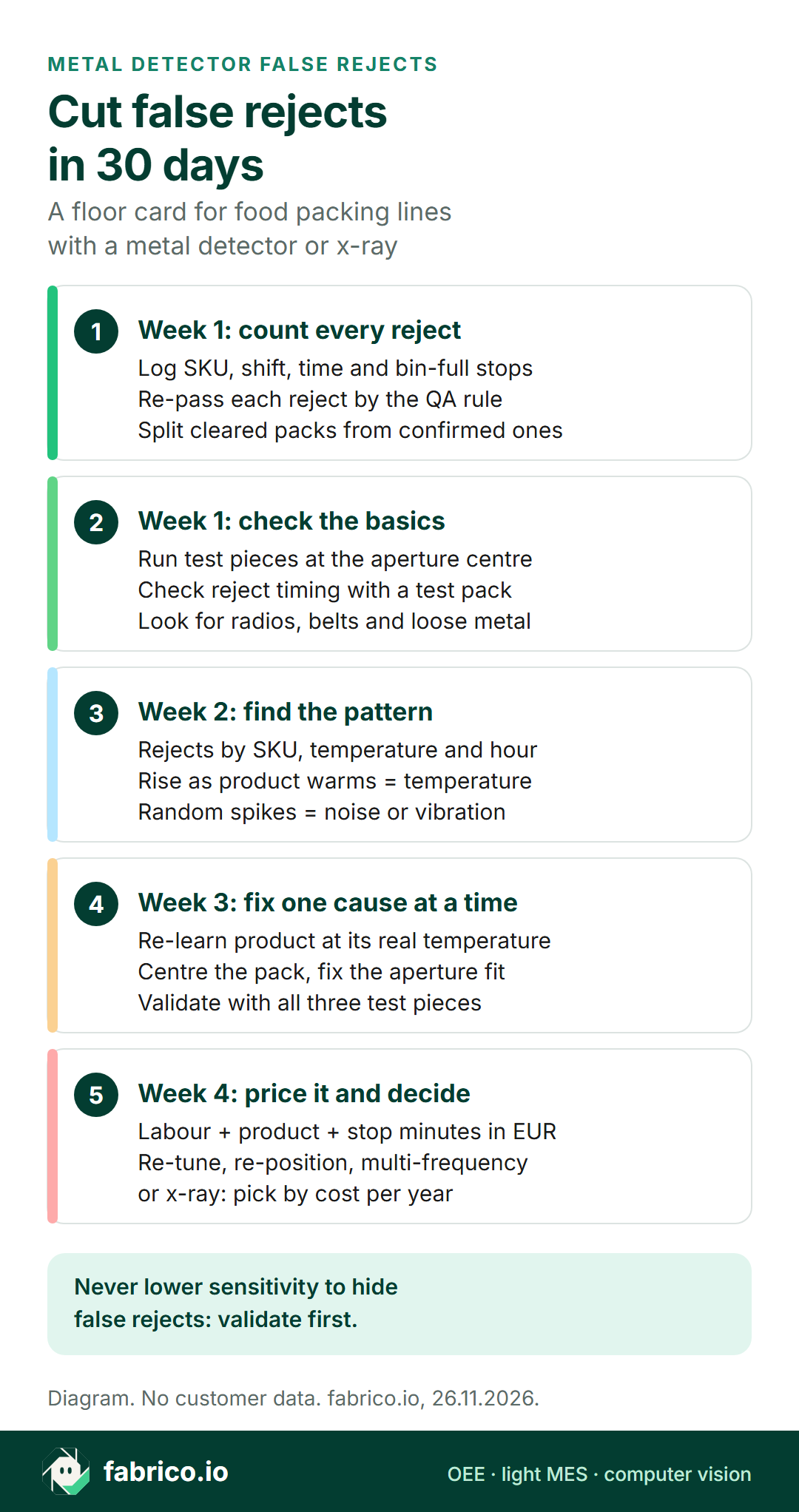
Text version of the diagram
- Week 1, count every reject: log SKU, shift, time and bin-full stops; re-pass each reject by the QA rule; split cleared packs from confirmed ones.
- Week 1, check the basics: run test pieces at the aperture centre; check reject timing with a test pack; look for radios, belts and loose metal.
- Week 2, find the pattern: rejects by SKU, product temperature and hour; rejects rising as product warms point to temperature drift; random spikes point to noise or vibration.
- Week 3, fix one cause at a time: re-learn the product at its real temperature; centre the pack and fix the aperture fit; validate with all three test pieces.
- Week 4, price it and decide: labour plus product plus stop minutes in EUR; choose between re-tune, re-position, multi-frequency or x-ray by cost per year.
Never lower sensitivity to hide false rejects: validate first.
Watch the machine upstream as well. When bin-full stops halt the detector conveyor, the thermoformer or sealer before it stops too, and the loss shows up in its numbers. The tray sealer OEE guide covers that side of the line.
Where Fabrico fits
Fabrico is OEE software and a light MES with computer vision. Fabrico is made by the publisher of this article. On this topic it does the counting and the pricing:
- A reject signal from the line PLC is counted like any machine signal; where there is none, reject counts are entered by product and reason.
- Scrap is recorded by product and reason, so cleared, confirmed and destroyed packs stay apart.
- A stop for a full reject bin gets its own reason, chosen by the operator at the machine in a few taps.
- With the selling price and margin of each product entered, losses are priced in money and stops are ranked by financial impact.
- OEE by line and shift (read at the core machine on a linked line), with analytics by hour, shift, day, week and month.
Detector settings and validation stay with QA and the detector supplier. See the OEE and MES software overview, or pricing: one quote per plant, by machines and modules.
Sources, accessed 26.11.2026: EUR-Lex, Regulation (EC) No 178/2002, General Food Law; US FDA, CPG Sec. 555.425, Foods, Adulteration Involving Hard or Sharp Foreign Objects; US FDA, Fish and Fishery Products Hazards and Controls Guidance, June 2022, chapter 20 Metal Inclusion; USDA Agricultural Marketing Service, QAD 609 Metal Detection procedure, 2018; UK Food Standards Agency, food alerts open data, product recall notices from 2025; Payne, O'Bryan, Marcy and Crandall, Detection and prevention of foreign material in food: a review, Heliyon 9(9), 2023, DOI 10.1016/j.heliyon.2023.e19574; Bai and Dong, High precision algorithm of metal detector based on balance coil, Journal of Shandong University (Engineering Science) 47(4), 2017, DOI 10.6040/j.issn.1672-3961.0.2016.112; Eurostat, Labour cost levels by NACE Rev. 2 activity (lc_lci_lev), Spain, manufacturing, 2025.
Frequently asked questions
What is an acceptable metal detector false reject rate?
No regulator publishes one figure. Set a target per SKU from two weeks of your own reject log, then price it: on the sample ham line in this article, 0.5% cost EUR 62,496 a year and 0.1% cost EUR 8,709.
Can rejected packs be put back through the metal detector?
Only under a written QA procedure in the HACCP plan, after the detector has passed its test pieces. FDA's seafood guidance lists hold and evaluate, rework, destroy, or divert to non-food use as the options for rejected product. Operators should never re-feed rejects on their own.
Why does a metal detector reject more packs as the product warms up?
Wet and salty product conducts, and its signal changes with temperature. A product learnt cold drifts toward the threshold as it warms. Re-learn at the real run temperature and keep product temperature steady.
Why does the metal detector reject with nothing on the belt?
That points to electrical noise, vibration or a ground loop in the conveyor, not the product. Run the belt empty, switch nearby drives and radios on and off, and tap the frame to find the source.
Do false rejects count as quality loss in OEE?
Destroyed packs do. Packs cleared on re-pass are good output but belong in the first-pass reject rate. Stops caused by a full reject bin are availability loss with their own reason.
How often should a metal detector be tested?
The HACCP plan and its validation set the frequency. FDA's seafood guidance tests at start, every 4 hours, on any change in processing factors and at the end; a USDA grading procedure tests at least once every hour.
Does x-ray inspection have fewer false rejects than a metal detector?
It has different ones. X-ray ignores salt and moisture but rejects on density changes such as folded slices or product in the seal. A trial of both on the real product settles the choice.
See every reject next to the stops it causes. A demo shows OEE by line and shift, scrap by product and reason, and losses priced in money from the prices and margins you enter.
Latest from our blog







Real Fabrico tiles, sample data.