





 Login
 Blog
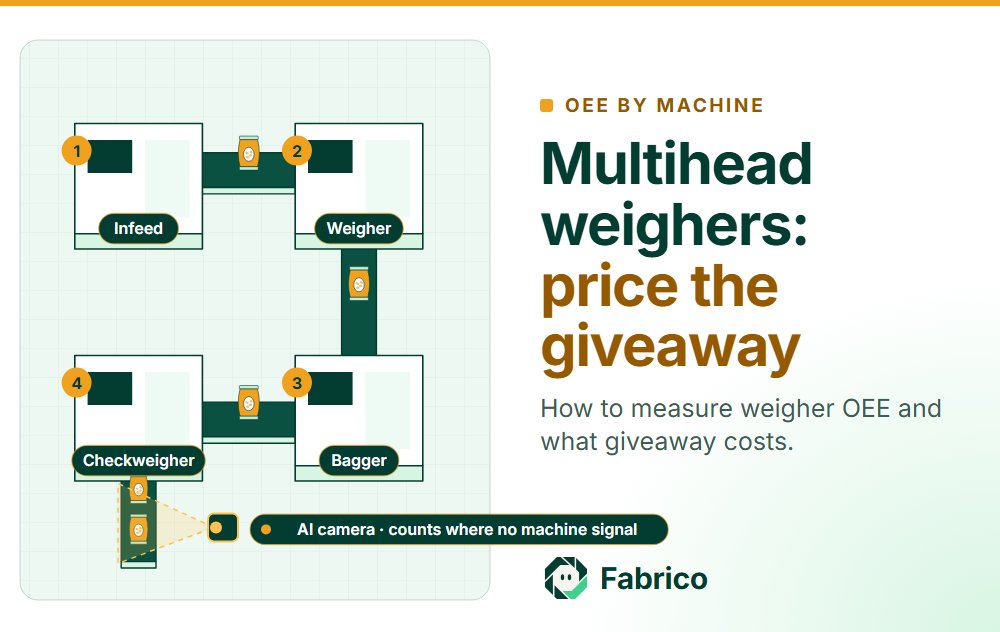
Multihead Weigher OEE: How to Measure It and Price Giveaway

In short
- Measure two views: OEE for the weigher and bagger as one unit at the bag, plus the weigher's own availability, performance and quality from its dumps and waits.
- Find the constraint by waiting time: if the bagger waits for the weigher more than the weigher waits for the bagger, the weigher sets the speed.
- Speed costs grams: at a higher dump rate fewer hoppers are ready, the fill spread widens and the legal floor for the average fill rises.
- Price both sides: in the worked example, 75 bags a minute instead of 80 saves EUR 194.61 a shift, about EUR 147,000 a year, while OEE falls from 84.8% to 81.0%.
- Keep giveaway beside OEE: OEE counts a heavy bag as a good bag, so grams need their own number.
Multihead weigher OEE is the share of planned time the weigher spends delivering good, on-target dumps at its rated speed. Measure it twice: for the weigher and VFFS bagger as one unit at the bag, and for the weigher alone, from its dumps, waits and no-combination cycles.
Then price the result. The weigher's speed and its giveaway pull against each other, and OEE only sees the speed side.
This page shows how to find which machine is the constraint, how to split each loss between weigher and bagger, why giveaway rises with speed under the average system, and a priced example: a 14-head weigher over a bagger rated 80 bags a minute, packing 150 g crisps in Spain.
Weigher or bagger: which one sets the speed
A multihead weigher makes weighments; the bagger makes bags. One dump fills one bag, so the pair never runs faster than the slower of the two. The catch is that the weigher's real limit is not its mechanical speed.
Its limit is how fast it can dump while still finding a combination close to target.
A 14-head weigher may manage 80 dumps a minute on crisps, but at that rate fewer hoppers are refilled and settled when the next combination is chosen. It keeps running, yet the spread widens and some cycles find no valid combination.
The bagger's rated 80 is then a speed the pair can reach, not one it can afford. The only way to know is to measure both machines at the speed you plan to run.
A three-signal test for the constraint
- Bagger waiting for weigher: the bagger is ready to make a bag and no dump has arrived. This time belongs to the weigher, or to the product feed above it.
- Weigher waiting for bagger: the weigher holds a ready combination and the bagger has not asked for it. This time belongs to the bagger.
- No-combination cycles: hoppers are loaded but no combination falls inside the weight limits. Count them per hour at each speed setting.
Run one full shift at the planned speed. If the bagger waits for the weigher more than the weigher waits for the bagger, the weigher is the constraint. If no-combination cycles jump between two speed settings, the upper setting is past what the weigher can do on that product.
The pair hands off through a ready signal and a discharge request, which may be wired through the line PLC. Those are the signals to log. The bagger's own losses, from film to jaws, are covered in the guide to VFFS machine OEE; this page stays on the weigher side of the pair.
The weigher's own availability, performance and quality
Pair OEE tells you how many good bags the line made. Weigher OEE tells you how much of the loss the weigher caused. Use the same planned production time for both, so the numbers can be compared shift by shift.
| Factor | What to measure on the weigher | Where the count comes from |
|---|---|---|
| Availability | Planned time minus weigher faults, starved infeed and weigher cleaning | Weigher ready signal, stop reasons |
| Performance | Good dumps a minute against the rated dump rate for that product | Dump count, discharge requests |
| Quality | Dumps that became a legal bag, minus over-limit and rejected dumps | Over-limit count, checkweigher rejects |
| Beside OEE | Mean giveaway in grams and the fill standard deviation | Checkweigher statistics or sample weighing |
Two rules keep weigher OEE clean:
- Blocked is not down. Time the weigher spends holding a ready combination because the bagger has stopped is the bagger's loss. Charge it there, or the weigher looks worse than it is.
- Rated means rated for the product. Set one rated dump rate per product and bag size, at the accuracy you need, not the brochure maximum. A light, bulky crisp and a dense frozen pea do not share a rated speed.
The quality factor is narrow on purpose. A bag 3 g over is still a good bag in OEE. Track grams next to it, as explained in the page on giveaway as a hidden quality loss, and count rejects the way the guide to checkweigher rejects in OEE quality sets out.
The weigher-bagger pair loss table
This is the table to pin at the line. Each loss has one owner and one OEE factor, so the morning meeting argues about fixes, not about who caused the stop.
| Loss | Charge to | OEE factor | What it costs |
|---|---|---|---|
| Infeed empty, weigher starved | Product feed | Availability | Crew minutes |
| Weigher fault or hopper error | Weigher | Availability | Crew minutes |
| Bagger waiting for a dump | Weigher | Performance | Bags not made |
| No-combination cycle | Weigher | Performance | Empty cycles |
| Weigher holding, bagger stopped | Bagger | Availability | Counted on the bagger |
| Over-limit dump rejected | Weigher | Quality | Product, time, breakage |
| Product in the seal | Discharge timing | Quality | Leakers, film |
| Splice, jaw or tracking stop | Bagger | Availability | Crew minutes |
| Mean fill above target | Weigher setup | Not in OEE | Grams on every bag |
Product in the seal sits between the two machines. If the product stream from the weigher is long or late against the jaw timing, the bagger seals on crisps. Give it its own reason code and check the discharge timing first, because the fix can sit in the hand-off between the two.
Waits of two or three seconds, repeated hundreds of times a shift, may never reach a paper log. Count them from the machine signal, as described in the page on micro-stops, and price them with the same crew minute as a long stop.
Why speed costs grams: the legal floor under the average system
E-marked packs in the EU follow the average system of Directive 76/211/EEC. As the directive reads, the actual contents shall not be less, on average, than the nominal quantity.
The share of packs short by more than the tolerable negative error (TNE) must be sufficiently small, and a pack short by more than twice the TNE may not carry the e-mark.
For a 150 g bag the TNE is 4.5% of the nominal quantity, rounded up to 6.8 g, per the table in the GB guidance on the Packaged Goods Regulations 2006. Check the table that applies in your market before you set a target.
The same guidance turns the three packers' rules into a target for a process with standard deviation s. The target mean must be the greatest of:
- the nominal quantity, here 150 g;
- nominal minus 1 TNE plus 2s;
- nominal minus 2 TNE plus 3.72s.
The guidance adds that where s stays below half a TNE, the average rule is the critical one. Above that, the target always has to sit above the label weight. For a 150 g bag, half a TNE is 3.4 g.
That single number tells you how much spread you can afford before every extra tenth of a gram of s costs product.
Where speed comes in
A multihead weigher cuts spread by choosing from many possible combinations of hopper weights. A study of weigher setup published in the European Journal of Operational Research found the error of packed weights falls drastically as the number of available combinations rises, with the number of hoppers fixed (del Castillo, Beretta and Semeraro).
Speed works the other way. Each dump empties several hoppers that must refill and settle before they can be chosen again. Push the dump rate and fewer hoppers are ready, so fewer combinations are on offer and s rises. Once s passes 3.4 g on a 150 g bag, the legal floor climbs with it.
The instrument's own class
The weigher is also a measuring instrument. OIML R 61-1 calls it a selective combination weighing instrument, one that computes an appropriate combination of the loads and combines them into one fill.
Under Annex MI-006 of the Measuring Instruments Directive 2014/32/EU, a fill of 100 to 200 g in class X(1) may deviate from the average fill by up to 3.6%, which is 5.4 g on a 150 g bag. The operational class is set after installation for the products weighed.
That class is a ceiling for the machine, not a target for the plant. A weigher well inside its class still gives product away if the target is set by habit. The class covers the instrument; the packers' rules cover the packs.
Worked example: 150 g crisps in Spain at four speeds
Spain suits the example: food was the largest contributor to Spanish manufacturing product sales in 2024, 22.6% of EUR 552,895 million, per the INE annual industrial products survey. The numbers below are an example, not a customer's. Sample figures are labelled; replace them with your own trial data.
Inputs
- Line: 14-head weigher over a VFFS bagger rated 80 bags a minute, 150 g e-marked crisps.
- Shifts: three 8-hour shifts, each with 460 minutes of planned production (20 minutes of breaks and checks) and 60 minutes of stops (sample figure), so 400 minutes of run time.
- Calendar: 21 production days a month (63 shifts) and 252 a year (756 shifts).
- Labour: EUR 28.20 an hour, the 2025 hourly labour cost for Spanish manufacturing in Eurostat lc_lci_lev. A crew of 3 on the line (sample figure) costs EUR 84.60 an hour, EUR 1.41 a minute.
- Product cost: EUR 3.00 per kg of finished crisps (sample figure; use your standard cost).
- Buffer: the plant sets its target 1.0 g above the legal floor (sample figure).
- Sampling: the line checks at least 50 bags per 10,000 packed, so the GB guidance adds no sampling allowance.
- Rejects: the same at every speed in this trial, so they cancel and are left out.
Trial results at four speeds (sample figures)
| Set speed | Bags a minute | Fill SD | Mean giveaway | Pair OEE |
|---|---|---|---|---|
| 65 | 65.00 | 2.4 g | 1.0 g | 70.7% |
| 70 | 69.86 | 2.9 g | 1.0 g | 75.9% |
| 75 | 74.55 | 3.6 g | 1.4 g | 81.0% |
| 80 | 78.00 | 4.4 g | 3.8 g | 84.8% |
Bags a minute is the set speed minus no-combination cycles: none at 65, 0.2% at 70, 0.6% at 75 and 2.5% at 80. Pair OEE is availability (400 ÷ 460 = 86.96%) times performance (bags a minute ÷ 80).
The giveaway column comes straight from the three rules.
At 80 a minute: 150 - 6.8 + 2 × 4.4 = 152.0 g, and 150 - 13.6 + 3.72 × 4.4 = 152.77 g. The floor is 152.8 g after rounding up; add the 1.0 g buffer and the mean is 153.8 g, 3.8 g over.
At 75: 150 - 6.8 + 2 × 3.6 = 150.4 g is the highest of the three, so the mean is 151.4 g with the buffer. At 65 and 70 the spread stays under 3.4 g, the average rule binds and the mean is 151.0 g.
Slowing from 70 to 65 buys no grams at all: below 3.4 g of spread, only a smaller buffer cuts giveaway further.
The cost of making the same 31,200 bags
At 80 a minute the shift makes 400 × 78.00 = 31,200 bags. To compare like with like, each slower speed has to make the same 31,200 bags, so it needs extra crew time. Extra minutes = 460 × (31,200 ÷ bags made in the shift - 1).
| Speed | Giveaway on 31,200 bags | Extra crew time | Total a shift |
|---|---|---|---|
| 65 | 31.20 kg, EUR 93.60 | 92.0 min, EUR 129.72 | EUR 223.32 |
| 70 | 31.20 kg, EUR 93.60 | 53.6 min, EUR 75.58 | EUR 169.18 |
| 75 | 43.68 kg, EUR 131.04 | 21.3 min, EUR 30.03 | EUR 161.07 |
| 80 | 118.56 kg, EUR 355.68 | 0 min, EUR 0 | EUR 355.68 |
Running at 75 instead of 80 saves EUR 355.68 - EUR 161.07 = EUR 194.61 a shift. That is EUR 194.61 × 63 = EUR 12,260.43 a month and EUR 194.61 × 756 = EUR 147,125.16 a year, if the trial results hold across products.
OEE prefers 80 a minute: 84.8% against 81.0%. The money prefers 75. Neither number alone picks the speed; put grams and minutes in the same currency first.
If the plant is sold out
When every extra bag can be sold, price speed by margin instead of crew time. At 80 a minute the shift makes 1,380 more bags than at 75 (31,200 against 29,820).
The giveaway gap is 118.56 kg against 41.75 kg (29,820 × 1.4 g), so EUR 355.68 - EUR 125.24 = EUR 230.44 a shift. Running at 80 pays only if each extra bag earns more than EUR 230.44 ÷ 1,380 = EUR 0.167 in contribution margin. Below that, 75 still wins.
Two unit costs to put on the line board
- One gram on every bag at 75 a minute: 29,820 × 1 g = 29.82 kg × EUR 3.00 = EUR 89.46 a shift, EUR 67,631.76 a year.
- One minute of stop that has to be made up: EUR 1.41 of crew time, or 74.55 bags of margin if the plant is sold out.
In this example one gram on every bag costs as much as 63 minutes of crew time a shift (89.46 ÷ 1.41). That ratio is why the target setting deserves the same attention as the stop list.
Product flow losses, and how to count each one
Weigher losses can start above the scale, in how product arrives and how it leaves the buckets. Each one has a signal or a count you can log by shift and price with the unit costs above.
- Bridging: product wedges across a pool or weigh hopper and does not drop on time. It shows as a hopper error or a slow dump. Charge it to the weigher and look at gate timing and hopper fill level.
- Sticky or oily product: seasoned and oily crisps leave a film on buckets and chutes. Product hangs, weights drift and dumps slow. A rise in hopper errors late in the shift, reset by a wipe-down, points at build-up.
- Uneven infeed: the top cone or radial feeders deliver unevenly, so some heads run light and others heavy. Fewer usable combinations follow and the spread grows. Check per-head weights, then feeder settings and the level control.
- Hopper starvation: the elevator or incline conveyor above the weigher runs empty. Charge it to the product feed, not the weigher, with its own stop reason.
- Empty dumps and no-combination cycles: the weigher has no valid combination and the bagger cycles without product, or waits. Count them per hour; a sharp rise at one speed setting marks the weigher's real limit on that product.
- Over-limit dumps: the combination is above the upper weight limit and is rejected or held. Count it as weigher quality loss. Product sent back to the infeed still costs time and breakage.
On frozen lines the list shifts but the method does not. Frost on buckets acts like oily build-up, clumps act like bridging, and a long stop lets product thaw and stick. Log each as its own reason so the pattern shows by hour.
Price the worst one first. In the example, a 0.4 g rise in mean fill caused by uneven infeed costs 0.4 × EUR 89.46 = EUR 35.78 a shift, more than 25 minutes of crew time.
Changeovers between products and bag sizes
A weigher changeover has its own steps, separate from the bagger's former, film and coder. Time each part against its own standard, so a long changeover shows which machine held the line.
- Weigher part: recall the product program (target, upper limit, feeder settings, timings), clean buckets and chutes when the flavour or allergen changes, weigh the first bags and confirm the target.
- Bagger part: former tube and bag length, film reel, date coder, seal check on the first bags.
- Shared part: discharge timing against the jaws, because a new bag length or product changes the product stream.
Prepare what needs no stop before the stop: stage the next program, the cleaning kit and the sample scale. A crew waiting for any of the three is lost time that no machine caused.
The target is the step that is easy to skip. A new flavour can change piece weight and spread, so the old target may be too high or too low. Weigh a sample of first bags, work out s, and reset the target from the three rules before going to full speed.
Price the overrun the same way as a stop. In the example, every 10 minutes beyond the standard costs EUR 14.10 of crew time and about 746 bags of output at 75 a minute.
How to start: a one-week weigher trial
The trial needs no new equipment on day one: the weigher's own counters, the checkweigher statistics and a stop log split by owner. Run each speed for at least a full shift on the same product, so the spread is measured, not guessed.
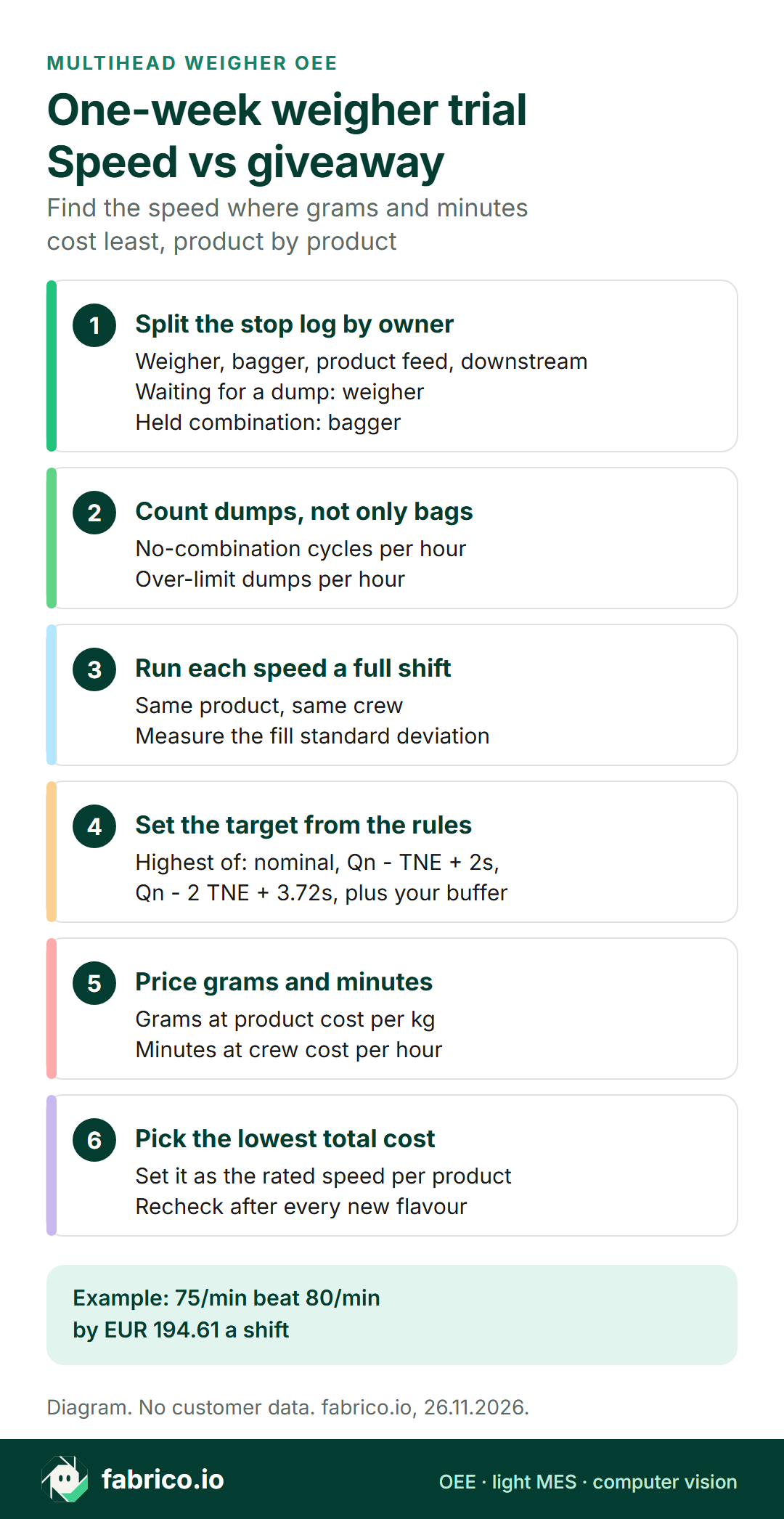
Text version of the diagram
- Split the stop log: weigher, bagger, product feed and downstream; waiting for a dump goes to the weigher, a held combination to the bagger.
- Count dumps, no-combination cycles and over-limit dumps per hour, not only bags.
- Run each candidate speed for a full shift on one product and measure the fill standard deviation.
- Set the target from the three packers' rules plus your buffer.
- Price giveaway grams at product cost and lost minutes at crew cost.
- Choose the speed with the lowest total cost, set it as the rated speed for that product, and recheck after each new flavour.
At the end of the week you have one rated speed and one target per product, both backed by data. Write them into the product program and the line's standard, and re-run the trial when the product or the infeed changes.
Choosing how to measure the pair: options, cost and who picks which
There are four ways to get these numbers, and a plant can end up using two: one for weight, one for time. The weight side and the time side may not come from the same system.
Weight data: the weigher and the checkweigher
The weigher's screen and the checkweigher's statistics give the mean, the spread and the reject counts by product. That is enough to set targets and track giveaway. They may not show why the line stopped, or for how long, by shift.
Time data: OEE or light MES software from machine signals
OEE or light MES software reads the weigher and bagger signals through the line PLC or an added sensor, counts stops, waits and output by shift, and asks the operator for a reason at the machine. It answers the constraint question with data, not opinion.
What you see: a shift timeline, unclassified time waiting for a reason, and the operator's line-down screen, on sample lines. Book a demo.
Plays from YouTube. Google may set cookies when you press play. Privacy policy.
| Option | What it gives | Cost | Fits |
|---|---|---|---|
| Paper log and checkweigher reports | Stops by shift, giveaway by batch | Operator and supervisor time | One line, first month |
| Weigher and checkweigher statistics | Mean, spread, dump and reject counts | Can be part of the machines; ask the supplier about data export | Setting targets |
| OEE or light MES software | Stops, waits, counts and reasons for the pair, priced | Ask the vendor for a price per line per month | Several lines, daily meetings |
| Camera counting | Output where a station has no usable signal | Ask the vendor for a price per line per month | Older bagger or case packer |
For lists of tools, see the comparisons of OEE software for high speed packaging lines and OEE software for food and beverage, or the overview of OEE software.
Who should pick which
- One line, giveaway is the worry: start with the weigher and checkweigher statistics and a paper stop log split by owner.
- Several weigher lines, speed disputes every week: line software from machine signals, so waits and no-combination cycles are counted, not argued.
- A mix of old and new machines: software from signals where they exist, camera counting where they do not.
- Quality owns the target, production owns the speed: give both the same priced table, or each will optimise half the problem.
Questions to ask a vendor or supplier
- Which weigher and bagger signals can be logged: ready, discharge request, dump count, no-combination?
- Can blocked and starved time be charged to the machine that caused it?
- Can the rated speed be set per product and bag size?
- How are stops of two or three seconds counted, and can they be grouped by hour?
- Can checkweigher reject counts be logged or entered beside OEE?
- How are losses priced, and which price and margin fields are needed per product?
- What does it cost per line per month, and what has to be installed at the machine?
Where Fabrico fits
Fabrico is made by the publisher of this article.
- Real-time OEE (availability x performance x quality); on a linked weigher and bagger, OEE by line and shift, read at the core machine.
- Machines connect through the line PLC or a Fabrico IoT device with sensors; micro-stops come from the machine signal.
- Stop reasons are chosen by the operator at the machine in a few taps, with planned and unplanned stops kept apart.
- A reject signal from the line PLC, such as a checkweigher reject, can be counted like any machine signal, and scrap is recorded by product and reason.
- Changeovers are tracked against a standard time; with the selling price and margin of each product entered, losses are priced in money and stops ranked by financial impact.
- Where a station has no usable signal, the camera add-on counts output: see OEE with computer vision. Pricing is one quote per plant by machines and modules.
Sources, accessed 26.11.2026: Eurostat, Labour cost levels by NACE Rev. 2 activity (lc_lci_lev); Eurostat, Hourly labour costs; EUR-Lex, Council Directive 76/211/EEC on prepackaged products; EUR-Lex, Directive 2014/32/EU, Annex VIII (MI-006); OIML, R 61-1:2017 Automatic gravimetric filling instruments; GOV.UK, Weights and Measures (Packaged Goods) Regulations 2006: Guidance (GB); del Castillo, Beretta and Semeraro, Analysis and Optimal Targets Setup of a Multihead Weighing Machine, European Journal of Operational Research 259(1), 2017; INE, Encuesta Industrial Anual de Productos 2024.
Frequently asked questions
How do you calculate OEE for a multihead weigher?
Use the pair's planned production time. Availability is that time minus weigher faults, starved infeed and weigher cleaning; performance is good dumps a minute against the rated dump rate for the product; quality is dumps that became legal bags. Keep giveaway in grams beside it.
Is the weigher or the VFFS bagger the bottleneck?
Compare waiting time over a full shift. If the bagger waits for dumps more than the weigher waits for the bagger, the weigher is the constraint. A sharp rise in no-combination cycles at one speed setting confirms it.
Why does giveaway rise when the weigher runs faster?
At a higher dump rate fewer hoppers are refilled and settled for each choice, so fewer combinations are available and the fill spread grows. Under the average system a wider spread forces a higher target once it passes half the tolerable negative error.
What is the legal minimum average fill for a 150 g bag?
It is the greatest of 150 g, 150 - 6.8 + 2s and 150 - 13.6 + 3.72s, where s is the fill standard deviation and 6.8 g is the tolerable negative error from the GB guidance table. With s at 3.4 g or less, the floor is 150 g.
What is a no-combination cycle?
A cycle where the weigher has loaded hoppers but none of the possible combinations falls inside the weight limits, so it cannot dump. The bagger waits or makes an empty cycle. Count it as a weigher performance loss.
How often should the weigher target be reset?
Whenever the spread changes: a new product or flavour, a new bag size, a change in infeed, or a new rated speed. Weigh a sample of first bags, work out the standard deviation and set the target from the three packers' rules.
See the line's losses on one screen. The demo shows OEE by line and shift, stops with operator reasons and losses priced in money from machine signals.
Latest from our blog






Real Fabrico tiles, sample data.