





 Login
 Blog
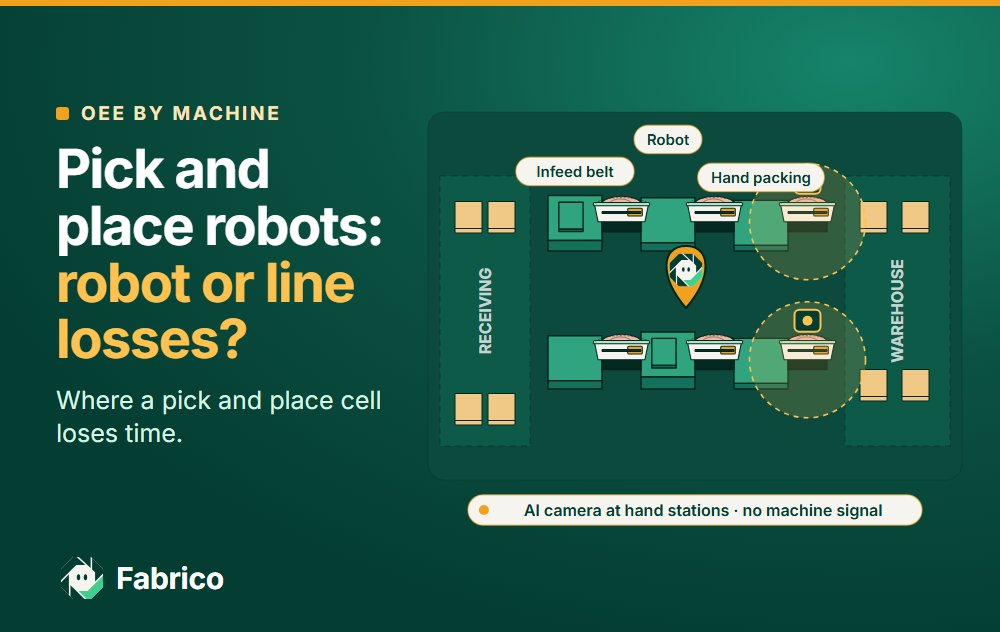
Pick and Place Robot OEE: Robot Losses or Line Losses?

In short
- Count four points: packs presented at the infeed, packs placed by the robots, trays leaving the cell and packs in the catch bin. Presented is total count, packs in accepted trays are good count.
- Rated cell speed, not robot speed: performance compares packs presented with the rated packs a minute of the whole cell. A cell can never run faster than the wrapper feeds it.
- Robot or line: in the worked example only 13% of the lost packs start in the robots. Half start in the tray supply, the wrapper and the product spacing upstream.
- Missed picks cost twice: lost cell output plus hand repacking. Weigh the catch bin every shift to count them.
- The money: in the example, 24 minutes of tray starvation a shift cost EUR 864 a shift and EUR 622,080 a year in lost margin, if the plant can sell every pack.
Pick and place robot OEE is availability x performance x quality for the whole robotic cell: robots, vision system, infeed belt, tray supply and outfeed. Measure it against the rated cell speed in packs a minute. Total count is packs presented at the infeed; good count is packs in trays that pass the tray check.
Then tag every loss with where it starts: in the robot, in the line around it, or in shared work such as changeovers. Below: a loss split table, one worked shift on two delta robots packing biscuits in Italy, the cost in EUR, and how to count a cell with no usable signal.
What OEE means on a robotic top-loading cell
A top-loading cell takes flow-wrapped packs from a belt and places them into trays or cases. Delta or SCARA robots do the picking. A vision system above the belt finds each pack's position and angle, so the robot knows where to pick.
The OEE formula is the same as for any machine. The definitions are what make it useful on a robot cell:
- Rated speed: the packs a minute the cell is specified to place for the format running. Two robots at 120 picks a minute make a 240 packs a minute cell.
- Total count: packs presented to the pick zone, counted at the cell infeed.
- Good count: packs in trays that pass the tray check and leave the cell.
- Planned production time: shift time minus planned breaks.
Two choices trip most plants. Counting robot picks as total count hides missed picks: a pack that rides past both robots never shows as a loss. And using a robot's catalogue cycle time as the rated speed makes performance look poor for reasons nobody on the floor can fix.
Robotic welding cells need other counts, such as arc-on time and parts per fixture: see OEE for robotic welding cells. The case packer that often follows a top-loader has its own losses, covered in case packer OEE.
These cells are spreading. The International Federation of Robotics reports that the EU food and beverage industry installed 5,300 industrial robots in 2025, up 4%, while total EU installations fell 11% to 60,500. Italy installed about 7,800, the second-largest EU market.
The four count points
One count is not enough on a robot cell. Four counts, each from its own place, let the losses be separated:
| Count point | Counts | Typical source | Used for |
|---|---|---|---|
| Cell infeed | Packs presented | Photo-eye on the infeed belt | Total count, performance |
| Robot controller | Packs placed, fault codes | Robot counters mapped to the cell PLC | Robot losses, fault minutes |
| Tray outfeed | Trays out x packs per tray | Photo-eye, or a camera where no signal exists | Good count |
| Catch bin | Packs no robot picked | End-of-belt photo-eye or bin weight | Missed picks |
The counts must close every shift: presented equals placed plus missed, and placed equals good plus rejected at the tray check. If they do not close, one sensor is wrong. Fix that before anyone discusses OEE.
The eight losses of a pick and place cell
Every robotic packing cell loses output in the same eight ways. The names differ by plant; the mechanics do not.
- Missed picks. A pack passes the pick zone of every robot and ends in the catch bin or on a return belt. Typical causes: packs touching, packs rotated past the pick window, a belt too fast for the zone, worn cups, a vision misread.
- Recirculated and rejected packs. A return belt sends unpicked packs round again, using belt space twice. Crushed, misplaced or double-placed packs are pulled at the tray check.
- Gripper and suction faults. Vacuum alarms, worn or torn cups, a blocked filter, a cup set changed mid-shift.
- Tray or case starvation. The tray erector or denester stops, the blank magazine runs empty, trays arrive skewed. The robots wait with nowhere to place.
- Spacing and orientation upstream. Packs leave the wrapper in clusters, touching or rotated. The robots cannot keep up during a burst and wait during the gap.
- Recipe changeovers. New pick pattern, new tray, new cup set, new vision recipe, first trays checked by quality.
- Safety stops and door opens. A guard door opened to clear a jam or pull a fallen pack stops the cell, by design.
- Micro-stops. Stops under 2 minutes: a vacuum reset, a tray nudged straight, a short door open. Each one is small. Fifty a shift is not.
The tray is also the shelf display. FEFCO describes shelf-ready packaging as faster and easier shelf replenishment, because it is no longer necessary to re-stock shelves. A tray with a gap or a crooked pack goes on the shelf as it is, which is why the tray check rejects it.
Pick order is a hidden speed loss
Some speed losses never show on a fault list. In a peer-reviewed study, Han, Feng and Yu (IEEE Robotics and Automation Letters, 2020) note that simple greedy pick orders are common on moving conveyors. Computed pick sequences gave typical efficiency gains of about 10-40% over them on delta and SCARA robot models.
That is a lab result, not a promise for any cell. It shows why a cell that never stops can still lose speed inside the robot.
Robot or line? The loss split table
Every loss shows on the cell. Few start there. Tag each loss with where it starts and who owns the fix before anyone opens the robot programme.
| Loss | Starts in | Shows on the cell as | Owner | First fix |
|---|---|---|---|---|
| Missed picks, packs touching | Wrapper, infeed belt | Misses in bursts, both robots busy | Line lead | Spacing belt speed, wrapper gap check |
| Missed picks, normal spacing | Robot: cups, pick window, vision | Misses spread evenly, one robot worse | Robot technician | Cup change by hours run, vision recipe check |
| Gripper and suction faults | Robot | Vacuum alarm, stop | Robot technician | Cup and filter plan by hours run |
| Tray starvation | Tray erector, blank magazine | Robots waiting, no tray in place | Line lead | Magazine refill rule, erector stops logged |
| Infeed starvation | Wrapper, upstream | Robots idle, belt empty | Line lead | Log on the wrapper, not the cell |
| Outfeed blocked | Case packer, palletiser | Trays backed up, cell stops | Line lead | Downstream stop log, accumulation |
| Slow feed, gaps | Wrapper speed, product flow | Running below rated, no stop | Line lead | Wrapper rate against cell rating |
| Changeover overrun | Process and people | Long stop at a format change | Shift lead | Standard time and checklist |
| Safety stops, door opens | Jams in the cell, people | Short and long stops | Shift lead, safety | Remove the reason the door opens |
| Rejects at tray check | Robot placement, tray quality | Packs pulled, trays rejected | Quality | Place offsets, tray spec |
The owner column is the point. A robot technician cannot fix a blank magazine that runs empty at 3 a.m., and a line lead cannot change a vision recipe.
Starvation and blocking stay in the cell's OEE, because the cell lost the time. They are tagged as line losses, so the robot team is not blamed for them, and the wrapper or tray erector stop log shows the same minutes from its side.
How to tell a robot miss from a line miss
Missed picks are where the argument starts. Four checks on one week of data settle most of it:
- Misses against spacing. If misses rise when packs arrive touching or in clusters, the cause is upstream. A look at the infeed belt during a burst usually shows it.
- Misses by robot. In a two-robot cell, the second robot picks what the first one leaves. If one robot misses more than its share with normal spacing, check its cups and pick window first.
- Misses against speed. If the miss rate climbs with cell speed, the pick zone is too short for the rate. More speed then costs more in misses than it gains.
- Misses after a changeover. If the first hour after a format change misses most, the vision recipe or pick offsets were not set to standard.
To count misses without a sensor, weigh the catch bin at the end of each shift and divide by the pack weight. It takes a few minutes and turns "quite a few" into a number.
Recirculation hides misses
Cells with a return belt send unpicked packs round again. Nothing lands in a bin, so misses vanish from view. A photo-eye on the return belt counts them: each one is a pick the cell paid for twice in belt space.
Worked example: two delta robots top-loading biscuits in Italy
The numbers below are an example, not a customer's. Every line can be redone with a calculator.
- Cell: two delta robots with a vision system, top-loading flow-wrapped biscuit packs into shelf-ready trays of 12.
- Rated speed: 240 packs a minute, 120 per robot, so 20 trays a minute.
- Feed: straight from the flow wrapper with no buffer, so a cell stop is a line stop.
- Shifts: 3 shifts of 8 hours with 30 minutes of planned break: 450 minutes of planned production time. 20 days a month gives 60 shifts a month and 720 a year.
- Pack values (sample figures): sold value EUR 0.60 a pack, contribution margin EUR 0.15 a pack.
- Labour: Eurostat labour cost levels (lc_lci_lev) put Italian manufacturing at EUR 32.80 an hour in 2025.
The stops in one shift
| Stop | Minutes | Packs lost (x 240) | Starts in |
|---|---|---|---|
| Changeover (standard 15 min) | 26 | 6,240 | Shared |
| Tray starvation | 24 | 5,760 | Line |
| Infeed starvation (wrapper) | 18 | 4,320 | Line |
| Safety stops, door opens | 10 | 2,400 | Shared |
| Gripper and suction faults | 9 | 2,160 | Robot |
| Outfeed blocked | 8 | 1,920 | Line |
| Vision and teach faults | 5 | 1,200 | Robot |
| Total | 100 | 24,000 |
OEE for the shift
- Availability: 450 minus 100 minutes of stops leaves 350 minutes of run time. 350 / 450 = 77.8%.
- Performance: 48 micro-stops of 15 seconds take 12 minutes. In the other 338 minutes the wrapper fed 232 packs a minute: 78,416 packs presented. The ideal in run time is 350 x 240 = 84,000. 78,416 / 84,000 = 93.4%.
- Quality: 940 packs missed (1.2% of presented) and 196 pulled at the tray check. 78,416 minus 940 minus 196 leaves 77,280 good packs: 6,440 full trays. 77,280 / 78,416 = 98.6%.
- OEE: 77.8% x 93.4% x 98.6% = 71.6%. Check: 77,280 / (450 x 240 = 108,000) = 71.6%.
The counts close: 78,416 presented equals 77,476 placed plus 940 missed, and 77,476 placed equals 77,280 good plus 196 rejected.
Robot or line, in packs
Of the 108,000 packs the cell could have placed in planned time, 30,720 were lost. Split by where each loss started:
- Line, 15,304 packs (49.8%): tray starvation 5,760, infeed starvation 4,320, outfeed blocked 1,920, slow feed 2,704 (338 minutes x 8 packs below rated), and 600 misses during bursts of touching packs.
- Shared, 11,520 packs (37.5%): changeover 6,240, door opens and safety stops 2,400, micro-stops 2,880.
- Robot, 3,896 packs (12.7%): gripper faults 2,160, vision faults 1,200, 340 misses with normal spacing and 196 placement rejects.
The 940 misses were split with the spacing check above: misses during bursts went to the line, misses with normal spacing to the robot.
The robot gets the blame because the robot is where the stop shows. In this example the robots start about 1 lost pack in 8. Tray starvation alone loses more packs than the grippers, the vision system and the robot misses together.
What the losses cost per shift, month and year
Lost minutes are priced at the sample margin of EUR 0.15 a pack: EUR 36 for every minute the cell stands (240 x 0.15). That money is real when the plant can sell every pack, or when it pays overtime to catch up. Scrap is priced at the sample sold value of EUR 0.60 a pack.
| Cost line | Per shift | Per month (60) | Per year (720) |
|---|---|---|---|
| Tray starvation: 5,760 packs x EUR 0.15 | EUR 864.00 | EUR 51,840 | EUR 622,080 |
| Infeed starvation: 4,320 packs x EUR 0.15 | EUR 648.00 | EUR 38,880 | EUR 466,560 |
| Changeover overrun: 11 min x 240 x EUR 0.15 | EUR 396.00 | EUR 23,760 | EUR 285,120 |
| Missed picks, hand repack: 40 min x EUR 32.80 an hour | EUR 21.87 | EUR 1,312 | EUR 15,744 |
| Missed picks, scrapped: 140 packs x EUR 0.60 | EUR 84.00 | EUR 5,040 | EUR 60,480 |
| Tray check rejects: 196 packs x EUR 0.60 | EUR 117.60 | EUR 7,056 | EUR 84,672 |
Missed picks: the repack line nobody budgets
Of the 940 missed packs, 800 are clean. An operator places them into trays by hand at about 20 a minute: 40 minutes a shift. The other 140 are crushed or open and go to scrap.
Hand repacking looks cheap at EUR 21.87 a shift. It is also 40 minutes of an operator not watching the cell. The repacked trays reach the shelf, so the product is saved, but they stay a quality loss for the cell: the robots did not place those packs.
Missed picks in total cost EUR 105.87 a shift, EUR 6,352 a month and EUR 76,224 a year here. Small next to tray starvation, but a rising miss rate is an early sign of a spacing or gripper problem.
Changeovers: price the overrun, not the whole stop
The full changeover takes 26 minutes: 6,240 packs, EUR 936 a shift at the margin. Only the 11 minutes over the 15-minute standard are in the table, because that is the part a checklist can win back. The method is in changeover time.
What fixing the top two would earn
If tray starvation drops from 24 to 6 minutes a shift and changeovers hold the 15-minute standard, the cell gains 18 plus 11 minutes: 6,960 packs a shift. At the sample margin that is EUR 1,044 a shift, EUR 62,640 a month and EUR 751,680 a year, if the gain holds and the packs sell.
The robots' own losses cost EUR 584.40 a shift at the same margin (3,896 x 0.15). Worth fixing, but third in line.
Safety stops and door opens: count them, never shortcut them
A guard door that stops the robots is doing its job. The EU Machinery Regulation (EU) 2023/1230, which applies from 14 January 2027, requires interlocking movable guards to have a device that "gives a stop command whenever those guards are no longer closed".
ISO 10218-1:2025 treats the industrial robot itself as partly completed machinery; its integration into a cell is covered by ISO 10218-2. Guard design belongs to the integrator and the safety team, not to an OEE project.
HSE guidance on machinery guards says opening an interlocked guard should stop the machine or that part, and that the interlocking switch should make it difficult for someone to defeat.
So a cell that loses 10 minutes a shift to door opens has a jam problem, not a guard problem. Count each door open as a stop reason with what the operator went in to do:
- Clear a jam at the tray conveyor.
- Pull a fallen or crushed pack from the pick zone.
- Straighten a skewed tray.
- Change or clean cups.
The count shows which jam to engineer out. Every door open avoided is minutes back, with the guarding unchanged.
Decision: how to count the cell and track its losses
The split table needs data, so the counting choice comes first. Four options, from lightest to heaviest:
| Option | Gives | Cost basis | Fits |
|---|---|---|---|
| Stop sheet, tally and bin weight | Stops over 2 min, misses from bin weight | 10 min a shift: EUR 5.47 a shift, EUR 3,936 a year at Italian 2025 labour cost | A 4-week baseline on one cell |
| Cell PLC signals into line software | Run, stop, micro-stops, infeed and tray counts, reasons from the operator | Ask the vendor for a price per line per month | Cells where the PLC signals can be reached |
| Robot controller counters | Placed count, robot fault codes | Integrator hours: ask the integrator for a fixed quote | Cells where robot losses are disputed |
| Camera counting trays at the outfeed | Trays out where no usable signal exists | Ask the vendor for a price per line per month | Closed cells, old controllers, no integrator support |
Line software that reads machine signals, such as OEE software, turns the cell's run and stop signals into stops, micro-stops and counts per shift, and lets the operator choose the stop reason at the cell.
The OEE screens your counts feed, in Fabrico. The video shows the software, not the camera. Book a demo.
Plays from YouTube. Google may set cookies when you press play. Privacy policy.
The robot controller is the richest source but the hardest to reach. Its counters and fault codes often sit behind the integrator's programme. Mapping a placed count and a fault word to the cell PLC is a small job when the integrator is still around, and a project when nobody has the source code.
A camera at the tray outfeed counts trays, not picks. It does not see why a pack was missed. Missed picks still need an end-of-belt photo-eye or the weighed catch bin. How camera based production monitoring works, and how many cameras a line needs for OEE, are covered separately.
Who should pick which
- One cell, nobody agrees on the losses: the stop sheet and bin weight for 4 weeks. It shows the split before any money is spent.
- Several cells, PLC signals reachable: cell signals into line software first. Add robot counters later, only if robot losses stay disputed.
- A closed cell or a controller nobody can open: a camera on the tray outfeed, plus the bin weight for misses.
- Many lines across a site: compare OEE software for high speed packaging lines and OEE software for consumer goods before a pilot.
Questions to ask a vendor or integrator
- Which signal marks the cell as running, and is a robot waiting for trays told apart from a robot stopped by a fault?
- Are stops under 2 minutes kept as micro-stops, or lost inside run time?
- Can the operator choose a stop reason at the cell, including which door was opened and why?
- Can starvation and blocking be tagged to the upstream or downstream machine?
- Where the cell gives no usable signal, what counts the trays, and how is that checked against a hand count?
- How are changeovers timed against a standard for each format?
- What is the price per line per month, and what does it include?
A first-month plan for one cell
A month is enough to know where the losses of one cell start. The plan fits on one floor card:
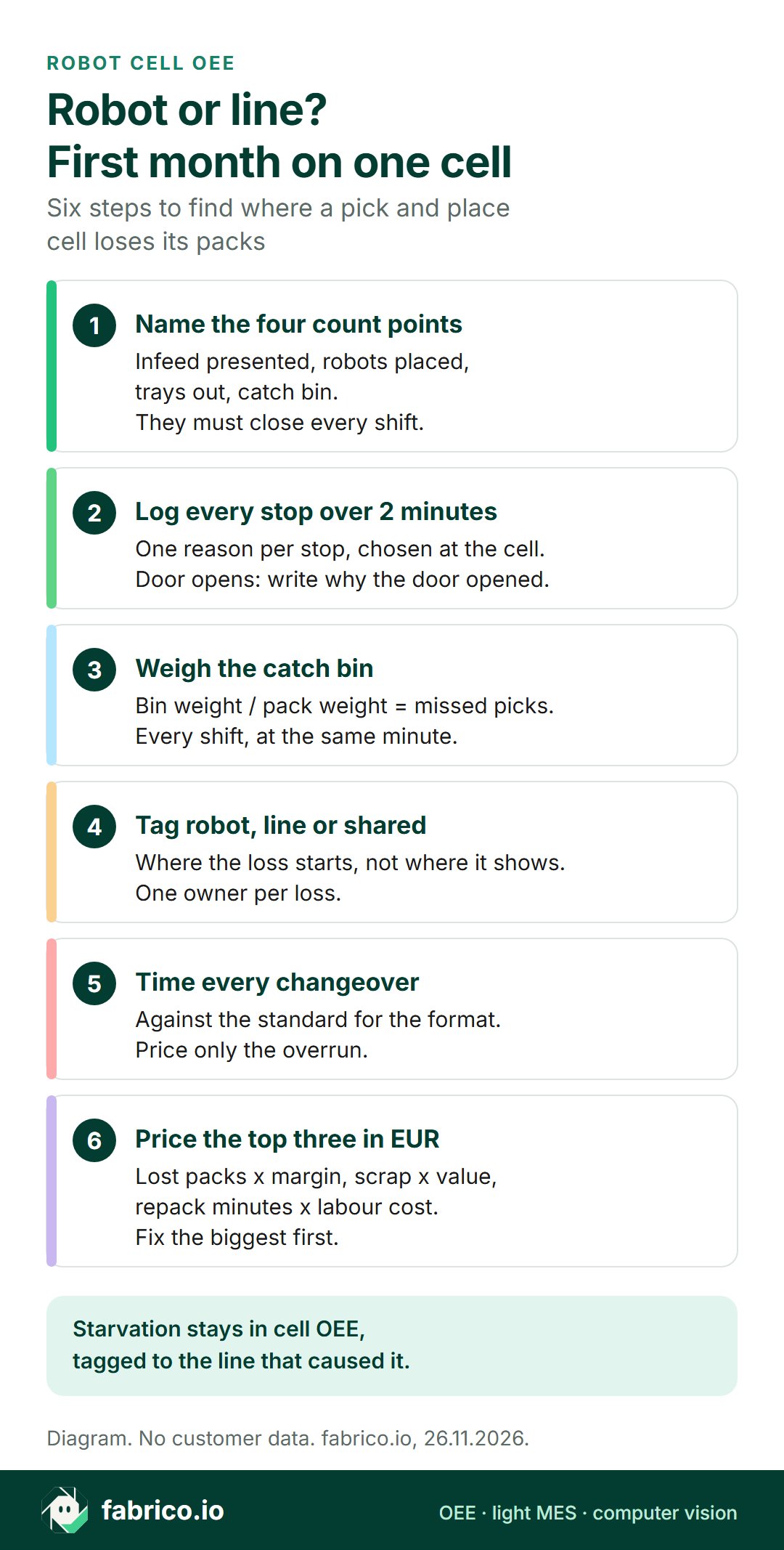
Text version of the diagram
- Name the four count points: infeed presented, robots placed, trays out, catch bin.
- Log every stop over 2 minutes with a reason, including why each door was opened.
- Weigh the catch bin every shift and divide by the pack weight to count missed picks.
- Tag each loss robot, line or shared, with one owner.
- Time every changeover against the standard for the format.
- Price the top three losses in EUR per shift and fix the biggest first.
Two habits keep the data clean. Starvation is logged twice: on the cell as a line loss, and on the tray erector or wrapper as its own stop. And the rated speed is written down once per format, never adjusted to make a shift look better.
Where Fabrico fits
Fabrico is made by the publisher of this article. It measures OEE on the line the cell sits in, read at the core machine; the robot programme and the guarding stay with the integrator.
- OEE by line and shift from the core machine, read through the line PLC or a Fabrico IoT device with sensors.
- Micro-stops from the machine signal; stop reasons chosen by the operator at the machine in a few taps, so tray starvation and door opens each get their own reason.
- Changeovers tracked against a standard time. A miss or reject signal from the line PLC can be counted like any machine signal, or the count can be entered.
- Where the cell has no usable signal, the camera add-on counts output, for example trays leaving the cell. Where a camera covers the station, the video for the minute of a stop can be opened from the shift timeline, streamed on request and not stored.
- With the selling price and margin of each product entered, losses are priced in money and stops are ranked by financial impact.
More on OEE with computer vision. Plant pricing is one quote by machines and modules: see pricing.
Sources, accessed 26.11.2026: Eurostat, Labour cost levels by NACE Rev. 2 activity (lc_lci_lev); International Federation of Robotics, World Robotics 2026 press release, European Union (24 September 2026); EUR-Lex, Regulation (EU) 2023/1230 on machinery, Annex III 1.4.2.2 and Article 54; ISO, ISO 10218-1:2025 Robotics, Safety requirements, Part 1: Industrial robots; Health and Safety Executive, Guarding (general advice); Han, Feng and Yu, Toward Fast and Optimal Robotic Pick-and-Place on a Moving Conveyor, IEEE Robotics and Automation Letters 5(2), 2020; FEFCO, Shelf Ready Packaging (SRP).
Frequently asked questions
How do you calculate OEE for a pick and place robot cell?
Multiply availability (run time over planned time), performance (packs presented over run time x rated cell speed) and quality (good packs in accepted trays over packs presented). Use the rated speed of the whole cell for the format, not a robot's catalogue cycle time.
Are missed picks a quality loss or a performance loss?
Count them as quality loss when total count is packs presented at the infeed. A pack that entered the cell and did not end up in an accepted tray was not processed right the first time, even if someone repacks it by hand later.
Should tray starvation count against the robot cell's OEE?
Yes, the cell lost the time, so it stays in the cell's availability. Tag it as a line loss with the tray erector or magazine as the owner, so the robot team is not asked to fix it.
How can missed picks be counted without a sensor?
Weigh the catch bin at the end of each shift and divide by the pack weight. On cells with a return belt, a photo-eye on the return belt counts recirculated packs.
Can a camera count the output of a robot cell?
Yes, where the cell gives no usable signal, a camera at the outfeed can count trays leaving the cell. It counts output; it does not show why a pack was missed, so misses still need their own count.
Should safety stops and door opens count as downtime?
Yes, as unplanned stops with their own reason. Log what each door was opened for, then remove the jam or fault behind it. Never shorten a stop by changing the guarding.
See where a robot cell's minutes go, by line and shift. A demo shows OEE by line and shift from the core machine, stop reasons chosen at the machine, and output counted by camera where a station has no usable signal.
Latest from our blog





Real Fabrico tiles, sample data.