





 Login
 Blog

Pouch Filling Machine OEE: Station Losses and What They Cost

In short
- Count pouches, not cycles: OEE is good filled pouches divided by planned minutes times rated pouches per minute. The turret's cycle counter includes empty cycles.
- Empty cycles are speed loss: when no-pouch-no-fill skips a cycle, the machine runs and makes nothing. Log each one by cause: missed pick, double pouch or pouch not opened.
- Look first at two places: the magazine pick and the closure (spout, cap and top seal). Give each station a floor check and a named owner.
- Worked example: a 60-a-minute filler at 73.0% OEE makes 7,300 fewer good pouches than rated per shift and loses EUR 357 a shift (EUR 180,092 a year) in paid crew time and scrap.
- Fix the machine before buying better pouches: in this example a pouch premium above EUR 0.0023 a pouch pays only when the line is sold out.
Pouch filling machine OEE is the share of planned time a premade pouch filler spends making good, sealed pouches at its rated speed. Count good pouches at discharge and divide by planned minutes times rated pouches per minute.
On a rotary doypack machine the losses sit at stations: missed picks at the magazine, pouches that do not open, drips on the seal area, leakers, spout and cap jams, and changeovers between pouch sizes.
This article maps each station to its loss, shows where the loss lands in availability, performance or quality, and prices it on one example line: 90 g spouted fruit puree pouches in France. It ends with one decision: pay the converter for better pouches, or fix the machine.
How OEE works on a premade pouch filler
A premade pouch filler takes pouches the converter has already made, opens them, fills them, closes them and sends them out. Three inputs define its OEE.
- Planned production time: shift minutes minus planned breaks and planned cleaning.
- Rated speed: the pouches per minute the machine is specified to run on this pouch size and product. Use the rated figure for the format, not the best minute anyone remembers.
- Good pouches: filled, closed, at correct weight, past the leak check and counted at discharge.
OEE = good pouches / (planned minutes x rated speed). Availability, performance and quality then split the gap so each loss has a home.
| Loss on a pouch filler | OEE factor | Why |
|---|---|---|
| Magazine jam that stops the turret | Availability | The machine is stopped |
| Changeover between pouch sizes or flavours | Availability | Planned time with no output |
| Short stops under the logging threshold | Performance | Running time without full output |
| Empty cycles: no pouch, or pouch not opened | Performance | The turret cycles, nothing is filled |
| Running below rated speed for a thick product | Performance | Fewer pouches per minute |
| Leakers, cap faults, weight rejects | Quality | Made, then scrapped or reworked |
Two rules prevent arguments. First, set the stop threshold once (for example, any stop over 1 minute is a logged stop) and keep it.
Second, an empty cycle is never a quality reject: no product went in. A pouch that failed to open is still a wasted pouch, so count it in a separate pouch-scrap figure.
The machine type matters. A sachet or stick pack machine forms its packs from a reel across many lanes (see sachet and stick pack machine OEE). A vertical form-fill-seal machine forms bags from film around a tube (see VFFS machine OEE).
On a premade filler the pack arrives finished, so the pouch itself becomes a supply quality question.
The station-by-station loss map
Walk the turret in the order the pouch travels. Each station has its own symptom, its own OEE hit and one person who can fix it. If the owner cell is empty on a real line, the loss stays.
| Station | Symptom | OEE hit | Floor check | Fix owner |
|---|---|---|---|---|
| Magazine and pick | Missed pick, double pouch, magazine jam | P (empty cycle), A (jam) | Missed picks per 1,000 cycles, by pouch lot | Converter (curl, static, size), then mechanic (suction cups) |
| Gripper transfer | Pouch dropped or skewed | P, Q | Watch 100 cycles after each changeover | Mechanic (gripper width) |
| Opening | Pouch does not open, fill is skipped | P (empty cycle), pouch scrapped | Unopened pouches per 1,000 cycles, by lot | Converter (blocked mouth), then mechanic (vacuum, air) |
| Fill | Drips, splash, under or over weight | Q (leaker later, weight reject) | Look at the seal area of 20 pouches an hour | Process engineer (nozzle, product temperature) |
| Spout and cap | Fitment missing or skewed, cap loose, feeder jam | A (jam), Q (cap fault) | Cap torque check each hour | Mechanic (feeder, torque) |
| Top seal and cooling | Leakers, wrinkles, weak seal, temperature alarm | Q, A (alarm) | Squeeze test, peel test at shift start | Process engineer (temperature, pressure, dwell) |
| Discharge | Outfeed jam, backed up downstream | A | Note where the stop started | Line lead |
| Changeover | Size or flavour change over standard | A | Clock last good to first good pouch | Shift lead and mechanic |
Read the owner column first. Two rows point at the converter, two at the process engineer and the rest at the mechanic or the line and shift leads. That split is the first argument the data should settle, and the money section below shows why it matters.
Floor rule: no loss without a station and an owner. "Machine stopped" is not a reason; "capping feeder jam" is.
Empty cycles: the loss the cycle counter hides
A premade filler can run a no-pouch-no-fill check. Sensors confirm a pouch is in the gripper and open before the nozzle fires. If not, the nozzle skips and the turret keeps turning. That protects the product and the seal jaws, but it costs a cycle.
The trap is the count. Many machines count turret cycles, and a cycle with no pouch still adds one. In the worked example below, the turret made 20,520 cycles but only 20,000 filled pouches left the machine. Counting cycles reports 74.9% OEE instead of 73.0%: 1.9 points of loss nobody owns.
Split empty cycles by cause, because each cause has a different owner:
- Missed pick: no pouch reached the gripper. Usual causes are pouches stuck together, curl, static, worn suction cups, or a magazine run too low or packed too tight.
- Double pouch: two pouches picked together and ejected before the fill. Causes: static or pouch edges fused at the converter's cutting step.
- Pouch not opened: the opening cups or air jet failed to separate the pouch mouth. Usual causes are a blocked or fused mouth, low vacuum or worn cups.
The floor check is simple. For one week, count empty cycles per 1,000 cycles and note the pouch lot in the magazine. If the rate moves with the lot, the converter owns most of it. If it moves with the shift or jumps after a changeover, the machine owns it.
Leakers: drips, particles and converter seals
A 2021 review in Packaging Technology and Science calls the seal area "the most problematic part in food packaging" for keeping out moisture and gas. Fruit puree attacks it in two ways.
- Liquid in the seal: the same review notes that liquid contaminants at the sealing interface can act as a heat sink and lower the heating efficiency. A drip from the nozzle becomes a weak seal.
- Particles in the seal: solid particles can cause microchannels and poor integrity through the seal. Fibre, pulp and seeds in a puree are exactly that.
The U.S. FDA's method for examining flexible pouches, BAM Chapter 22C, tells the examiner to inspect the edges of each seal for product in the seal area: no product should be visible.
Its defect list for flexible pouches includes contaminated seal, channel leaker, nonbonding and wrinkle. Use those names as reject reasons on the line, because each one points at a station.
| Reject reason | Likely station | First check |
|---|---|---|
| Contaminated seal (product in seal) | Fill | Nozzle drip after the fill, fill speed, product temperature |
| Channel leaker | Top seal, or fill (particles) | Jaw temperature and pressure, particle size in the batch |
| Wrinkle in the seal | Gripper or top seal | Gripper width for this pouch size, jaw alignment |
| Leak at a side or bottom seal | Converter | Hold the lot, peel test retained pouches |
| Leak around the spout | Spout and cap | Fitment position, seal around the fitment |
Then measure the seal instead of only rejecting it. ASTM F88/F88M, the test method for seal strength of flexible barrier materials, states that seal strength "is a quantitative measure for use in process validation, capability, and control."
A peel test at shift start and after every changeover, plotted on one chart, shows a drifting jaw before it makes leakers.
A leaker caught at the line costs a pouch and its puree. One that reaches a retailer costs a complaint and possibly a lot hold. The example below prices only the first.
Doypack machine stops: magazine, spout and changeovers
Stops that halt the turret are availability loss. On a rotary premade machine, look in three places.
Magazine and pick stops
The magazine jams when pouches bridge, curl or stick, or when vacuum drops. It also stops when nobody refills it in time. Log that last one as its own reason: it is a staffing question, not a machine fault, and mixing the two hides both.
Spout and cap feeder jams
Spouted pouches add a feeder for the fitment or cap. On the example machine, the station places a capped spout fitment in the pouch mouth and the top seal closes around it.
Other spouted machines fill through a spout the converter has already fitted, then tighten the cap. Either way the feeder jams, and the closure is where leaks start.
Two checks pay quickly: cap torque once an hour, and the feeder's parts list on the changeover sheet, so the wrong cap colour never goes in after a flavour change.
Micro-stops
A pouch caught in a guide, cleared in 20 seconds, never reaches the stop log. Forty of those is 13 minutes. They show up as performance loss, and only a machine signal catches them reliably. The pattern is covered in micro-stops.
Changeovers between pouch sizes and flavours
A size change touches the gripper width, magazine guides, fill volume, seal jaws and the spout feeder. A flavour change means cleaning the product path.
Clock it from the last good pouch of the old run to the first good pouch of the new one, against a standard per pouch size. The method is in changeover time.
Cleaning time is set at purchase. EHEDG publishes Doc. 46, "Aseptic and Hygienic Filling Machines - Planning, Installation, Qualification and Operation". When buying a filler, ask which EHEDG guidance its product contact parts follow. A filler that is quick to clean is quicker to change between flavours.
Pouch supply: what the converter controls
A premade pouch arrives with half its OEE already decided. Size tolerance, flatness, static, how easily the mouth opens and side seal strength all show up later at the magazine and the leak check.
The food contact paperwork does not cover this. Regulation (EC) No 1935/2004, Article 3, requires materials to be made under good manufacturing practice so they do not transfer their constituents to food in harmful quantities.
Regulation (EU) No 10/2011 sets an overall migration limit of 10 mg per dm2 for plastics and, in Article 15, a written declaration of compliance.
Those documents answer "is it safe?", not "will it run at 60 a minute?". Machinability belongs in the purchase spec:
- Width, height and gusset tolerance, matched to the gripper and magazine guides.
- A flatness and curl limit after storage at plant temperature.
- Mouth opening: edges free, not fused (for example, 100 pouches opened by hand at goods-in).
- Side and bottom seal strength by an agreed method, such as an ASTM F88 peel test, with a minimum value.
- Spout weld strength, fitment position and cap torque range.
- Bundle count, orientation and no crushed bundle edges.
Regulation 1935/2004 also asks, in Article 17, that the traceability of materials "be ensured at all stages". Use it on the line: write the pouch lot on the shift record whenever a new box goes into the magazine.
That one line lets you compare empty cycles and leakers by lot, and turns a complaint to the converter from an opinion into a count.
Worked example: 90 g fruit puree pouches in France
One rotary premade pouch filler runs 90 g spouted fruit puree pouches, two 8-hour shifts a day. The numbers are an example built to show the method, not a customer's data.
| Item | Value | How |
|---|---|---|
| Rated speed | 60 pouches a minute | For the 90 g format |
| Planned production time | 450 min a shift | 480 minus 30 planned (break, start-up checks) |
| Ideal output | 27,000 pouches | 450 x 60 |
| Logged stops | 90 min | Changeover 40, magazine 20, cap feeder 15, seal alarm 15 |
| Run time | 360 min | 450 - 90 |
| Micro-stops | 18 min | Under the 1-minute threshold |
| Turret cycles | 20,520 | (360 - 18) x 60 |
| Empty cycles | 520 | 340 missed picks, 180 not opened |
| Filled pouches | 20,000 | 20,520 - 520 |
| Rejects | 300 | 180 leakers, 60 cap faults, 60 weight |
| Good pouches | 19,700 | 20,000 - 300 |
Now the three factors:
- Availability: 360 / 450 = 80.0%.
- Performance: 20,000 filled / (360 x 60) = 20,000 / 21,600 = 92.6%.
- Quality: 19,700 / 20,000 = 98.5%.
- OEE: 0.800 x 0.926 x 0.985 = 73.0%. Check: 19,700 / 27,000 = 73.0%.
The gap is 27,000 - 19,700 = 7,300 good pouches a shift. At 60 a minute, that is 121.7 minutes of rated time. The figure shows where those minutes went.
Pricing the losses
The inputs, with the source or the label for each:
- Labour: EUR 47.1 an hour for French manufacturing in 2025 (Eurostat, lc_lci_lev). With a crew of 3 on the filler (sample figure), that is EUR 141.30 an hour, or EUR 2.355 a minute.
- Filled pouch material: pouch, spout, cap and 90 g of puree, EUR 0.20 (sample figure).
- Empty pouch with spout and cap: EUR 0.06 (sample figure).
- Contribution margin: EUR 0.10 a good pouch (sample figure), used only when the line is sold out.
- Calendar: 42 shifts a month (2 shifts x 21 days) and 504 a year.
There are two ways to price a lost pouch. With spare capacity, the loss is cash: crew time paid with nothing made, plus material thrown away. When the line is sold out, every missing pouch is a lost sale, so the loss is margin plus material.
Many compote lines may sit in the first case. FranceAgriMer counts 653,000 tonnes of compotes, jams and candied fruit marketed by French processors, and reports household compote buying flat for the first time in 2024: 77% of households, 7.9 kg each a year. In a flat market, spare capacity is more likely than a sold-out line.
The three losses every pouch line meeting returns to, worked out:
- Empty cycles: 520 / 60 = 8.67 minutes x EUR 2.355 = EUR 20.41 of crew time, plus 180 unopened pouches x EUR 0.06 = EUR 10.80. Total EUR 31.21 a shift.
- Leakers: 180 / 60 = 3 minutes x EUR 2.355 = EUR 7.07, plus 180 x EUR 0.20 = EUR 36.00. Total EUR 43.07 a shift.
- Changeover overrun: 40 minutes against a 25-minute standard. The 15 extra minutes x EUR 2.355 = EUR 35.33 a shift. Sold out, it is 15 x 60 = 900 pouches x EUR 0.10 = EUR 90.
| Loss (example) | Per shift | Per month | Per year | Year, sold out |
|---|---|---|---|---|
| Empty cycles (520) | EUR 31.21 | EUR 1,311 | EUR 15,730 | EUR 31,651 |
| Leakers (180) | EUR 43.07 | EUR 1,809 | EUR 21,705 | EUR 27,216 |
| Changeover overrun (15 min) | EUR 35.33 | EUR 1,484 | EUR 17,804 | EUR 45,360 |
| All losses vs rated (121.7 min) | EUR 357.33 | EUR 15,008 | EUR 180,092 | EUR 403,603 |
The last row adds every lost minute at EUR 2.355 (EUR 286.53) to all scrapped material: 300 rejects x EUR 0.20 plus 180 unopened pouches x EUR 0.06 (EUR 70.80). Sold out, it is 7,300 lost pouches x EUR 0.10 = EUR 730, plus the same EUR 70.80, a shift.
Not all of that is recoverable: a changeover will never take zero minutes. The useful number is the gap to a realistic target, station by station.
Buy better pouches or fix the machine?
In this example, the lot check from the empty cycle section splits the losses into two groups.
- Pouch-caused: 340 missed picks, 20 minutes of magazine stops, 180 unopened pouches and 60 side seal leakers. That is 29.7 minutes plus EUR 22.80 of material, or EUR 92.67 of cash a shift.
- Machine-caused at fill, cap and seal: 120 leakers from nozzle drips, 15 minutes of seal alarm, 15 minutes of cap feeder jams and 60 cap faults. That is 33 minutes plus EUR 36.00 of material, or EUR 113.72 a shift.
Three options are on the table. The costs and the "halves the loss" effects are sample assumptions to show the method; replace them with the converter's price, a service quote and a trial result.
| Option (sample) | Cost | Saved a year, cash | Saved a year, sold out | Result |
|---|---|---|---|---|
| Tighter-spec pouches, +EUR 0.003 each, halve pouch-caused loss | EUR 30,542 a year | EUR 23,352 | EUR 50,602 | Cash: EUR 7,191 worse. Sold out: EUR 20,059 better |
| Fix nozzle drip, cap feeder and seal jaws, halve machine-caused loss | EUR 8,000 once | EUR 28,656 | EUR 58,968 | Pays back in 3.4 months (1.6 sold out) |
| Bring changeover from 40 to the 25-minute standard | EUR 2,000 once | EUR 17,804 | EUR 45,360 | Pays back in 1.3 months (0.5 sold out) |
How the pouch row works: about 20,200 pouches go through the magazine a shift, so the premium is 20,200 x EUR 0.003 = EUR 60.60 a shift, or EUR 30,542 a year.
Halving the pouch-caused loss saves EUR 46.33 a shift in cash. The premium only breaks even below EUR 46.33 / 20,200 = EUR 0.0023 a pouch.
Sold out, the same halving recovers 890 pouches a shift at EUR 0.10 margin plus EUR 11.40 of material, EUR 100.40 a shift. Then the break-even premium rises to EUR 0.0050 a pouch.
The answer in this example: fix the changeover and the closure first, because both pay back within four months either way. Buy better pouches only if the line is sold out or the converter's premium is under the cash break-even.
Before signing, run a lot trial: two lots, same shift, same settings, with missed picks and unopened pouches counted per 1,000 cycles.
How to start measuring next week
Six steps on one card are enough for the first week. They need a pen, the shift record and agreement on the count point.
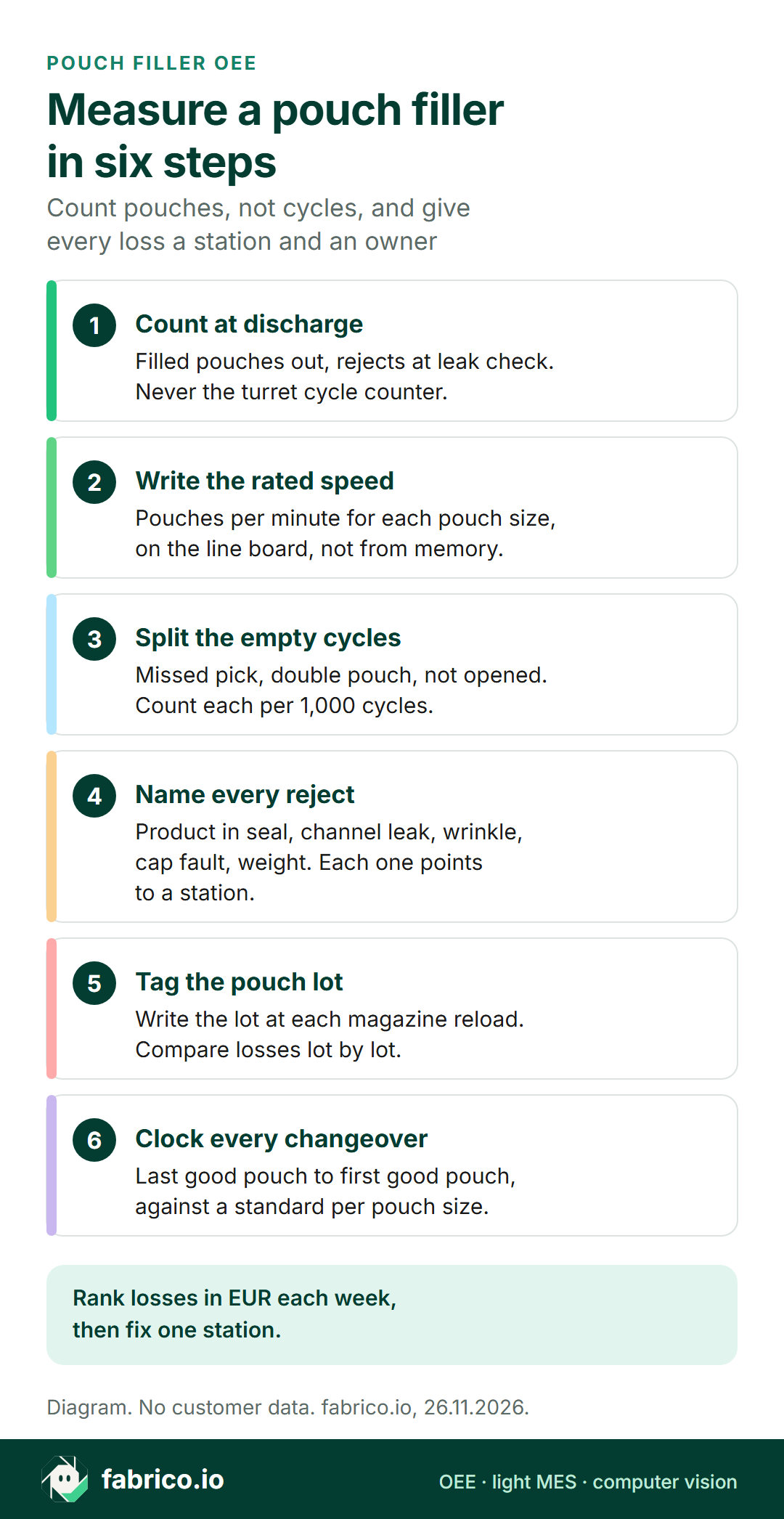
Text version of the diagram
- Count at discharge: filled pouches out and rejects at the leak check, never the turret cycle counter.
- Write the rated speed: pouches per minute for each pouch size, on the line board, not from memory.
- Split the empty cycles: missed pick, double pouch, not opened, each per 1,000 cycles.
- Name every reject: product in seal, channel leak, wrinkle, cap fault, weight. Each points to a station.
- Tag the pouch lot: write the lot at each magazine reload and compare losses lot by lot.
- Clock every changeover: last good pouch to first good pouch, against a standard per pouch size.
Then rank losses in EUR each week and fix one station.
After a week, sort the losses by EUR, not by count. A rare 15-minute seal alarm can cost more than a hundred missed picks. Pick the top station, name the owner, and check the same number a week later.
Choosing how to measure: options, costs and questions
There are four ways to collect the numbers, from paper to software. Prices for software vary by plant and module, so the only reliable figure is a quote.
| Option | Cost | Fits | Misses |
|---|---|---|---|
| Paper shift sheet | Operator and supervisor time | One filler, the first month | Micro-stops, empty cycles, accuracy after week two |
| Machine counters plus spreadsheet | Engineer hours every week | A plant with readable counters | Stop reasons at the machine, a live view |
| OEE software from machine signals | Ask the vendor for a price per line per month | Fillers that are sold out or have leaker complaints | Needs a signal at each count point |
| Camera counting where no signal exists | Ask the vendor for a price per line per month | Old fillers with no usable counter | Counts output; does not grade seals |
OEE or light MES software reads the filler's run, stop and count signals from the line PLC or an added sensor, takes stop reasons from the operator at the machine, and shows OEE by shift as it happens.
What you see: a shift timeline, unclassified time waiting for a reason, and the operator's line-down screen, on sample lines. Book a demo.
Plays from YouTube. Google may set cookies when you press play. Privacy policy.
For a pouch filler, the test is whether it counts filled pouches apart from cycles and keeps rejects by reason. For the wider buying view, compare OEE software for high speed packaging lines, the shortlist of OEE software for food and beverage, and the basics of OEE software.
Who should pick which:
- One filler, no complaints, spare capacity: a paper sheet for a month, then decide with real numbers.
- Several fillers with readable counters: a spreadsheet first to prove the count points, then software when the weekly sums take an engineer's day.
- A sold-out filler or a leaker complaint from a retailer: software from the start. Each lost pouch is margin, so the money view pays fastest here.
- An old filler with no usable counter: a camera at discharge to count output, plus stop reasons entered by the operator.
Questions to ask a software vendor or the converter:
- Can the system count filled pouches at discharge separately from turret cycles?
- How are empty cycles shown: as performance loss, split by cause?
- Can operators pick a stop reason at the machine in a few taps, with reasons for each station?
- Can changeovers be tracked against a standard time for each pouch size?
- Can losses be priced in EUR from each product's price and margin?
- For the converter: which machinability tolerances will go into the signed spec (size, curl, opening, seal strength by ASTM F88)?
- For the converter: what is the premium per pouch for the tighter spec, and will a trial lot be supplied first?
Where Fabrico fits
- OEE by machine, line and shift, from the line PLC or a Fabrico IoT device with sensors on the filler.
- Micro-stops from the machine signal; the operator picks the stop reason at the machine in a few taps (magazine jam, cap feeder jam, seal alarm).
- Changeovers tracked against a standard time.
- Scrap recorded by product and reason, so leakers, cap faults and weight rejects stay apart.
- With the selling price and margin of each product entered, losses are priced in money and stops are ranked by financial impact.
- Where the filler has no usable signal, the camera add-on counts output (OEE with computer vision). Pricing is one quote per plant by machines and modules (pricing).
Fabrico is made by the publisher of this article.
Sources, accessed 26.11.2026: Eurostat, Labour cost levels by NACE Rev. 2 activity (lc_lci_lev); EUR-Lex, Regulation (EC) No 1935/2004 on food contact materials; EUR-Lex, Commission Regulation (EU) No 10/2011 on plastic food contact materials; ASTM International, F88/F88M-23 Seal Strength of Flexible Barrier Materials; Ilhan, Turan, Gibson and ten Klooster, Understanding the factors affecting the seal integrity in heat sealed flexible food packages: a review, Packaging Technology and Science 34(6), 2021; U.S. FDA, BAM Chapter 22C: Examination of Flexible and Semirigid Food Containers for Integrity; EHEDG, Guidelines (Doc. 46, Aseptic and Hygienic Filling Machines); FranceAgriMer, Fiche filière fruits et légumes transformés, January 2026.
Frequently asked questions
How do you calculate OEE on a pouch filling machine?
Divide good pouches counted at discharge by planned minutes times the rated pouches per minute for that format. At 19,700 good pouches in 450 minutes on a 60-a-minute machine, OEE is 19,700 / 27,000 = 73.0%.
Is an empty cycle a performance loss or a quality loss?
Performance. The turret ran at speed but nothing was filled, so no product exists to reject. Count the wasted pouch from a failed opening separately as pouch scrap.
What causes doypack machine stops?
Magazine jams from curled, stuck or static pouches, spout and cap feeder jams, seal temperature alarms and changeovers. Log each as its own reason, and log an empty magazine apart from a jammed one.
Why does a premade pouch filler run below its rated speed?
Thick or particle-laden products can need a slower fill to avoid splash and drips on the seal area. Running slower is performance loss, so measure against the rated speed for the format and record the reason.
What causes leaking spouted pouches?
Product or particles in the top seal, jaw temperature, pressure or dwell out of range, a misplaced spout fitment, and weak side seals from the converter. Name each leaker by defect type, such as contaminated seal or channel leaker, to find the station.
Is it cheaper to buy better pouches or fix the filler?
It depends on whether the line is sold out. In this article's example, fixing the closure and the changeover paid back within four months, while a EUR 0.003 pouch premium paid only when every extra pouch could be sold.
What is a good OEE for a pouch filling machine?
No single figure fits every pouch filler: product, pouch size and rated speed all move it. Set the target from the machine's own baseline after four weeks of clean data, then raise it station by station.
See where your pouch filler loses money. The demo shows OEE by machine and shift, stop reasons picked at the machine, changeovers against a standard and losses priced in EUR.
Latest from our blog






Real Fabrico tiles, sample data.