





 Login
 Blog
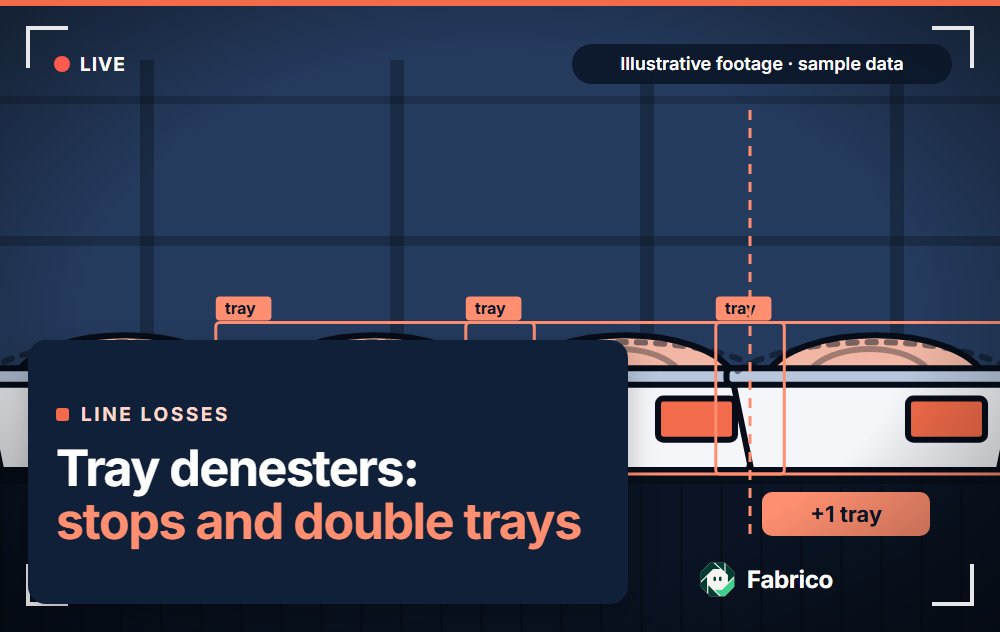
Tray Denester Stops and Double Trays: Causes, Fixes, Cost

In short
- Four faults cause the denester stops on the example line: missed picks, double trays, cracked trays and an empty magazine. Each one starves the depositor and the tray sealer behind it.
- A gap is a speed loss at the sealer: an empty pocket travels through, the sealer cycles anyway, and output drops. Count trays out, not cycles, or the loss stays hidden.
- Doubles that reach the sealer cost the most: in the example, 4 of them cost 10 minutes and 604 meals a shift, more than all 240 empty pockets together.
- Split the cost by owner: tray faults (nesting, static, cracks) go to the tray spec and the denester settings; empty-magazine stops go to the refill routine.
- Price it before buying: the example line loses EUR 124.70 a shift in paid time and scrap, and up to EUR 1,272.60 a shift in margin when every meal is sold.
A tray denester stops, misses trays or drops two at once for a short list of reasons: trays nested too tightly, static holding them together, worn vacuum cups or a badly set blade, cold and brittle trays, and a magazine that runs empty before someone refills it.
Each fault leaves an empty pocket or stops the feed, and the depositor and tray sealer behind it wait. This page gives a fault table with floor checks, the tray tolerances to agree with the supplier, how the gaps show in OEE, and a priced example from a German ready meal line.
How a denester feeds one tray at a time
On tray lines for ready meals and fresh meat, the denester sits at the start of the line. It holds stacks of empty CPET, PP or PET trays in a magazine and places one tray into each pocket of the line conveyor. The depositor fills the tray, and the tray sealer closes it with film.
Separation is mechanical. Rotating screws or blades slip between the bottom tray and the one above it, catching under the flange or a destacking lug. Vacuum cups then pull the bottom tray down into the pocket. A tray that nests too deep, clings or cracks breaks that sequence.
On the example line, the denester does not set the line rate. The tray sealer does, because its tool closes a fixed number of trays per cycle. So the denester only has to keep up, and its faults show at the sealer: as empty positions in the tool, or as a sealer that waits.
- Missed pick: no tray in the pocket. The depositor skips it and the sealer cycles one tray short.
- Double tray: two trays stuck together in one pocket. If nobody pulls it, it gets filled and can stop the sealer tool.
- Cracked tray: the tray is placed, but the flange is split, so the seal leaks and the meal is scrapped.
- Empty magazine: no trays left in a lane. The feed stops and the line starves within seconds.
The denester fault table: seven failure modes
Seven failure modes cover the denester stops on the example line. The table pairs each one with the floor check that confirms it and the first fix to try. Keep a copy at the magazine and add rows once the log shows faults the table does not list.
| What you see | Likely causes | Floor check | First fix |
|---|---|---|---|
| Missed pick, empty pocket | Worn, split or dirty vacuum cups; low vacuum; trays nested too deep | Look at the cup lips; read the vacuum gauge; pull one tray from the stack by hand | Change cups on a set count; clean the vacuum filter |
| Two trays in one pocket | Tight nesting; shallow destacking lugs; static; blade or screw timing | Separate a double by hand: force needed means nesting, cling and crackle means static | Agree lug depth and stack pitch with the supplier; static control; reset the blade |
| Cracked tray or chipped flange | Cold, stiff trays; blade or screw set too tight; cups pulling too hard | Stack temperature at loading; crack in the same corner every time points to the blade | Condition trays in the hall before loading; reset the blade gap |
| Tray tilted or off the pocket | Warped flange; guide width; drop timing | Lay 10 trays on a flat table and look for rocking | Reset the guides; reject a warped lot to the supplier |
| Magazine empty, line starved | Late refill; magazine too short for the rate; no low-stack warning | Time between refills against magazine minutes (see below) | Refill standard; low-stack warning; taller magazine |
| Stack jams in the magazine | Sleeve film left in the guides; crushed or leaning stack; guides too narrow | Leaning stacks; film scraps in the magazine | Loading standard; reject crushed cases at goods-in |
| Faults right after a tray change | Format parts or settings not changed for the new tray | Settings against the changeover sheet for that tray code | Mark format parts with the tray code; one sheet per tray |
Two patterns save time. If faults follow a tray lot or a delivery, start with the tray. If they follow a lane, a shift or the hours since the last cup change, start with the machine. Write the tray lot on the stop log so the pattern can be seen.
Static, cold trays and warm stacks
Plastic trays charge as they slide apart, and charged trays cling. A double that crackles or jumps to your hand when you pull it apart points to static, not nesting.
An ionising air bar at the separation point is the usual machine fix. Dry air in the packing hall makes static worse.
Temperature changes the tray too. Trays taken straight from a cold store are stiffer and can crack under the blades. Trays stored warm under the weight of a full pallet can nest deeper than the denester was set for.
Agree a storage temperature and a conditioning time with the supplier, and keep to it.
Tray tolerances: what to agree with the tray supplier
A denester is set up for one tray. When the stack pitch, the lug depth or the flange thickness drifts from that tray, the settings stop fitting, and the line pays in missed picks and doubles. These numbers belong in the purchase specification, not in the operator's head.
Food contact paperwork is a separate matter. Regulation (EC) No 1935/2004 requires food contact materials to be made under good manufacturing practice, so that in normal or foreseeable use they do not transfer their constituents to food in quantities that could harm health or change the food.
For plastic trays, Commission Regulation (EU) No 10/2011 requires a written declaration of compliance at marketing stages other than retail. Ask for it. But that paperwork is about food contact; denesting dimensions and tolerances have to be agreed in the specification itself.
| Spec item | Why the denester cares | Ask the supplier for |
|---|---|---|
| Stack pitch (height each tray adds to the stack) | Sets trays per magazine and the blade timing | Nominal value and tolerance per lot |
| Destacking lug depth and position | The blade or screw catches here | Drawing with tolerance; notice before any tool change |
| Flange width and thickness | Thin flanges crack and seal badly | Tolerance and how it is checked |
| Flange flatness | Warped trays tilt in the pocket | Maximum warp and the measuring method |
| Material and storage | Cold trays can be brittle; warm stacks nest tighter | Storage temperature range and conditioning advice |
| Stack count and packing | Crushed or part stacks jam the magazine | Trays per sleeve, sleeves per case, case strength |
| Lot code | Links faults to one production run | A lot code on every case |
The lot code also serves the law. Article 17 of Regulation 1935/2004 asks for traceability of food contact materials at all stages, to support control and recall. The same code lets the plant tie a run of doubles to one supplier batch, which turns a complaint into a fact.
Magazine minutes: how long one stack lasts
An empty magazine is the one denester fault that has nothing to do with the tray or the blades. It is arithmetic plus a refill routine. Work out how long a full magazine lasts, then compare it with how often someone actually gets there.
Magazine minutes = (usable magazine height ÷ stack pitch) ÷ trays per minute per lane
Sample figures: a 1,200 mm usable magazine and an 8 mm stack pitch hold 150 trays per lane. At 30 trays a minute per lane, that is 5 minutes. Over a 450-minute shift, the loader refills both lanes 90 times.
At that pace the loader has no slack. One late refill in 15 means 6 empty-magazine stops a shift. Doubling the minutes, with a taller magazine or a buffer magazine, halves the refill rounds to 45. At the same 1 in 15 miss rate, that leaves 3 stops.
A low-stack warning works on the other side. A stack light or horn when a lane drops below, say, one minute of trays turns a surprise into a planned refill. Ask the machine supplier whether the denester has a low-stack sensor and whether the line PLC can read it.
Empty pockets in OEE: a speed loss at the sealer
On a linked tray line, OEE is read at the core machine: the tray sealer. Everything the denester does wrong shows up there. The only question is which of the three OEE factors carries it.
- Empty pocket: the sealer runs at full rate but closes fewer trays. That is a performance (speed) loss.
- Short sealer stop from a double or an empty lane: a micro-stop. Below your micro-stop threshold it lands in performance; above it, in availability.
- Leaker from a cracked flange: made but not good. A quality loss.
The page on micro-stops covers how to set that threshold. Whatever you choose, the money is the same: a minute without trays costs the same whichever factor carries it.
Short stops add up. In a two-month study of bottling lines, Zennaro and colleagues in the International Journal of Quality & Reliability Management found that micro downtime, defined as stops under 15 minutes, covered 57 percent of the inefficiency on the least efficient line they studied.
Count trays out, not cycles
Many sealers count cycles. A cycle with one pocket empty still counts as a full cycle, so a cycle counter reports full speed while the line makes fewer meals. In the example below, 240 empty pockets a shift hide behind the cycle count: almost 0.9 OEE points nobody sees.
- Empty positions = sealer cycles x trays per cycle, minus trays sealed. Take cycles from the sealer and trays from an outfeed count.
- Pocket presence: a sensor after the denester, or the depositor's own no-tray-no-fill signal, counts empty pockets where they start.
- Doubles: a tally at the conveyor, or the trays in the double bin at the end of the shift.
- Weekly check: count one hour by hand with a clicker, to confirm the signals agree.
The same logic sits behind tray sealer OEE, which covers the sealer's own losses: tool changes, film and seal faults. This page stays with the machine that feeds it.
Worked example: chilled ready meals in CPET trays in Germany
German output of ready meals reached 1.7 million tonnes worth EUR 5.9 billion in 2024, a quarter more by volume than in 2019, according to Destatis, the German federal statistics office. The line below is a sample from that segment. The numbers are an example, not a customer's.
- Line: a two-lane denester, a depositor and a tray sealer closing 4 CPET trays per cycle at 15 cycles a minute: 60 trays a minute.
- Product: 400 g chilled ready meals.
- Hours: two 8-hour shifts with a 30-minute break, so 450 minutes of planned run time a shift; 21 days a month, so 42 shifts a month and 504 a year.
- Ideal output: 450 x 60 = 27,000 trays a shift.
- Crew (sample): 4 operators: magazine loader, depositor, sealer and end of line.
The shift log below is a sample. It counts only the losses that start at the denester. For the plant-wide picture, see OEE for ready meal production.
| Failure mode | Count a shift | Line minutes lost | Meals lost |
|---|---|---|---|
| Missed pick, empty pocket | 190 | 3.2 | 190 |
| Double pulled by hand | 50 | 0.8 | 50 |
| Double reached the sealer | 4 stops x 2.5 min | 10 | 604 (600 + 4 scrapped) |
| Empty magazine | 6 stops x 1.5 min | 9 | 540 |
| Cracked flange, leaker | 30 | 0 | 30 (scrapped) |
| Total | 23 | 1,414 |
1,414 meals is 5.2% of the 27,000 the sealer could close: 0.9 points of performance from empty pockets, 4.2 points from short stops and 0.1 points of quality from scrap. All of it starts at the denester.
Labour is priced at EUR 49.50 an hour, the Eurostat labour cost level for German manufacturing in 2025. With 4 operators, a lost line minute costs 4 x 49.50 ÷ 60 = EUR 3.30.
The meal figures are sample figures: EUR 1.20 of materials per meal including its tray, EUR 0.08 per empty tray, and EUR 0.90 contribution margin per meal. Every pulled double is binned, so 50 doubles bin 100 trays.
| Item and maths | Per shift | Per month | Per year |
|---|---|---|---|
| Crew time lost: 23 line minutes x EUR 3.30 | EUR 75.90 | EUR 3,187.80 | EUR 38,253.60 |
| Scrapped meals: 34 x EUR 1.20 | EUR 40.80 | EUR 1,713.60 | EUR 20,563.20 |
| Binned trays: 100 x EUR 0.08 | EUR 8.00 | EUR 336.00 | EUR 4,032.00 |
| Cost paid every shift | EUR 124.70 | EUR 5,237.40 | EUR 62,848.80 |
| Margin at risk when sold out: 1,414 x EUR 0.90 | EUR 1,272.60 | EUR 53,449.20 | EUR 641,390.40 |
Read the two layers separately. The cost paid every shift, about EUR 63,000 a year, is crew time, food and trays. Where lost meals are made up with overtime, this layer plus the overtime premium is what the denester costs in a normal week.
The margin layer applies only when the line is the constraint and every meal is sold. Then it is ten times larger per shift (1,272.60 ÷ 124.70 = 10.2). Use it for peak weeks and promotions, not as the everyday figure.
Tray spec or machine fix: the money comparison
Split the same shift by who owns the fix. Missed picks, doubles and cracked flanges happen where the tray meets the machine, so the tray spec or the denester settings can cure them. Empty-magazine stops are about refills and magazine size only.
| Group | Paid a shift | Paid a year | Margin at risk a year |
|---|---|---|---|
| Tray meets machine: missed picks, doubles, cracks | EUR 95.00 | EUR 47,880.00 | EUR 396,446.40 |
| Magazine: empty-lane stops | EUR 29.70 | EUR 14,968.80 | EUR 244,944.00 |
| Total | EUR 124.70 | EUR 62,848.80 | EUR 641,390.40 |
The tray group costs three times the magazine group in paid cost (47,880 ÷ 14,968.80 = 3.2). The magazine group is cheaper to fix: a refill standard, a low-stack warning, perhaps a taller magazine.
What a better tray is worth
Suppose a tighter specification, with lug depth, stack pitch and flange tolerance agreed and checked per lot, halves the tray group's losses. That is an assumption to test, not a promise. It saves EUR 23,940 a year in paid cost (47,880 ÷ 2).
The line uses about 13 million trays a year (25,700 a shift x 504 shifts). So a price premium of up to EUR 1.84 per 1,000 trays pays for itself on paid cost alone (23,940 ÷ 13,000).
If every meal were sold all year, the saving would also carry half the tray group's margin, EUR 198,223.20. Then the break-even premium rises to EUR 17.09 per 1,000 trays ((23,940 + 198,223.20) ÷ 13,000).
What a machine fix is worth
The same saving can pay for work on the denester: cups and filters on a schedule, a blade reset, static control, or a servo upgrade. Payback in months is the quote divided by the monthly saving: EUR 1,995 a month in paid cost if the tray group's losses halve (23,940 ÷ 12).
Then compare the two routes on the same saving. A tighter tray spec costs nothing up front if the supplier can hold it at the same price. A machine fix costs a quote but stays fixed when the tray supplier changes.
The answer can be both: a tray that fits, and settings that tolerate its spread.
Clearing a double tray safely
The fastest fix for a double tray is a hand into the machine, and that is where people get hurt.
HSE's guidance on packaging machinery says injuries from using, maintaining or clearing blockages at packaging machines can be severe or even fatal, and that most happen when people enter the machine and become trapped.
The risk is not limited to rare repairs. The EU-OSHA OSHwiki article on maintenance work estimates that 15-20% of all accidents in Europe, depending on the country, relate to maintenance, and says machines must be cut off from energy sources before work starts.
- Pull doubles outside the guard: give the conveyor after the denester a point where doubles can be lifted out without opening a guard.
- Stop and isolate for anything inside: a jam in the magazine, the screws or the sealer tool is cleared with the machine stopped and isolated under the plant's safe system of work, never with a guard held open.
- Train the people who clear jams: the loader who clears 10 doubles a shift needs the procedure as much as the fitter does.
- Bin hand-handled trays: set a rule in the hygiene plan for trays that touched the floor, a glove or the machine frame.
Changes near the open tray zone also need a hygiene check. EHEDG Guideline 29 part 1 (second edition, July 2024) sets out a concept for the hygienic design evaluation of packaging machines for solid foodstuffs, to help makers and users talk through hygienic design risk assessments.
Put any bracket, sensor or ioniser added to the denester through that kind of assessment before it goes on the line. A fix that cuts doubles but leaves a ledge over open trays swaps one problem for another.
Choosing the fix: supplier, machine or measurement
The options below fix different faults. The stop log decides which one comes first.
| Option | Fixes | Does not fix | Cost |
|---|---|---|---|
| Tray spec and lot checks | Doubles, missed picks and cracks from tray drift | Worn cups, late refills | Staff time; ask the supplier for any price change |
| Denester care: cups, filters, blade settings | Missed picks and doubles from wear | Tray drift between lots | Spare parts; ask the machine supplier for prices |
| Static control at the separation point | Doubles from clinging trays | Tight nesting | Ask the machine supplier for a quote |
| Magazine work: refill standard, low-stack warning, taller magazine | Empty-lane stops | Tray faults | From staff time to a machine quote |
| Line software from machine signals | Shows which fault costs most, per shift | Nothing on its own | Ask the vendor for a price per line per month |
Measuring first is the cheapest way to rank the other four. Equipment downtime tracking software that reads the tray sealer's machine signal counts the short sealer stops nobody writes down, and lets the operator log the denester cause in a few taps.
What you see: a shift timeline, unclassified time waiting for a reason, and the operator's line-down screen, on sample lines. Book a demo.
Plays from YouTube. Google may set cookies when you press play. Privacy policy.
Two weeks of that data shows whether doubles, missed picks or refills lead. The same signals feed OEE software for the whole line, and a MES for food manufacturing ties those losses to orders, products and shifts.
Who should pick which
- Faults follow the tray lot: start with the supplier spec and lot checks.
- Faults follow a lane or the hours since the last cup change: start with denester care and settings.
- Doubles cluster on dry days or with one material: add static control.
- Empty-lane stops lead the log: work out magazine minutes and fix refills before anything else.
- Nobody agrees which fault leads: measure for two weeks first.
Questions to ask the tray supplier and the machine supplier
- What are the stack pitch, lug depth and flange tolerances, and how are they checked per lot?
- Will you give notice of a tool or material change before delivery, and send sample trays for a denester trial?
- What storage temperature and conditioning time do you advise before denesting?
- Can you supply the written declaration of compliance for the trays under Regulation (EU) No 10/2011?
- For the machine: which wear parts (cups, blades, screws) need a change interval, and what are their lead times?
- Does the denester give a low-stack signal and a fault signal the line PLC can read?
- For software: what is the price per line per month, and which machine signals are needed?
A two-week denester log
Before buying anything, log the denester for two weeks. The card below fits on the magazine guard.
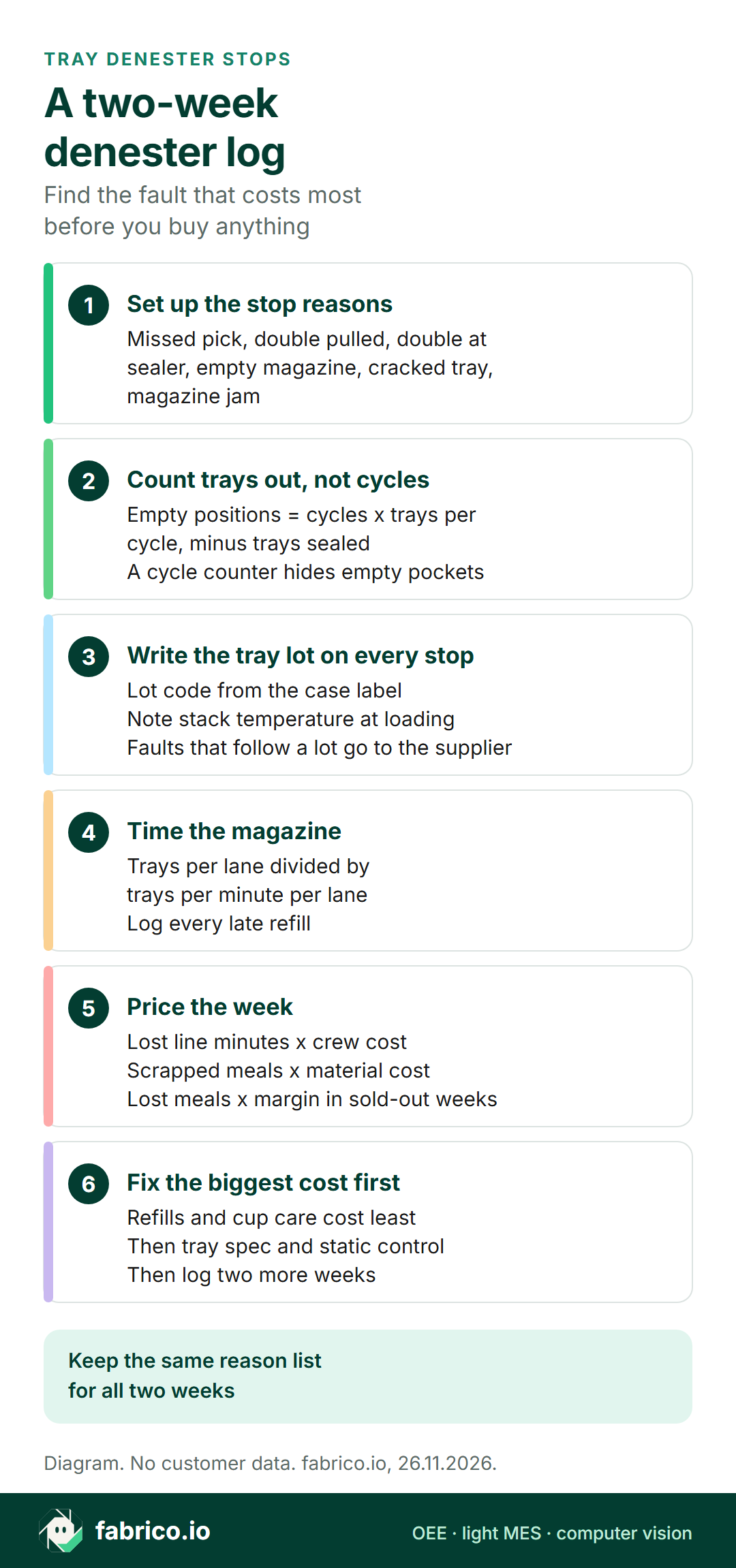
Text version of the diagram
- Set up the stop reasons: missed pick, double pulled, double at sealer, empty magazine, cracked tray, magazine jam.
- Count trays out, not cycles: empty positions are sealer cycles times trays per cycle, minus trays sealed.
- Write the tray lot on every stop and note the stack temperature at loading. Faults that follow a lot go to the supplier.
- Time the magazine: trays per lane divided by trays per minute per lane. Log every late refill.
- Price the week: lost line minutes times crew cost, scrapped meals times material cost, lost meals times margin in sold-out weeks.
- Fix the biggest cost first: refills and cup care cost least, then the tray spec and static control. Then log two more weeks.
Keep the reason list fixed for the two weeks, or the before and after cannot be compared.
Where Fabrico fits
- OEE by line and shift from the core machine, here the tray sealer, read through the line PLC or a Fabrico IoT device.
- Micro-stops from the machine signal, so the short sealer stops a double tray causes are counted without a shift sheet.
- The operator logs "double tray", "magazine empty" or "magazine jam" as the stop reason at the machine in a few taps, set up in the reason list.
- Scrap recorded by product and reason, for example leakers from cracked flanges.
- With selling price and margin entered, losses are priced in money and stops are ranked by financial impact.
- A work order from a logged stop in one tap, for example a vacuum cup change.
Fabrico does not set up the denester or check tray tolerances; that stays with the machine supplier, the tray supplier and quality.
Fabrico is made by the publisher of this article. Where a camera covers the line it counts output: see OEE with computer vision. Pricing is one quote per plant by machines and modules.
Sources, accessed 26.11.2026: EUR-Lex, Regulation (EC) No 1935/2004 on materials and articles intended to come into contact with food; EUR-Lex, Commission Regulation (EU) No 10/2011 on plastic materials and articles intended to come into contact with food; Destatis, press release N 002 of 14 January 2026 on ready meal production; Eurostat, Labour cost levels by NACE Rev. 2 activity (lc_lci_lev); Zennaro et al., Micro downtime: data collection, analysis and impact on OEE in bottling lines, International Journal of Quality & Reliability Management 35(4), 2018; HSE, Packaging machinery; EU-OSHA OSHwiki, Basic rules when conducting maintenance work; EHEDG, Guideline 29 part 1, Hygienic design of packing systems for solid foodstuffs.
Frequently asked questions
Why does a tray denester pick two trays at once?
Check three causes first: trays nested too tight to separate, trays clinging from static, or blades or screws catching two flanges. Separate a double by hand: if it needs force, check stack pitch and lug depth with the supplier; if it clings and crackles, look at static.
Why does the denester miss trays?
Worn, split or dirty vacuum cups, low vacuum and trays nested too deep are the usual causes. Check the cups and the vacuum reading first, then try trays from a different lot.
How long should a denester magazine last?
Work it out: usable magazine height divided by stack pitch gives trays per lane, and trays per lane divided by trays per minute gives minutes. Compare that with how often the loader can actually get there.
Is an empty pocket an availability or a performance loss?
Performance. The tray sealer keeps cycling at full rate but closes fewer trays. Short stops caused by doubles or an empty magazine land in performance or availability depending on the micro-stop threshold you set.
Should cold CPET trays be warmed before denesting?
Ask the tray supplier for the storage temperature and conditioning advice, and set the denester up for trays at that temperature. Trays taken straight from a cold store can crack more easily at the blades.
Can a separated double tray go back on the line?
Set the rule in the plant's hygiene plan. The example on this page bins every pulled double, which is why binned trays appear in its cost table.
What tray tolerances belong in the purchase specification?
Stack pitch, destacking lug depth and position, flange width and thickness, flange flatness, trays per sleeve and a lot code on every case. Ask for notice before any tool or material change.
See sealer stops and lost output priced in money. A demo shows OEE by line and shift from the core machine, stop reasons logged at the machine, and losses ranked by financial impact.
Latest from our blog






Real Fabrico tiles, sample data.