





 Login
 Blog

Turret punch press OEE: where minutes go, a EUR example, decisions

In short
- The minutes leak between sheets: tool changes, waiting for sheets and programs, shaking parts out of the skeleton. In the example these are 114 of the 144 minutes of downtime in a shift.
- Measure per machine and shift: sheets, ideal cycle per program, scrap and a reason for every stop.
- Punch or laser is a cost per good sheet question: machine rate × ideal cycle ÷ OEE, not hit speed alone.
- Worked example: 56.0% OEE and EUR 351 lost per shift. Presetting tools off the machine is worth about EUR 14,100 a year, a sheet tower about EUR 20,600, if the gain holds.
- Older press with no signal: a camera over the unload table counts output, and the operator picks the stop reason.
OEE on a CNC turret punch press tells you how much of the planned time went into good sheets at the ideal cycle. The formula is the usual one: availability × performance × quality. What differs is where the minutes go. On a turret punch, the hit itself is rarely the problem.
The time goes between sheets: changing tools in the turret, waiting for a sheet or a program, jams, a broken punch, shaking parts out of the skeleton by hand. This article shows how to measure those losses per machine and shift, with a reason for every stop, and how to turn them into euros.
The sector is large and jumpy. In Bulgaria, according to Eurostat (sbs_ovw_act, NACE C25), fabricated metal products had 3,275 enterprises and 56,447 persons employed in 2024, or 11.81% of manufacturing employment (accessed 26.11.2026).
Orders swing hard. The Bulgarian NSI industrial production release for June 2026 shows fabricated metal products up 15.7% on May but 7.0% below June 2025 (accessed 26.11.2026). With swings like that, plants look for capacity in the machines they already own before they buy a new press.
A day on one press: where the minutes go
Take one turret punch in a plant making electrical cabinets, enclosures or HVAC parts. The shift is 8 hours with a 30 minute planned break, which leaves 450 minutes of planned time. The press hits fast, but between two jobs it stands still for longer than the shift report suggests.
The table lists the losses in the order they show up on the floor. The last two columns say what to log and how to measure it, so nobody argues about the numbers later.
| Loss | Possible cause | What to log | How to measure |
|---|---|---|---|
| Turret setup | New tools for the next job, hunting for a die | Number of changes, minutes, stations changed | From last good sheet to first good sheet |
| Waiting for sheets | No sheet at the machine, forklift busy, wrong gauge | Minutes, reason "material" | Machine ready but not hitting |
| Waiting for program | Nest not released, drawing changed | Minutes, which job is waiting | From end of job to start of next program |
| Jams, slug pulling | Part tips up, slug rides back up with the punch | Count and minutes, station | Every stop coded, short ones as micro-stops |
| Broken or worn punch | Dull tool, clearance set for another gauge | Tool, station, hits since last sharpening | Minutes to first good sheet after the swap |
| Shake-out | Manual shake-out and sorting, press waits for the operator | Minutes the machine stands | Machine ready, operator at the table |
| Scrap | Wrong program, wrong sheet, burr on the edge | Sheets or parts, reason | Scrapped ÷ total, in sheets |
Shake-out is the hidden loss. On many presses micro-joints hold the parts in the skeleton, and the operator breaks them out and sorts them at the table. While he does, the press is not hitting. In the shift report those minutes can disappear into "running".
Micro-joints have a second effect. Too strong and shake-out slows down. Too weak and parts drop or tip, which causes jams. Log both losses, so you can see whether a micro-joint change just moves minutes from one bucket to the other.
How to measure press OEE per machine and shift
Start with one press and one shift. You need five numbers, each with a clear source. Without them OEE becomes an argument, not a measure.
- Planned time: the shift minus planned breaks and planned maintenance. Everything else, tool changes included, stays inside planned time.
- Ideal cycle per program: the sheet time from the CAM program at full speed. It differs for every nest, so do not use one number for the whole machine.
- Sheet count: from the controller's completed-program counter, from a camera or by hand, but always from one source.
- Scrap: in sheets, with partial scrap converted to sheets by its share of the parts.
- Stops with a reason: every stop above a threshold, say 2 minutes, gets a code from the operator. Shorter ones go to micro-stops.
Performance on a punch is a sum: the ideal cycle of each program × sheets run, divided by run time. If one job is perforation and the next is three holes and a contour, that is the only fair way to compare them.
Some older presses have no signal you can use. The controller knows the hit count but does not share it, or the interface is closed. Then camera-based production counting over the unload table gives the number of sheets coming off, without touching the machine.
The method is the same on the next operations, but the losses differ. If bending after the punch is the bottleneck, see OEE for press brakes. If the shop also runs a laser, compare with OEE for laser cutting, so both machines are measured by the same rules.
Punch or laser: a decision per job type
The habit rule says: "perforation goes to the punch, contours to the laser". The rule can be right, but not always. The better question is what one good sheet costs on each machine, at real OEE rather than brochure speed.
Cost per good sheet = machine rate × ideal cycle ÷ OEE. At EUR 70/h, a 4.0 min cycle and 56.0% OEE: 70 × 4 ÷ 60 ÷ 0.56 = EUR 8.33 per sheet, machine time only.
The formula shows why OEE decides. A machine can be faster per hit, but if half the shift waits for tools, the sheet comes out expensive. That is why every job type in the table has a "what to measure" column: decide on data from your own shop.
| Job type | Punch | Laser | What to measure |
|---|---|---|---|
| Dense hole patterns: perforation, grilles | Strong: one hit per hole | Weak: every hole is its own contour | Cycle per sheet on both machines |
| Forming features: louvres, extrusions, countersinks | Strong: in the same cycle | Weak: needs a separate operation | Minutes for the extra operation |
| Thick sheet | Limited by press force | Limited by power and cutting speed | Force by the formula, edge scrap |
| Small batch with new tools | Weak: setup spread over few sheets | Strong: no tool change | Setup minutes ÷ sheets |
| Complex contour, few holes | Weak: many hits for the contour | Strong | Cycle and edge quality |
Thickness is where people guess. Do not guess. The sheet metal course handout from the University of Florida gives the maximum punch force as P = 0.7 × ultimate tensile strength × thickness × length of the sheared edge (accessed 26.11.2026).
Example: a Ø20 mm hole in 3 mm steel with 400 MPa tensile strength. The sheared length is π × 20 = 62.8 mm. The force is 0.7 × 400 × 3 × 62.8 = about 52.8 kN, or about 5.4 t. Compare it with the rated force of the press and of the tool in their documentation.
The same source says the clearance between punch and die is the major factor in the shape and quality of the sheared edge. As clearance grows, the edge gets rougher. So when the gauge changes, change the die too, not just the program.
If the press runs long coil-fed series rather than sheets, the losses look different. There the better read is OEE software for stamping presses.
Turret tool change: before, during and after
The biggest loss in the example is tool changes. You shorten them by moving everything that can be done while the press is still hitting the previous job off the machine. That is the core of the SMED method.
It works well beyond big presses. In a peer-reviewed paper by D. Stadnicka (Management and Production Engineering Review, 2015, DOI 10.1515/mper-2015-0006), a CNC machine setup fell from 1 h 12 min to 44 min 55 s, a 37.67% cut (accessed 26.11.2026).
The first step in the observation sheet there is "looking for a CNC program". Sound familiar? Here is a checklist for one job change on a turret punch.
Before the current job ends (machine running)
- The program and nest for the next job are released and loaded.
- The tool list is printed from the program: station, size, angle.
- Tools are pulled from the rack, cleaned and checked for length and sharpness.
- Dies are picked for the next sheet's gauge.
- Sheets are at the machine, with gauge and grade checked on the label.
- The forklift driver knows when to come.
During the change (machine stopped)
- Remove and insert in the same order, station by station.
- Frequently used tools stay in fixed stations.
- No hunting for keys: everything needed is on the cart next to the press.
After the change
- The first sheet is checked against the drawing before the run.
- Removed tools go back with their hit count noted.
- The time is logged against the standard time for that type of setup.
Worked example: one press, one shift
The numbers below are an example, not a customer's. Swap in your own and the arithmetic stays the same. The EUR 70/h machine rate is an input assumption for machine time with operator and overhead.
| Input | Value |
|---|---|
| Planned time | 480 − 30 break = 450 min |
| Tool changes | 6 × 9 min = 54 min |
| Waiting for sheets | 25 min |
| Shake-out, machine standing | 20 min |
| Jams and slug pulling | 18 min |
| Broken or worn punch | 12 min |
| Waiting for program | 15 min |
| Ideal cycle | 4.0 min per sheet |
| Sheets punched | 66, of which 3 scrap |
| Material per scrapped sheet | EUR 40 |
The arithmetic
- Downtime: 54 + 25 + 20 + 18 + 12 + 15 = 144 min. Run time: 450 − 144 = 306 min.
- Availability: 306 ÷ 450 = 68.0%.
- Performance: 66 × 4.0 = 264 min of ideal time; 264 ÷ 306 = 86.3%. The missing 42 min are micro-stops and slow running.
- Quality: 63 ÷ 66 = 95.5%.
- OEE: 0.680 × 0.863 × 0.955 = 56.0%. Check: 63 good sheets × 4.0 min = 252 min; 252 ÷ 450 = 56.0%.
What the loss is worth
- Lost time: 450 − 252 = 198 min = 3.3 h × EUR 70 = EUR 231.
- Scrap material: 3 × EUR 40 = EUR 120.
- Total: EUR 351 per shift. On 2 shifts and 21 working days: 42 shifts × 351 = EUR 14,742 a month, and 504 shifts × 351 = EUR 176,904 a year.
That is the ceiling, not the target. No press runs at 100% OEE. The number is useful because it shows where the money is. Here 114 of the 144 downtime minutes are tool changes, waiting for sheets, shake-out and waiting for programs. None of them is a problem with the hit itself.
What two specific fixes are worth
- Presetting tools off the machine (SMED): from 9 to 5 min per job change, 6 × 4 = 24 min per shift. 24 ÷ 60 × 70 = EUR 28.00 per shift, EUR 1,176 a month, EUR 14,112 a year. Availability rises to 330 ÷ 450 = 73.3%, OEE to about 60.4%.
- A sheet tower: shake-out leaves machine time (20 min) and waiting for sheets drops from 25 to 10 min. Together 35 min per shift: EUR 40.83 per shift, EUR 1,715 a month, EUR 20,580 a year. OEE about 62.4%.
- Both together: 59 min per shift, about EUR 34,692 a year, OEE about 66.8%. Cost per good sheet falls from EUR 8.33 to about EUR 6.99.
All of this holds in this example, if the gain holds and performance and quality stay the same. One more condition: the minutes are worth EUR 70/h only if the press is the bottleneck and has orders waiting. If it is not, the real value is overtime or a second shift you avoid.
Put the yearly value next to the quote for the tower, or next to the engineer's hours for SMED. The decision is still yours, but now it is arithmetic, not a feeling.
Jams, slug pulling and punch breakage: how to code the stops
A Pareto chart is only as useful as the codes under it. If half the stops are "other", the analysis is worthless. The aim is that every code has an owner who knows what to do about it.
| Code | What it means | Who acts | Extra field |
|---|---|---|---|
| Part jam | Part or skeleton caught | Process engineer | Program, micro-joints |
| Slug pulling | Slug rides back up with the punch | Tool room | Station, tool |
| Broken punch | Punch damaged | Tool room | Station, hits since sharpening |
| Worn tool | Burr, stop to swap | Tool room | Station, hits since sharpening |
| Tool change | Job change | Supervisor | Stations changed |
| Waiting for sheets | No material at the machine | Stores, logistics | Gauge, grade |
| Waiting for program | No program released | Process engineer | Job number |
| Shake-out | Press waits for the operator | Supervisor | Parts per nest |
Three rules make the codes useful. First, short stops under the threshold are not coded one by one, but they are counted. Ten one-minute jams weigh as much as one long breakdown. There is more on them in the article on micro-stops.
Second, tool codes carry the station and the hit count. Then the Pareto shows not just "broken punch" but which tool and after how many hits. Third, rank the Pareto by minutes and by count. Long breakdowns and frequent small stops need different fixes. See how a real-time downtime Pareto works.
Why does the hit count matter? In a study by Mucha and Tutak (Materials, 2019, DOI 10.3390/ma12081261), at a clearance of 5% of sheet thickness the burr on the straight edge grew by 133% after 60,000 cuts (accessed 26.11.2026).
In the same study the punch at 5% clearance showed microcracks at about 63,000 cuts, and the second punch failed after about 65,000. The figures are for 0.5 mm hardened steel in lab conditions, not your shop. The general lesson holds: wear shows in the burr before the punch breaks.
Grouping jobs by sheet gauge and tool set
Every gauge change means another die, sometimes other punches too. Every new job with tools outside the turret means a setup. So the job sequence decides much of the availability before the operator has touched the machine.
The problem has been studied. Zamiri Marvizadeh and Choobineh (Omega, 2013, DOI 10.1016/j.omega.2012.06.001) describe large CNC punch presses on which dismantling and reloading the turret takes several hours (accessed 26.11.2026).
The authors write that cutting the number of setups depends on careful grouping of the required tools. They solve it with an integer program and heuristics. Your presses probably change faster, but the logic is the same: group the jobs.
- By gauge and grade: all jobs on 1.5 mm galvanised steel together, then 2 mm.
- By shared tool set: jobs with the same holes and louvres back to back.
- By fixed stations: frequently used tools never leave the turret.
- By due date, inside the group: the due date sets the day, the group sets the order within the day.
The plan and the nests are made in the ERP or the nesting software. An OEE system does not plan. It supplies the measured numbers without which the plan is a guess: real cycle per program, real setup minutes by job type and real scrap by reason.
Safety and noise when the press process changes
A sheet tower, a new tool change routine or a faster cycle changes the work around the press. So OEE fixes go together with the risk assessment, not after it.
Watch one assumption. The press safety standard ISO 16092-1:2017 explicitly excludes machines whose principal purpose is turret punch pressing. The scope was checked in the preview of EN ISO 16092-1:2018 published by the Slovak standards body (accessed 26.11.2026).
The EU legal frame is Regulation (EU) 2023/1230 on machinery. It applies from 14 January 2027 and from that date repeals Directive 2006/42/EC (Articles 51 and 54; accessed 26.11.2026).
Noise is the other question. The UK regulator HSE gives a typical 95-100 dB(A) for CNC punch presses without controls (accessed 26.11.2026). Among the controls it lists automating sheet loading and unloading, so operators spend less time near the machine.
For reference, Directive 2003/10/EC sets an upper exposure action value of 85 dB(A) and an exposure limit value of 87 dB(A) for daily exposure (Article 3; accessed 26.11.2026). A sheet tower can help OEE and noise at once.
How to collect the data: paper, spreadsheet, controller or system
There are four ways. The costs below are derived from sector labour costs: according to Eurostat, employee benefits expense per hour worked in C25 in Bulgaria was EUR 10.24 in 2024 (accessed 26.11.2026).
| Option | Cost (derived) | What it gives | Who it suits |
|---|---|---|---|
| Paper at the press | 10 min per shift + 30 min a week typing: about 9 h, about EUR 92 a month per press | Stops with reasons, but late and rounded | One press, first month |
| Spreadsheet kept by the supervisor | Same time + about 4 h of analysis a month: about EUR 133 | A weekly Pareto | One to three presses, no IT help |
| Controller counters | Engineer hours to extract; not every machine shares data | Exact sheets and hits, no reasons | Newer presses with an open controller |
| OEE and light MES with reasons and cameras | Quote by machines and modules | Live OEE, reasons, scrap, setups | Several presses or a mixed fleet with old machines |
The paper arithmetic: 10 min × 42 shifts = 7 h a month, plus about 2 h of typing, so about 9 h × EUR 10.24 = about EUR 92. Analysis adds about 4 h × 10.24 = about EUR 41. The hidden cost is elsewhere: the data arrives a week late and the minutes are rounded.
How to choose? With one press and the question of whether the problem exists at all, start with paper for two weeks. If the loss in the example is close to yours, the yearly value of one fix, say EUR 14,112 from SMED, is the upper bound for a sensible yearly spend on measuring that press.
For systems, see pricing: the quote is per plant, by machines and modules.
What to ask vendors about punch press data
- How are sheets counted on a press with no usable controller signal?
- How is the ideal cycle set per program rather than once per machine?
- How many taps does the operator need to pick a stop reason, and can the list differ per machine?
- How are tool changes compared with the standard time for that job type?
- How is scrap logged by product and reason, including partial scrap from a sheet?
- How are losses expressed in euros, and from which inputs?
- What happens to the data when the network drops?
How to get started
Do not start with every machine. One press, two weeks and clear codes give more than a project for the whole shop.
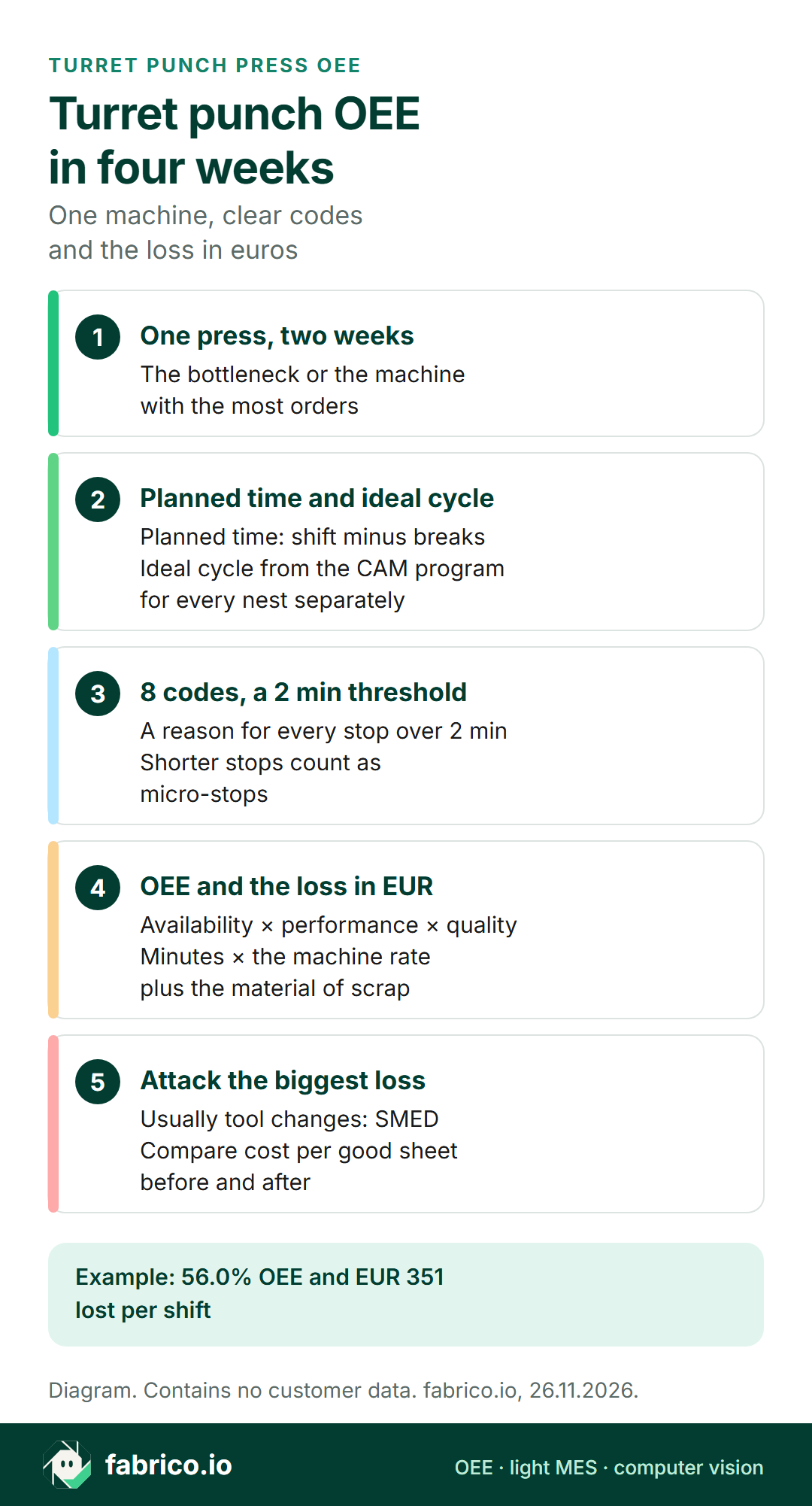
Text version of the diagram
- Pick one press and two weeks: the bottleneck or the machine with the most orders.
- Set the planned time and the ideal cycle per program.
- Introduce 8 stop codes and a 2 min threshold; shorter stops count as micro-stops.
- Calculate availability, performance, quality and OEE for every shift and price the loss in euros.
- Attack the biggest loss: usually tool changes with off-machine presetting, then waiting for sheets and programs. Compare cost per good sheet before and after.
- Week 1: paper or a tablet at the press, 8 codes, a 2 min threshold.
- Week 2: the first Pareto by minutes and by count. In the worked example, tool changes are on top.
- Week 3: the tool change checklist and a standard time for each job type.
- Week 4: compare OEE and cost per good sheet with week 1.
Where Fabrico fits
Fabrico is an OEE and light MES system. It shows OEE live by machine, line and shift. Operators pick stop reasons in a few taps, tool changes are tracked against a standard time, and scrap is recorded by product and reason. The top-20 stoppages table gives you the Pareto ready-made.
Where a camera covers the press, it counts output, including on older machines with no signal. The minute of a stop is opened from the shift timeline and streamed on request, not stored. Losses are priced in money per product. The plan and the nests stay in the ERP or the nesting software.
Frequently asked questions
What is a good OEE for a turret punch press?
No published range with a named primary source was found specifically for turret punches, so none is given here. Compare the press with itself: measure for two weeks and track the change after each fix.
Can a turret punch without controller data still get an OEE figure?
The sheet count comes from a camera over the unload table or from a manual log, and the operator enters the stop reasons. The ideal cycle comes from the CAM program.
Do tool changes count against OEE?
Yes. A tool change is an availability loss inside planned time. Give it its own code so you can compare it with the standard time.
Is shake-out a loss for the press?
Yes, when the press stands and waits for the operator. If shake-out happens off the machine while it punches the next sheet, it is labour, but not a press loss.
Should scrap be counted in sheets or in parts?
For press OEE, count in sheets and convert partial scrap by its share of the parts in the nest. For root-cause analysis, keep the part count as well.
When does a sheet tower pay back?
When the yearly value of the minutes saved exceeds the yearly cost of the tower. In the example, 35 min per shift is worth about EUR 20,580 a year, but only if the press is the bottleneck.
Which safety standard applies to turret punch presses?
ISO 16092-1 explicitly excludes turret punch pressing. The legal frame is Regulation (EU) 2023/1230, which applies from 14 January 2027; the specific risk assessment is for the manufacturer and the employer.
See where your press loses its minutes. The demo shows live OEE by machine and shift, stop reasons, tool changes against a standard time and scrap by reason.
Latest from our blog






Real Fabrico tiles, sample data.