







 Login
 Blog
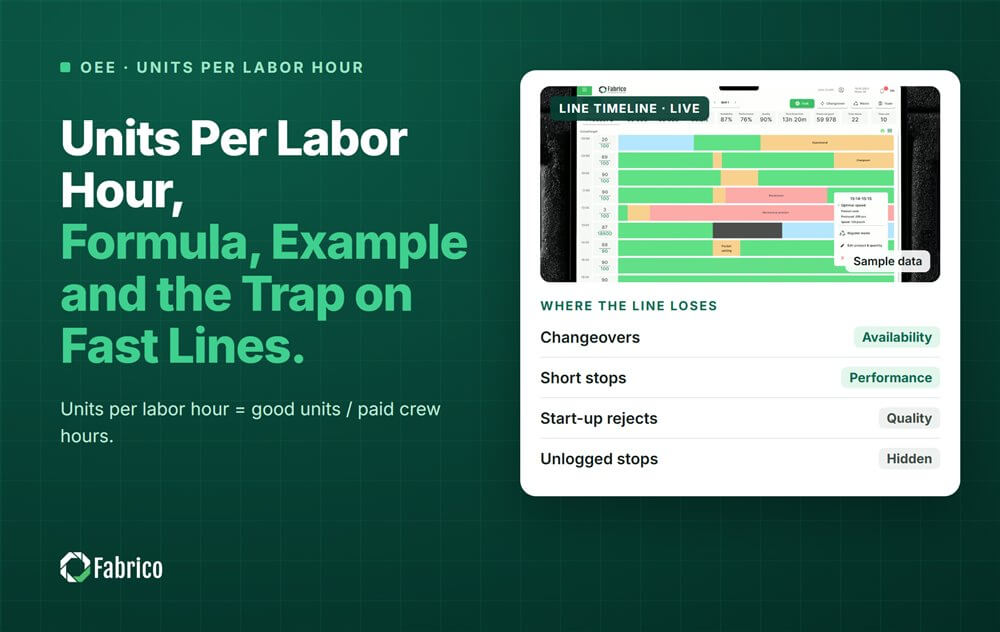
Units Per Labor Hour: Formula, Example and the Trap on Fast Lines

Key takeaways
- Divide good units by the paid hours of everyone on the line.
- The crew is fixed on a fast line, so stops and slow running move the number most.
- A smaller crew can raise the ratio and still lose output.
- Report it by line and shift, never by named operator.
Units per labor hour, often written UPLH, is the labor side of shift performance. It is easy to calculate and easy to misread, especially on fast FMCG lines where machines set the pace.
Fabrico, OEE and light MES software with AI cameras, gives plants good output by line and shift from the machine signal. Pair that count with paid crew hours from your time system and you have units per labor hour for every shift.
What is units per labor hour?
Units per labor hour is a labor productivity number. It tells you how many good units the line made for each hour of paid crew time.
Units per labor hour = good units / total paid labor hours on the line
Some plants call it parts per labor hour or output per man hour. The idea is the same. What changes from plant to plant is which hours count.
Which hours count as labor hours?
Count the paid hours of everyone assigned to the line for the shift. Write the rule down once and keep it.
- In: operators, the line lead, material handlers, packers and anyone borrowed from another line.
- In: overtime hours, at actual hours, not at the overtime pay rate.
- Your choice: paid breaks. Most plants include them, because they are paid.
- Usually out: maintenance, quality lab and shared support staff. Track them in their own numbers.
The rule matters more than the choice. If one shift counts the forklift driver and another does not, the comparison is broken before it starts.
Worked example: what is units per labor hour on one shift?
Sample line (illustrative numbers, not a customer): a snack bagging line. The bagger is rated at 100 bags a minute, or 6,000 an hour. The shift has 7.5 planned hours. Each person is paid 8 hours.
| Case | Crew | Labor hours | OEE | Good bags | Units per labor hour |
|---|---|---|---|---|---|
| A: today | 6 | 48 | 70% | 31,500 | 656 |
| B: fewer stops | 6 | 48 | 77% | 34,650 | 722 |
| C: one person less | 5 | 40 | 62% | 27,900 | 698 |
- Case A: good bags = 6,000 x 7.5 x 0.70 = 31,500. Then 31,500 / 48 = 656.
- Case B: the crew fixes two repeat jams and OEE rises to 77%. Good bags = 34,650, so 34,650 / 48 = 722, up 10%.
- Case C: the plant cuts one packer. Case packing falls behind and the bagger slows down. OEE drops to 62%. Good bags = 27,900, so 27,900 / 40 = 698.
Case C looks better than today on the labor number. Yet it made 3,600 fewer bags than case A. At a sample contribution of $0.10 a bag, that is $360 a shift, or €360 in a euro plant at €0.10 a bag. Case B beat both and kept the crew.
Why does units per labor hour follow OEE on a fast line?
On a manual line, more people usually means more output. On an automated line, the machines set the pace and the crew size stays the same all shift.
So the labor hours are fixed and only the good units move. Each stop, slow run and reject comes straight off the top of the ratio. That is why case B in the example was the real win.
Look at the six big losses first: breakdowns, changeovers, short stops, slow running, rejects and start-up losses. Our OEE calculation guide shows how each one shows up in the number.
Is units per labor hour the same as OLE or labor productivity?
They are close relatives, but they answer different questions.
- Units per labor hour counts output per paid hour. It is quick and good for trends on one line.
- Labor productivity is the wider family. It can compare output in money with labor cost.
- OLE, overall labor effectiveness, splits labor time into availability, performance and quality, the way OEE does for machines.
Our guide to overall labor effectiveness explains OLE in detail. For the difference between output and effort, see productivity vs efficiency.
Should I compare units per labor hour between people?
No. Compare lines and shifts, not named people. On a fast line, a person's number mostly reflects the machine they stood next to.
There is a legal reason too. In the EU AI Act, Annex III treats AI that monitors and evaluates workers' performance as high risk. Measure the process, never the person. Crews also log stops honestly only when the data is not used to blame them.
How do I raise units per labor hour without cutting people?
- Fix repeat stops at the bottleneck. Short jams cleared in under a minute add up fast.
- Win the first hour. Stage materials before the shift so the line reaches rated speed sooner.
- Shorten changeovers. Prepare parts while the line still runs.
- Plan crew to the line's real speed. Our guide to labor planning with live OEE covers overtime and shift decisions.
Where Fabrico fits
Fabrico is a computer vision enabled Manufacturing Performance Platform. OEE and light MES come first. It gives the good unit count and the losses behind it, by line and shift.
- Automatic downtime logging from the machine signal, so stops are counted even when nobody writes them down.
- The operator confirms the reason in one tap, and a camera clip can serve as evidence for the stop.
- Every loss priced in money, so a lost bag and a lost labor hour can sit in the same conversation.
It reports by line and shift, never by named operator. You start with a pilot on one line. There is no free plan and there are no tiers: each plant gets a quote. See how cameras log stops on our computer vision OEE page.
Frequently asked questions
How do you calculate units per labor hour?
Divide good units made in the shift by the total paid hours of everyone assigned to the line. Six people paid 8 hours each give 48 labor hours. If the line made 31,500 good units, the result is 31,500 divided by 48, or 656 units per labor hour.
What is a good units per labor hour?
There is no general benchmark. It depends on the product, the pack size and how automated the line is. Compare a line with its own past shifts, on the same counting rule. A rising trend with the same crew means the line is losing less time.
Should overtime count in labor hours?
Yes. Count overtime at the actual hours worked, not at the higher pay rate. If you leave overtime out, a shift that needed extra hours to hit its target looks more productive than it was. Keep cost and hours as two separate numbers.
Does a higher units per labor hour always mean a better shift?
No. A smaller crew can raise the ratio while the line makes fewer units. In the sample above, cutting one person raised the ratio from 656 to 698 but lost 3,600 bags. Always read the ratio next to total good output.
Can units per labor hour be tracked automatically?
Yes. Good units come from the machine count, and paid hours come from the time and attendance system. Join them by line and shift. The hard part is agreeing which roles count as line labor, so settle that rule before you build the report.
Bring one line and a week of crew hours to a Fabrico demo. We will show which stops moved your labor numbers, or contact us with a question.





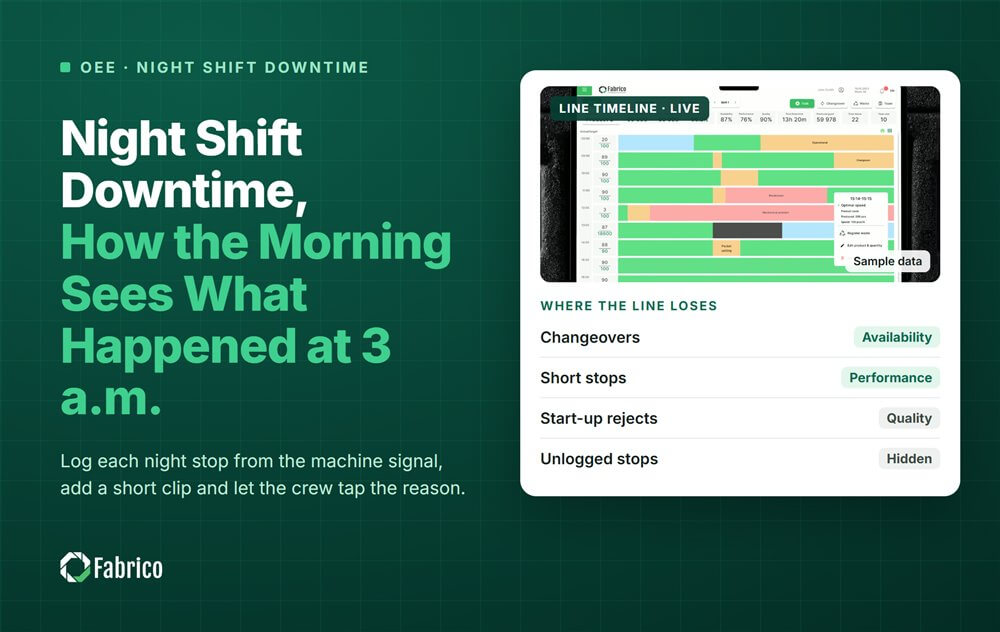


Real Fabrico tiles, sample data.