





 Login
 Blog

Vacuum Packing Machine OEE: Leakers, Chamber Load and the Money

In short
- Rated output is cycles times positions: a packer rated at 2.4 cycles a minute with 4 positions per cycle should make 9.6 packs a minute. Measure packs against that, not cycles.
- Split performance in two: cycles lost waiting for the loader, and positions left empty in the chamber. A cycle counter hides the second one.
- Trace every leaker to a branch: puncture, seal, vacuum or late leak. Mark where the hole or open seal is before the pack is cut open.
- Price the chamber cycle: in the Danish cheese example one empty position costs EUR 0.29, one leaker caught at the tunnel EUR 1.45, and all losses add up to EUR 527.20 a shift.
- Fix the loading method before adding a loader: a second person costs EUR 440 a shift, more than the EUR 206.82 lost to pace and part loads.
Vacuum packing machine OEE is the number of good, tight packs made in planned time, divided by the chamber's rated output: rated cycles per minute times the positions in each cycle. On a belt or rotary chamber packer with a shrink tunnel, most of the gap comes from four places.
They are leakers, part-empty chamber cycles, a cycle paced by hand loading, and stops at the seal bar, pump and tunnel. Below: how to count each, a leaker cause tree with floor checks, and a priced example of cheese blocks on one belt packer in Denmark.
Rated output on a chamber packer: cycles times positions
A belt chamber packer works in cycles. The belt carries bagged products into the chamber, the lid closes, the pump draws the vacuum, the seal bars seal, the chamber vents and the belt carries the packs out to the shrink tunnel.
Each cycle holds a fixed number of positions, set by the seal bar length and the product size. Rated output is the rated cycle rate times the positions per cycle, for that product and bag.
- Availability: planned production time minus stops at the seal bar, pump, tunnel, bag changes and waits for product.
- Performance: packs made per run minute against rated cycles times positions. It has two parts: the cycle rate and the chamber load.
- Quality: packs that leave the tunnel tight, against all packs made. Leakers are the loss.
A packer can run every cycle close to its rated rate and still lose an eighth of its output, because one position goes in empty every other cycle. The cycle counter shows nothing wrong.
Three count points
- Cycle count: from the packer's own counter or its cycle-complete signal.
- Pack count: at the tunnel exit, by sensor or by tally.
- Leaker count: at the inspection point after the tunnel, by cause.
Packs divided by cycles is the average chamber load. Divided again by the positions, it is the load factor, a number the cycle counter never shows.
The packer is the core machine of the pack-off line
Upstream sit cutting, the ripening store or the boning hall; downstream a labeller, checkweigher and case packing. Read OEE at the packer, and charge starved and blocked time to the machine that caused it.
On a rotary chamber machine, rated output is chambers per minute times products per chamber. Lines that form packs from film rolls are covered in thermoforming OEE, tray lines in tray sealer OEE.
The pack-off loss map: who owns which minute
Pin this table at the line. Each loss has one OEE factor and one owner, so the morning meeting talks about fixes instead of blame.
| Loss | OEE factor | How to count it | Owner |
|---|---|---|---|
| Seal bar fault or tape change | Availability | Stop with operator reason | Maintenance |
| Pump slow, vacuum not reached | Performance, then availability | Cycle time and pump-down time | Maintenance |
| Shrink tunnel fault | Availability | Stop with operator reason | Maintenance |
| Bag size change | Availability | Time against a standard | Production |
| Waiting for the loader | Performance | Cycles a minute against rated | Production |
| Part chamber loads | Performance | Packs per cycle against positions | Production |
| No product from upstream | Availability, charged upstream | Starved time with reason | Upstream |
| Labeller or case packer full | Availability, charged downstream | Blocked time with reason | Downstream |
| Leakers and re-packs | Quality | Tally by cause at the tunnel exit | Shared |
Two rows need care. Waits for the loader last a few seconds and repeat all shift, so a paper log never sees them. Count them from the cycle signal, as set out in the page on micro-stops, and price them like any long stop.
A slow pump first shows as a longer cycle, a performance loss, long before it becomes a stop. A 25-second cycle that drifts to 28 seconds loses 10.7% of rated output with no alarm.
Leaker cause tree: four branches, one floor check each
A leaker is a pack that has lost its vacuum, through a hole or an open seal. After the shrink tunnel it shows as a loose bag: air is inside and the film lifts off the product.
Re-packing it costs a bag, a minute of handling and a second chamber position. Missing it costs more. In commercial vacuum-packed cheddar, Hempel and co-authors at University College Cork found oxygen averaged 3% right after packing and rose in all packs, to 3.6-8.2% after six days at 4 °C.
Their readings led to further checks that found the causes of those failures. The floor rule: before a leaker is cut open, mark where the hole or open seal is. The position tells you the branch.
| Branch | Sign on the pack | Floor check | Owner |
|---|---|---|---|
| Puncture: bone or sharp edge | Hole over a bone end | Bone guard used? Bone turned away from the bag wall? | Meat cutting |
| Puncture: rind or block corner | Hole at a corner or edge | Corner shape, block size against bag size | Cheese forming |
| Puncture: handling | Hole in the same spot on many packs | Walk the belt, tunnel exit and crates for a burr | Maintenance |
| Seal: contamination | Channel through the seal, fat or whey on it | Bag mouth clean and dry? Product too close to the seal? | Loader |
| Seal: wrinkle | Pleat across the seal | Bag flat over the bar? Bag width against product | Loader, bag spec |
| Seal: bar condition | Weak seal along one bar | Seal tape, counter-bar rubber, settings against the bag spec | Maintenance |
| Vacuum: pump or lid | Every position in one cycle loose | Pump-down time and end vacuum; lid gasket | Maintenance |
| Late leak | Tight at the tunnel, loose days later | Hold and recheck a sample from the cold store | Quality |
The bag sets how much abuse a pack can take. In a laboratory study of barrier shrink bags for fresh beef, Rodrigues and co-authors describe puncture resistance as a film's ability to resist pinholes from rough handling or sharp objects such as meat bones. They measured seal strength beside it.
That does not make a tougher bag the first fix. A hole in the same spot on every pack is a burr on the line; a pleat across the seal is a loading habit. Change the bag only after the floor checks point at the film.
One look-alike: a weak shrink keeps its vacuum but leaves loose film and ears. Log it as a tunnel reason, not a leaker.
Rules that shape the re-pack
- Contamination: Regulation (EC) No 852/2004, Annex II, Chapter X, requires wrapping and packaging operations to be carried out so as to avoid contamination of the products. That includes the re-pack table.
- Meat temperature: under the hygiene rules for food of animal origin, Regulation (EC) No 853/2004, meat of domestic ungulates (beef, pork, lamb) is kept at not more than 7 °C (3 °C for offal) during cutting, boning, wrapping and packaging, by an ambient of not more than 12 °C or an equivalent system. A queue of leaker primals is inside that rule.
- Bags: shrink bags are food contact materials under Regulation (EC) No 1935/2004, made under good manufacturing practice so they do not transfer their constituents to food in quantities that could endanger health or change the food unacceptably. Change bag type only with the supplier's and quality team's sign-off.
For cheese, the general hygiene rule and the plant's HACCP plan set how long a leaker block may wait.
Chamber load and the hand-loaded cycle
On a hand-loaded belt packer, people load the product. They put each block or primal in its bag, lay the bag mouth over the seal bar and space the packs on the belt. The chamber cannot close before they finish, so the crew sets the cycle rate, not the pump.
Two losses come out of that:
- Waiting for the loader: the chamber is ready and the belt is not. Each wait is short and repeats all shift.
- Part loads: the chamber closes with an empty position to keep the cycle going. The cycle rate looks fine and the pack rate drops.
Part loads have their own causes:
- Product arriving in gaps from cutting or the store.
- A layout that does not suit the product, such as four positions planned for a block size that only fits three.
- The last cycle of each order.
- A loader target set in cycles, which rewards closing a part-empty chamber.
Floor checks for loading
- Count products per cycle for one hour, by hand if needed. Every cycle below the full positions is lost output.
- Stand at the loading table for ten cycles. Note where hands wait: for product, for bags or for the belt.
- Check that bag stock is within reach and opened bags are ready for the next cycle before the chamber opens.
- Set one chamber layout per product and bag size, and write it on the line board.
A loader target that counts packs, not cycles, removes the reason to close a part-empty chamber.
Seal bar, vacuum pump and shrink tunnel checks
In the worked example below these three cause all 40 unplanned stop minutes a shift, and each can be checked before it fails. Make the checks part of the shift start, not a reaction to a run of leakers.
Seal bar
- Seal tape (the non-stick cover) worn or burnt; counter-bar rubber cut or flattened.
- Seal time, temperature and cooling against the bag supplier's specification for that bag.
- A test seal on the first cycle of each shift and after each bag change, pulled by hand along its length.
Vacuum pump
- Pump-down time: the seconds to reach the set vacuum. Log it at shift start; a rising trend points at filters, oil or the lid gasket before the packs go loose.
- End vacuum: if the set level is not reached, every position in that cycle is at risk.
- Lid gasket: a cut or flattened gasket slows every cycle.
Shrink tunnel
- Temperature or water level out of range, so bags do not shrink tight.
- Transfer or conveyor stops between packer and tunnel, which block the packer.
- Packs touching or overlapping in the tunnel, which leaves loose corners.
Safety while clearing
Wiping a seal bar or freeing a pack under the lid puts hands where the machine closes. HSE's guidance on packaging machinery notes that the largest share of packaging machines is used in food and drink manufacturing, and says the system of work should be formalised and workers trained.
Write the clearing steps down, and never run with an interlock bridged to save a minute.
Bag changes and cleaning: planned time or loss
A bag size change is short but frequent: new bag stock, seal bar settings, the chamber layout, the date code and a check of the first packs. A product change may also need the belt and chamber cleaned.
- Time each change against a standard per bag size, from the last good pack to the first good pack.
- Do before the stop what needs no stop: stage the bags, labels and the layout card for the next order.
- Group orders by bag size where the plan allows. The plan is made in the ERP or the planning spreadsheet; measured changeover times make it more accurate.
- Treat cleaning set by the hygiene plan as planned time, and any overrun beyond its standard as a loss.
The packer's hygienic design sets how long cleaning takes. EHEDG Doc. 29 covers the hygienic design of packing systems for solid foodstuffs; ask how a packer meets it before you buy. The method for cutting the minutes is in the guide to changeover time.
Worked example: Gouda-type blocks on one belt packer in Denmark
Danish dairies produced 524.5 million kg of cheese in 2025, per Statistics Denmark table ANI7. The example is one packer in a plant of that kind. The numbers are an example, not a customer's; sample figures are labelled.
Inputs
- Line: one belt vacuum packer with 2 seal bars and 4 positions per cycle, rated 2.4 cycles a minute (a 25-second cycle), so 9.6 packs a minute, then a shrink tunnel (sample figures).
- Product: 3 kg Gouda-type blocks in shrink bags (sample figure).
- Shifts: two 8-hour shifts, each with 450 minutes of planned production after 30 minutes of breaks and start-up checks. 21 days a month (42 shifts), 252 a year (504 shifts).
- Stops a shift: 2 bag changes of 15 minutes against a 10-minute standard, plus 40 minutes of seal bar, pump and tunnel stops (sample figures). Run time is 380 minutes.
- Pace and load: 2.2 cycles a minute, paced by the loader, and 3.5 blocks per cycle on average (sample figures).
- Leakers: 3.0% of packs, re-bagged and run again (sample figure).
- Labour: EUR 55.00 an hour, the 2025 hourly labour cost for Danish manufacturing in Eurostat lc_lci_lev. A crew of 3 (sample figure) costs EUR 165.00 an hour, EUR 2.75 a minute.
- Re-pack: EUR 0.25 per shrink bag and 1 minute of one person's time, EUR 0.92 (sample figures).
- Cheese value: EUR 4.66 a kg, the 2025 average value of Gouda exported from Denmark in Statistics Denmark table KN8Y: DKK 303,639,255 for 8,736,807 kg, DKK 34.75 a kg, at Eurostat's 2025 average of 7.4634 kroner to the euro.
OEE for one shift
- Cycles: 380 × 2.2 = 836.
- Packs made: 836 × 3.5 = 2,926.
- Leakers: 2,926 × 3.0% = 87.8, so 88. Good packs: 2,926 - 88 = 2,838.
- Availability: 380 ÷ 450 = 84.4%.
- Performance: 2,926 ÷ (380 × 9.6 = 3,648) = 80.2%. That is the cycle rate, 2.2 ÷ 2.4 = 91.7%, times the load, 3.5 ÷ 4 = 87.5%.
- Quality: 2,838 ÷ 2,926 = 97.0%.
- OEE: 84.4% × 80.2% × 97.0% = 65.7%, the same as 2,838 good packs ÷ 4,320 rated positions (450 × 9.6).
Every lost position, in euros
Each loss is priced at crew cost, because the shortfall is made up with extra crew time. One position at rated speed costs EUR 2.75 ÷ 9.6 = EUR 0.29.
| Loss | Per shift | EUR a shift |
|---|---|---|
| Bag changes | 30 min, 288 positions | 82.50 |
| Seal bar, pump and tunnel stops | 40 min, 384 positions | 110.00 |
| Waiting for the loader | 76 cycles, 304 positions | 87.08 |
| Part chamber loads | 418 empty positions | 119.74 |
| Leakers | 88 packs at EUR 1.453 | 127.88 |
| Total | 1,482 positions | 527.20 |
Waiting for the loader is (2.4 - 2.2) × 380 = 76 cycles, or 304 positions at EUR 0.28646 each, EUR 87.08. Part loads are 836 cycles × 0.5 empty positions = 418 positions, EUR 119.74.
A leaker costs its second chamber position (EUR 0.286), a bag (EUR 0.25) and the re-pack minute (EUR 0.917), so EUR 1.453 (EUR 1.45 rounded). For 88 leakers that is EUR 127.88.
EUR 527.20 a shift is EUR 527.20 × 42 = EUR 22,142.40 a month and EUR 527.20 × 504 = EUR 265,708.80 a year, measured against the packer's rated output.
The cycle counter shows the packer at 91.7% of its rated cycle rate. The pack count shows 80.2%. The gap is 418 empty positions, the largest loss in the example when counted in positions, and it appears on no alarm list.
What a first round of fixes is worth
- Bag changes back to the 10-minute standard: 10 minutes, EUR 27.50 a shift.
- Leakers from 3.0% to 1.0%: 29 leakers instead of 88, so 59 × EUR 1.453 = EUR 85.73 a shift.
- Chamber load from 3.5 to 3.8 blocks a cycle: 836 × 0.3 = 250.8 fewer empty positions, EUR 71.84 a shift.
Together that is EUR 185.07 a shift, EUR 7,772.94 a month and EUR 93,275.28 a year, holding everything else equal. None of the three needs a new machine.
The leaker that leaves the plant
Inside the plant a leaker costs EUR 1.45. A 3 kg block that leaks after dispatch can cost the block itself: 3 × EUR 4.66 = EUR 13.98 of cheese, before freight and the claim. That is more than nine times the in-plant cost.
Across one shift, 2,926 blocks × 3 kg = 8,778 kg of cheese pass the packer, worth 8,778 × EUR 4.66 = EUR 40,905.48 at export value. The check after the tunnel deserves a fixed place and a named person.
The price of one chamber cycle
Minutes on a line board get argued about. A price per chamber cycle gets acted on, because every loader and fitter sees what the next cycle is worth. These are the example's prices; use your own.
| Loss in one cycle | Cost | Where you see it |
|---|---|---|
| One empty position | EUR 0.29 | Packs per cycle below the positions |
| One cycle lost waiting | EUR 1.15 | Cycle rate below rated |
| One minute of stop | EUR 2.75 | Stop log with operator reason |
| One leaker caught at the tunnel | EUR 1.45 | Leaker tally by cause |
| One leaker found by the customer | EUR 13.98 and up | Complaint or return |
Two comparisons drive the decisions at the packer in the example:
- One leaker costs as much as five empty positions (1.45 ÷ 0.29 = 5.0). A loading change that fills the chamber but adds leakers can lose money.
- A second loader costs EUR 55.00 × 8 = EUR 440 a shift. In the example the whole pace and part-load loss is EUR 87.08 + EUR 119.74 = EUR 206.82 a shift. Fix the loading table, bag stock and layout before adding a person.
Two weeks of counts at the packer
The start needs no new equipment: the packer's cycle counter, a tally sheet at the tunnel exit and a stop log split by owner. Two weeks give enough cycles per product to see the pattern.
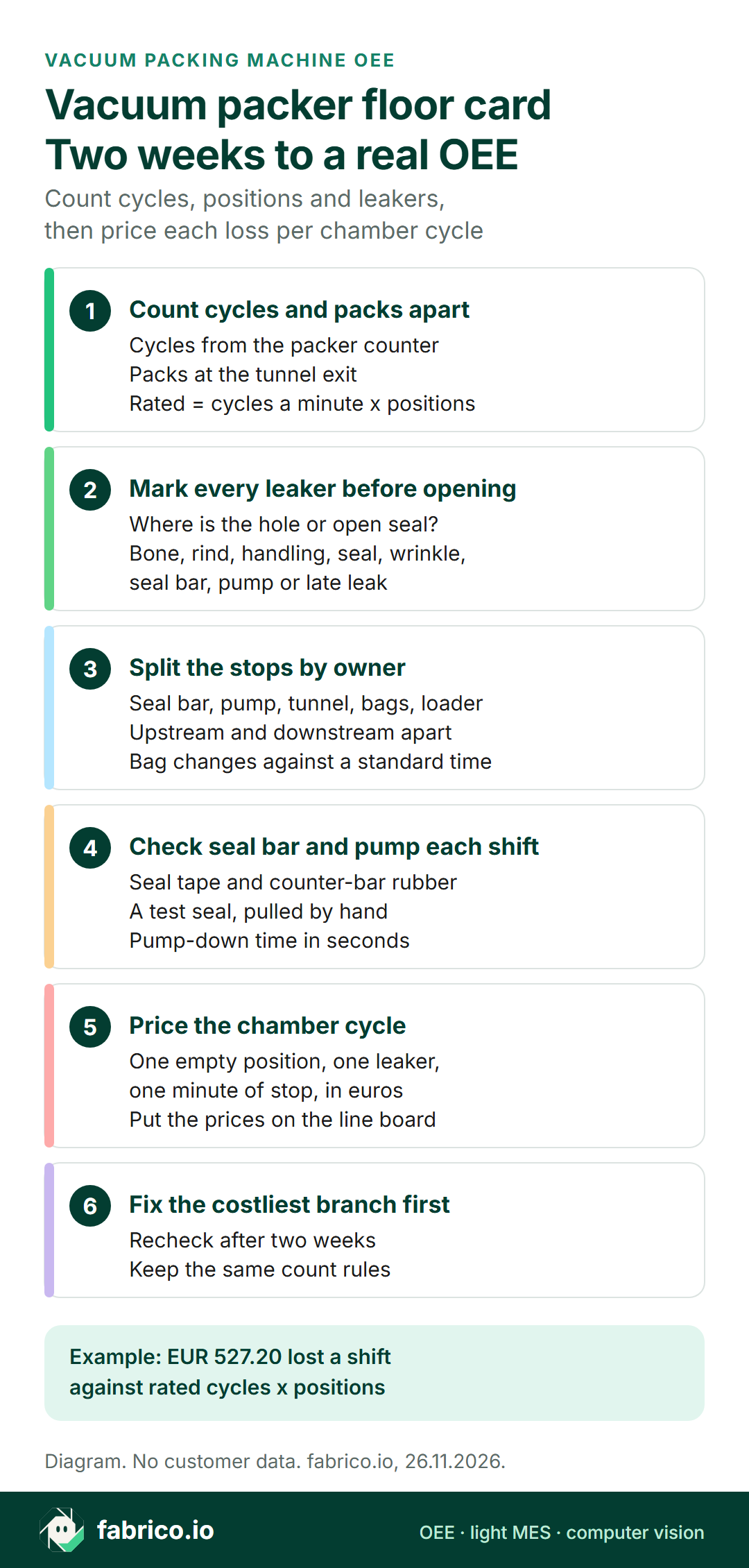
Text version of the diagram
- Count cycles and packs separately: cycles from the packer, packs at the tunnel exit, and set rated output as cycles a minute times positions.
- Mark every leaker before it is opened: where the hole or open seal is, and which branch it belongs to: bone, rind, handling, seal, wrinkle, bar, pump or late leak.
- Split the stops by owner: seal bar, pump, tunnel, bag changes, loader, upstream and downstream, with bag changes timed against a standard.
- Check the seal bar and pump at every shift start: seal tape, counter-bar rubber, a test seal and the pump-down time.
- Price the cycle: one empty position, one leaker and one minute of stop, in euros, on the line board.
- Fix the costliest branch first and recheck after two weeks with the same count rules.
At the end of the two weeks you have a rated output per product, a load factor, a leaker rate by cause and a priced loss list. That is enough to choose the first fix with numbers rather than opinion.
Decision: fix the bag, the loading or the measurement first
The example line faces three choices at once: change the bag, change the loading, or change how the line is measured. The priced cycle table sets the order: fix the branch that costs most a shift, and measure well enough to see whether the fix held.
Options and what they cost
| Option | What it gives | Cost | Fits |
|---|---|---|---|
| Tally sheet and stop log | Leakers by cause, stops by shift | Operator and supervisor time | One packer, first two weeks |
| Packer counters and screen | Cycles and alarms | Part of the machine; ask the supplier about data export | Cycle rate only |
| OEE or light MES software | Stops, cycles, packs and reasons by shift, priced | Ask the vendor for a price per line per month | Several lines, daily meetings |
| Camera counting | Packs out where no usable signal exists | Ask the vendor for a price per line per month | Older packers and tunnels |
| Tougher bag | Fewer punctures | Ask the bag supplier for a price per 1,000 bags | Puncture branch proven |
| Second loader | Faster loading | EUR 440 a shift at Danish labour cost | Loading method already fixed |
Line software from machine signals
OEE or light MES software reads the packer's cycle and stop signals through the line PLC or an added sensor, counts packs at the tunnel exit and asks the operator for a stop reason at the machine. Ask whether it logs cycles and packs apart, so cycle rate and chamber load show as separate losses (question 1 below).
What you see: a shift timeline, unclassified time waiting for a reason, and the operator's line-down screen, on sample lines. Book a demo.
Plays from YouTube. Google may set cookies when you press play. Privacy policy.
For lists of tools, see the comparison of OEE software for food and beverage, the overview of OEE software and, for plant-wide needs in cheese and milk, MES for dairy processing.
Who should pick which
- One packer, leakers are the worry: a tally by cause for two weeks, then fix the top branch.
- Several packers, arguments about pace: line software from machine signals, so pace and packs per cycle are counted, not debated.
- Old packers without usable signals: camera counting at the tunnel exit, software where signals exist.
- Meat plants with bone-in cuts: floor checks first; change the bag once the puncture branch leads the tally.
Questions to ask a vendor or supplier
- Can cycle count and pack count be logged separately, so chamber load shows as its own loss?
- Can rated output be set per product as cycles a minute times positions?
- How are waits of a few seconds counted, and can they be grouped by hour?
- Can leakers be recorded as scrap by product and cause, and priced?
- Can blocked and starved time be charged to the tunnel, upstream or downstream?
- Which signals does the packer give: lid closed, cycle complete, alarm, pump-down time?
- What does it cost per line per month, and what has to be fitted at the machine?
Where Fabrico fits
Fabrico is made by the publisher of this article.
- Real-time OEE (availability x performance x quality); on a linked pack-off line, OEE by line and shift from the core machine, here the vacuum packer.
- Machines connect through the line PLC or a Fabrico IoT device with sensors; micro-stops come from the machine signal.
- Stop reasons are chosen by the operator at the machine in a few taps, from a reason list the plant sets up, with planned and unplanned stops kept apart and changeovers tracked against a standard time.
- Scrap is recorded by product and reason, so leakers by cause sit beside the stops.
- With the selling price and margin of each product entered, losses are priced in money and stops are ranked by financial impact; a work order can be raised from a logged stop in one tap.
- Where a station has no usable signal, the camera add-on counts output: see OEE with computer vision. Pricing is one quote per plant by machines and modules.
Sources, accessed 26.11.2026: Eurostat, Labour cost levels by NACE Rev. 2 activity (lc_lci_lev); Eurostat, Euro exchange rates, annual data (ert_bil_eur_a); Statistics Denmark, ANI7 Production and use of milk; Statistics Denmark, KN8Y Imports and exports by CN, Gouda 04069078; EUR-Lex, Regulation (EC) No 852/2004 on the hygiene of foodstuffs; EUR-Lex, Regulation (EC) No 853/2004, hygiene rules for food of animal origin; EUR-Lex, Regulation (EC) No 1935/2004 on food contact materials; Hempel, Gillanders, Papkovsky and Kerry, Detection of cheese packaging containment failures using reversible optical oxygen sensors, International Journal of Dairy Technology 65(3), 2012, DOI 10.1111/j.1471-0307.2012.00849.x; Rodrigues, Brunelli, Sarantopoulos and Oliveira, Properties of barrier shrink bags made with EVOH and polyamide for fresh beef meat preservation, Polímeros 28(2), 2018, DOI 10.1590/0104-1428.04516; EHEDG, Guidelines list, Doc. 29 Hygienic design of packing systems for solid foodstuffs; HSE, Packaging machinery in all manufacturing industries.
Frequently asked questions
How do you calculate OEE for a vacuum packing machine?
Set rated output as rated cycles a minute times positions per cycle. Availability is run time over planned time, performance is packs made against rated output in run time, and quality is tight packs over all packs. Multiply the three, or divide good packs by planned time times rated output.
What causes leakers on a vacuum packer?
Four branches: punctures from bone, rind, block corners or handling; seal failures from contamination, wrinkles or a worn seal bar; incomplete vacuum from the pump or lid gasket; and late leaks that open in storage. Mark where the hole or open seal is before cutting the pack.
Why is the cycle rate fine but output still low?
The chamber is closing with empty positions. Divide packs by cycles: in the example, 3.5 blocks per cycle on a 4-position chamber took 12.5% off the output while the cycle counter looked normal.
Is every loose pack after the shrink tunnel a leaker?
No. A weak shrink keeps its vacuum but leaves loose film and ears, and belongs to the tunnel. A leaker has air inside and the film lifts away from the product when pressed. Log them as different reasons.
Should bag changes count as downtime in OEE?
Yes, as an availability loss timed from the last good pack to the first good pack. Cleaning required by the hygiene plan can be treated as planned time, as long as the rule is the same on every shift.
See the pack-off line's losses on one screen. The demo shows OEE by line and shift from the core machine, stops with operator reasons and losses priced in money from machine signals.
Latest from our blog







Real Fabrico tiles, sample data.