


 Login
 Blog

CMMS Software for CFOs: How to Read the Maintenance ROI Business Case

Why CFOs Should Care About CMMS (and What to Be Skeptical Of)

CMMS business cases arrive on CFO desks framed as maintenance efficiency projects. But the financial case for CMMS is actually a production capacity and cost avoidance story.
Three Levers, and How to Scrutinize Each
- Reactive maintenance cost reduction (most credible): Emergency repairs genuinely cost 3-5x planned repairs. The CFO question: does the maintenance team have actual data on current reactive maintenance spend, or is this an industry benchmark applied to headcount?
- Unplanned downtime reduction (compelling but verify): The production revenue per downtime hour calculation is accurate only if the plant sells all its capacity. Plants running below capacity should use contribution margin per hour, often 30-50% lower.
- Maintenance labor efficiency (real but often overstated): 30% efficiency improvement is achievable but assumes baseline data most maintenance organizations don't have.
The CMMS Financial Model: What to Verify Before Approval
Before approving a CMMS investment, verify four inputs in the business case:
- Baseline data: Ask for 12 months of actual maintenance spend broken into planned, reactive, and contractor categories. If this doesn't exist in usable form, the business case is built on assumptions.
- Revenue per downtime hour: Is the plant running at full capacity (use full revenue/hour) or has unused capacity (use contribution margin/hour)?
- Implementation cost: Request vendor Statements of Work, not estimates. Apply a 20% contingency buffer for scope creep.
- Payback sensitivity: Run the business case at 50% of claimed savings. If payback remains under 24 months at half the claimed benefit, the investment is defensible.
The CFO CMMS Investment Framework
A structured CMMS approval framework should evaluate three dimensions:
- Financial return: Positive NPV at 15% hurdle rate over 3 years using conservative (50% of claimed) benefit realization?
- Strategic fit: Does the plant have a credible maintenance leadership team that will drive adoption? The most common CMMS failure mode is a technically capable system with poor adoption.
- Risk: What is the vendor lock-in exposure? Evaluate data portability, contract termination costs, and vendor financial stability.
For MES and OEE Platforms with CMMS Built In
Add a fourth dimension, operational integration value: is the manufacturing team also tracking production efficiency KPIs that would benefit from connecting to maintenance data? If yes, an integrated platform like Fabrico delivers incremental value that a CMMS-only purchase cannot.
The combined business case is materially stronger, and the approval threshold should reflect it.
See Fabrico live. Request a demo.
Request a demoRelated articles






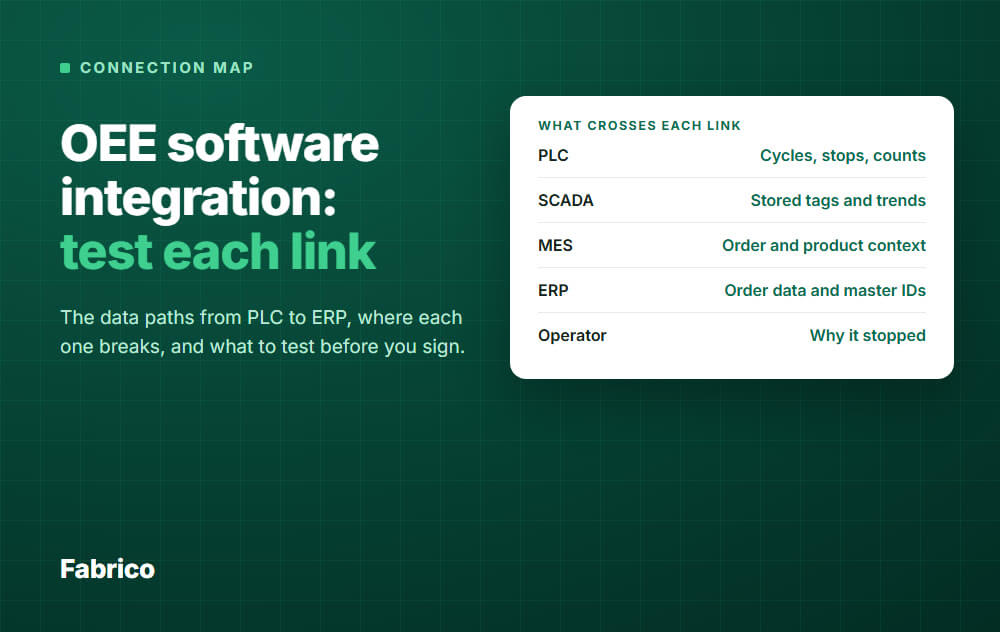
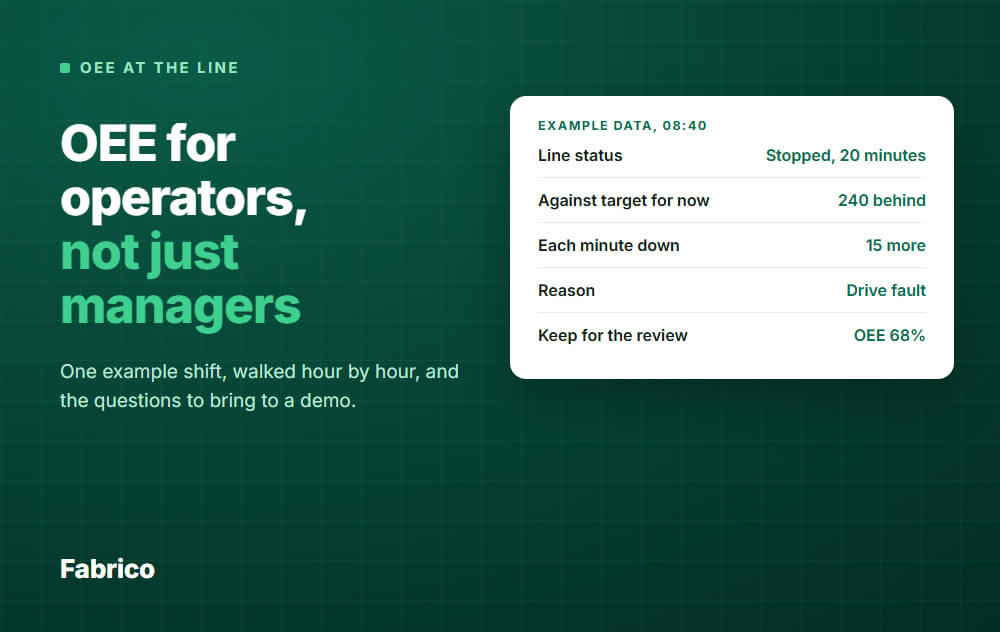


Real Fabrico tiles, sample data.