


 Login
 Blog

7 Best Manufacturing Operations Management (MOM) Software Tools (2026)

The manufacturing operations management (MOM) software that fits you depends on how much of the operations layer you need: full MES and MOM suites such as Siemens Opcenter, Plex, AVEVA and SAP Digital Manufacturing run production orders on the shop floor, while a light MES covers machine data collection, production monitoring, OEE and downtime analytics and leaves routings, BOMs, dispatching and genealogy in the ERP. Fabrico, our product, is a cloud-based OEE and light MES platform with maintenance (CMMS) built in, for plants that want to start with the machine layer next to the ERP they already run.
Key Takeaways
What MOM is: the layer between the ERP and the shop floor that coordinates production, quality, maintenance and inventory. ISA-95 (IEC 62264) places it at Level 3.
Full MOM or light MES: a full suite plans, dispatches and traces orders; a light MES measures what the machines and lines actually do. Plants can start with either.
Seven tools compared: Fabrico, Siemens Opcenter, Plex, Tulip, L2L, AVEVA and SAP Digital Manufacturing, each from its own site, checked 7 November 2026.
Many plants run maintenance, quality, production and finance in separate tools, and the gaps between them are where the daily questions go unanswered: why did the line stop, what did it cost, and who fixed it. Manufacturing operations management (MOM) software is the layer that connects the ERP (planning and finance) with the PLC and the machines on the shop floor.
What MOM software covers, and where light MES fits
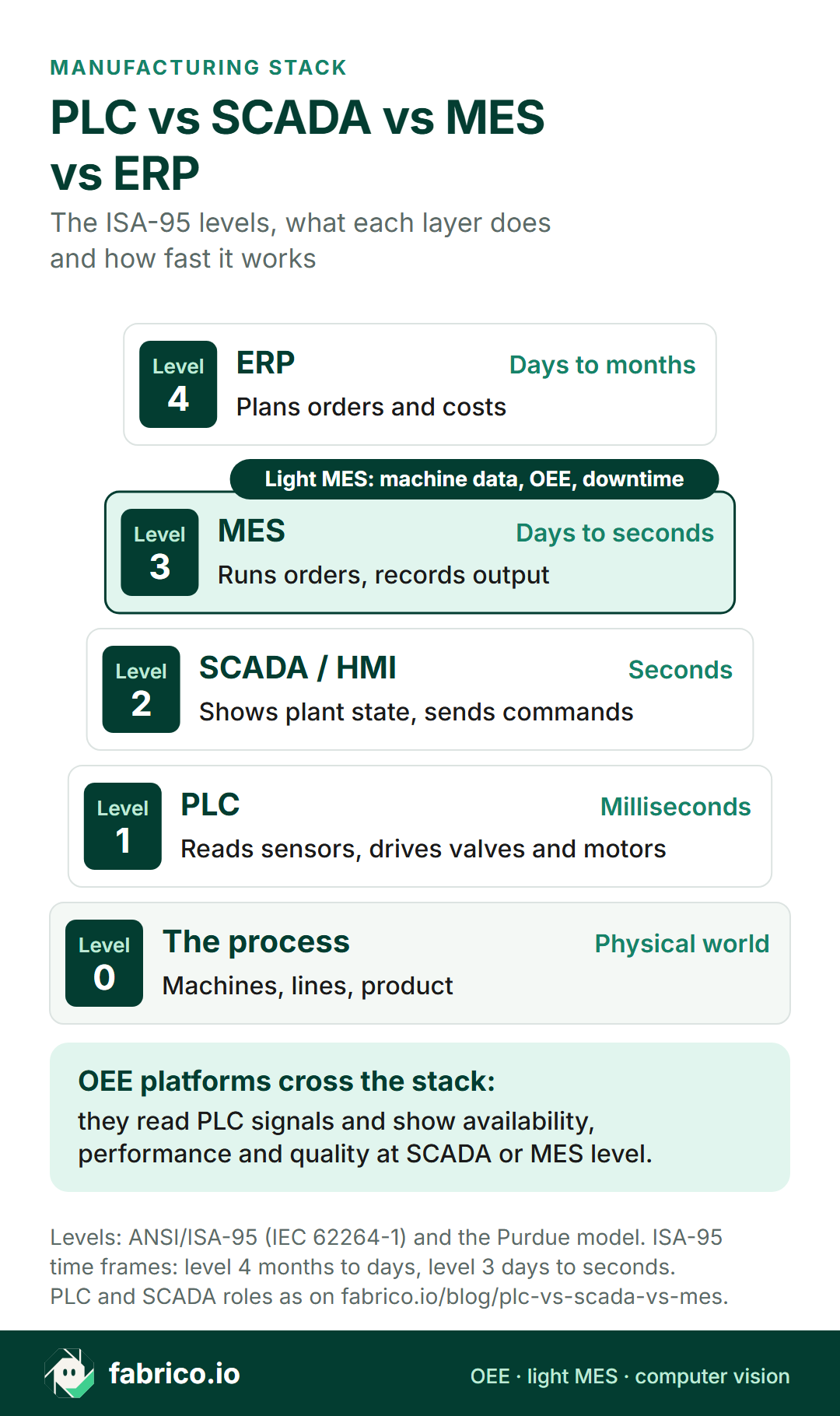
ISA-95 (IEC 62264) describes the levels from the sensors and the PLC up to the ERP. MOM sits at Level 3, between the control systems and the business systems. A full MOM or MES suite can take on scheduling, dispatching, quality and traceability at that level. A light MES takes the part that measures the machines.
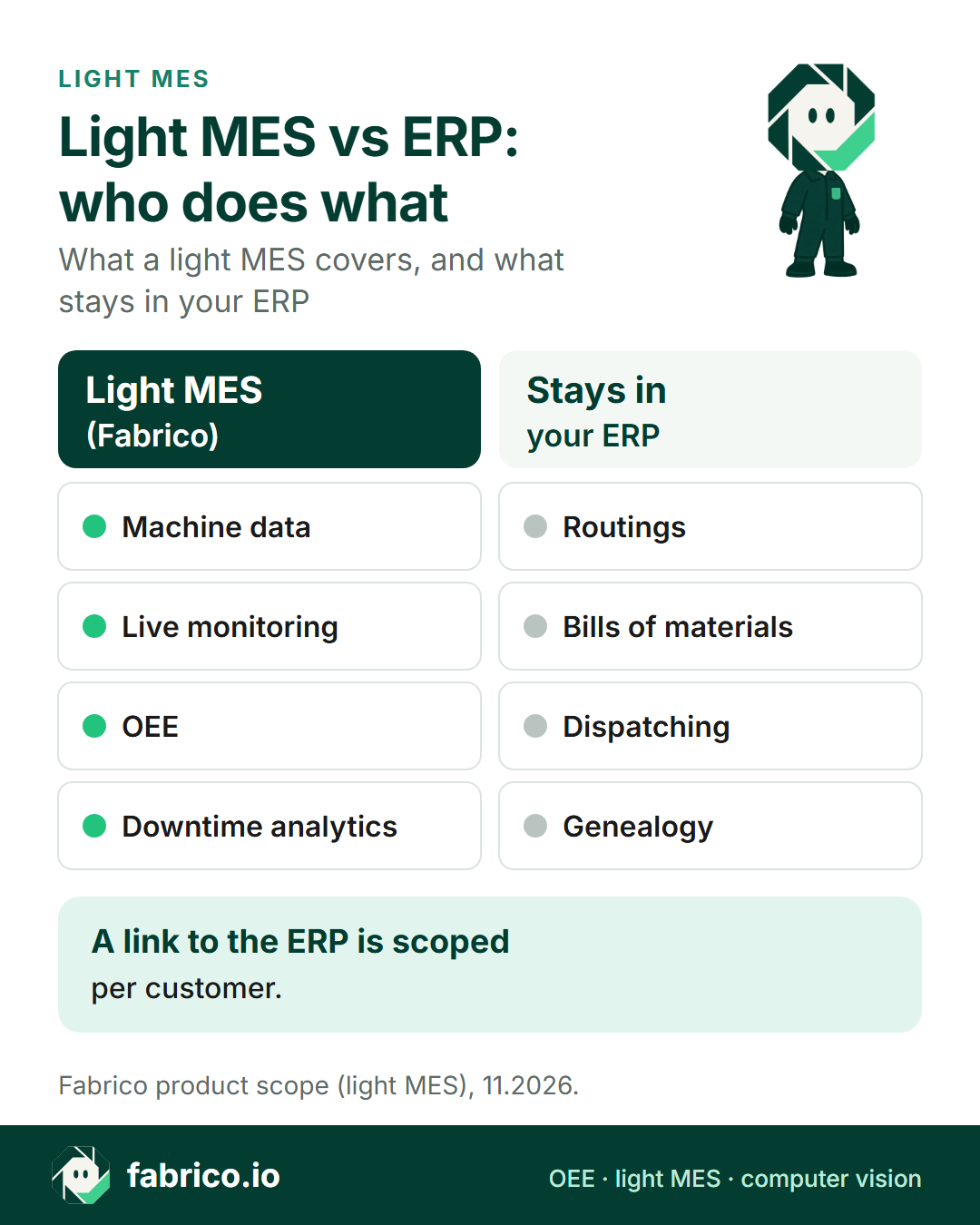
| Light MES covers | Stays in the ERP |
|---|---|
| Machine data collection | Routings |
| Production monitoring | BOMs |
| OEE and downtime analytics | Dispatching |
| ERP connection, scoped per customer | Genealogy |
Fabrico is a light MES in this sense, with maintenance (CMMS) built in. More in light MES and OEE vs MES.
Below are 7 manufacturing operations management software tools for 2026, each described from its own site. Fabrico is first because it is ours.
1. Fabrico: OEE and light MES with maintenance built in
What it is: Fabrico, our product, is a cloud-based OEE and light MES platform. It covers machine data collection, production monitoring, OEE and downtime analytics, with the ERP connection scoped per customer. Routings, BOMs, dispatching and genealogy stay in the ERP.
Machine data: from the PLC, from a Fabrico IoT device with external sensors on older machines, or from AI cameras (an add-on) where there is no machine signal. Protocols: OPC UA, Modbus, PROFIBUS, PROFINET, MQTT, EtherNet/IP, EtherCAT, IO-Link and HTTP (machine connectivity).
OEE: real-time OEE (availability x performance x quality) per line and shift, on a live OEE dashboard, with micro-stop detection and the six big losses made visible. Revenue at risk and profit impact per loss, in real time.
Maintenance on the same data: maintenance (CMMS) is built in. A work order is opened from the stop in one step, linked to the line.
ERP: REST API and webhooks, Excel or CSV export. A connection to SAP PM or SAP S/4HANA can be scoped per customer with your SAP team; Dynamics, Oracle and other ERPs through a custom integration.
Several plants: a group account lets head office see all plants, cross-plant reports compare machines and lines, and each site keeps its own control.
Apps and security: iOS, Android and web. ISO/IEC 27001, ISO 9001 and ISO/IEC 20000-1. EU clients hosted on AWS in Frankfurt, Germany.
Installing the devices and connecting the machines takes about one month. Full rollout across the lines you choose takes 3 to 4 months.
Fits: plants that want OEE and loss data from the machines, with maintenance on the same data, next to the ERP that already runs orders. Not a fit: plants that need scheduling, dispatching or genealogy in the new system; production planning is not part of Fabrico today.
2. Siemens Opcenter (formerly SIMATIC IT)
How it describes itself: "Opcenter Execution MES products optimize manufacturing operations, accurately reflecting design, engineering and process data in the production of actual finished products." For smaller firms: "Opcenter X is a digital manufacturing software-as-a-service (SaaS) solution with a modular approach to manufacturing operations management (MOM) for the SMB market."
OEE: Opcenter Execution Foundation OEE: "It calculates OEE and makes this information visible to all stakeholders."
Traceability: "MES functionality enables forward and backward traceability of components and their use within each end product."
Maintenance: Siemens says Opcenter Execution helps "ensure that production does not outpace maintenance requirements".
Ask Siemens: which edition and modules your first phase needs; Opcenter is a product family, not one application.
Sources: Siemens Opcenter, Opcenter Execution and Foundation OEE pages, checked 7 November 2026.
3. Plex (Rockwell Automation)
How it describes itself: "Plex MES (Manufacturing Execution System) is a cloud-based production management platform that gives manufacturers full visibility across the plant floor".
MES functions: "Plex MES features operator control panels, error-proofed workflows, closed-loop quality control, inventory tracking, and finite scheduling".
MES and ERP: "If you're looking for a solution that includes ERP and MES in one, the Smart Manufacturing Platform offers fully-integrated MES, ERP, and supply chain management (SCM)." Or the cloud MES on its own, to "connect to your corporate ERP."
Production monitoring: "Production monitoring software gives manufacturers real-time visibility into what's happening on the plant floor by automatically capturing machine data, downtime and production performance."
Ask Plex: whether you would run its MES with your current ERP or move to its ERP too.
Sources: Plex pages on its MES, Smart Manufacturing Platform and production monitoring, checked 7 November 2026.
4. Tulip
How it describes itself: "Tulip is a composable frontline operations platform used to implement a composable MES."
Apps: "Create apps, add logic, build connectors, and more with no-code editing."
Machines: "OPC UA and MQTT connections are native, so most modern machines and PLCs connect directly."
Traceability: "Tulip captures genealogy and traceability data automatically at the point of work."
Next to an MES: "Many customers run Tulip alongside an existing MES as the frontline execution and adaptability layer."
Ask Tulip: which apps fit your process as delivered, and which your team would build and maintain.
Sources: Tulip pages on electronics, the app editor, OEE tracking, genealogy and how it works, checked 7 November 2026.
5. L2L (Leading2Lean)
How it describes itself: "L2L is the Connected Manufacturing Operations Platform that eliminates downtime and increases productivity." and "L2L is more than a typical MES."
OEE: "Connect L2L to your PLCs, SCADA systems, and IIoT devices to automate OEE calculations and downtime tracking."
Losses: "Automate data capture, use consistent definitions, and get visibility into the Six Big Losses in real time."
Maintenance: "Track every work order, technician, and spare part in the same system that tracks production".
Ask L2L: how traceability is handled and what stays in your ERP. If L2L is the tool you are replacing, see our L2L alternatives.
Sources: L2L home page, MES, platform, production management and maintenance pages, checked 7 November 2026.
6. Aveva (Wonderware)
How AVEVA defines MOM: "Manufacturing operations management (MOM) is the art of orchestrating people and processes on the shop floor for the efficient and profitable production of quality products that are safe to consume and use."
Execution: AVEVA Manufacturing Execution System: "Manage plant schedules and job execution with up-to-date production and inventory information."
OEE: "Measure and monitor OEE KPIs and schedule adherence in real time."
Traceability: "Track the transformation of materials into finished products across storage and production locations on the shop floor."
ERP: AVEVA "Enterprise Integration automates the exchange of production planning and results data between your manufacturing execution system and business applications."
Ask AVEVA: how it would run for your sites, on premises or in the cloud, and which functions the first phase needs.
Sources: AVEVA MOM and Manufacturing Execution System pages, checked 7 November 2026.
7. SAP Digital Manufacturing (DMC)
How it describes itself: "SAP Digital Manufacturing is a manufacturing operations management (MOM) platform that supports agile operations". SAP adds: "With SAP Digital Manufacturing you can connect the shop floor with the top floor to minimize risk and control costs."
Execution: "Manage area or cell worklist, track labor, manage skills, and enforce high-quality and reliable production."
Deployment: "Cloud deployment on SAP Business Technology Platform".
Older SAP products: "SAP Manufacturing Execution and SAP Manufacturing Integration and Intelligence are being retired, and version 15.5 is the final release."
Ask SAP: how machine data and OEE reach Digital Manufacturing, and what the move from SAP ME or MII involves.
Source: SAP Digital Manufacturing, checked 7 November 2026.
MOM software compared: 7 manufacturing operations management solutions
This is what each vendor's own site says, in our words or quoted. It is not a ranking, and a gap means only that we did not find it on the pages we read, so ask each vendor directly.
| Tool | How it describes itself | Scope, from its own site |
|---|---|---|
| Fabrico (ours) | Cloud-based OEE and light MES platform | Machine data, production monitoring, OEE and downtime analytics; maintenance (CMMS) built in; routings, BOMs, dispatching and genealogy stay in the ERP |
| Siemens Opcenter | MES products; Opcenter X for "manufacturing operations management (MOM) for the SMB market" | OEE (Foundation OEE); "forward and backward traceability of components" |
| Plex | "a cloud-based production management platform" | "operator control panels, error-proofed workflows, closed-loop quality control, inventory tracking, and finite scheduling"; MES and ERP in one suite, or MES connected to your ERP |
| Tulip | "composable frontline operations platform" | No-code apps, native OPC UA and MQTT, genealogy and traceability |
| L2L | "Connected Manufacturing Operations Platform" | OEE from PLCs, SCADA and IIoT devices; the Six Big Losses; maintenance work orders |
| AVEVA | MES; defines MOM as orchestrating "people and processes on the shop floor" | Plant schedules and job execution, OEE KPIs, material traceability, ERP exchange |
| SAP Digital Manufacturing | "a manufacturing operations management (MOM) platform" | Worklists, labor and skills; cloud on SAP Business Technology Platform |
Sources: the vendor pages linked in each section above, checked 7 November 2026.
Book a demo to see OEE, stop reasons and the light MES scope on lines like yours.
What to check before you choose MOM software
The question you cannot answer today: why lines stop, what each loss costs, where an order is, or which lot went into which product. The first two point to OEE and light MES; the last two to a full MES.
What stays in the ERP: routings, BOMs, dispatching and genealogy. Decide whether to move them or keep them.
How machines connect: which protocols, and how older machines without an open PLC are handled.
How maintenance follows a stop: whether a work order can be opened from the stop and stays linked to the line.
How the ERP connection is built: standard connector, API, or a project scoped with your ERP team.
One line first: ask each vendor what the first line needs and how the next lines are added.
Languages, hosting and certificates: which interface languages are live, where the data is hosted, and which ISO certificates the vendor holds.
Summary: which MOM software fits
Look at Siemens Opcenter, AVEVA or SAP Digital Manufacturing if you need a full MES or MOM suite with scheduling, execution and traceability, and the project that comes with it.
Look at Plex if you want MES and ERP from one vendor.
Look at Tulip if you want to build your own apps and have people to build and maintain them.
Look at L2L if dispatch, notifications and maintenance in one system are the main need.
Choose Fabrico if you want OEE and light MES from machine data, with maintenance built in, next to the ERP you already run.
Book a demo to see Fabrico on lines like yours, or contact us.
Frequently asked questions
What is MOM software?
Manufacturing Operations Management covers the coordination of production, quality, maintenance and inventory as one operational layer, rather than as four systems that each hold part of the truth. It is a scope description more than a product category.
How is MOM different from MES?
MES is generally the execution piece: dispatching, tracking and recording production as it happens. MOM is the wider umbrella that also takes in quality, maintenance and inventory operations. In practice vendors use the terms loosely, so compare capabilities rather than labels.
Where does ISA-95 fit?
ISA-95 is the standard that describes the layers between control systems and business systems, with operations management sitting at Level 3, between the shop floor and ERP. It is useful mainly as shared vocabulary when scoping who owns which data.
Do you need MOM if you already have ERP?
ERP is built around transactions and planning periods, not around what happened on a machine in the last ten minutes. Plants usually need something closer to the process for real time decisions, then feed summarised results back to ERP.
Where should you start?
With the operational question you cannot answer today, not with the full layer. Most successful rollouts begin with production visibility or downtime capture on a few lines and expand from a working base. See why MES implementations fail.
What does a light MES cover, and what stays in the ERP?
A light MES covers machine data collection, production monitoring, OEE and downtime analytics, with the ERP connection scoped per customer. Routings, BOMs, dispatching and genealogy stay in the ERP. Fabrico works this way, with maintenance (CMMS) built in on the same data.
See OEE and light MES on lines like yours.
Book a demoRelated articles









Real Fabrico tiles, sample data.