


 Login
 Blog

Computer Vision for Seafood Processing: From Trim Table to Tray Pack

In short: computer vision for seafood processing mostly means graders and X-ray that judge each fish. An OEE camera does a different job: it counts output and shows why a line stopped, mostly at the hand trimming and packing stations that no PLC counts.
- Graders, X-ray bone detection and portion cutters already scan each fish. That is process and inspection equipment, and it stays.
- Filleting machines, freezers and tray sealers have signals. Trim tables, tray loading and hand packing usually don't, so that is where an AI camera counts.
- Wet, cold halls are hard on cameras: fog, washdown and glare off wet fish. Test in your own hall.
- A camera count at the trim exit shows the real table rate for each size grade: the data you need to set fair ideal rates.
- Fabrico takes stops and counts from machine signals, and stop reasons from operators. Its AI camera add-on counts output and lets you open video for any moment of the shift.
A seafood plant can fillet farmed salmon on Monday, run wild whitefish when the boats land, and pack cooked prawns next door. Each loses time in its own way, and the fish is never the same twice.
Farming now outweighs wild catch. FAO's State of World Fisheries and Aquaculture 2026 reports that aquaculture of aquatic animals reached 103 million tonnes in 2024, while capture fisheries were about 92 million tonnes. Farmed intake is easier to plan; wild fish still arrives by season and landing.
This page is for the plant manager or CI lead choosing camera and OEE software for fish lines. For OEE rules such as yield and waiting for fish, see OEE for seafood processing.
We sell Fabrico, so hold our claims to the same test as any vendor's.
What computer vision does in a seafood plant, and what it doesn't
Many seafood plants already scan every fish. Graders size it, X-ray systems look for bones, and portion cutters scan each fillet before they cut. An OEE camera does none of that. It counts output and gives you the video for the minute a station stopped.
| Job | Grader or inspection | OEE camera |
|---|---|---|
| Size and weight grading | Grader or batching scale | No |
| Bones, blood spots, colour | X-ray or inspection vision | No |
| Visible parasites | Candling table or inspection system | No |
| Planning portion cuts | The cutter's own scanner | No |
| Count fillets leaving the trim tables | Not its job | Yes |
| Show why the tray packer stopped | No | Video for that minute |
The parasite row is a legal duty. Regulation (EC) No 853/2004, the EU hygiene rules for food of animal origin, says fishery products must have a visual examination for visible parasites before they go on the market.
A reject count or signal from the checkweigher, or from the X-ray when a fillet is downgraded or scrapped, can feed the quality part of OEE. Fillets sent back for a second trim are rework: they cost table time, not good packs. Kilos in and out from the grader belong to yield, a separate number; OEE vs yield explains why.
Where the losses hide on fish and seafood lines
Raw material is by far the biggest cost. The European Commission's STECF economic report on the fish processing industry finds that raw materials are 71% of production costs. It counts 3,245 EU firms with fish processing as their main activity in 2023, employing around 102,000 full-time equivalents.
So yield and grading rightly get the attention. Line time is the next lever, and people at the trim tables and packing stations often set it.
Filleting and skinning
Filleting, heading and skinning machines have run signals and cycle counts. Their stops come from blade changes, jams and new settings for a size grade. The PLC logs these well, so a camera adds video only where the fault code is vague. Waiting for fish is a separate loss with its own reason code, and no camera fixes it.
Trimming and pin-bone tables
After the machines, people trim belly fat, pull pin bones and cut out defects, often in a long row along one belt. On many fillet lines, this sets the pace of the whole line.
No PLC counts what leaves a trim table. An AI camera over the outfeed belt can count fillets or portions as they leave, so a slow spell shows up at the table, not hours later at the packer.
When the X-ray finds bones, fillets often go back for a second trim. The X-ray counts the fillets it sends back, but not the table time they take. A camera count at the trim exit, set beside the X-ray's reject count, shows how much of the tables' work is second passes.
Freezing
On a frozen line, an IQF tunnel or a plate freezer can be the constraint. A tunnel runs as a flow and a plate freezer in batches; both give run state and cycle signals.
The same regulation says frozen fishery products must be kept at -18 °C or colder in all parts of the product, and fresh ones at a temperature approaching that of melting ice. So the rooms are cold, damp and misty. Our page on cameras in a frozen food packing hall covers fog, frost and short stops at the freezer exit.
Tray loading, sealing and packing
Fresh portions are laid into trays by hand, then sealed on a tray sealer or packed on a thermoformer as vacuum skin packs. The machine counts its cycles; the hand loading in front of it counts nothing. When the packer stops, video for the minute shows whether the loaders or the machine held it up. For the machine side, see thermoforming OEE; for the people side, OEE for a manual packing station.
Shellfish and cooked lines
Prawn and shrimp lines run peelers, cookers and graders that track weight, not packs. The regulation requires rapid cooling after crustaceans are cooked, and many plants then pack by hand in a chilled room. A camera can count that hand packing.
Line map: where a camera goes on a fresh fillet line
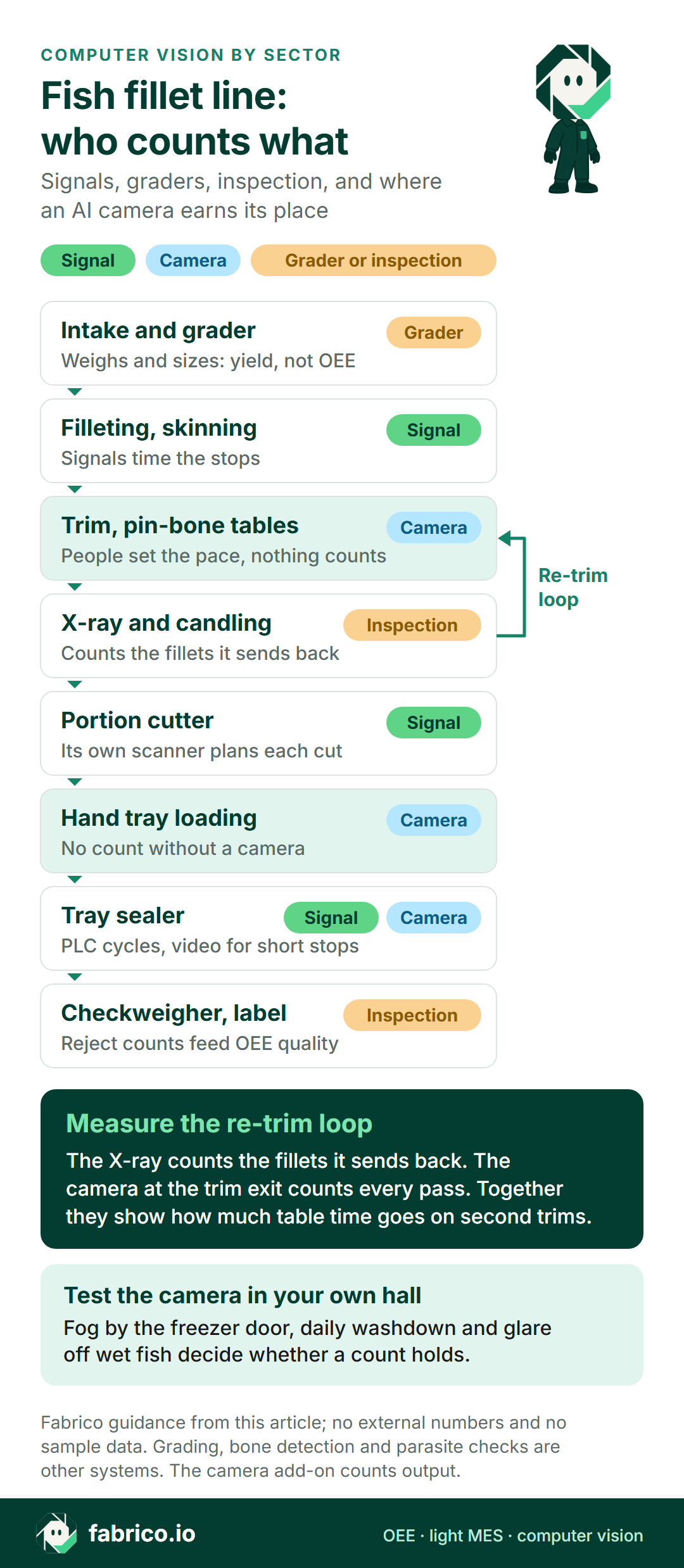
Here is a fresh salmon or whitefish fillet line from intake to pallet, with the system that owns each job.
Start where nothing counts: the trim tables and the hand tray loaders. Add video at the packer next, where stops get blamed on the wrong station. The camera count depends on your trim rows and loading points; how many cameras per line walks through the sums.
Wet, cold halls: what a camera has to survive
Ask every vendor about each point, and test in your own hall, not a demo room.
- Fog and condensation. A camera near a freezer door, or between a cold room and a warmer corridor, will mist up. Ask how the housing copes.
- Washdown. Hoses, foam and chemicals every day. Ask for the IP rating and the cleaning agents the housing is rated for.
- Glare. Wet fillets, glazed frozen fish and shiny belts reflect light. Placement and lighting decide whether a count holds. See camera placement and lighting.
- Salt and corrosion. Brine and sea water are hard on mounts and fixings. Ask what the brackets are made of.
Fillets also touch and overlap on the belt, so check the count: film a run, count it by hand, and compare. Our page on how accurate camera OEE is sets out a fair test.
Camera, sensor or operator: station by station
Whatever the station, the signal says when and how long, the operator says why, and video helps check it.
| Station | Counts and stops from | Where a camera helps |
|---|---|---|
| Grader | Its own weights and counts | Not for counting. Its kilos go to yield |
| Filleting, skinning | PLC run state, cycles | Video for jams and vague faults |
| Trim and pin-bone tables | Nothing, or a scale | Counts fillets or portions leaving |
| X-ray, candling | Inspection system or people | None. Rejects feed quality |
| IQF or plate freezer | PLC run state, batches | Video at the infeed and exit |
| Hand tray loading | Nothing, or a tally | Counts trays loaded |
| Tray sealer, thermoformer | PLC cycles and faults | Video for short stops |
| Case and pallet | PLC, or by hand | Counts cases packed by hand |
To map your own hall, book a demo and bring a station list that says what each station can signal today.
Worked example: one shift on a salmon portion line
This is sample data for one 8 hour shift on a fresh salmon line packing skin packs of two portions. It describes no real customer line and is not a product screen.
Planned time was 480 minutes. The line uses one ideal rate for both size grades it ran that day: 30 packs a minute, counted at the packer.
The line stopped for 60 minutes, timed by the packer's signal: 16 for a size grade change, 20 for film and seal faults, 14 for filleting jams and 10 at the labeller. Run time was 420 minutes, so availability is 420 of 480, or 87.5%.
At 30 a minute, 420 minutes should give 12,600 packs. The packer made 10,710, so performance is 85.0%.
The checkweigher and seal checks rejected 210 packs, leaving 10,500 good. Quality is 10,500 of 10,710, or 98.0%.
OEE is 87.5% x 85.0% x 98.0% = 72.9%. As a check, 10,500 good packs of the 14,400 possible in 480 minutes is also 72.9%.
The packer's signal only sees the result: 1,890 packs short of ideal. The camera count at the trim exit, with the X-ray's reject count, shows where most of it started.
After the size grade change the fish were smaller, so the crew trimmed more fillets for every pack. The tables fell behind and lost 1,050 packs. Set against the X-ray's reject count, another 420 went to fillets sent back for a second trim. Only 420 were short stops at the packer.
So the fix is not at the packer. If the slower pace is the true standard for small fish, give that size grade its own ideal rate; if not, plan more people at the tables. The re-trim loop is a question for the filleting settings and the X-ray.
Slower trimming wastes hours, not fish: the shift runs over or the order ships short. At an assumed contribution of €0.90 a pack, the 1,470 packs lost upstream come to about €1,323 in one shift. Check the costing rule with your controller before quoting it.
Species, size grades and seasons
On a seafood line, the raw material changes more than the machines. Three things follow.
- Ideal rates per product and size grade. Large and small salmon portions on one line are two jobs. The camera count at the trim exit gives you each grade's real rate to set it from; OEE for seafood processing covers the rules.
- Changeover types that match your plant. A size grade change is a few settings. A species change may mean a full clean, and fish to shellfish is an allergen clean-down. The signal times each one; the operator codes the type.
- Targets that know the season. When wild fish comes in, lines may run long shifts on one species, then stand.
Questions to ask any vendor of computer vision for seafood processing
Ask every vendor the same questions, us included, and bring a real shift from your busiest line.
| Ask | How to test the answer |
|---|---|
| Can it count wet, touching fillets? | Film your smallest size grade on the trim belt, count it by hand, and compare. |
| Will it work in our coldest room? | Ask how the housing handles fog and condensation. Test it next to the freezer door. |
| How does it handle size grades? | Ask how ideal rates are set per product and grade, and who keeps them current. |
| Where do X-ray and checkweigher rejects go? | Ask how the reject signal reaches OEE quality, and how re-trims show up. |
| Does it keep yield apart from OEE? | Ask where kilos in and out go, and check they don't change the quality factor. |
| Where does the video go? | Ask whether it is kept, for how long, and who has access. |
| What does a pilot look like? | One line, ideally across a size grade change, and a hand count to compare. |
Comparing whole platforms for a food plant? Our overview of food OEE software tools sorts them by data source.
Privacy and the works council
Trim tables put many people side by side over one belt, so a camera aimed at the table would see hands and faces all shift. Expect the works council or employee representatives to want a say first.
- Aim at the outfeed, not the table. Count fillets on the belt after the trimmers, where the frame holds fish, not people.
- No numbers per person. The count belongs to the table row and the shift, never to one trimmer.
- Explain video handling. Fabrico's standard setup streams video when someone asks for it and does not store it.
- Brief seasonal staff too. Put the notice in the languages your crews speak, and repeat it when the season brings new people.
Wider automatic masking of people is on the roadmap, so ask what is available now. Our page on GDPR and production line cameras covers the legal side.
Where Fabrico fits
Fabrico is cloud software for OEE and light MES. Here is what it does in a seafood plant today, and what it doesn't do.
- Machine data: stops and counts come from the PLC, a sensor or a counter. Operators add the stop reason at the line from a tablet or phone.
- Results: OEE, downtime and losses by line and shift, with losses in money, in web, iOS and Android apps.
- Camera add-on: AI cameras count output, including at trim tables and hand tray loading where no machine counts. From the shift timeline, you can open the camera video for any moment. Standard setup: video is streamed on request, and Fabrico does not store it.
- Data out: REST API, webhooks, and Excel or CSV export, so OEE can sit beside your grader's yield data.
- Roadmap: cameras that detect stops by themselves, jam zones at the packer infeed, and a likely reason offered for the operator to confirm. Not live today.
- Not Fabrico: grading, yield by batch, bone detection, parasite inspection and label checks. Those systems stay, and their reject counts can flow into OEE. Planning questions: ask us in the demo.
For a wider view of platforms, see our OEE software guide. For plants that run more than fish, see computer vision for FMCG manufacturing.
Book a demo, or send us a question first.
What people ask next
Can an OEE camera grade fish or find bones?
No. Grading, bone detection and parasite checks are jobs for graders, X-ray and inspection systems. An OEE camera counts output and gives you video for any moment. The reject counts from those systems can feed the quality part of OEE.
Can a camera count wet fillets that touch on the belt?
That depends on the view, the light and how much the fillets overlap, so prove it on your own product. Film a run of your smallest size grade, count it by hand, and compare. Ask each vendor for accuracy on wet, touching fish, not on cartons.
Can a camera explain why the fish line stopped?
Not by itself today. The signal records when the line stopped and for how long, the operator gives the reason, and the video for that minute helps them check. Roadmap: a likely reason offered for the operator to confirm.
Where should the first camera go in a seafood plant?
Over the outfeed of the trim tables, where people set the pace and nothing counts. Hand tray loading in front of the packer is the next candidate.
What drives the cost of computer vision in a seafood plant?
The number of lines and cameras, housings for wet and cold rooms, mounting, network and training. Send every vendor the same station list, so the quotes compare.
Want to test a camera count on your own trim line? Book a demo.
Related articles














Real Fabrico tiles, sample data.