


 Login
 Blog
Syncade Alternatives: DeltaV MES, PAS-X, Opcenter or an OEE Layer

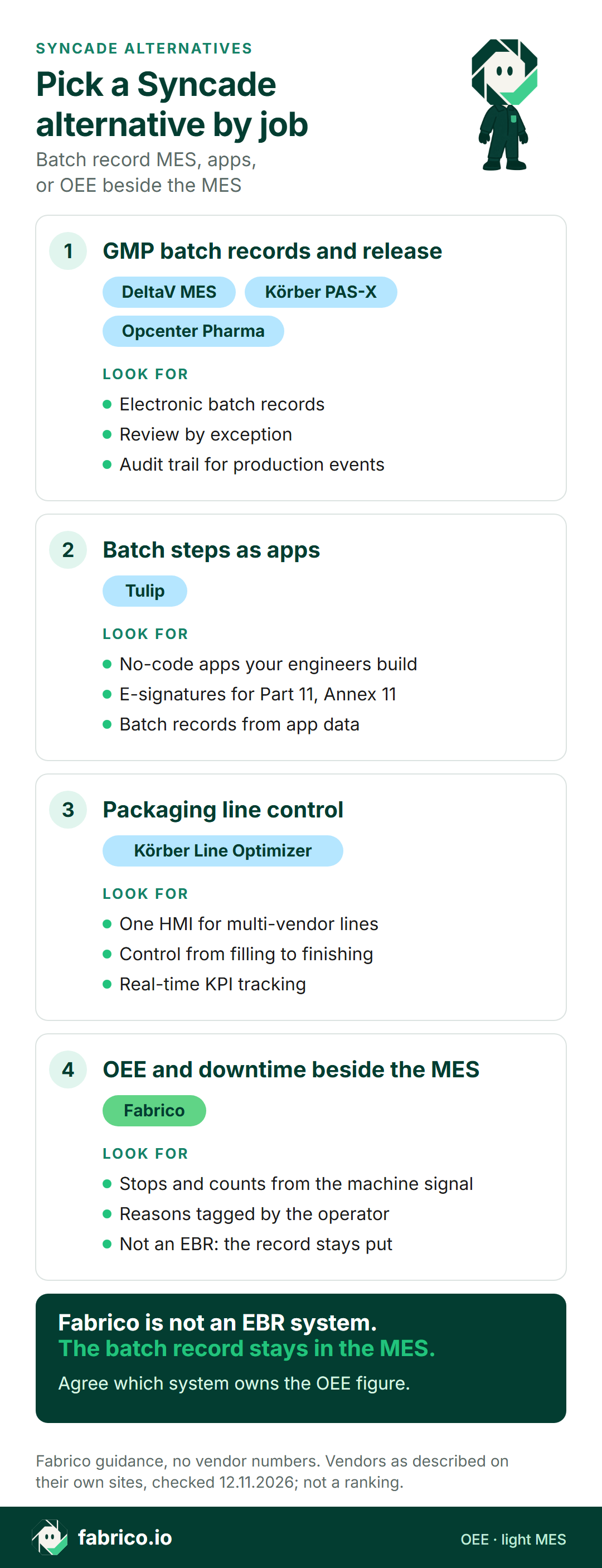
In short: Syncade alternatives depend on which job you are replacing or adding. For GMP electronic batch records, recipe execution and review by exception, the alternatives to Emerson's DeltaV MES (formerly Syncade) are other pharma and process MES, such as Körber PAS-X, Siemens Opcenter Execution Pharma and Tulip. For OEE and downtime on filling and packaging lines, Fabrico, an OEE and light MES layer, can run next to the MES. Fabrico is not an electronic batch record system.
- Emerson now sells Syncade as DeltaV MES, part of its life sciences software suite on the DeltaV Automation Platform.
- Its pages put electronic batch records, quality review, materials and equipment management first.
- Replacing the batch record means another validated MES. Measuring line losses does not touch the batch record.
- Vendor facts come from each vendor's own site, as of 12.11.2026, linked in place. No prices, no verdicts, no ranking.
A pharmaceutical plant runs DeltaV control on its formulation suites and DeltaV MES for batch records. QA is happy with release times. The packaging manager is not: two vial lines miss their weekly plan, and nobody can say whether the cause is format changes, the labeler or waiting for product.
Those are two different questions. The first is answered by the MES that owns the GMP record. The second is answered by measuring line time. Below: what Syncade is today, per Emerson's pages, when it is the right pick, and four alternatives grouped by job. Fabrico wrote this page and is one of the four. We sell Fabrico, so it is not ranked.
What Syncade is today (as of 12.11.2026, per Emerson's site)
Emerson's own data sheet for DeltaV Workflow Management refers to "DeltaV MES (formerly Syncade)", so the product is current under a new name. Emerson's DeltaV MES page places it in the life sciences software suite of the DeltaV Automation Platform and says it speeds up batch record generation. What its pages say, as of 12.11.2026:
- Electronic batch records. The electronic batch record page starts from the need for pharmaceutical makers to document manual and automated procedures throughout production, and offers paperless execution to meet it.
- Compliance. It electronically controls materials, equipment, recipes and executed batch records, and keeps an audit trail for all production events.
- Quality Review Manager. Exception management to identify, assess and resolve process exceptions early, with review by exception to speed product release.
- Materials and equipment. Materials dispensed correctly and traced through the batch. The equipment management module is an electronic logbook for equipment use, status, cleaning, maintenance and calibration.
- Integration. Plant floor data connects with process control, ERP, LIMS and CMMS.
- Recipes and workflows. DeltaV MES runs the legacy WF and newer WFX engines in one instance. Workflow Management is a SaaS option for no-code recipe authoring, execution and data capture.
Ask in the demo: which line performance figures the MES reports today, and where its downtime data comes from.
When DeltaV MES is the right pick
Keep DeltaV MES, or shortlist it, if most of these are true:
- You run DeltaV control and want the MES and the control system from one supplier.
- GMP batch records drive your release, and review by exception is how QA wants to work.
- Material dispensing and equipment status must be enforced and logged inside the batch.
- Your existing recipes run on the WF engine, and you want to move to newer workflows at your own pace.
If the real gap is line performance rather than the batch record, replacing a validated MES is a large project for a problem it may not solve. Read on.
The batch record and line performance are different jobs
A pharma MES watches the batch: which recipe, which material lot, which operator signed, which deviation. An OEE layer watches the time: when the filler or cartoner ran, when it stopped, why, and what that cost. Our OEE vs MES guide covers the split, and OEE for pharmaceutical manufacturing covers the pharma side.
Comparison table: DeltaV MES and four alternatives
This is what each vendor's own site says, in our words, as of 12.11.2026, linked in each section below. It is not a ranking. A short cell means only that we kept the table readable, so ask each vendor directly. Fabrico comes first because we wrote this page.
| Tool | Built around, per its site | Batch record role | Ask in the demo |
|---|---|---|---|
| DeltaV MES (for reference) | Life sciences MES on DeltaV | Electronic batch record, review by exception | What line metrics does it report? |
| Fabrico | Machine signal and operator stop reasons | Not an EBR; sits beside one | How is a line with no PLC read? |
| Körber PAS-X | MES for pharma, biotech, cell and gene | PAS-X EBR, paper-on-glass | PAS-X MES or PAS-X Neo? |
| Siemens Opcenter Execution Pharma | Master batch record driven MES | Batch record review by exception | Native to which control systems? |
| Tulip | Composable apps for frontline work | Electronic batch records from apps | Who validates the apps? |
Want to see line losses on a filling line like yours? Book a demo and bring a week of stop notes.
Fabrico: an OEE layer beside the batch record
Fabrico wrote this page. It is a cloud-based OEE and light MES platform, not an electronic batch record system: recipes, the GMP record and batch release stay in your MES. What it does, per our MES and OEE overview:
- Machine data, three ways. From the PLC on automated machines, from a Fabrico IoT device with external sensors on older machines, or from AI cameras, an add-on, at manual steps with no machine signal (machine connectivity).
- Stops with reasons. Connected machines report their own stops, including short stops too brief to log by hand. Operators tag the reason on a tablet or phone.
- OEE and losses in money. Live OEE by line and shift, with losses shown in money, on the web, iOS and Android.
- The camera add-on counts output at manual packing steps, and its video opens for any moment on the shift timeline. In the standard setup, video from the camera add-on is streamed on request, not stored in Fabrico (how the camera add-on works).
- Maintenance built in. When a stop needs a repair, a technician opens a work order from the stop, on the same machine record.
- Data out. REST API and webhooks, Excel or CSV export. A connection to SAP or another ERP can be scoped per customer.
- Rollout. Devices connected in about a month; full rollout in 3 to 4 months.
- Stays in your MES or ERP: batch records, recipes, dispatching, BOMs, routings and genealogy. Roadmap, not live: production planning and scheduling, and a camera add-on that detects stops and offers a likely reason.
Fabrico's data is for running the line better. It is not the GMP record, so agree with QA how it is classified before you connect it to anything validated.
Ask in the demo: how the filler and cartoner report stops, and how stop data could be passed to the MES.
Fits plants that keep their MES for the batch record and want downtime ranked by cause and priced by line and shift on filling and packaging lines. EU customers are hosted on AWS in Frankfurt. Start with a one-line pilot. See our OEE software guide.
Körber PAS-X: MES for pharma, biotech and cell and gene therapy
Körber's life sciences MES page describes the PAS-X Suite for digitalizing pharmaceutical, biotech and cell and gene therapy production. What its pages say, as of 12.11.2026:
- PAS-X MES is the flagship for large, highly integrated plants. PAS-X Neo is an additional option for more standardized, less complex processes.
- Three deployment models: on premise, private cloud or SaaS.
- On its packaging and serialization page, PAS-X EBR replaces manual logs with guided production, using graphical paper-on-glass workflow design.
- The same page lists PAS-X Track & Trace for serialization and a Line Optimizer for machine-level integration and line efficiency across multi-vendor lines, from filling to finishing, with real-time KPI tracking.
Körber's page quotes percentage gains; those are vendor figures, so we leave them out.
Compared with DeltaV MES: both own the electronic batch record and review. Körber's pages add serialization and a packaging line layer from the same supplier; Emerson's tie the MES to the DeltaV control platform.
Fits plants that want batch records, serialization and packaging line control from one pharma supplier.
Siemens Opcenter Execution Pharma: master batch record driven MES
Siemens says Opcenter Execution Pharma speeds up design, execution and review steps for fully documented pharmaceutical production. What the page says, as of 12.11.2026:
- Production runs from a master batch record that covers product definition, resources, process definitions, quality plans and batch review and release.
- It controls execution at all stages, for human operations and those run by the automation layer.
- Batch documents sit in one storage point, and QA can review the batch record by exception to release product sooner.
- It integrates natively with the production control system, with one central place to review alarms, events and reports.
Compared with DeltaV MES: both offer review by exception and integration with the control layer. Ask each how much of the integration is native to the control system you already run.
Fits plants that want a master batch record driven MES, especially next to Siemens automation.
Tulip: composable apps, including batch records
Tulip calls itself a composable platform that connects equipment, enterprise systems and frontline workers (OEE tracking page). Its homepage names pharmaceutical plants first and offers searchable electronic batch records produced automatically. As of 12.11.2026, its pages say:
- Barcode scans capture material, component and operator data at each step, with electronic signatures built for 21 CFR Part 11 and Annex 11 (genealogy).
- Guided weigh and dispense and deviation alerts are listed among its solutions.
- OEE combines machine and PLC data over OPC UA or MQTT with the reason codes operators enter, by line and shift.
Compared with DeltaV MES: both produce electronic batch records. DeltaV MES is a packaged MES tied to Emerson's control platform; Tulip describes apps that your engineers compose and validate. See our Tulip alternatives.
Fits plants that want their own engineers to build and validate batch step apps, starting with one area.
Which Syncade alternative fits your plant
- Batch records and review by exception on the DeltaV control platform: DeltaV MES, the current Syncade.
- Batch records plus serialization and packaging line control from one pharma supplier: Körber PAS-X.
- A master batch record driven MES next to Siemens automation: Siemens Opcenter Execution Pharma.
- Batch steps digitized as apps that your engineers build: Tulip.
- OEE and downtime by cause on filling and packaging lines, beside whichever MES owns the batch record: Fabrico.
The MES and the OEE layer can run side by side if each record has one owner. See light MES vs full MES, and for supplement and nutraceutical packaging, computer vision for supplement manufacturing.
Worked example: a vial line where the batch record looks fine
The numbers below are sample data, not from a customer or a product screen: a vial filling and packaging line, one 8 hour shift with a 30 minute break, so 450 planned minutes. The filler sets the ideal rate at 150 vials a minute, or 67,500 vials a shift.
Stops took 54 minutes, so run time was 396 minutes and availability 88.0%. In 396 minutes the ideal is 59,400 vials. The line made 51,084, so performance is 86.0%.
Inspection rejected 1,022 vials, leaving 50,062 good: quality is 98.0%. OEE is 88.0% x 86.0% x 98.0% = 74.2%, the same as 50,062 good vials over 67,500 possible.
The batch record in DeltaV MES holds the lot, the materials, the line clearance sign-off and the reject reconciliation. The batch completes and reconciles, so nothing in it looks wrong. The OEE layer shows 55.4 minutes of slow running, more than all 54 minutes of stops together: the line ran below its rated speed for long stretches. That is a question for line data rather than for the batch record. See OEE calculation for the formula and micro-stops for the short stops a paper log misses.
Questions to ask any vendor on this list
Ask every vendor the same things, Fabrico included, with one filling or packaging line as the test case.
- Does it replace the batch record or sit beside it? Settle this before you compare anything else.
- Which parts are GMP validated? And which parts serve improvement work only.
- How does it connect to DeltaV? Natively, through an interface, or through the ERP.
- What happens to WF recipes? How existing recipes and open batches move if you go to WFX or to another MES.
- Where do the OEE inputs come from? The ideal rate, how format changes and line clearance count, how older packaging machines report, and who enters stop reasons.
- Which records stay in the ERP, LIMS or CMMS, and which data flows back.
What people ask next
Is Syncade still sold?
Yes, under a new name. Emerson's own data sheets refer to DeltaV MES (formerly Syncade), and its DeltaV MES pages list electronic batch records, quality review, materials and equipment management for life sciences.
What are the main alternatives to Syncade for batch records?
For GMP electronic batch records, the alternatives are other pharma and process MES. This page covers Körber PAS-X, Siemens Opcenter Execution Pharma and Tulip, each as described on its own site.
Can Fabrico replace Syncade or DeltaV MES?
No. Fabrico does not execute recipes, hold the GMP record or release batches, so it cannot stand in for an electronic batch record system. It measures OEE and downtime on lines and can sit beside DeltaV MES or another MES.
Where does an OEE layer help in a DeltaV MES plant?
On filling and packaging lines, where losses come from format changes, jams, starved machines and slow running. An OEE layer takes stops and counts from the machine signal and the reason from the operator, and shows the losses by line and shift.
Does an OEE layer need validation?
That depends on how your QA team classifies it. Fabrico's data is for performance improvement, not the GMP record, so agree its classification before you connect it to a validated system.
How is Körber PAS-X different from DeltaV MES?
Per their own sites, both provide electronic batch records and review. Körber's pages add PAS-X Neo, serialization and a packaging Line Optimizer; Emerson's tie DeltaV MES to the DeltaV control platform. Ask both to run the same batch scenario.
Want to see OEE running beside a batch record system? Book a demo or contact us.
Related articles


Latest from our blog



Real Fabrico tiles, sample data.