


 Login
 Blog
HALCON vs OpenCV: Licence, Scope and Build Effort on Production Lines

In short: HALCON vs OpenCV is a choice between machine vision software you buy from MVTec and an open-source computer vision library under the Apache 2.0 licence that your team or integrator builds on. Either can sit under an inspection, measurement or counting app on a production line. What differs is who supplies the tools and who writes and maintains the code. Counting output for OEE is a separate job from inspection.
- MVTec calls HALCON comprehensive machine vision software, from image acquisition to deep learning in one package, on its HALCON page.
- OpenCV's GitHub repository names it the Open Source Computer Vision Library, licensed Apache-2.0.
- Neither is a finished inspection station: camera, lighting, application code and the PLC link come on top.
- MVTec facts from mvtec.com, OpenCV facts from its GitHub repository, both read on 13.11.2026.
An automation engineer is asked to add a check at the end of a line: read a label, gauge a part, confirm a pack is full. Before any camera is ordered, the software question comes up: license MVTec HALCON, or build on OpenCV? On a real line, the useful question is narrower: which one suits the team that will own the application for years.
Fabrico does not sell a vision library or inspection. The second half of the page covers the point where a vision app hands numbers to OEE, which is the part we build. HALCON facts come from mvtec.com. OpenCV facts come from OpenCV's own GitHub repository: its README, LICENSE file, modules folders and releases page. For a hardware-led pair, see our Cognex vs Keyence comparison.
HALCON vs OpenCV at a glance
Summarised on 13.11.2026 from the pages linked in the sections below. The OpenCV column reflects what its repository pages state, which is shorter than the library itself.
| Point | MVTec HALCON, per mvtec.com | OpenCV, per its GitHub repository |
|---|---|---|
| What it is | Comprehensive machine vision software, image acquisition to deep learning | Open Source Computer Vision Library |
| Licence | Commercial licence from MVTec | Apache License 2.0, no-charge and royalty-free |
| Language bindings | Language-specific Programmer's Manuals | Binding folders: python, java, js, objc |
| Deep learning | Deep learning methods, MVTec Deep Learning Tool, OpenVINO and TensorRT | dnn module folder |
| Measuring and matching | Subpixel-accurate measuring, lens calibration, shape-based matching | calib3d (4.x) or calib (5.x), features2d (4.x) or features (5.x), and imgproc module folders |
| Help and extras | Documentation and Reference Manual | Q&A forum, opencv_contrib, OpenCV.ai services |
| Current release | HALCON 26.05 release notes | OpenCV 5.1.0 marked latest; 4.14.0 newest on the 4.x line |
What MVTec HALCON offers
MVTec's HALCON product page calls HALCON "a comprehensive machine vision software" and says it covers the range "from image acquisition to deep learning in one package." It names multicore platforms, GPU acceleration and automatic operator parallelization for high throughput, and says deep learning is accelerated with Intel OpenVINO and NVIDIA TensorRT. For gauging, the page says HALCON enables subpixel-accurate measurements and has calibration tools that correct lens distortions.
The features and tools page describes a mix of rule-based and deep-learning-based approaches for defect detection, and says HALCON is designed for broad compatibility across operating systems, processors and image acquisition hardware, with embedded and Arm-based platforms named. MVTec's matching technology page says its subpixel-accurate, template-based matching finds objects in real time even with rotation, scaling, perspective distortion, local deformation, partial occlusion or lighting changes, and that objects can be trained from image templates or CAD data.
On deep learning, MVTec's deep learning page says HALCON with the MVTec Deep Learning Tool forms a complete toolchain for deep learning projects. The HALCON 26.05 release notes list enhanced data augmentation for deep learning, an anchor-free network architecture with no anchor parameters to tune, and a new class of shape-based matching algorithms called Automatic Contour Optimization.
The documentation page lists Windows 10 and 11 (x64), Windows Server and Linux on x86_64 and aarch64 for HALCON 26.05. It calls the Reference Manual the central API and operator reference, and describes Programmer's Manuals as language-specific guidance for building applications. For line jobs, MVTec's food and beverage page names empty container inspection, checks that packs hold the expected number and type of containers, and label checks for presence, alignment, print quality and readable codes.
Put to MVTec: which programming language your team would build in, and how a HALCON application is deployed and licensed on each line PC or embedded device you plan to use.
What OpenCV offers
OpenCV's README opens with "OpenCV: Open Source Computer Vision Library". The repository is licensed Apache-2.0, and the LICENSE file is the Apache License, Version 2.0, January 2004. Its section 2 says each contributor grants "a perpetual, worldwide, non-exclusive, no-charge, royalty-free, irrevocable" copyright licence. The licence also sets conditions for redistribution, so the full text is one for your legal team.
OpenCV runs two lines. The 4.x modules folder holds calib3d, core, dnn, features2d, imgproc, objdetect, video and videoio, among others. The 5.x modules folder, the line behind the latest release, renames and splits some of them into calib, features, geometry and stereo. Both hold python, java, js and objc folders. The README points to opencv_contrib for additional OpenCV functionality, to a Q&A forum, and to OpenCV.ai, which it describes as "Computer Vision and AI development services from the OpenCV team." As of 13.11.2026, the releases page marks OpenCV 5.1.0 as the latest release, with 4.14.0 the newest release on the 4.x line.
A permissive licence moves the work, not the risk. Somebody still picks the camera, writes and tunes the check, links it to the PLC and keeps it alive through new SKUs: your developers or an integrator you hire.
Put to your developer or integrator: which OpenCV modules and version they would build on, and who updates the code when a pack or part changes.
HALCON vs OpenCV, job by job
Four jobs, what the sources say for each, and the test that settles it.
Inspection. MVTec describes rule-based and deep learning defect detection, and food and beverage checks such as label presence, alignment and print quality. For OpenCV, the repository's imgproc, features2d (4.x) or features (5.x), objdetect and dnn folders are the starting points a developer would build a check from. Test: the same set of good parts and real defects through both, with false rejects counted.
Measurement. MVTec states subpixel-accurate measurements and lens distortion calibration. OpenCV's repository has a calib3d (4.x) or calib (5.x) folder alongside imgproc. Test: gauge a reference part many times and compare the spread to your tolerance.
Locating parts. MVTec's matching page describes template and CAD-based matching under rotation, scaling and occlusion. In OpenCV, a developer would work from modules such as features2d (4.x) or features (5.x) and objdetect. Test: parts at the angles and positions your feeder really delivers.
Counting. MVTec's food and beverage page names checking that packs hold the expected number of containers. Either library can sit under an application that counts objects passing a camera. That count answers "how many went by?", which is not yet OEE; the next sections explain the gap.
Look at HALCON first if you want one supplier for tools, documentation and support, and subpixel gauging or CAD matching are central.
Look at OpenCV first if you have developers who will own the code, want a no-charge, royalty-free licence, and accept support from the forum or paid services.
Owning the code: support, licence and people
With either library, the code your team writes is most of the project. The choice changes who you call and what you own.
Tools and support. With HALCON, the tools, documentation and Reference Manual come from one company you have a contract with. With OpenCV, the code is open, extra modules sit in opencv_contrib, and help comes from the forum, your own people or paid services such as OpenCV.ai.
Licence review. HALCON is bought from MVTec under its terms. OpenCV's Apache 2.0 licence is no-charge and royalty-free, with conditions your legal team should read. Both need a decision before the first line goes live, not after.
Who owns the application. A vision app written by one engineer can become a single point of failure. Ask who documents it, who keeps the sample images, and who can retrain or retune it at a SKU change.
Counting for OEE is a different job from inspection
An inspection app answers one question per part: good or bad. OEE answers a question per shift: how long did the line stop, why, how fast did it run while it ran, and how many good units came out. A vision count can be one input, but it is not the measurement. The split is covered in detail in label and code vision vs an OEE camera.
The two jobs share one number. Whatever your HALCON or OpenCV app rejects belongs in the quality part of OEE, and the simplest way in is the line's reject count or a reject signal from the PLC. Stop times and the run count come from the machine signal. Where there is no usable signal, for example at a hand packing table, a camera can count output; AI visual counting in manufacturing explains how that works and where it gets hard.
Teams that already own a vision library often think about writing the counting and downtime screens on top of it. Before you do, read our build vs buy guide for computer vision OEE: shift calendars, stop reasons, operator input and reports tend to outgrow the counting script. Whichever route you take, check any vision count against a hand count for one shift; how accurate is camera OEE shows the method.
Already logging rejects from a HALCON or OpenCV check? Book a demo with one shift of that reject log and the line's stop notes, and see them as one OEE figure.
Where Fabrico sits in a vision project
If you own the HALCON or OpenCV application, this is the boundary. Fabrico sells no vision library, no inspection system and no smart camera; its camera add-on counts output and does not judge parts. Fabrico is cloud OEE software with light MES, per our OEE and MES overview. The table splits the questions a plant asks between your app and Fabrico.
| Question | Your HALCON or OpenCV app | Fabrico |
|---|---|---|
| Is this part good? | Its core task | Not Fabrico's task |
| How many good units this shift? | Supplies the reject count | Count from the PLC, sensor or counter; rejects feed quality |
| Why did the line stop? | Outside an inspection app's task | Stop from the signal; operator tags the reason on a tablet or phone |
| No signal at a manual step? | A custom counting build | Camera add-on counts output there |
| Data to other systems | Your own interface | REST API, webhooks, Excel or CSV export |
A vision engineer gets OEE, downtime and the cost of each loss per line and shift on the web and in iOS and Android apps. With the camera add-on, you can open the video for any moment on the shift timeline; the standard setup streams it on request and does not keep it in Fabrico. Still on the Roadmap, not live: camera stop detection, jam zones and camera stop-reason suggestions that an operator confirms. More on the camera add-on is on our computer vision OEE page, and for food, drink and household lines, see the computer vision for FMCG guide.
To compare OEE tools more widely, start with our OEE software guide.
Worked example: one label check, retuned at a SKU change
Illustrative, sample data: no customer's line and no product screen. A wrapper line runs a 480 minute planned shift at an ideal 50 packs a minute, so it could make 24,000 packs. A label check app built on one of the two libraries sits after the wrapper. A new SKU arrives with a new label, and the same check runs on it twice: first on the old settings, then on the next run of that SKU after the retune.
Run 1, old settings. Stops took 96 minutes: a 30 minute changeover, 42 minutes when the label app halted the line on repeated fails, 12 minutes of film reel changes and 12 minutes of short stops the crew logged as minor jams. The line ran 384 minutes, so availability is 384 / 480 = 80.0%. In 384 minutes the ideal is 19,200 packs; the wrapper's counter showed 17,280, so performance is 17,280 / 19,200 = 90.0%. The label app rejected 864 packs, most of them good packs failed by settings tuned on the old label, leaving 16,416 good: quality is 16,416 / 17,280 = 95.0%. OEE is 80.0% x 90.0% x 95.0% = 68.4%, the same as 16,416 good of 24,000 possible.
Run 2, after the retune. The same 30 minute changeover, 12 minutes of reel changes and 12 minutes with no reason, but label halts fell to 6 minutes, so stops took 60 minutes. The line ran 420 minutes: availability is 420 / 480 = 87.5%. The ideal is 21,000 packs and the counter showed 18,900, so performance is 18,900 / 21,000 = 90.0%. The label app rejected 189 packs, leaving 18,711 good: quality is 18,711 / 18,900 = 99.0%. OEE is 87.5% x 90.0% x 99.0% = 78.0% (77.96% before rounding), the same as 18,711 good of 24,000 possible. Each step of the formula is in our OEE calculation guide.
On one shift, the retune is worth 36 fewer minutes of halts and 2,295 more good packs (18,711 against 16,416). Whoever owns the app decides how many shifts run on the old settings: a team with MVTec support on HALCON, an in-house developer on OpenCV, or an integrator on either. Ask each one how soon after a new label they can retune, and on how many sample images.
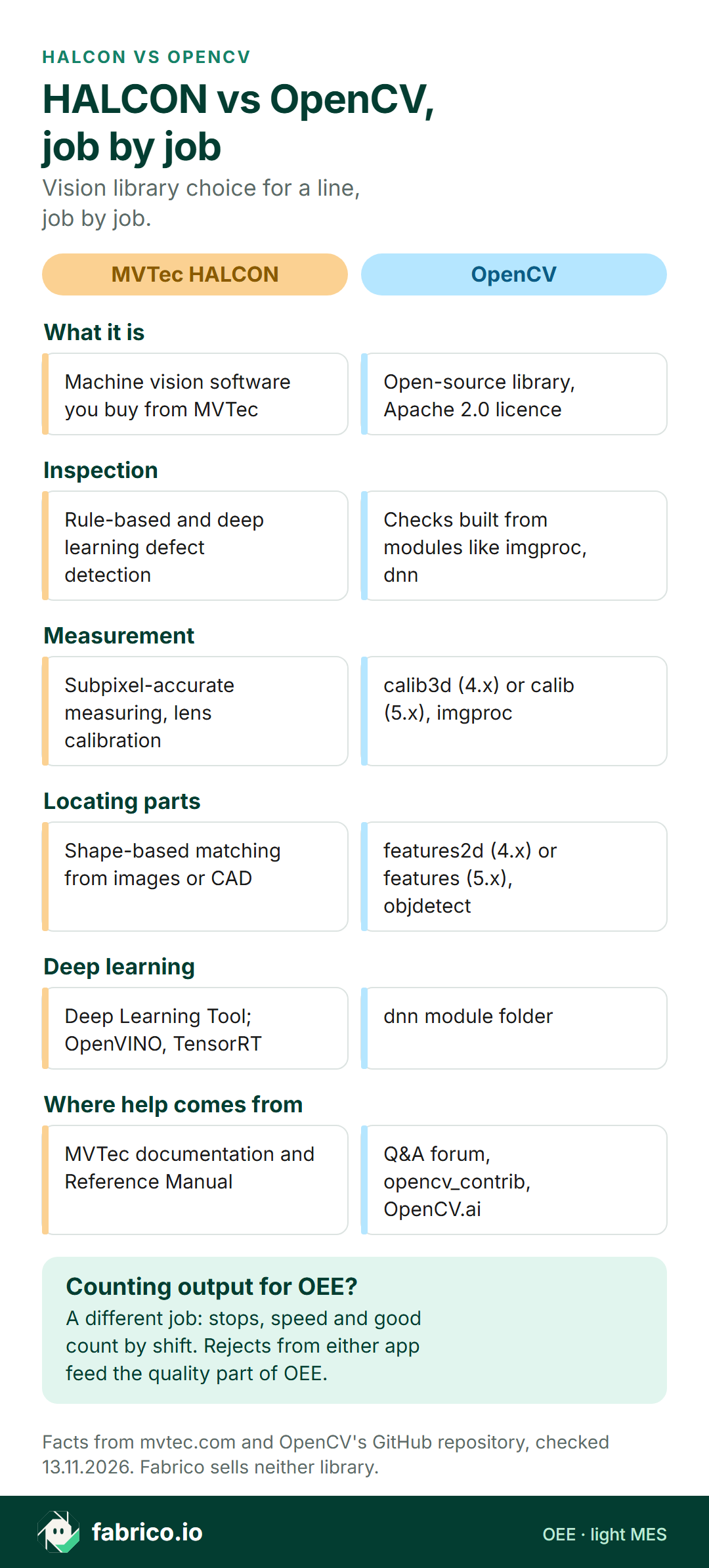
Text version of this infographic
- What it is. HALCON: Machine vision software you buy from MVTec. OpenCV: Open-source library, Apache 2.0 licence.
- Inspection. HALCON: Rule-based and deep learning defect detection. OpenCV: Checks built from modules like imgproc, dnn.
- Measurement. HALCON: Subpixel-accurate measuring, lens calibration. OpenCV: calib3d (4.x) or calib (5.x), imgproc.
- Locating parts. HALCON: Shape-based matching from images or CAD. OpenCV: features2d (4.x) or features (5.x), objdetect.
- Deep learning. HALCON: Deep Learning Tool; OpenVINO, TensorRT. OpenCV: dnn module folder.
- Where help comes from. HALCON: MVTec documentation and Reference Manual. OpenCV: Q&A forum, opencv_contrib, OpenCV.ai.
Questions to settle before you pick a library
Put the same questions to MVTec and to whoever would build on OpenCV, using the same parts.
- Who owns the application after go-live? Name the person or company that fixes it at night and documents it.
- Does it pass on our sample images? Run the same good and defective parts through both, and count false rejects.
- What does the licence ask of us? MVTec's terms for HALCON; the full Apache 2.0 text for OpenCV, read by your legal team.
- Which camera and computer? Confirm the camera interface and the line PC or embedded target before anything is ordered.
- What happens at a SKU change? Who changes the setup, how many images a new product needs, and how long the line waits.
- How does a reject reach the PLC and the count? Ask for the reject as a signal or count, so it can feed the quality part of OEE.
- Where do images go? Where they are kept, for how long and who can see them. If people are in the image, involve the works council before the first test.
What people ask next
Is HALCON better than OpenCV for machine vision?
This page does not rank them. HALCON is machine vision software you buy from MVTec, with tools from image acquisition to deep learning in one package, per MVTec. OpenCV is an open-source library under the Apache 2.0 licence. Which one fits depends on who will write and maintain the application, so test both on the same sample images.
Is OpenCV free for commercial use?
OpenCV's GitHub repository is licensed under the Apache License 2.0, which grants a perpetual, worldwide, non-exclusive, no-charge, royalty-free, irrevocable copyright licence. The licence also sets conditions, so have your legal team read the full text before you ship a product built on it. This page is not legal advice.
Does HALCON include deep learning?
Yes, per MVTec. Its deep learning page says MVTec offers a broad range of deep learning methods, and that HALCON with the MVTec Deep Learning Tool gives a complete toolchain for deep learning projects. The HALCON page says deep learning is accelerated with Intel OpenVINO and NVIDIA TensorRT.
Can I count output for OEE with HALCON or OpenCV?
You can write a counting application with either library. OEE needs more than a count: planned time, stop times and reasons, the ideal rate and rejects, by line and shift. If you use a vision count, check it against a hand count for one shift before you trust it.
Can Fabrico take rejects from a HALCON or OpenCV inspection app?
Yes, through the line's reject count or signal, which feeds the quality part of OEE. Fabrico does not sell vision libraries or inspection, so the app keeps judging parts and Fabrico measures the shift.
Where do the facts on this page come from?
HALCON facts come from mvtec.com. OpenCV facts come from OpenCV's own GitHub repository: the README, the LICENSE file, the 4.x and 5.x modules folders and the releases page. All were fetched on 13.11.2026. Pages change, so check them again before you decide.
Want us to mark which numbers from your vision check go to OEE? Send the station list for the check and the line around it, and book a demo.



Latest from our blog



Real Fabrico tiles, sample data.