


 Login
 Blog
Neurala Alternatives: AI Inspection Software for Standard Cameras

In short: the right Neurala alternative depends on whether you build a product or run a line. Neurala licenses its L-DNN vision AI as a software library that OEMs, platform companies and systems integrators build into their own products. A plant that wants AI visual inspection on a standard camera can compare a no-code vision app on a standard PC and camera (MVTec MERLIC), an AI vision sensor (SICK Inspector83x), a training tool for the cameras it already has (Teledyne DALSA Astrocyte) or an open-source library (anomalib). If the real question is output and lost time, compare OEE software such as Fabrico, whose camera add-on counts output.
- Per Neurala's site, L-DNN trains and runs on the device, on standard processors, with anomaly detection for checks such as seal and closure inspection.
- Inspection answers "is this tray good?". OEE answers "where did the shift go?". Many plants need both, joined by the reject count.
- Every vendor or project fact below comes from its own page, checked on 12.11.2026 and linked. There are no prices, scores or rankings here.
- Fabrico is one of the options and wrote this page, so test it like any vendor's.
Two kinds of people search for Neurala alternatives: an engineer building a smart camera, machine or platform who wants vision AI inside it, and a quality or production lead who wants a camera to judge trays, seals or parts at a station. Neurala's integration page names OEMs, platform companies and systems integrators as its partners, and its customer stories include a food producer that runs L-DNN in its own production facility. This page covers both, plus a third job that hides in the same project: counting output and explaining lost time for OEE.
We are Fabrico, one of the options below. Fabrico comes first in the vendor sections because we wrote this page, not as a ranking. For the wider inspection market, see our visual quality control software guide.
What Neurala offers (as of 12.11.2026, per neurala.com)
Neurala, Inc. is based in Boston. Its homepage describes a patented technology called L-DNN (Lifelong Deep Neural Network) that runs the entire AI workflow at the edge, trains on a handful of images and integrates into a partner's hardware or software stack. Per its pages:
- Delivered as a library. The homepage says Neurala is delivered as a software library engineered to fit the partner's stack, and calls the work "a technology partnership, not a software purchase".
- Built for product makers. Its integration page names three kinds of partner: an OEM building a product, a platform company adding AI capability, or a systems integrator delivering a solution for its clients. The Why Neurala page says L-DNN is designed for embedding production-ready vision AI inside hardware and software products.
- Standard edge hardware. Per the homepage, training, adaptation and inference run on-device, on standard processors such as Intel i3 or higher, with no GPU required. The integration page lists Intel, ARM, NVIDIA and other standard edge hardware.
- Data on the device. The homepage says image data is processed and stored locally by design, and end users can train models on their own hardware.
- Three model types. Its technology page lists classification, anomaly detection and detection. Anomaly detection learns what normal looks like from a small reference set and flags deviations; its example applications include packaging integrity verification, seal and closure inspection and foreign object detection. Detection examples include object counting and presence or absence checks.
- Food production. Its customer stories include a food producer that checks for missing meal components before trays leave the line.
Neurala's speed and accuracy figures are vendor-reported, so we leave them out. Ask Neurala whether your project fits its OEM and integrator model, and which partner would build and support the station.
When Neurala fits
Per its own pages, Neurala fits teams that:
- build a camera, machine or platform and want vision AI inside it as a library;
- train and infer on the device, with no cloud in the workflow;
- let end users add new classes to a deployed model;
- run on standard edge processors rather than a GPU.
Build, buy or count: three jobs behind one search
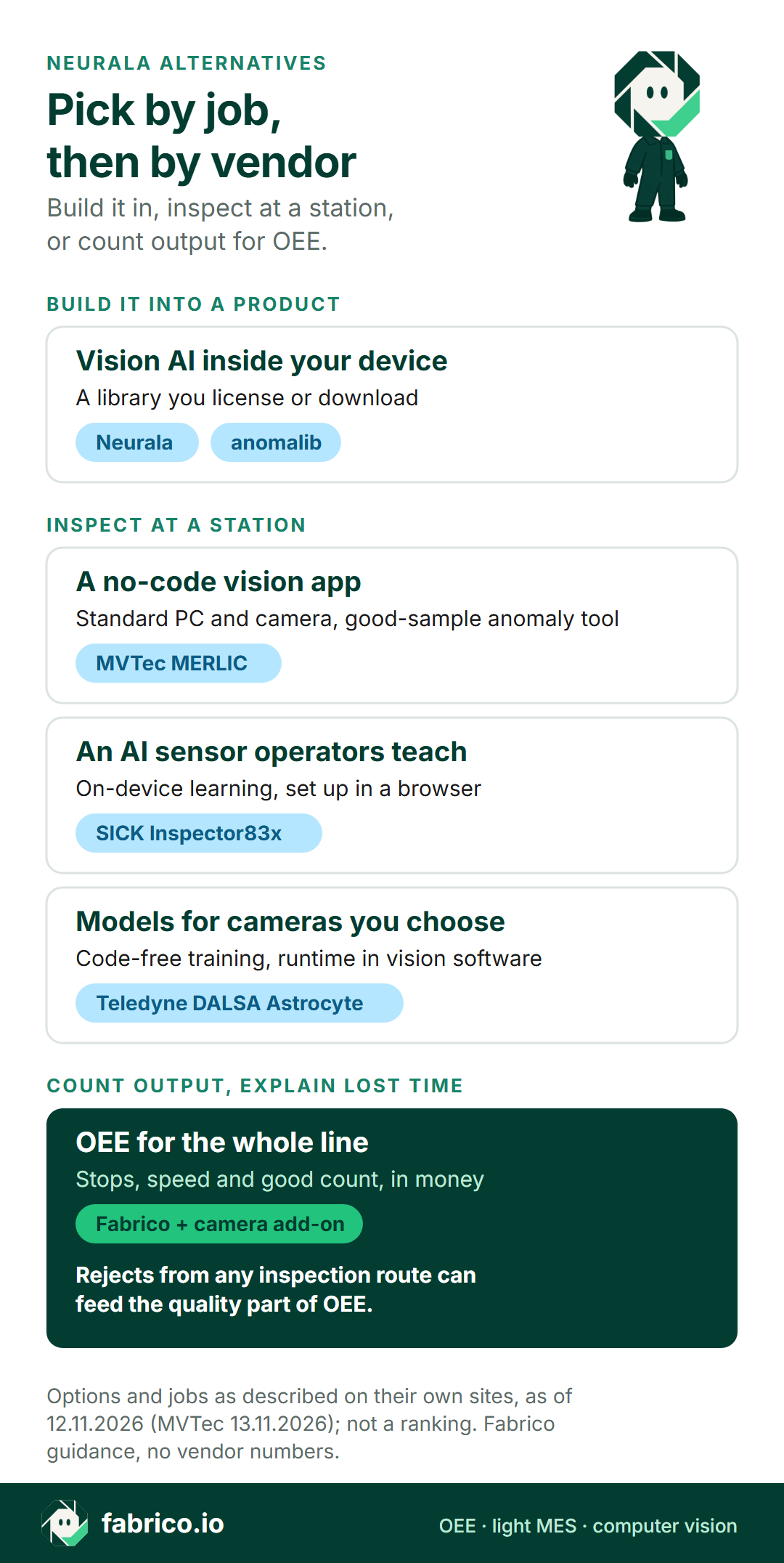
Name the job before you compare vendors. A library, a ready inspection product and OEE software solve different problems.
| Job | What to check | Examples, per their sites |
|---|---|---|
| Build vision AI into a product | Licence, supported chips, who maintains the model | Neurala L-DNN; anomalib |
| A no-code app on a standard PC | Good-sample anomaly tool, PLC recipes, OCR | MVTec MERLIC |
| An AI sensor operators retrain | On-device learning, browser setup, OCR tools | SICK Inspector83x |
| Models for cameras you choose | Camera support, runtime software, GPU needs | Teledyne DALSA Astrocyte |
| Output and lost time for OEE | Signal or camera count, stop reasons, money | Fabrico, with its camera add-on |
Inspection decides about each unit. OEE explains time: when the line ran, why it stopped, how fast it ran and how many good units came off. For codes and labels, the split is set out in code-reading vision vs an OEE camera.
Neurala and five alternatives at a glance
Sources for every cell sit in each vendor's section below, checked on 12.11.2026.
| Option | What its site leads with | Camera and compute | Model types named |
|---|---|---|---|
| Neurala (for reference) | Vision AI library for product makers | Partner's hardware; standard processors | Classification, anomaly detection, detection |
| Fabrico | Line OEE and downtime, in money | Machine signal; camera add-on for counts | Output counts, not inspection |
| MVTec MERLIC | No-code machine vision software | Standard IPC, camera and PLC | Anomaly detection, classification, OCR, codes |
| SICK Inspector83x | AI vision sensor operators teach | 2D vision sensor, set up in a browser | Anomaly detection, classes; OCR and OCV tools |
| Teledyne DALSA Astrocyte | Code-free AI training tool | Teledyne or third-party cameras; GPU or CPU runtime | AI models beside rule-based tools |
| anomalib | Open-source anomaly detection library | USB or IP cameras in Anomalib Studio; OpenVINO export | Anomaly detection algorithms |
Want to see camera counts and reject counts on one OEE screen? Book a demo and bring your station list.
Fabrico: OEE and light MES, with a camera add-on that counts output
Our own entry. Fabrico is cloud software for OEE and light MES. It does not inspect products. It measures the line's time and output.
- Data in: a PLC, sensor or counter reports run, stop and count, and the operator picks the stop reason on a tablet or phone.
- What you see: OEE, downtime and losses by line and shift, with losses shown in money, in the browser and in the iOS and Android apps.
- Camera add-on, on request: AI cameras in the add-on count output where no machine gives a usable count, such as a hand-pack table. You can open the video for any moment on the shift timeline; in the standard setup it is streamed on request, not stored in Fabrico.
- Data out: REST API, webhooks, Excel and CSV.
- Roadmap, not in the product today: stops detected by the camera, jam zones drawn on its view, and a suggested stop reason for the operator to accept or change.
- Not Fabrico's job: checking seals, labels, trays or parts. An inspection system does that. When its rejects arrive as a signal or counter, they feed the quality part of OEE.
Compared with Neurala: Neurala supplies vision AI that others build into products. Fabrico is a finished application for plant teams, and its camera add-on counts output rather than judging each unit.
Fits plants that want stops, speed and good output priced in money, with counts from the camera add-on where no PLC counts (Fabrico computer vision, OEE solution overview).
MVTec MERLIC: a no-code vision app on a standard PC and camera
As of 13.11.2026, MVTec's MERLIC page describes software that builds image processing applications without code by combining and configuring standardized tools. Per that page:
- Good-sample anomaly detection: a MERLIC tutorial uses the deep-learning "Detect Anomalies" tool to inspect glass bottles for local defects from a few good samples, and a feature video shows PCBs inspected the same way, with no programming.
- Standard hardware: MVTec shows MERLIC's deep-learning text tool reading use-by dates on a standard IPC, camera and PLC, and says MERLIC supports common industry standards and various hardware types.
- Line changes: MERLIC recipes let the PLC reconfigure or switch vision apps on demand.
- Rule-based tools too: classification, measurement and counting, inspection, OCR and barcode and 2D code reading sit beside deep learning.
Compared with Neurala: both learn defects from good samples. MERLIC is a finished application that a plant team or integrator configures on its own PC and camera; L-DNN is a library a partner builds into its product.
SICK Inspector83x: an AI vision sensor operators teach
As of 12.11.2026, a SICK blog article describes the Inspector83x as a 2D vision sensor with on-device AI. Per that page:
- Teaching: the operator collects images of good examples or different classes and trains the sensor with its on-device AI tools, from a standard web browser.
- Product changes: SICK writes that novice operators can add a new product example and the sensor learns by itself.
- Food example: AI anomaly detection checks ice cream containers for residues or foreign objects before filling.
- Labels: AI functions plus rule-based OCR and OCV tools check label information and placement.
- Larger datasets: the SICK dStudio cloud service trains large datasets for the sensor and supports shared annotation.
Compared with Neurala: both train at the edge from examples. SICK sells the sensor; Neurala supplies AI for other makers' devices.
Teledyne DALSA Astrocyte: AI models for the cameras you already run
As of 12.11.2026, Teledyne's Astrocyte page describes a code-free AI training tool for machine vision. The angle that matters next to Neurala is where the camera and the runtime come from. Per that page:
- Cameras: live video from Teledyne and third-party cameras, or from a frame grabber.
- Runtime: models export to Teledyne DALSA Sapera Processing and Sherlock vision software, where they can run beside rule-based algorithms, on GPU or CPU.
- Food example: Sherlock and Astrocyte with Teledyne cameras for defect detection in noodle inspection.
Compared with Neurala: Astrocyte trains models that run inside Teledyne's vision software on a PC; L-DNN is packaged into a partner's own device or platform software.
anomalib: an open-source anomaly detection library
As of 12.11.2026, the anomalib repository in the open-edge-platform organisation on GitHub describes a deep learning library that collects anomaly detection algorithms for benchmarking on public and private datasets. Per the repository:
- Library: ready-to-use algorithm implementations, plus tools for building custom models, under an Apache-2.0 licence.
- Deployment: most models can be exported to OpenVINO for accelerated inference on Intel hardware, and the install options cover CPU and NVIDIA, AMD and Intel GPUs.
- Anomalib Studio: a low or no-code web application that connects USB and IP cameras, or a folder of images, and can pass results to industrial pipelines through ROS messages or MQTT.
Compared with Neurala: both are libraries for teams that build. With anomalib, your own team or an integrator builds the station from the open-source code or Anomalib Studio; Neurala's engineers package L-DNN as a library for each partner's stack.
Pick the route by the job
Product makers who want vision AI inside a device compare libraries: Neurala or anomalib. Plant teams that want a pass or fail at a station compare a no-code app on a standard PC (MERLIC), a sensor operators teach (SICK) or training for cameras they choose (Astrocyte). Plants that need lost time explained and priced compare OEE software. More inspection tools are compared on the Landing AI alternatives page (model-building platforms) and the Overview.ai alternatives page (AI inspection cameras).
Worked example: false rejects, escapes and the OEE figure
Picture a tray sealing line in a ready meal plant. The numbers are invented for this page, not taken from a customer or a product screen.
The pilot. Before go-live, the quality team runs 2,450 trays past an anomaly model trained on good trays: 50 known bad and 2,400 good. The model rejects 72 trays, 48 of the bad ones and 24 good ones. That is 96.0% of bad trays caught, 2 escapes and a false reject rate of 1.0%.
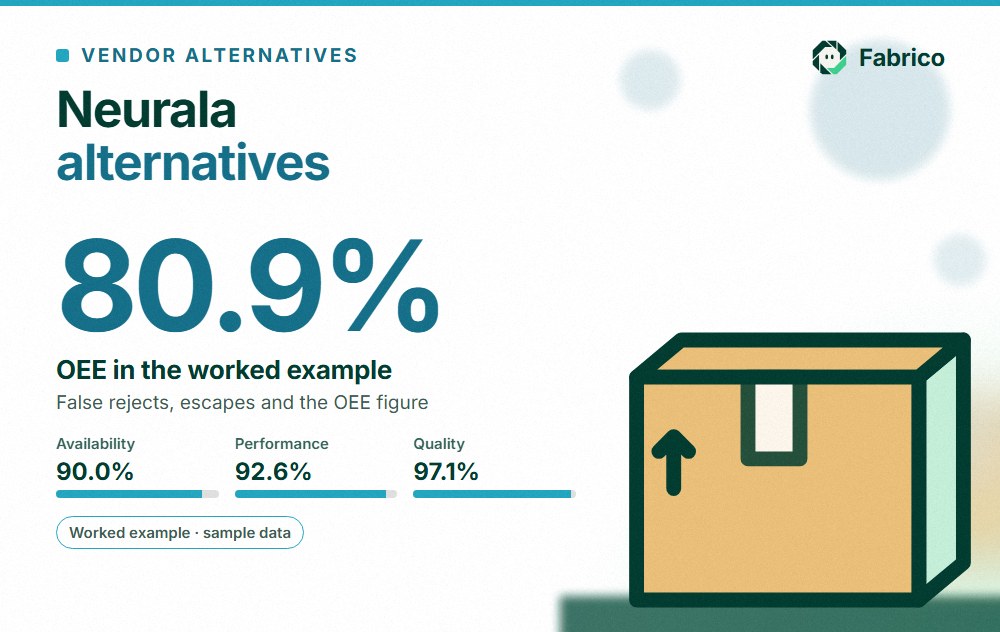
The shift. The line is planned for 480 minutes at an ideal 50 trays a minute, so 24,000 trays is the ceiling. Stops take 48 minutes, so availability is 432 of 480 minutes, 90.0%. At full speed those 432 minutes would give 21,600 trays. The line makes 20,000, a performance of 92.6%.
The quality figure. Say 2.0% of trays are bad: 400. If the pilot rates hold, the inspection camera rejects 384 of them, lets 16 through, and also rejects 196 good trays. That makes 580 rejects and 19,420 trays counted good, a quality of 97.1%. OEE is 90.0% x 92.6% x 97.1% = 80.9%, which matches 19,420 out of 24,000.
What it shows. False rejects cost 196 good trays a shift, about 1 point of quality. Escapes work the other way: 16 bad trays count as good, so OEE reads slightly high. Stops cost 2,400 trays, about 12 times the false rejects, so tune the model and also find out why the sealer stops. Check any camera count against a hand count first; see how accurate camera OEE is. Tray lines in more detail: computer vision for ready meal production.
Questions to ask any vendor before a pilot
- Which job is it? Pass or fail per unit, or output and lost time.
- Who owns the model? Who retrains and supports it: your team, an integrator or the vendor.
- What images does the pilot need? How many good and bad samples, labelled by whom.
- Where do images live? Device, plant server or cloud, for how long, seen by whom.
- How does a result travel? To the PLC, the reject gate and the OEE system.
- What is the pass mark? Escapes and false rejects, agreed before the pilot.
- What happens at a changeover? Run at least one pack change in the pilot.
- Same quote basis? Ask every vendor to quote the same list: stations, cameras, lenses, lighting, mounting, network, integration and training.
Cameras near people need the works council early; see cameras without surveillance. For the OEE half, the computer vision OEE pilot plan has the week-by-week detail, and food, household and personal care plants can read the FMCG buyer's guide.
What people ask next
What is Neurala used for?
Per its own site, Neurala supplies its L-DNN vision AI to companies that build it into cameras, machines and software. Its anomaly detection examples include packaging integrity verification, seal and closure inspection and foreign object detection.
Can a plant use Neurala on its own production line?
Neurala's integration page names its partners as OEMs building a product, platform companies adding AI capability and systems integrators delivering solutions for their clients. Its customer stories include a food producer that deployed L-DNN in its own production facility. Ask Neurala which route fits your line.
Does Neurala need the cloud or a GPU?
Its homepage says training, adaptation and inference run on the device, on standard processors such as Intel i3 or higher, with no GPU required, and that image data is processed and stored locally by design.
Which Neurala alternatives train on good parts?
MVTec shows the MERLIC anomaly tool inspecting glass bottles from a few good samples. SICK describes operators teaching the Inspector83x with good examples. Teledyne describes Astrocyte anomaly detection as trained on good images.
Does Fabrico do visual inspection like Neurala?
No. Fabrico is OEE and light MES software. It records when the line runs and stops, the stop reasons operators enter and the good output, and prices the lost time. Its camera add-on counts output at stations without a machine signal; it does not judge seals, labels, trays or parts.
Can rejects from an inspection system feed OEE?
Yes, when the reject count reaches the OEE software as a signal or counter. Rejected units then lower the quality part of OEE. Test the count in a pilot: false rejects lower OEE, and escapes are counted as good.
Want to see stops, speed and reject counts for a line like yours in one place? Book a demo.
Related articles




Real Fabrico tiles, sample data.