


 Login
 Blog
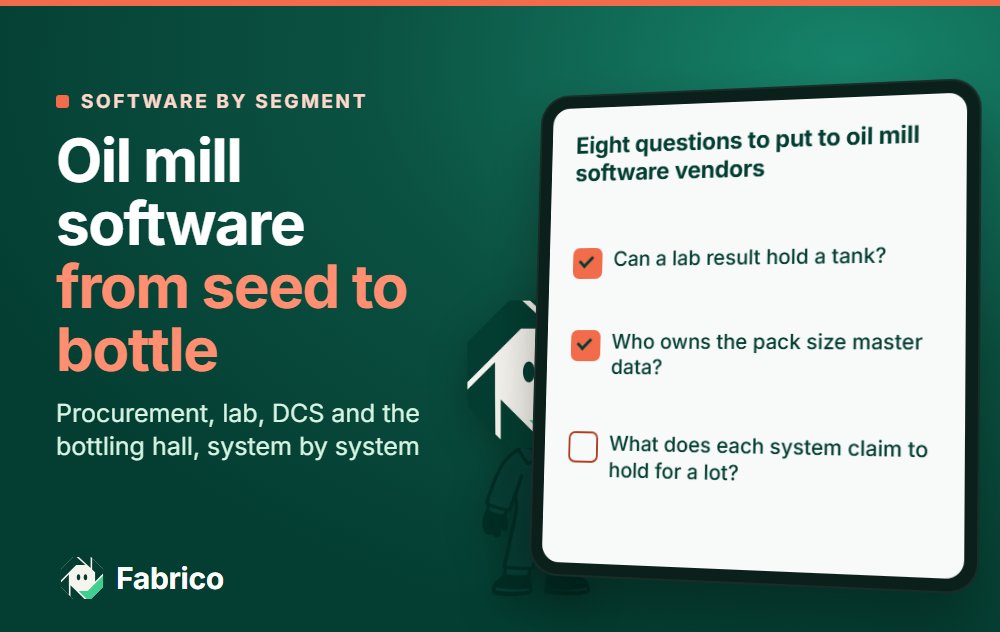
Oil Mill Software: From Seed Intake to the Bottling Hall

In short: oil mill software is several products, not one. A seed crushing and edible oil refining plant runs commodity procurement and an ERP for seed contracts and lots, an intake and lab system for moisture, FFA and peroxide value, a DCS or SCADA for the presses, extractor and refinery, tank records and a WMS for oil in stock, and an OEE and light MES layer for the bottling hall. Edible oil refinery software is mostly process control; OEE starts where oil reaches the filler.
- Seed is bought by the tonne at a moisture and oil content basis, so intake readings and the ERP decide the crush margin.
- Pressing, solvent extraction and refining run around the clock under process control, with a historian holding temperatures, vacuum and flows.
- Lab results decide when crude or refined oil may move to the next tank. That record belongs to the lab.
- The bottling hall is discrete work: blow moulder, filler, capper, labeller and case packer. Fabrico sits there, and only there.
An oil mill is a continuous plant with a packing plant bolted on the end. Seed arrives by truck, gets weighed, sampled and dried, then goes through cleaning, cracking and conditioning to the expellers. Press cake goes on to solvent extraction, and the crude oil goes to the refinery. Only at the end does the work turn into bottles, caps and cases.
Sunflower, rapeseed, soybean and palm kernel crushers, refiners that buy crude oil, and bottlers that pack refined oil all search for oil mill software or edible oil refinery software. They need a map more than a feature list, because the right first purchase depends on where the plant loses money.
Crushing is the main use of oilseeds in some markets. The USDA Economic Research Service says that for US soybeans, more than 80 percent of the crop is processed into soybean meal and oil through crushing. So every tonne of seed carries two products, oil and meal, and the software stack has to book both.
Fabrico builds the OEE and light MES layer for the bottling hall. It is not a process control system, a lab system or a commodity tool, and this page keeps those lines clear.
Oil mill software, system by system
The systems in an oil mill fall into three groups: those that price and track seed, oil and meal; those that run and prove the continuous process; and the one that measures the discrete machines in the hall.
| System | What it does in an oil mill | Owner | Fabrico? |
|---|---|---|---|
| Commodity procurement and ERP | Seed contracts, intake weights, crush margin, oil and meal sales, lots, costing | Trading, finance | No |
| Intake and weighbridge | Truck weights, moisture and foreign matter at intake, silo allocation | Intake team, lab | No |
| Lab system (LIMS) | Moisture, oil content, FFA, peroxide value, colour, residual solvent | QA lab | No |
| DCS or SCADA and historian | Expellers, extractor, desolventiser, degumming, neutralising, bleaching, deodorising | Process engineers | No |
| Tank records and WMS | Crude and refined oil tanks, cased oil, jerrycans, bulk dispatch | Logistics, QA | No |
| Quality system (QMS) | HACCP plan, audits, complaints, supplier approval | QA, food safety | No |
| OEE and light MES | Stops, counts and losses from blow moulder to case packer | Operations, CI | Yes, this is Fabrico |
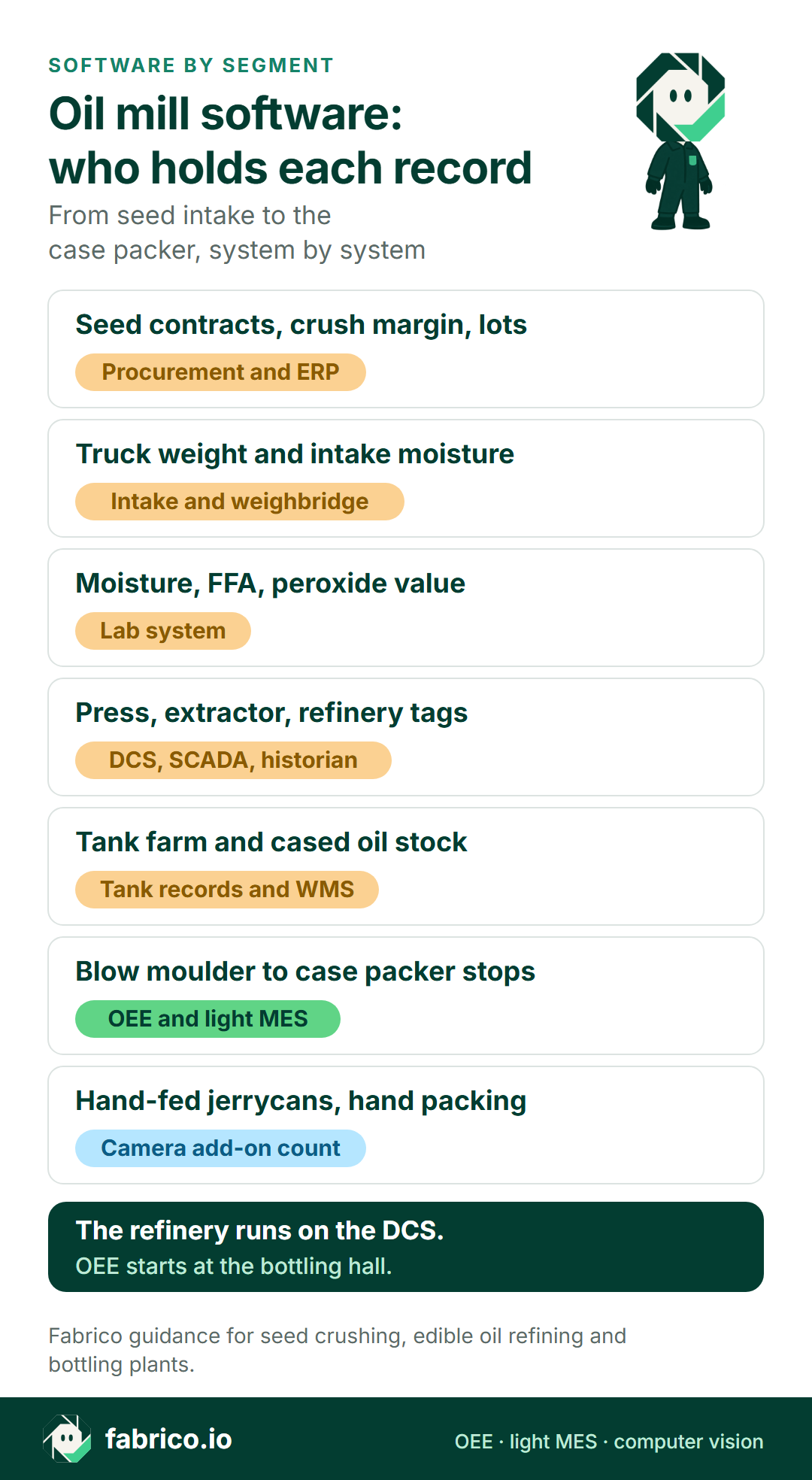
Text version of this infographic
- Seed contracts, crush margin and lots: procurement and ERP.
- Truck weight and intake moisture: intake and weighbridge.
- Moisture, FFA and peroxide value: lab system.
- Press, extractor and refinery tags: DCS, SCADA and historian.
- Tank farm and cased oil stock: tank records and WMS.
- Blow moulder to case packer stops: OEE and light MES, where Fabrico sits.
- Hand-fed jerrycans and hand packing: camera add-on count.
- The refinery runs on the DCS. OEE starts at the bottling hall.
Commodity procurement and ERP
This is where the crush margin lives: what the seed cost, what the oil and meal sold for, and what drying, solvent and energy took in between. Seed contracts carry a basis for moisture and oil content, so the ERP needs the intake readings to settle each truck. Ask any vendor to show one contract from purchase to the meal and oil it produced.
Intake, weighbridge and lab
At intake, the truck is weighed and sampled, and moisture decides whether seed goes to the dryer or straight to a silo. Later, the lab tests crude and refined oil for free fatty acids (FFA), peroxide value, colour and residual solvent. These results release or hold a tank, so the lab system must tie each result to a tank and a time, not to a sheet of paper.
Tank records and warehouse
Crude, neutralised, bleached and deodorised oil all wait in tanks between steps. Tank records show what is in each tank and its status. Once oil is bottled, a WMS takes over: cased oil on pallets, 5 L and 20 L jerrycans, and bulk oil leaving by tanker or IBC.
What edible oil refinery software covers
Refining is the most automated part of the plant. Degumming removes phosphatides, neutralising takes out free fatty acids, bleaching removes colour and traces, and deodorising strips odour under heat and vacuum. Physical refiners skip chemical neutralising and remove FFA in the deodoriser. All of it runs continuously, so the software is a DCS or SCADA that holds setpoints and a historian that keeps every tag.
This layer is usually bought with the refinery or from an automation integrator, and it answers to process engineers. Its numbers are tonnes an hour, temperatures, vacuum and oil loss. An OEE tool adds little here: there are no discrete cycles, and a slowdown is a process question, not a stop reason picked at a tablet. Where a DCS ends and an MES begins is set out in MES vs DCS.
Two rules show why the lab and the refinery records matter more than any line metric:
- Solvent residue. Directive 2009/32/EC on extraction solvents, as published on legislation.gov.uk, lists hexane for "Production or fractionation of fats and oils and production of cocoa butter" with a limit of 1 mg/kg in the fat or oil or cocoa butter. That proof comes from the lab, after extraction and desolventising.
- Contaminant limits. Regulation (EC) No 1881/2006 as retained in Great Britain, on legislation.gov.uk, sets 1 000 µg/kg for glycidyl fatty acid esters, expressed as glycidol, in vegetable oils and fats placed on the market for the final consumer or for use as an ingredient in food, with listed exceptions. EU plants should check the current EU text with their QA team.
Both limits are proven with lab results against refinery runs and tanks. A filler stop log proves nothing about either, and no line software should claim it does.
Bottling hall losses, briefly
The hall is where cases are lost minute by minute. A PET blow moulder that stops starves the filler. Fill speed changes with oil temperature, so a cold morning slows a 5 L line. Capper and labeller jams back up the filler, and the case packer and palletiser block the whole line. Jerrycan and bulk lines are often fed by hand, with no machine count at all. The station rules, the ideal rate per pack size and a worked shift are in OEE for edible oil bottling lines. Repairs on expellers, the extractor and the hall machines belong in a maintenance system; that job is covered in software for vegetable oil refineries.
Which oil mill software to buy first
Start with the row that costs the most this year. The first four are commercial, lab and process buys, and they come first when seed is mispriced or a tank release is on paper. The bottling hall row comes first when the plant sells all it can bottle and the hall is the limit.
Plant type changes the order. A crusher that sells crude oil in bulk may never need bottling hall software. A refiner that bottles its own brand needs both the lab and DCS layer and the hall layer, but usually buys the lab system first. A bottler that buys refined oil in tankers starts in the hall.
Take a week of filler stop sheets and the pack size list to a demo, and we will show which numbers Fabrico fills and which stay in the lab, the DCS and the ERP.
Worked example: one complaint traced from bottle to seed
An invented case, from no real plant. A retailer returns 1 L sunflower oil from one lot code, saying it tastes rancid. QA must show the refined oil tank behind that lot, the deodoriser run, the FFA and peroxide value release, the crude oil and seed lots, and when the filler ran. Five systems hold the answers.
| Record | Held in | Where the hand-off breaks |
|---|---|---|
| Bottling lot code | ERP, from the coder at the filler | Lot code typed in by hand after a coder change |
| Refined oil tank and deodoriser run | Tank records and the DCS historian | Filler switched tanks mid-run, not logged |
| FFA and peroxide value release | Lab system | Release signed on paper, not linked to the tank |
| Crude oil batch and seed lots | ERP and intake records | Two seed lots blended in one silo |
| Run times, stops and bottle counts | OEE and light MES | Holds no lot or lab record, only run data |
The trace fails where a tank change, a lab release or a lot code moves by hand. Fabrico plays no part in the lot trace itself; it supplies only when the filler ran, when it stopped and how many bottles it counted. For the OEE maths of a bottling shift, see OEE for edible oil bottling lines.
Who hands what between oil mill systems
Most trouble in an oil mill stack sits in the links, not in the systems. Agree each link and its owner before go-live.
One link to avoid: copying refinery or lab data into the line layer. The filler does not need the deodoriser temperature. It needs to know that it waited for oil, and the operator can say so with one reason code. Units differ too: the hall reports bottles and cases, while the plant reports tonnes. Our page on OEE units: bottles, cases and pallets covers the conversion.
Eight questions to put to oil mill software vendors
Put them to every shortlisted vendor, and bring one month of intake records, lab results and filler stop sheets.
| Ask | How to test the answer |
|---|---|
| Does procurement read moisture and oil content from intake? | Ask for one truck priced with a moisture discount, from weighbridge to contract. |
| Can a lab result hold a tank? | Ask to see a refined oil tank blocked until FFA and peroxide value pass, then released. |
| Which historian tags does the refinery keep, and for how long? | Ask for one deodoriser run pulled up by date and tank. |
| Which ERP fields does the bottling hall layer read and write? | Pack sizes, products and orders in; good cases and stop minutes out. Ask who maintains the link. |
| How are hand-fed jerrycan and 5 L lines counted? | Ask what happens where no machine count exists, and who checks the count. |
| Who owns the pack size master data? | One owner, usually the ERP. Ask how a new bottle size reaches the line layer. |
| What does each system claim to hold for a lot? | Write it down per system. Only the ERP, the lab and tank records should claim lot data. |
| How does the bottling layer mark a filler waiting for oil? | Ask for a reason that books the minutes to refinery supply, not to the filler crew. |
Where Fabrico fits in an oil mill
Fabrico is a cloud OEE and light MES platform. In an oil mill it covers the bottling hall, from the PET blow moulder to the palletiser:
- Refinery supply waits in their own bucket: when the filler waits for oil from the refinery or the tank farm, operators pick that reason, so the hall does not carry the refinery's minutes.
- Pack size by pack size: 1 L, 2 L, 5 L and 20 L runs each get their own rate and count, so a pack change shows as its own loss in cases and money.
- Stops from the hall's machines: run state and counts come from the blow moulder, filler, capper, labeller and case packer signals, and the crew tags the reason on a tablet or phone.
Where jerrycans are filled by hand or cases are packed at a table, the camera add-on counts output where no machine count exists. Its video for a moment on the shift timeline is streamed on request, not stored in Fabrico. The FMCG camera guide and the computer vision add-on page explain how those counts work.
The platform as a whole, from loss pricing to apps and exports, is on the MES and OEE software page. For where a light layer stops, read light MES vs full MES.
What Fabrico does not do: seed procurement, crush margin, intake grading, lab results, process control of presses, extraction or the refinery, tank records, WMS, HACCP and quality records, fill weight control, label or code inspection, and lot genealogy. Those stay in the ERP, the lab system, the DCS and with QA. The bottling plan stays with your planners and the ERP.
What oil mill teams ask next
What is oil mill software, in one line?
It is the set of systems a crushing and refining plant runs: procurement and ERP, intake, lab, process control, tank records, quality and bottling hall OEE. Each holds a different record.
Is edible oil refinery software the same as a DCS?
Mostly, yes. The refinery runs continuously, so its control software is a DCS or SCADA with a historian, often bought with the refinery equipment. Lab and tank records sit beside it.
Does OEE software belong in the refinery?
Rarely. Degumming to deodorising is a continuous process, measured in tonnes an hour, temperatures and vacuum. OEE fits the discrete machines of the bottling hall far better.
Which system should release a tank of refined oil?
The lab system, or the QA team through it. A tank should move to bottling only when its FFA, peroxide value and other results pass.
Can one ERP cover seed buying and the bottling hall?
It can hold the contracts, stock, orders and costing for both. It does not usually record why the filler or the case packer stood still during a shift.
Does Fabrico record FFA or peroxide values?
No. Lab results stay in the lab system. Fabrico records run times, stops and counts on the bottling lines, and the reasons operators give.
Want the bottling hall's lost hours sorted by cause? Book a demo, with a week of filler stop sheets and the pack size list to hand.
Related articles
Latest from our blog



Real Fabrico tiles, sample data.