


 Login
 Blog
Sugar Mill Software: From the Cane Yard to the Bagging Line

In short: sugar mill software is a set of separate systems, not one package. A cane or beet factory runs a weighbridge and grower payment system at the gate, a DCS or SCADA for milling or diffusion, clarification, evaporation and the pans, a laboratory system for pol and brix, an ERP and warehouse system for sugar stock and sales, and an OEE or light MES layer for the centrifugals, bagging and retail packing lines.
- The DCS runs the continuous process. OEE and light MES do not control anything; they time stops and count output.
- Grower payment depends on weight and sugar content, so the weighbridge and the lab feed it, not the production floor.
- The campaign is the year. Machine downtime in those months costs crushing or slicing time that cannot be made up later.
- Fabrico sits at the batch and packing end: centrifugals, bagging of 50 kg sacks and bulk, and retail packing lines.
A sugar factory is two plants joined by a silo. Upstream, cane or beet becomes juice, syrup and massecuite in a process that runs day and night through the campaign under a control system. Downstream, sugar is spun, dried, stored and packed in machines that start, stop and change over like any packing hall.
Buying sugar mill software goes wrong when one product is asked to do both jobs. A process control vendor is not a packing line OEE vendor, and a grower payment system knows nothing about why the 1 kg packer stood still. This map sorts the systems, the record each one owns, and the one to buy first.
Fabrico builds OEE and light MES for the batch and packing end. It does not control the process, pay growers or run the lab.
Sugar mill software: the systems and who owns them
Read the table from the cane yard to the dispatch bay. Notice where ownership changes: the cane office and the lab own the money record, the process engineers own the control system, and operations owns the packing hall.
| System | What it does in a sugar factory | Owner | Fabrico? |
|---|---|---|---|
| Weighbridge | Gross and tare per cane truck, tractor trailer or beet load, linked to the grower | Cane or beet office | No |
| Grower and cane payment | Deliveries per grower, quality payment rules, advances and final payment | Cane office, finance | No |
| Laboratory system | Pol, brix and purity of cane, juice, syrup, massecuite and sugar; colour of the product | Lab, QA | No |
| DCS or SCADA | Mills or diffuser, clarifiers, evaporators, vacuum pans, boilers; control and history | Process engineers | No |
| ERP and WMS | Sugar stock by grade, silo and warehouse, lots, sales and dispatch | Finance, logistics | No |
| OEE and light MES | Running and stopped time at centrifugals, dryers, baggers and retail packers | Operations, CI | Yes, this is Fabrico |
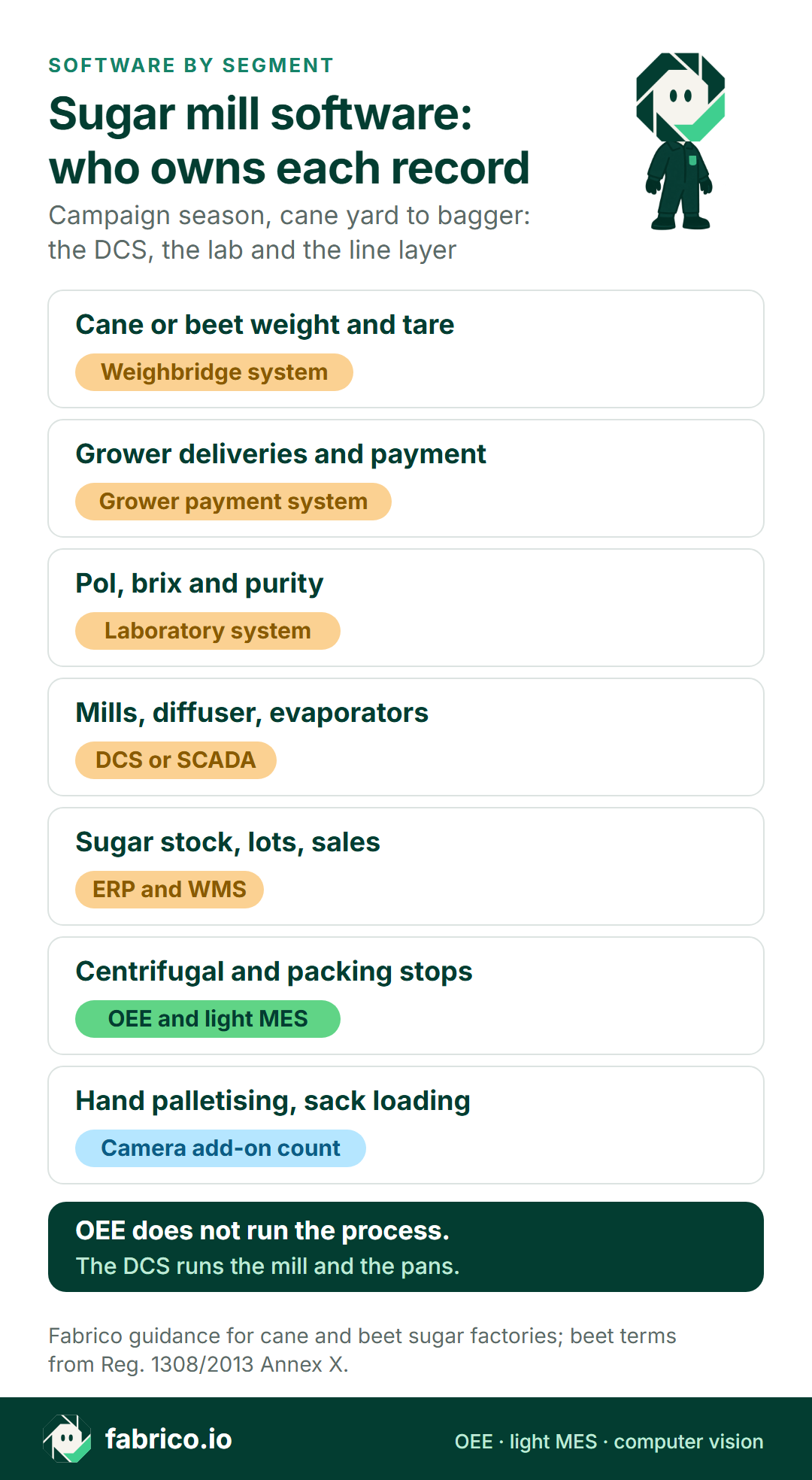
Text version of this infographic
- Cane or beet weight and tare: weighbridge system.
- Grower deliveries and payment: grower payment system.
- Pol, brix and purity: laboratory system.
- Mills, diffuser and evaporators: DCS or SCADA.
- Sugar stock, lots and sales: ERP and WMS.
- Centrifugal and packing stops: OEE and light MES.
- Hand palletising and sack loading: camera add-on count.
- Footer: OEE does not run the process. The DCS runs the mill and the pans.
Weighbridge and grower payment
Every delivery starts on the scale, and every grower is paid from it. In the EU the purchase terms for beet are written into law: Annex X of Regulation (EU) No 1308/2013 says delivery contracts shall lay down a fixed sugar content for beet, shall provide for the gross weight, tare and sugar content to be determined using procedures agreed, and shall fix the time limits for any advance payments and for payment of the purchase price. Cane industries elsewhere use their own national payment rules. Either way, the payment system needs the weighbridge and the lab, and nothing from the packing hall.
Laboratory: pol, brix and the product spec
The lab measures pol and brix from cane or beet samples through to the final sugar. Purity, the ratio of the two, tells the process team how well each stage is working. At the end, the lab proves the product spec. The UK Specified Sugar Products Regulations 2003 define white sugar with polarisation not less than 99.7°Z, and similar national rules apply elsewhere. These are lab and QA records, held by lot or silo sample.
DCS or SCADA: the continuous process
Milling tandems or the beet diffuser, juice heaters, clarifiers, multiple effect evaporators and vacuum pans run under a distributed control system or SCADA, with a historian behind it. This is process control, bought from automation suppliers and engineered for the factory. An OEE tool should never sit in that loop. For how these layers differ, see SCADA vs DCS and SCADA vs MES.
ERP and warehouse
The ERP holds sugar stock by grade, raw and refined sales contracts, molasses and pulp, and costing. A warehouse system or ERP module tracks silos, bagged stock and dispatch. Bulk sugar leaves by tanker; bagged sugar leaves on pallets.
OEE and light MES: the batch and packing end
From the centrifugals onward the factory behaves like a discrete plant. Batch centrifugals cycle, dryers and coolers run or trip, and baggers and retail packers start, stop and change format. This is where an OEE layer reads machine signals and operators record why the line stopped.
Which records cross between sugar factory systems
The links that carry money run from the gate and the lab to grower payment, and nobody on the packing floor should touch them. The links that carry output run between the ERP and the packing hall: pack orders down, bags and run hours back. The centrifugal PLCs can report cycles and run state. The DCS stays closed to the OEE layer, because nothing on the packing side needs to write into process control.
Campaign downtime, briefly
The campaign sets the cost of every lost hour. The USDA Economic Research Service puts it plainly: once harvested, sugarcane must be processed quickly before its sucrose deteriorates, and stored beet must also be processed before sucrose deterioration occurs. A mill or diffuser stop backs up the yard. Downstream, the losses are machine losses: a centrifugal waiting for massecuite or held for a screen wash, a dryer trip, a bagger stopped for empty sacks or a sewing head, a retail packer changing from 1 kg to 2 kg packs. Process losses such as sugar in molasses or bagasse are lab and process engineering numbers. For cycle based machines, see OEE for batch processes; packing hall stops are covered in VFFS bagger stops and in palletizer OEE.
Which sugar mill software to buy first
A factory that cannot pay growers correctly has no campaign, so payment and the lab come before anything on the floor. After that, buy for the loss you can see.
| What hurts most | Start with | Why |
|---|---|---|
| Growers dispute weights or quality payments | Weighbridge and grower payment system | Growers are paid from these numbers |
| Pol, brix and purity sit in lab books | A laboratory system | Payment and process both need the same results |
| Process upsets in evaporation or the pans | DCS or SCADA work with your automation supplier | Process control is engineered, not configured in an OEE tool |
| Centrifugal station idle with no record of why | OEE and light MES on the centrifugals | PLC cycles time the gaps; operators add the reason |
| Bagging or retail packing below rated speed | OEE on the packing lines | Splits sack supply, sealing, weigher and format change losses |
| Silo, bagged stock and sales never reconcile | ERP and WMS | Stock and dispatch need one owner |
Bring last campaign's packing hall shift reports and one centrifugal log to a demo. You will see which of those numbers Fabrico would hold, and which stay with the lab, the cane office and the DCS.
Worked example: one lot of 50 kg white sugar, traced
This case is made up for illustration. A soft drink maker complains about colour in one delivery of 50 kg sacks and asks for the history of that lot. The answer is spread across five systems, and the silo makes it harder: sugar from many pan strikes mixes before it is bagged, so a bag lot maps to a window of silo time, not to one strike.
| Record | Held in | Where the hand-off breaks |
|---|---|---|
| Pan strike and massecuite data | DCS historian | Strike numbers never reach the bag lot code |
| Colour and pol of the sugar | Laboratory system | Samples by shift, not by silo window |
| Lot code, buyer and sales order | ERP | Lot opened by hand at shift change |
| Pallets of the lot and where they are | WMS | Pallets moved before the hold was set |
| Bagger run and stop times, sacks counted | OEE and light MES | Machine time and counts, nothing on quality |
The trace breaks where the DCS clock, the lab sample times and the bag coder disagree. Fabrico adds no lot or quality record here. Its share is the bagger's run time, its stops and its sack count. The OEE maths for cycle based machines like centrifugals is in OEE for batch processes.
Seven questions for a sugar mill software vendor before the campaign
Put them to every shortlisted supplier, with last campaign's packing reports and a week of centrifugal logs to hand.
| Ask | How to test the answer |
|---|---|
| Does the product control anything in the process? | For an OEE tool the right answer is no. Control stays in the DCS or SCADA. |
| Which signals does it read from the centrifugals? | Cycle complete and run state from the PLC is enough. Ask who wires it and who keeps it working. |
| How is a planned screen wash kept apart from a fault? | Ask for both as separate reasons, so washing time shows up as planned work. |
| Can a bagger hold one rate for 50 kg sacks and another for bulk bags? | Ask to see two pack formats on one machine, each judged on its own speed. |
| How does the off season look? | Ask to switch lines to not planned for the repair season without hurting the OEE history. |
| Which ERP fields does the packing hall read? | Pack orders, sizes and brands in; bags and run hours out. Agree who maintains the interface. |
| Does any of it touch grower payment? | It should not. Weights and sugar content go from the weighbridge and lab to payment only. |
Where Fabrico fits in a sugar factory
Fabrico runs in the cloud as OEE plus light MES, and in a sugar factory it covers the batch and packing end:
- Centrifugals and dryers: run state and cycles come from the PLC or a sensor, and the operator enters the reason on a phone or tablet: no massecuite, screen wash, discharge fault, dryer trip.
- Bagging and retail packing: each line gets a rated speed per pack, from 1 kg retail packs to 50 kg sacks and bulk bags, so changeovers, sack supply and sealing stops are counted apart.
- Campaign downtime: machine stop time in the packing hall during the campaign is shown by line and shift. The data can be exported to Excel or CSV, or pulled by the ERP over the REST API and webhooks.
Sacks stacked or loaded by hand have no machine count, so there the camera add-on counts them. Where a camera covers the station, the video for the minute of a stop can be opened too, streamed on request, not stored in Fabrico. See the computer vision add-on and the FMCG camera guide. Platform features are listed under MES and OEE software, and the food plant software map is in food manufacturing software.
What Fabrico does not do: process control of mills, diffusers, evaporators or pans; weighbridge, grower or cane payment; pol, brix or colour testing; sugar inspection or grading; ERP or warehouse records. The crushing and packing plan stays with your production planners and the ERP.
What people ask next
Is sugar mill software the same as a DCS?
No. The DCS or SCADA controls the continuous process from the mills or diffuser to the pans. Sugar mill software also covers grower payment, the lab, the ERP and packing line OEE, each a separate product.
Can OEE software calculate grower payments?
No. Grower payment depends on delivered weight and sugar content, which come from the weighbridge and the lab. OEE software counts packed output and machine time.
Where does OEE help most in a sugar factory?
At the centrifugals and in the packing hall, where machines start and stop. The continuous process upstream is judged by the process team on throughput and recovery, not by a packing line OEE.
How should the off season appear in the data?
As time not planned for production, so repair months do not drag the campaign figures down. The packing hall may still run from silo stock, and it can keep its own planned hours.
Does Fabrico read data from the DCS?
It does not need to. Fabrico works from centrifugal and packing machine signals. If a factory wants a DCS value shown, that is a separate integration agreed with the process team.
Want to see a campaign week of packing hall stops in one view? Book a demo with one centrifugal log and a bagger shift report.
Related articles
Latest from our blog



Real Fabrico tiles, sample data.