


 Login
 Blog
SYMESTIC Alternatives: MDE, BDE and OEE Software, by Module

In short: the right SYMESTIC alternative depends on which modules your spec actually lists. For machine data (MDE), production data (BDE) and OEE in one MES, compare SYMESTIC with MPDV HYDRA X and FORCAM ENISCO. If OEE and downtime come first and job dispatching stays in the ERP, sensor-based TeepTrak and the light MES Fabrico are the other two compared here.
- SYMESTIC is a cloud-native MES from Dossenheim, Germany, aimed at mid-sized manufacturers.
- Its pages describe MDE, BDE, OEE and shopfloor management on one data model, with two-way links to SAP, InforCOM and Microsoft Dynamics.
- Older machines connect through an IoT Box on their digital signals, without touching the PLC.
- Every vendor claim below comes from that vendor's site, checked on 13.11.2026, with a link in place. You will find no prices, verdicts or rankings here.
Picture a plastics and metal parts supplier near Stuttgart writing its first MES specification, the Lastenheft. Machine data collection, production data collection, OEE, a digital shift book and ERP feedback all go on the list, because every vendor brochure mentions them. Six months after go-live, the team finds that the line managers open the OEE screen and little else.
Sorting vendors by module avoids that. Below: what SYMESTIC is, a short guide to the German terms, and four alternatives with what each covers, per its own pages. Fabrico, our product, is among the four; for that reason the list carries no ranking.
What SYMESTIC is (as of 13.11.2026, per symestic.com)
The SYMESTIC home page calls it the cloud-native manufacturing platform for the German Mittelstand, with MES, OEE, BDE and MDE from one source. The site is in German; quotes are translated here. According to its about page, the GmbH dates from 1999 and started building a new cloud-native MES on Microsoft Azure in 2019, after mainly on-premise MES projects up to 2018, with a focus on automotive suppliers and food producers. Per its pages, as of 13.11.2026:
- One data model. The platform page describes one MES that is identical across plants, built on a standardized data model from 25 years of MES practice, so KPIs compare one to one.
- Machine connection. OPC UA, an IoT Box for digital signals on older machines without PLC changes, or a Cloud Gateway on your own server, optionally over mobile networks. The retrofit page shows a 1994 eccentric press as an example.
- Edge and cloud. The cloud handles scaling, multi-site and AI, while an edge layer in the plant keeps capturing data without internet.
- OEE. Its OEE page says availability, performance and quality are captured automatically and shown factor by factor. Stops are detected automatically and explained from a reason catalogue, in the operator's own language, with a translation for everyone else.
- BDE and the ERP. The BDE page describes order start, pause and finish at the workstation, with quantities, times and scrap reported back to InforCOM, SAP, Microsoft Dynamics NAV or Business Central.
- Further modules. The site lists shopfloor management, a digital shift book, worker guidance, machine alarm management, process monitoring and quality checks. SYMESTIC AI is marked as in active development.
Worth asking SYMESTIC: where the data is hosted, and which modules a first line needs.
Signs SYMESTIC suits your plant
- The spec reads like a German MES Lastenheft: MDE, BDE, OEE and order feedback in one system.
- Your ERP is SAP R/3, InforCOM or Microsoft Dynamics, and orders should flow both ways.
- Several plants need the same KPIs without a harmonisation project.
- IT is small, and nobody wants to run an MES server per plant.
If the honest answer is that OEE and downtime are what people will use first, keep reading.
MDE, BDE, OEE: what each module asks for
German specs use terms that English brochures blur. SYMESTIC's MDE page draws the line clearly: MDE captures machine data such as states and signals, BDE captures production and order data such as times, quantities and status, and SYMESTIC combines both in one system. OEE is calculated from both. Shopfloor management is the meeting routine that uses the numbers. Our guide to machine data collection covers MDE in more depth.
Each extra box adds value and work: BDE means order data in both directions, and shopfloor management means a daily routine someone has to own.
SYMESTIC and four alternatives, module by module
Condensed from what each vendor published on 13.11.2026; links sit in the vendor sections. This is not a ranking, and a brief cell is only brief, so confirm any module you need with the vendor. After the SYMESTIC reference row, Fabrico appears first because the page is ours.
| Tool | Scope, per its site | ERP link named | Ask the vendor |
|---|---|---|---|
| SYMESTIC (for reference) | Cloud MES: MDE, BDE, OEE, more | SAP R/3 via IDoc, InforCOM, Dynamics | Which modules does a first line need? |
| Fabrico | Light MES: machine data, OEE, losses | REST API; SAP scoped per customer | Which order data stays in the ERP? |
| MPDV HYDRA X | Modular MES across production areas | Standard interfaces to the ERP | Which mApps come first? |
| FORCAM ENISCO | Modular MES for discrete plants | SAP S/4HANA, SAP DM packages | LITE, FLEX or E-MES? |
| TeepTrak | Sensor-based real-time OEE | Exports to SAP, Oracle, Power BI | How are order data handled? |
A module grid is a start, not a decision. Book a demo and bring the module list from your spec.
Fabrico: machine data and OEE, dispatching stays in the ERP
We wrote this page, and Fabrico is our product. In German terms, Fabrico covers MDE and OEE and calls itself a light MES; job dispatching, BOMs and routings stay in your ERP. From the Fabrico MES and OEE overview:
- Machine data collection. Automated lines report through their PLC, and older machines through Fabrico's own IoT box, which reads external sensors. Protocols are listed under machine connectivity.
- Stops and reasons. Start times and durations come from the machine; the cause comes from the operator's phone or tablet.
- OEE in money. Machine and shift OEE, split into its three factors, with the losses shown in money.
- Several plants. A multi-plant view shows sites together, with comparison reports.
- Languages. German is one of five interface languages, next to English, French, Polish and Bulgarian.
- Manual stations. Where no signal exists, the camera add-on counts output; footage from the camera add-on opens from the shift timeline and is streamed on request, not stored, in the standard setup (camera add-on).
- ERP. REST API and webhooks. Linking SAP or another ERP is agreed per customer, while dispatching, BOMs, routings and genealogy remain ERP data.
- Rollout. Devices connected in about a month; full rollout in 3 to 4 months.
Suits plants that put OEE and downtime by cause first, across a mix of old and new machines, and keep job dispatching in the ERP. On hosting: EU customers are hosted on AWS in Frankfurt. Starting with a single-line pilot keeps risk low, and our OEE software guide sets out the basics.
MPDV HYDRA X: one modular MES, many functions
MPDV, founded in 1977 per its company history, sells HYDRA X. Its HYDRA X page positions it as a modular MES covering every production area. As of 13.11.2026:
- The function list runs from production and machine data acquisition through quality, material, maintenance, HR and energy management.
- It is platform-based, built from manufacturing apps (mApps), and also serves the process industry.
- Its cloud services page offers all current MPDV products as SaaS, with data processed in certified data centers in the EU.
Compared with SYMESTIC: both name MDE, BDE and OEE. MPDV's pages also name material, HR and process production; SYMESTIC's stress one cloud data model for mid-sized plants. Read light MES vs full MES to size that choice.
Fits plants that want one MES vendor for many functions and may grow into planning or process production.
FORCAM ENISCO: MES packages with SAP in mind
FORCAM ENISCO's MES overview describes modular MES solutions for discrete manufacturing, from parts production to final assembly. As of 13.11.2026:
- MES LITE targets production transparency, MES FLEX adds analysis, planning and optimisation, and E-MES controls semi-automated and fully automated lines.
- Its home page lists a cloud-based MES with SAP S/4HANA integration and standardized MDE/BDE work packages for SAP Digital Manufacturing.
- Monitoring covers OEE, utilization and downtime in real time, plus energy use and batch traceability.
Compared with SYMESTIC: both use the MDE and BDE vocabulary. FORCAM ENISCO's pages lean toward SAP landscapes; SYMESTIC's name SAP R/3, InforCOM and Microsoft Dynamics. See our Fabrico vs FORCAM comparison.
Fits plants that run SAP and want MES packages sized from light to full.
TeepTrak: OEE from sensors, before any MES decision
TeepTrak, founded by François Coulloudon, offers live OEE tracking and production analytics, as its English site puts it. As of 13.11.2026:
- Its sensors need no PLC work and suit machines of any make; the protocol list names MQTT, OPC UA, PROFINET, Modbus, Profibus and dry contact I/O.
- It logs stops, short stops, slow cycles and scrap as they happen, with causes entered on the floor.
- Data leaves through APIs and exports to SAP, Oracle and Power BI; reports are set up for ISO 9001 audits.
Compared with SYMESTIC: both read older machines without PLC changes. TeepTrak's pages center on OEE; SYMESTIC's cover BDE and order feedback as well.
Suits plants that start with sensor-based OEE and leave the MES question for later.
Which SYMESTIC alternative fits your spec
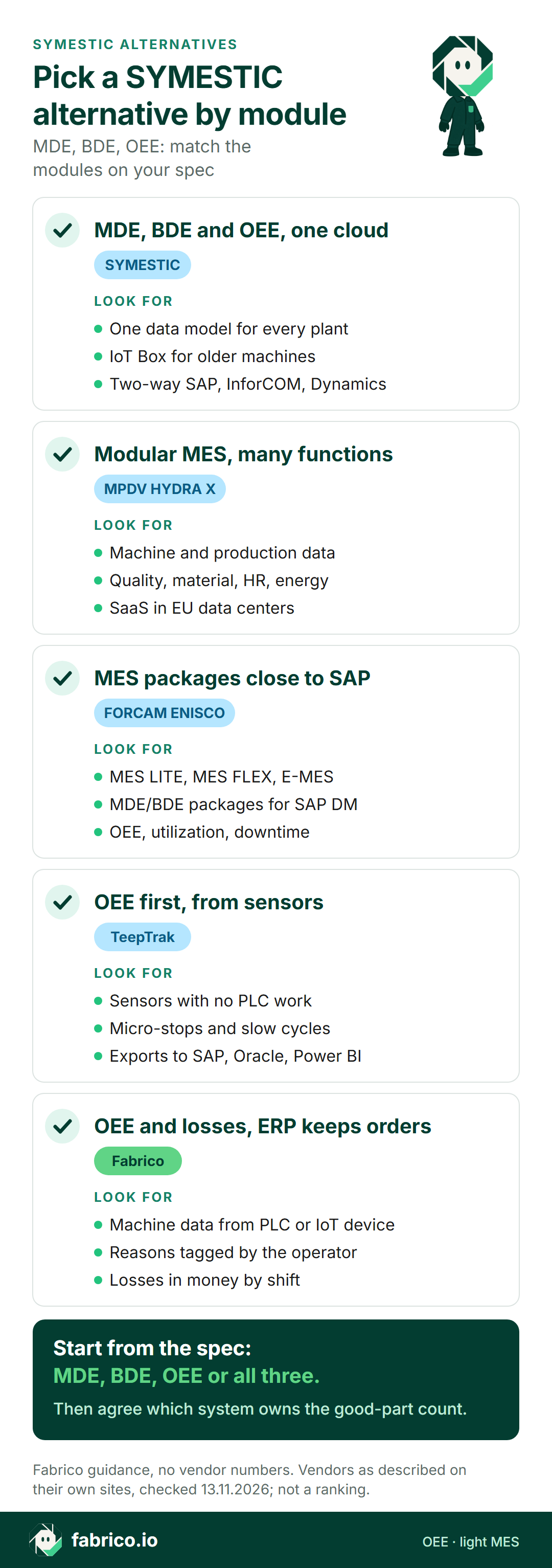
- MDE, BDE, OEE and ERP feedback in one cloud MES for a mid-sized plant: SYMESTIC.
- A modular MES that also covers material, HR, energy or process production: MPDV HYDRA X.
- MES packages from light to full, close to SAP: FORCAM ENISCO.
- Sensor-based OEE before any MES decision: TeepTrak.
- Downtime cost and OEE on a mixed machine park, dispatching kept in the ERP: Fabrico.
For broader lists, see our MES software review and the shop floor management software review. Food and consumer goods producers will find our FMCG computer vision guide a better start.
Worked example: MDE, BDE and OEE on one press
The numbers for this stamping press shift are invented, with no customer data or product screen behind them. The plan is 450 minutes, the ideal rate is 4 strokes a minute (0.25 minutes a part), and the press is working on an order of 5,000 parts.
MDE. The machine reports 390 minutes running, 60 minutes stopped and 1,404 parts. Availability is 390 / 450 = 86.7%. At 4 a minute, 390 minutes allow 1,560 parts, so performance is 1,404 / 1,560 = 90.0%.
BDE. The operator books 36 parts as scrap with a reason, so 1,368 good parts go against the order, and 3,632 remain open. Quality is 1,368 / 1,404 = 97.4%.
OEE. 86.7% x 90.0% x 97.4% = 76.0%, the same as 1,368 good parts x 0.25 minutes over 450 minutes. A full MES keeps all three records together; with a light MES, the machine record and the OEE live in one system and the ERP keeps the booking. The OEE calculation page explains the steps.
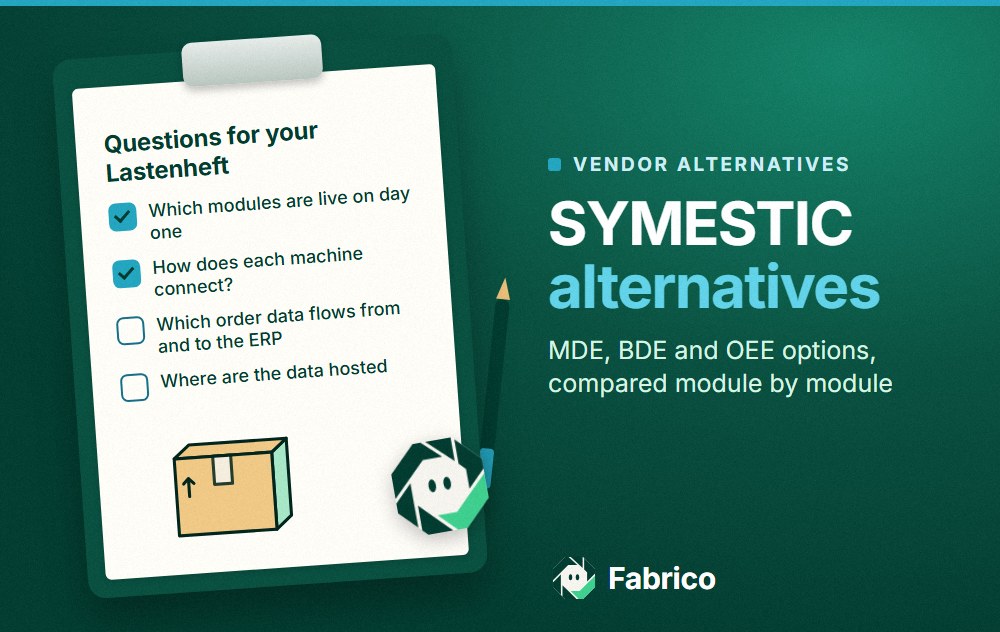
Questions for your Lastenheft
Send each vendor, Fabrico included, the same short list for one representative line.
- Which modules are live on day one, and which come later?
- How does each machine connect? OPC UA, digital signals, sensors, and who installs them.
- Which order data flows from and to the ERP, and which system owns the good-part count.
- Where are the data hosted, and what happens on site when the internet drops.
- Which languages do operators and managers get?
- How are plants compared, and who maintains the shared reason catalogue?
What people ask next
Where is SYMESTIC based?
In Dossenheim, Germany, per its site. Its about page says today's SYMESTIC GmbH was founded in 1999, worked chiefly on on-premise MES up to 2018, and rebuilt its platform as cloud-native software on Microsoft Azure from 2019.
What is the difference between MDE and BDE?
MDE (Maschinendatenerfassung) collects machine data such as states, cycles and part counts. BDE (Betriebsdatenerfassung) collects production and order data such as times, quantities, scrap and order status. OEE needs both.
Does SYMESTIC connect older machines?
Its pages say yes: an IoT Box reads the digital signals of older machines without changes to the PLC, and newer controls are read over OPC UA through its Cloud Gateway software.
Is SYMESTIC cloud software?
Yes. It describes a cloud-native SaaS platform with no server per plant, and an edge layer in the plant that keeps capturing data when the internet is down. Ask SYMESTIC where your data would be hosted.
How is Fabrico different from SYMESTIC?
SYMESTIC describes one cloud MES covering MDE, BDE, OEE, shopfloor management and order feedback to the ERP. Fabrico is a light MES focused on machine data, stops with operator reasons, OEE and losses in money, with job dispatching, BOMs and routings left in your ERP.
Is Fabrico available in German?
Yes. German is one of Fabrico's interface languages, along with English, French, Polish and Bulgarian, in a browser and in the mobile apps for iOS and Android.
Want to check Fabrico against your own spec? Book a demo; general questions go to our team.
Related articles


Real Fabrico tiles, sample data.