


 Login
 Blog
Tea Factory Software: From Green Leaf to the Packing Hall

In short: tea factory software is several products, not one: leaf weighment and grower accounts, processing records, auction and sales records, a QA lab, and in a packing plant blend recipes, an ERP and a warehouse system. OEE and light MES sit on the packing hall and on the processing machines that give a signal. Buy first whatever is missing behind the record that costs you most.
- Leaf weights and grower payments are money records. They belong to the intake and grower system.
- Withering and fermentation are timed process steps. Their logs belong to the factory's processing records.
- The CTC line, the dryer, the sorting room and the tea bag machines are where machine minutes can be counted.
- In the sample packing shift below, 40 recovered minutes on each of three bag machines are worth about EUR 794 a shift and about EUR 400,000 a year.
Tea is made twice. First a factory near the garden turns green leaf into made tea in a single day: wither, roll or cut, oxidise, dry, sort. Then a blending and packing plant, often in another country, mixes teas from several gardens and puts them into bags, cartons and caddies.
The volumes are large and the supply base is fragmented. The FAO's tea pages put world tea production in 2025 at around 7.3 million tonnes, with total imports of an estimated 2.0 million tonnes, and note that smallholders are responsible for 60 percent of world tea production. For a bought-leaf factory that means many growers delivering daily; for a packer, blends built from many invoices.
Tea factory software and tea manufacturing software are usually built for one of those sites, sometimes for one step inside them. Below is which system owns which record, what to buy first, and one packing shift priced in euros. Fabrico makes the OEE and light MES layer; the other rows are product categories, with no vendor names.
The tea factory software map: which system owns which record
Some tea systems prove what was bought, made, tested and sold. Others show where machine hours went. Keep the two apart when you compare products.
| System | What it does in tea | Owner | Link to line data |
|---|---|---|---|
| Green leaf intake and grower accounts | Weighs leaf at the buying centre or factory gate, books it to a grower, works out payments | Field office, finance | Leaf arrival times explain why the CTC line waited |
| Factory processing records | Withering trough times, roll or CTC passes, oxidation and dryer logs per batch | Factory manager | Wither end times line up with CTC start times |
| Auction and sales records | Grades, invoice numbers, sample lots, broker and auction sales | Sales, finance | None needed |
| Blend recipes and tasting | Blend sheets, taster scores, which invoices go into each blend | Blenders, tasters | The blend running shows on the bag machine timeline |
| QA lab | Moisture, residue and other lab results against an invoice or blend lot | Quality | Held packs counted once quality decides |
| ERP | Purchases, stock, orders, costing across the business | Finance, supply chain | Sends products and rates; gets good output and losses back |
| Warehouse system (WMS) | Sacks and chests in store, part-used sacks back from a blend, packed goods, holds and dispatch | Logistics | Pallet count per packing run, if the WMS asks |
| OEE and light MES | Stops, counts and reasons at the CTC line, dryer, sorters, tea bag machines and cartoners | Operations, CI | This is the line layer Fabrico makes |
The last row is the one that most often has no owner: why bag machine 2 lost an hour on Thursday, and what that cost. Measuring the line means a timeline per machine and shift: when the CTC line ran or waited for withered leaf, when each bag machine ran, stood or ran slow, and the reason the operator gave. That is where OEE and a light MES start, and the walkthrough below shows the screens.
What you see: a shift timeline, unclassified time waiting for a reason, and the operator's line-down screen, on sample lines rather than a tea factory. Book a demo.
Plays from YouTube. Google may set cookies when you press play. Privacy policy.
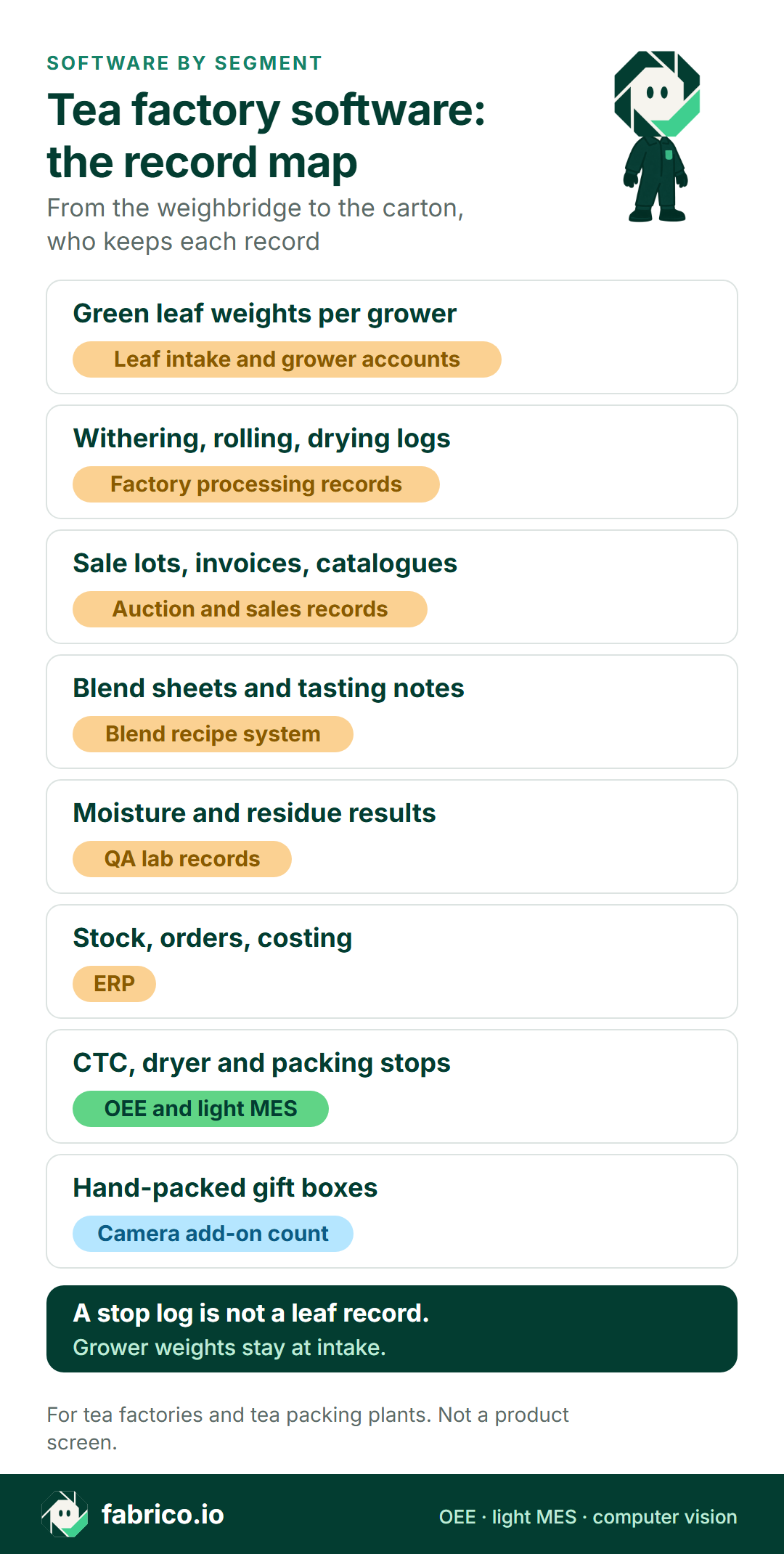
Text version of this infographic
- Green leaf weights per grower: leaf intake and grower accounts.
- Withering, rolling and drying logs: factory processing records.
- Sale lots, invoices and catalogues: auction and sales records.
- Blend sheets and tasting notes: blend recipe system.
- Moisture and residue results: QA lab records.
- Stock, orders and costing: ERP.
- CTC, dryer and packing stops: OEE and light MES.
- Hand-packed gift boxes: camera add-on count.
- A stop log is not a leaf record. Grower weights stay at intake.
Where a tea business loses machine hours
The process sets the factory's rhythm; machine ratings set the packing hall's ceiling. Four published figures:
| Step | Published figure | What it means for the line data |
|---|---|---|
| Green leaf at intake | A 1997 review in Food Chemistry by the Tea Research Foundation of Central Africa notes that fresh green leaf typically arrives above 75% moisture and can be as high as 83% | Most of the weight bought is water, so leaf kilos and made tea kilos are different units |
| Wither before maceration | The same review gives 68 to 72% leaf moisture as preferred for CTC maceration. For the orthodox method it gives 60 to 66%, but notes this may be weight loss rather than moisture content | Orthodox targets differ from CTC; book the wait for withered leaf as its own reason, not as a fault |
| Withering time | In a lab-scale CTC trial at IIT Kharagpur, fresh shoots were withered over 12 hours in a blower-fitted trough to 69 to 70% moisture, then dried with hot air at 90 to 95 °C for 25 to 30 minutes to 2 to 4% | Factory times differ, but the CTC line still starts only as troughs finish, and the dryer sets the day's pace |
| Tea bag machine | Tagged filter bags come off high-speed double-chamber machines; the worked example uses 250 bags a minute as a sample rate | One lost minute is hundreds of bags; short stops at the tag and string feed matter more than one long breakdown, and slow running hides inside "running" |
The moisture figures also explain a number every bought-leaf factory argues about: out-turn. A kilo of made tea at 3% moisture, the level Tamil Nadu Agricultural University's tea guide advises when tea is packed, holds 0.97 kg of dry matter. Leaf at 75% moisture carries 0.25 kg of dry matter per kilo, so it takes about 3.9 kg of leaf to make that kilo; at 80% it takes about 4.9 kg, and at the review's upper end of 83%, about 5.7 kg. That is arithmetic from the figures above, before handling losses.
In the packing hall, the split between short stops and slow running is in reduced speed loss vs minor stops, the station rules in OEE for tea packing lines, and the camera stations in computer vision for tea packing.
Tea line failure modes and their early signs
What goes wrong, what the line data shows before anyone complains, and the usual fix:
| Loss | Early sign in line data | Fix |
|---|---|---|
| CTC line starved by a slow wither | "Waiting for leaf" stops that cluster after wet weather or late afternoon intake peaks | Plan trough loading from intake times and book the wait to withering, not to the CTC crew |
| Dryer running below its load | Kilos out per hour fall while the dryer shows as running | Track dryer feed rate as its own speed loss and check it against the CTC output |
| Sorting room jams and fibre extractor stops | Short stops on sorters and fibre extractors that bunch across a long flush, while the dryer keeps running | Log sorter and extractor stops apart from the dryer; Sorting removes fibre and grades it by size, and loose meshes grade unevenly, so a mesh check is its own reason |
| Blend change overruns | Changeover minutes by blend spread wide, with the first good carton well after the restart | One dust clean and purge standard per blend family, as in changeover standards for FMCG lines |
| Bag machine starved by the blending room | "No blend" stops at shift start or after a blend change on several machines at once | Release blends to the hall against the pack plan, not when the blender is free |
| Tag, string and reel stops | Stops under two minutes that bunch after a new filter paper or tag reel | Reel and splice checks at the change; tag, string and paper as three reasons, not one |
| Weight rejects at the checkweigher | Rejects rise after a blend change on teas with a different particle size | Count rejects as a quality loss the same shift and set the dosing per blend |
Worked example: one tea bag shift in money
Sample figures for illustration only. The machine rate and the plant below are samples, not a real line. The margin matches the sample in OEE for tea packing lines; its 300 bags a minute is a different machine class, so use your own rating.
A packing plant runs three tea bag machines of the Constanta RC class, so the ideal rate is 250 bags a minute each. A shift is 8 hours with 30 minutes of planned breaks and cleaning, so planned production time is 450 minutes. Bags go into cartons of 20.
On one machine, in one shift, the line data shows:
- 50 minutes for two blend changes, dust cleaning included;
- 25 minutes waiting for blend from the blending room;
- 15 minutes of reel changes and longer tag and string stops;
- 81,000 bags counted, of which 1,620 were rejected at the checkweigher.
| Step | Calculation | Result |
|---|---|---|
| Run time | 450 planned minus 90 lost (50 + 25 + 15) | 360 minutes |
| Availability | 360 / 450 | 80.0% |
| Performance | 81,000 counted / (360 x 250 ideal) | 81,000 / 90,000 = 90.0% |
| Quality | (81,000 minus 1,620) / 81,000 | 79,380 / 81,000 = 98.0% |
| OEE | 0.800 x 0.900 x 0.980 | 70.6% |
| Check | 79,380 good / (450 x 250 = 112,500 possible) | 70.6% |
Now price it. With a sample contribution margin of EUR 0.60 per carton of 20 bags, each good bag is worth EUR 0.03. One minute of run time at this shift's performance and quality gives 250 x 0.90 x 0.98 = 220.5 good bags, or about EUR 6.62. An hour of downtime on one machine costs about EUR 397 in lost margin.
The fix in reach is not all 90 minutes. A dust clean standard cuts the two blend changes from 50 to 35 minutes, releasing blends against the pack plan cuts the waits from 25 to 5, and reel checks at the change cut those stops from 15 to 10. That recovers 40 minutes per machine and shift:
- Per machine and shift: 40 x 220.5 = 8,820 good bags, x EUR 0.03 = EUR 264.60.
- Per shift, three machines: 3 x EUR 264.60 = EUR 793.80.
- Per month: two shifts a day on 21 production days is 42 shifts, so EUR 793.80 x 42 = EUR 33,339.60.
- Per year: 12 months of 42 shifts is 504 shifts, so EUR 793.80 x 504 = EUR 400,075.20.
OEE on each machine rises from 70.6% to 78.4% (79,380 + 8,820 = 88,200 good bags out of 112,500). At a sample 2 g per bag, three machines at that output put about 529 kg of blend into good bags a shift: roughly 2.1 to 3.0 tonnes of green leaf at 75 to 83% leaf moisture, by the out-turn above.
Two checks. The money only counts if the market takes the extra cartons; if the hall already meets demand, price the minutes as a shift not run instead. Sensitivity: at half the margin, EUR 0.30 a carton, the same minutes are worth EUR 396.90 a shift for the hall and EUR 200,037.60 a year. The calculation itself is the standard one in OEE calculation.
Which tea manufacturing software to buy first
Start with the record that costs most when it is wrong: for a bought-leaf factory, usually the grower account; for a packing plant, often the blend sheet or the bag machine hours.
The type of site changes the order.
| Site | Usually first | Then |
|---|---|---|
| Estate factory with its own gardens | Factory processing records | OEE on the CTC line and dryer |
| Bought-leaf factory with many smallholders | Leaf intake and grower accounts | Processing records linked to intake days |
| Blending and packing plant | Blend recipes, QA lab and ERP | OEE and light MES on the bag lines |
| Group with factories and a packing plant | One ERP and lot code standard | Shared stop reasons across both sites |
Book a demo to see a blend change, a reel change and a cartoner block on one shift timeline, with the lost minutes priced by machine.
What moves between tea systems
Trouble sits between systems, where a number is typed again. Two links matter most: from the weighbridge to the day's manufacture, and from the sale invoice to the blend lot.
A residue complaint about one lot of packed blend shows where those links break:
| Record | Held in | Where the hand-off breaks |
|---|---|---|
| Blend lot code and pack date | ERP and packing records | Lot code set by hand at a blend change |
| Component invoices in the blend | Blend recipe system | Substitute invoice not added to the sheet |
| Residue result for each invoice | QA lab | Result filed by date, not invoice |
| Manufacture date of each invoice | Factory sales records | Invoice covers several days' manufacture |
| Leaf intake for those days | Leaf intake system | Leaf from many growers mixed in one wither |
| Bag machine run and counts | OEE and light MES | Holds run times and counts, not lots |
Bags, cartons and dryer kilos each stay in their own unit and are converted for the business view; OEE units: bottles, cases and pallets covers the conversion, and lot traceability data model covers the lot side.
Residue limits, and which system answers for them
Residue results are the record a tea buyer asks for first. The European Commission's page on maximum residue levels defines an MRL as "the highest level of a pesticide residue that is legally tolerated in or on food or feed". In Great Britain, Article 18 of Regulation 396/2005 says a listed product must not contain residues above its maximum level once it is placed on the market.
So the lab result has to sit against the invoice or blend lot that was tested, in the QA lab system and the blend records.
Nine questions for any tea factory software vendor
Generic sample data proves little. Put these to each product on the shortlist, with a month of leaf intake sheets and one week of packing hall reports on the table. For where a light line layer stops, see light MES vs full MES.
| Ask | How to test the answer |
|---|---|
| How does it book leaf from one grower at two buying centres? | Ask for one grower, two centres, one month, a deduction for water or poor leaf, and the payment that comes out. |
| Can a day's manufacture be linked to the leaf that fed it? | Ask to see intake days on the processing record, not typed in later. |
| How does an invoice number follow the tea into a blend? | Ask for a blend with a substitute invoice added mid-run. |
| Can one invoice be followed from the sorting room to the sale? | Ask for grade, sacks, sample sent, price achieved and the date the tea left the store. |
| Where does a residue result live? | Against the invoice or blend lot, with a hold the warehouse can see. |
| What does the line layer read from the dryer and CTC line? | Run state and, where a weigher exists, kilos out. Nothing about the process settings. |
| How does a seasonal crew log a reason in a dusty hall? | Hand a new operator the line screen with no training and ask for one stop reason, logged at the machine. |
| Can the bag machine and the cartoner be separate assets? | Ask for bags on one, cartons on the other, and blocked time kept apart. |
| Which ERP fields does the line layer read and send back? | Products, blends and orders in; run hours and good packs out. Ask who keeps the link. |
What a tea factory or packing manager can do this week and this quarter
This week, with paper and the data you already have:
- Pick the bag machine that missed the plan most often last month, or, in a factory, the CTC line and the dryer behind it.
- For five shifts, write each blend release time, or each trough's wither end, next to the stop sheet, and mark every "no blend" or "waiting for leaf" stop with what it waited for.
- Time every blend change from the last good carton to the first good carton, dust clean included.
- Split the bag machine's short stops into tag, string, filter paper and jam. Four reasons are enough to start.
- Put your own margin per carton into the worked example above and price one shift.
This quarter, once the week shows where the minutes go:
- Measure the chosen machines automatically, by machine signal or the camera add-on, so the shift report stops depending on handwriting.
- Agree a blend release rule with the blending room: blends reach the hall before the pack plan needs them.
- Write one dust clean standard per blend family and compare changeover minutes before and after.
- In a factory, book waiting for withered leaf to withering for a full flush and compare it with intake peaks.
Fabrico in a tea business: machine hours, not leaf or blends
Fabrico makes cloud OEE and light MES software. In tea it covers three places:
- Processing machines with a signal: on the CTC line, the dryer and the sorting machines, stops come from the machine signal and the operator tags the reason.
- The packing hall: tea bag machines, cartoners, overwrappers and case packers each run as an asset with its own unit and OEE by machine and shift; blend changes, reel changes and cartoner blocks get their own reasons, in minutes and money.
- Hand stations: where gift tins or sample boxes are packed by hand and no machine count exists, the camera add-on counts output. Its video is streamed on request, not stored in Fabrico.
Leaf, grower, process, sales, blend, lab and lot records stay in the systems that own them. Quality inspection is not part of Fabrico. Production planning and scheduling are not part of Fabrico today. More on the MES and OEE software page, the computer vision add-on page and in the FMCG camera guide; the wider picture is in food manufacturing software.
Questions tea factory and packing managers ask
Is there one tea factory software that does everything?
A suite may offer leaf intake, processing and sales in one product, and a packing plant still needs its blend, ERP and line records. Ask any suite to show each part working on its own data before you buy it as one.
Can OEE be measured on withering troughs?
Not in a useful way. Withering is a timed process that depends on the leaf and the weather. Measure the CTC line and the dryer instead, and book waiting for withered leaf as a separate reason.
Who should own the blend lot code?
The blending team and the ERP. The lot code has to carry the component invoices, so it starts at the blend sheet and travels with the packs. The line layer can show the lot that was running, but it is not the record.
At what size does a tea packer need OEE software?
When the bag machines run most shifts and nobody can say where the lost hours went. A plant that packs a few days a month usually gets more from blend and stock records first.
Book a demo to see a week of blend changes and bag machine stops priced per shift.
Related articles


Latest from our blog







Real Fabrico tiles, sample data.