


 Login
 Blog

Computer Vision for Breweries: Where Cameras Pay, From Crate to Keg

In short: computer vision for breweries pays where the filler PLC can't count a unit or show what caused a stop: the empties side of a returnable glass line, the crate and multipack packers, hand-built variety packs and the keg dock. Empty bottle, fill height, crown and label checks stay with your inspection systems.
- The filler counts bottles and cans at full speed. Read line OEE there, and keep its PLC as the counter.
- On returnable glass, many lost filler minutes start upstream, at the crate unpacker, the sorter and the washer. Video for those minutes gives each loss the right owner.
- Craft breweries have more manual steps, so a camera is often the only automatic count at the packing table or the keg dock.
- Fabrico times stops from the machine signal, operators give the reason, and an AI camera add-on counts units, with video for any moment of the shift.
From the door, a brewery packaging hall looks like any bottling hall. It works differently.
Returnable bottles come back in crates, some dirty, some broken, some from another brewer. On many lines, a tunnel pasteuriser holds many minutes of beer between the filler and the labeller. Kegs run on their own line. And the brand plan changes labels, crowns and packs every week, or every day in a craft brewery.
This page is for packaging managers, CI leads and plant managers choosing camera and OEE software for a brewery. For measuring the line itself, read OEE for brewery packaging lines. For soft drink and water lines, see computer vision for beverage lines.
We sell Fabrico, so read this as a vendor's page and test it.
What computer vision does in a brewery, and what it doesn't
Most brewery glass lines already have inspection cameras: the empty bottle inspector, the fill height and crown check, the label inspector and often a full crate check.
An OEE camera does a different job. It counts what the line makes and lets you open the video for the minute a stop happened. It inspects nothing and rejects nothing.
| Job | Inspection system | OEE camera |
|---|---|---|
| Find chipped, dirty or foreign empties | Empty bottle inspector | No |
| Check fill height and crown or end | Yes, every container | No |
| Check labels and date codes | Yes | No |
| Find a missing bottle in a crate | Full crate inspector | No |
| Count crates, packs and kegs | Not its job | Yes, where no signal counts |
| Show why the crate unpacker stopped | No | Video for that minute |
The two meet at the reject count. If a fill height, crown or label inspector puts out a reject signal or a counter, that number can go into the quality part of OEE. It tells you how many were rejected, not why. The split is covered in label and code vision vs an OEE camera.
The empty bottle inspector is a special case. Its rejects happen before filling, so they show up as starved time at the filler, not as a quality loss. Fabrico does not sell inspection, so keep the inspectors you have.
Where breweries lose packaging time
Volume is flat, and the range is getting wider. Eurostat reports that EU countries produced 34.4 billion litres of beer in 2025, 0.7% less than in 2024. Of that, 2.1 billion litres were low alcohol or alcohol-free beer.
The Brewers of Europe say non-alcohol beers have grown by a quarter in five years and are now 7.5% of beers sold. Each new alcohol-free beer is another brand on the packaging plan, with its own labels, packs and, on many lines, its own pasteuriser settings. On the line, the minutes hide in five places.
Returnable glass: the empties side starves the filler
In some markets, returnable glass is still how most beer is sold. In Germany, reusable glass bottles still carried 78.1 percent of beer in 2021, in German Environment Agency figures published in 2024. The agency has also said that reusable glass bottles can be refilled 50 times.
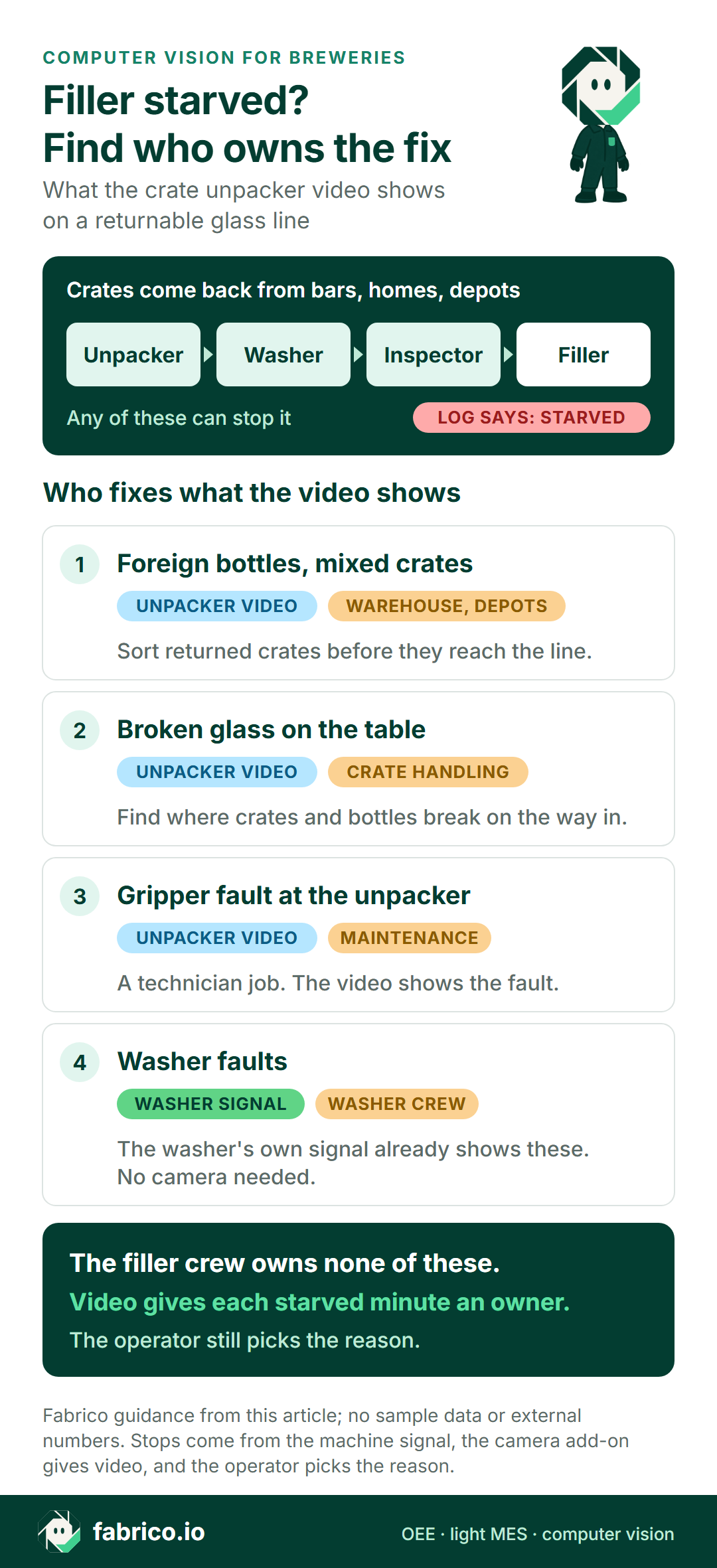
Every refill is another trip through homes, bars and depots. Crates come back with other brewers' bottles, broken necks, foreign objects and labels that load up the washer. The unpacker, sorter, washer and empty bottle inspector all stop for these, and each stop can starve the filler.
The filler PLC logs "starved". It does not say which of four machines caused it, or whether a machine was the cause at all. A camera at the crate unpacker lets the shift leader open that minute and see a gripper fault, a crate of foreign bottles or broken glass.
The fixes sit elsewhere. A gripper fault is maintenance. Foreign bottles are a sorting job for the warehouse and the depots. The filler crew owns neither.
The tunnel pasteuriser in the middle
A tunnel pasteuriser is a long, slow buffer between the filler and the labeller. A stop behind it backs up into the tunnel, and a restart sends gaps down the line for many minutes. Our tunnel pasteuriser OEE guide covers how to charge those minutes.
For a camera, the useful view is the discharge, where bottles down, outfeed jams and restart gaps show up. Inside the tunnel, the pasteuriser's own alarms tell you more. If your beer is flash pasteurised or sterile filtered before the filler, this step drops out.
Crates, multipacks and variety packs
After the labeller, one beer can leave in a crate, a carton, a shrink wrap, a clip pack or a mixed case, each at its own speed. Count each in its own unit, as in OEE units: bottles, cases and pallets.
Variety packs are the hard case. In many craft breweries, they are filled by hand at a table from pallets of single brands. No PLC counts them, so a camera at the end of the table may be the only automatic count you get. See manual packing station cameras for where to aim it.
Kegs
A keg line runs in kegs, with its own washer, racker and losses. OEE for keg filling lines covers lanes, rejected kegs and waiting for empties.
In an industrial brewery, the keg line PLC counts well. In a small brewery, kegs are often filled on a semi-automatic machine and moved by hand. There, a camera at the exit can count kegs as they leave the filler, and its video shows whether the machine stood idle with no empties or with nobody at it. The operator adds the cause, such as waiting for beer from the cellar.
Brand and pack changes
A brand change can mean new labels, crowns or ends, new packs and a flush of the filler. A format change adds change parts. Time both from the signal, and let the operator pick the type, each with its own standard time.
End the changeover at the filler, at the first good bottle of the new brand at rated speed, not when the first crate reaches the pallet. On a pasteurised line, that would add the whole tunnel transit to every change. Video at the labeller and the crate packer then shows where a brand change drags on after the filler restarts, such as a wrong label reel or a pack that will not run clean.
Craft brewery or industrial brewery: where the first camera goes
Most breweries are small, and most beer comes from a small number of large brewers. The Brewers Association counted 9,724 breweries in the US in 2025, and 9,578 of them were craft breweries. Yet small and independent brewers held 13.4% of the US beer market by volume.
That split decides where a camera pays. The usual picture, not a rule:
| Question | Craft brewery | Industrial brewery |
|---|---|---|
| Who counts at the filler? | The filler counter or a sensor, if it can export one | The filler PLC |
| Where do people step in? | Depalletising, hand packing, variety packs, kegs | Empties sorting, rework, pallet faults |
| Where does the first camera go? | Packing table or keg dock | Crate unpacker or crate packer |
| What does it show first? | Brand changes and waits for packers | Starved minutes from the empties side |
On a craft can line, seam checks and lid supply decide many stops. See can seamer OEE for how to code them.
Line map: where a camera goes on a returnable glass line
Start at the crate unpacker, the pasteuriser discharge and the end of the line, where blocked minutes get charged to the filler.
Camera, sensor or operator: station by station in a brewery
Ask every vendor to fill in the same table.
| Station | Signal today | What a camera adds |
|---|---|---|
| Crate unpacker and sorter | PLC run state | Video of starved minutes |
| Filler and crowner or seamer | Filler PLC, the line's counter | Rarely needed. Its fault codes come first |
| Tunnel pasteuriser | PLC and zone alarms | Video of bottles down and restart gaps |
| Crate, multipack or case packer | PLC run state, sometimes a count | Crate or pack count, plus video of jams |
| Variety pack table | Often nothing | Counts packs built by hand |
| Keg filler | Keg PLC, or none if semi-automatic | Keg count where the filler gives none |
In every row, the signal times the stop and the operator names the cause.
Want this table filled in for your own hall? Book a demo and bring a station list for one bottle line and one keg line.
Worked example: one shift on a returnable glass line
Sample data for one shift: no real customer, no product screen. The line fills 0.5 litre returnable bottles, 20 to a crate. The filler is rated at 500 bottles a minute, and planned production time is 450 minutes. The filler PLC logged 102 minutes of stops, and the operators gave each its first cause.
- Availability: 450 minus 102 leaves 348 minutes of run time, and 348 of 450 is 77.3%.
- Performance: at 500 a minute, 348 minutes could fill 174,000 bottles. The filler counted 162,000, so performance is 93.1%.
- Quality: a camera at the palletiser infeed counted 7,955 full crates, or 159,100 bottles. That is 159,100 good of 162,000 filled, or 98.2%. The 2,900 in between were fill height, crown and label rejects and broken bottles.
- OEE: 77.3% x 93.1% x 98.2% = 70.7%. As a check, 159,100 good bottles of the 225,000 possible in 450 minutes is also 70.7%.
Test any camera count first, ours included: see how accurate camera OEE is.
The biggest loss was not the brand change. It was 38 minutes from the empties side, which the filler log showed as one word: starved.
With video from the crate unpacker, the operators split it: 17 minutes of foreign bottles and mixed crates, 12 of broken glass on the unpacker table, and 9 of washer faults, which the washer's own signal already showed. Only the last is a machine fault.
At 500 a minute, 38 minutes is 19,000 bottles. At an assumed contribution of €0.10 a bottle, that is €1,900 in one shift, if you could have sold the beer. Agree that costing rule with your controller first.
The 17 minutes of foreign bottles point to a fix outside the hall: sorting returned crates before they reach the line. Tuning the filler would not have touched it.
What to ask a brewery computer vision vendor
Put these to each vendor, Fabrico included, with a real shift from a bottle line and the keg line.
| Ask | How to test the answer |
|---|---|
| Can it split starved minutes by machine? | Take one real starved stop and ask which upstream machine the report blames. |
| How does it treat the pasteuriser? | Ask how stops behind the tunnel are charged, and how restart gaps show. |
| Can it count crates, packs and kegs? | Ask to see each in its own unit on one timeline, and how they add up. |
| How are brand and pack changes coded? | Ask for separate codes, each with a standard time, and how a new brand gets added. |
| Will the camera cope with the hall? | Ask about steam from the washer and pasteuriser, condensation on cold glass, and lens cleaning. |
| Is the video kept? | Ask where it lives and who can open it. |
| Which features are roadmap? | Ask the vendor to mark them in the proposal, in writing. |
For a wider shortlist, compare OEE tools for food and beverage plants or read our OEE software guide. To test one line first, see how to run a computer vision OEE pilot.
Cameras, people and the works council
A camera at a packing table will see people. In a craft brewery, it sees the same few people every shift, so the rules matter more.
- Frame the product. Aim at crates, packs and kegs, not faces or break areas.
- Be clear about video. In Fabrico's standard setup, video is not stored in Fabrico. It is streamed when someone opens it.
- Report by line, not by person. Never a ranking of named operators.
- Agree it first. Agree purpose and video access with the works council or staff representatives before any camera goes up.
Automatic masking of people beyond what exists today is roadmap, so check what is live before promising it to staff. For the full checklist, see production line cameras without surveillance.
How Fabrico does it in a brewery
Fabrico is cloud software for OEE and light MES. Here is what runs today, what is roadmap, and what stays with other systems.
- Today, from the machines: the filler PLC, or a sensor or counter on another machine, times every stop and counts output. The operator picks the reason at the line, on a tablet or phone.
- Today, the numbers: OEE, downtime and losses for each line and shift, with the losses in money, in a browser or the iOS and Android apps.
- Camera add-on, on request: AI cameras count output at packing tables, keg docks and machines without a usable signal. Any moment on the shift timeline can be opened as camera video. The standard setup streams video on request and does not store it in Fabrico.
- Getting data out: REST API, webhooks, Excel or CSV export.
- Roadmap only: the camera spotting stops by itself, jam zones, and the camera proposing a likely reason that the operator confirms. None of these runs today.
- Other systems: inspection of empties, fill height, crowns, labels and crates. For production planning, ask us in the demo.
Custom AI modules exist as custom work on request. Start with the standard setup.
Test our claims like any vendor's, starting with the seven questions above. Book a demo, or send us your line list.
What people ask next
Do we need a camera on the tunnel pasteuriser?
Usually only at the discharge. Inside the tunnel, the pasteuriser's own zone alarms tell you more than a camera could. At the discharge, video shows bottles down, outfeed jams and the gaps after a restart, so the operator can code the stop.
Does an OEE camera replace our empty bottle inspector?
No. The inspector looks at every empty bottle and throws out chipped, dirty or foreign ones. An OEE camera does none of that: it counts finished units and shows you a stop. Keep the inspector.
Where should a craft brewery put its first camera?
Usually where people do the work and nothing counts it: the variety pack table or the keg dock. One camera there gives you a count you don't have today, and shows quickly whether a second is worth it.
Can video show whether returned empties starved the filler?
Often, if a camera watches the crate unpacker. The filler signal times the starved minutes, and the operator opens the unpacker video to see foreign bottles, broken glass or a gripper fault, then picks the reason. A camera that proposes the reason itself is on the roadmap, not live.
Do keg lines need their own camera?
Only where the keg filler gives no usable count, which is common on semi-automatic machines in small breweries. On an automatic keg line, the PLC counts kegs and a camera adds video, not counts.
What drives the cost of computer vision in a brewery?
Mostly how many lines and cameras you want, how hard they are to mount, the network in the hall, and training. Give each vendor one station list, with bottle, can and keg lines marked, so the quotes line up.
Want to see crate and keg counts on one timeline? Book a demo.
Related articles


Latest from our blog





Real Fabrico tiles, sample data.