


 Login
 Blog
Computer Vision for Pasta Production: Which Stations Need a Camera

In short: computer vision for pasta production belongs mostly after the dryer: at long and short goods packing, at hand-packing benches and at the end of line. The press already reports kg an hour and the dryer its own climate data, and sorting, weight and metal checks are inspection jobs.
- Two clocks: kg an hour at the press and dryer, packs a minute in packing, with silos or rod stores between them.
- Much of the product is made or spoiled in the dryer, hours before packing sees it. A camera at the packer can't see that cause; the dryer's own data can.
- In packing, video for the minute helps most at long goods weigher infeeds, baggers and cartoners, where many short stops share one fault code.
- Fabrico builds OEE from machine signals, with stop reasons from operators. Its camera add-on counts packs, and the shift timeline opens the camera video for any moment.
A pasta line is a slow, continuous process with a fast packing hall on the end: minutes in the press, far longer in the dryer, then dozens of packs a minute. That shape decides where a camera is worth its bracket.
If you run a dry or fresh pasta plant and are choosing camera and OEE software, this page is for you. The OEE method itself, with die changes and start-up scrap, is in OEE for pasta production. For OEE software in general, see the OEE and MES overview.
Fabrico is our product. Check our claims the way you would check anyone's.
What makes a pasta line different for cameras
Pasta is a volume business. Eurostat reports that EU countries produced 6.0 million tonnes of pasta in 2024, worth €9.1 billion: about €1.50 a kilo, or roughly €0.75 for a 500 g pack. More than two-thirds of it, 4.1 million tonnes, came from Italy. At under a euro a pack, the money sits in the minutes that repeat all shift, at the packers.
The process is short to describe. A 2022 review in the journal Foods calls pasta-making a continuous process with three main steps: dosing and mixing, kneading and shaping, and drying. Dry pasta keeps for up to three years because its moisture is generally below 12.5%.
Drying is where the product is made or spoiled. A 2024 study in Frontiers in Food Science and Technology notes that some structural changes happen at extrusion, but most of the changes in pasta come from drying. Traditional drying ran at about 50°C; pasta makers have since moved fast to high and very high temperature drying, at about 70°C and above 80°C.
Newer dryers are faster: the Foods review says new industrial lines can cut drying to about 3 hours for long pasta and less than 2 hours for short pasta. That is still a lot of pasta out of sight of any camera.
What computer vision does on a pasta line, and what it doesn't
On a pasta line, "vision" can mean an optical sorter rejecting specks and broken pieces, a code reader, or an OEE camera counting packs and showing the minute a packer stopped. Buyers sometimes get a quote for the wrong one.
| Job | Inspection system | OEE camera |
|---|---|---|
| Remove specks and broken pieces | Optical sorter | No |
| Moisture on target | Lab or inline moisture check | No |
| Pack weight | Checkweigher | No |
| Metal and foreign bodies | Metal detector or X-ray | No |
| Date code and label | Code and label inspection | No |
| Count hand-packed gift and display packs | Not its job | Yes |
| Show why the long goods weigher stopped | No | Video for that minute |
Inspection decides whether one pack is good, and its reject count can go into OEE quality, as our guide to checkweigher rejects in OEE explains. The OEE camera answers a different question: where the time went.
Where the losses hide on pasta lines
Press and die
The press sets the pace, and its PLC already reports kg an hour, vacuum, dough temperature and die pressure. A die face view can help review a stop, but it rarely earns a camera before the packing hall does.
Die material shows up later in the line. The Foods review notes that bronze-extruded spaghetti is more porous and more fragile than Teflon-extruded, with breaking strength 20 to 30% lower. More fragile strands can mean more breakage at the stripper, the cutter and the packer, so set ideal rates and reject expectations per SKU, not per line.
Product changes can cost more than die changes. A move from durum wheat to a gluten-free or egg pasta needs a full clean to the plant's own allergen rules. Give each such change its own code and standard time, and keep every required clean at full length, whatever it does to OEE.
Spreader, dryer and the long wait
On a long pasta line, the spreader hangs strands on rods that carry them through the dryer. Rods that jam and strands that fall are visible events, so a camera over the spreader or the stripper can give you the video for the minute the line stopped.
The dryer is a different case: a camera at its outfeed sees the result of a climate fault, not the cause. Book those losses to the dryer, from its own data.
Silos, rod stores and starved packers
Silos for short pasta and rod stores for long pasta split the plant in two. The press often runs around the clock, while packing may run fewer shifts and more pack sizes. Treat them as two lines with two OEEs.
The most misread packer stop is "starved": the silo for the next SKU is empty or not yet released. That is not the packing crew's loss. Our guide to starvation and blocking shows how to split it out.
Short goods packing
Short pasta usually goes through a multihead weigher into a vertical bagger or a cartoner. The weigher and bagger stop each other, so one "bagger stopped" code hides which one started it; VFFS bagger stops covers that pair. Cartoners lose time at the magazine, erecting and closing; see cartoner OEE.
Shape matters too. A shape that bridges in the weigher, or a fragile one that breaks into fines, packs slower than plain penne. Set one ideal rate per shape and pack size.
Long goods packing
Spaghetti, linguine and other long pasta need weighers and infeeds built for long goods. Strands that arrive crossed jam the infeed or break, and broken strands end up in the pack or on the floor. These stops are short and frequent, and often share one generic fault code.
That makes the long goods infeed the strongest case for a camera in many dry pasta plants. Semolina dust and glossy film both affect the view, so test it in your own light; see camera placement and lighting.
Fresh pasta lines
Fresh pasta runs on a different clock: sheeting, filling and forming for ravioli and tortellini, then pasteurising and packing in trays, with a short chilled shelf life.
Two losses lead here. Allergen changeovers, because fillings bring milk, egg, nuts or fish into the room; see dedicated vs shared allergen lines. And the tray sealer at the end, covered in tray sealer OEE. Where trays are loaded or topped by hand, a camera can count what no machine does.
Gift packs, promo packs and the end of line
Gift tins, bundles, display-ready trays and promo packs are often built by hand, out of reach of any PLC count; a camera can fill that gap. At the end of line, a case packer or palletizer that backs up stops the packers; the video for that minute shows where the stop started.
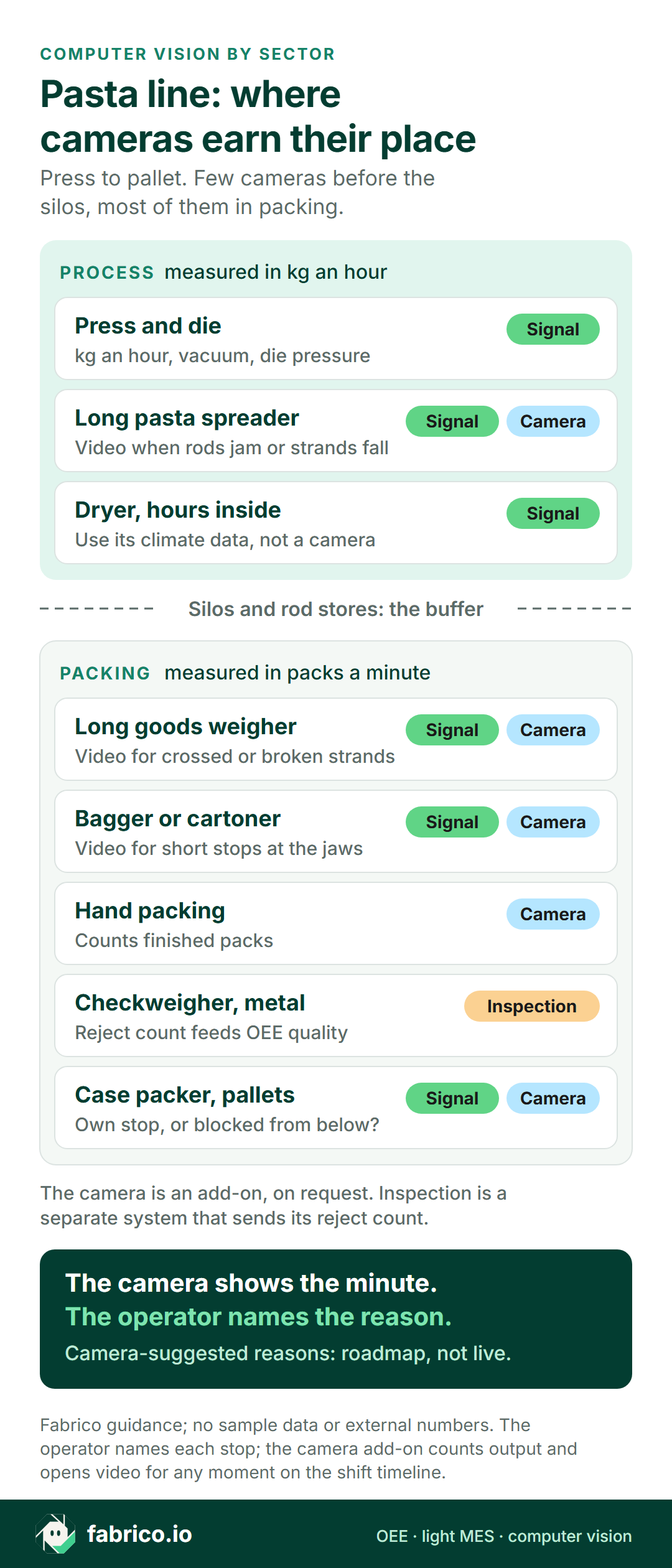
Pasta line map: where cameras sit from press to pallet
The map follows a dry pasta line from press to pallet and marks which system handles each station.
Most of the blue sits below the silos. To size a first project, read how many cameras a line needs.
Signal, camera or operator at each pasta station
| Station | Counts and stops from | Where a camera helps |
|---|---|---|
| Dosing, mixer, press | PLC: kg an hour, vacuum, pressure | Rarely. A die face view for stop reviews |
| Spreader, stripper | PLC run state | Video when rods jam or strands fall |
| Dryer | Climate and transport data | No. The cause is inside |
| Weigher, bagger, cartoner | PLC count and stop signal | Video for short stops at the infeed and jaws |
| Hand-packed and display packs | Usually nothing | Counts finished packs |
| Case packer, palletizer | PLC run state | Video shows own stops versus blocked time |
| Sorter, checkweigher, metal detector | Inspection systems | None. Their reject count feeds OEE |
Whatever the station, the machine signal clocks each stop; the operator names it on a tablet or phone and opens the video when the cause is unclear.
Planning a first camera? Book a demo and bring a sketch of one line, press to pallet.
Worked example: a shift on a long pasta packing line
Sample data, not a customer line and not a product screen. A long goods weigher and bagger packs 500 g spaghetti at an ideal 60 packs a minute, fed from a rod store. Planned production time is 450 minutes.
Stops added up to 80 minutes, all timed by the machine signal: a 25 minute format change from 1 kg to 500 g packs, 30 infeed jams worth 20 minutes, 8 minutes of film splices, 15 minutes starved while the rod store waited for release, and 12 minutes blocked by the case packer.
Run time is 370 minutes, so availability is 370 of 450, or 82.2%. The ideal in 370 minutes is 22,200 packs. The line counted 20,646, mostly because the set speed had been turned down after earlier jams and never turned back up, so performance is 93.0%.
The checkweigher and metal detector rejected 413 packs, leaving 20,233 good. Quality is 98.0%, and OEE is 82.2% x 93.0% x 98.0% = 74.9%. As a check, 20,233 good packs of the 27,000 possible is 74.9%.
This is where the camera pays off. Every one of the 30 jams reached the log as "weigher infeed fault". Looking at each minute's video, operators split them into 21 broken strands in the bucket and 9 crossed strands. Most broken-strand jams fell in the two hours the line packed a bronze-die spaghetti in the same 500 g format, which fits the Foods review: bronze-extruded strands break more easily. So the fix starts with the infeed settings for that SKU.
Price it with an assumed contribution of €0.25 a pack. The 28 minutes of own stops are 1,680 packs, or €420 a shift. The 27 waiting minutes, another 1,620 packs or €405, belong to the rod store and the case packer. If the format change standard is 15 minutes, the 10 extra minutes are 600 packs, or €150.
Those euros are real only when the line is sold out or the lost packs cost overtime; settle that rule with finance first.
Pasta plant checklist: what to ask every camera vendor
Ask every vendor the same things, Fabrico included, using one real shift from your plant.
| Ask | How to test the answer |
|---|---|
| Can it measure the press in kg an hour and packing in packs a minute? | Bring a shift of press rates and packer counts. Ask for both OEEs from that data. |
| How is a packer stop marked as starved by the silo? | Pick a real "no product" stop and see where it lands. |
| Will it count packs built by hand, like gift tins? | Hand count one run and compare. |
| How are ideal rates set per shape and pack size? | Ask to see 500 g spaghetti and 1 kg fusilli set up side by side. |
| Where do sorter, checkweigher and metal detector rejects go? | Ask to see each reject count arrive in OEE quality. |
| How do you record a dryer fault found at packing? | Ask who logs it, against which station, and when. |
| Where does camera video live, and who sees it? | Your works council will want the answer on paper. |
| What does a pilot look like? | Pick one packer, agree start and end dates, and keep a hand count alongside. |
On the hand count, read how accurate camera OEE is before the pilot starts.
Privacy and the works council
A camera over a weigher infeed or a packing bench will catch people walking past. Talk to the works council or staff representatives early; in many European countries they have a say first.
- Aim at the machine. The infeed, the jaws, the rods, the case, not the walkway.
- Explain the video. In Fabrico's standard setup, it is streamed on request, not stored in Fabrico.
- Keep it to counts and stops. No timing of named people.
Wider automatic masking of people is on the roadmap. The legal side is in GDPR and production line cameras.
Where Fabrico fits on a pasta line
On a pasta line, Fabrico works as a cloud OEE and light MES platform. Below: what it does now, what is roadmap, and what stays with other systems.
- Today, from the machine: stops and counts from PLCs, sensors or counters at the press, spreader, packers and end of line. Operators choose the reason on a tablet or phone beside the line.
- Today, in the report: OEE and downtime per line and shift, each loss priced in money, in the web app and the iOS and Android apps. Data leaves through a REST API, webhooks, Excel or CSV.
- Today, with the camera add-on: AI cameras count output where nothing else does, such as a hand-packing bench, and you can open their video at any point on the shift timeline. As standard, that video is streamed when someone requests it, and Fabrico does not keep a copy.
- Roadmap: stops detected by the camera, jam zones at a weigher infeed, and a suggested stop reason for the operator to confirm. Not live today.
- Other systems: sorting, weighing, metal detection, code checks and moisture. Fabrico doesn't inspect; it takes their reject counts. Recipes and drying profiles stay in your process control. For scheduling, ask us in the demo.
Ask us the eight questions above and expect the same proof you would ask of anyone. Book a demo or get in touch.
What people ask next
Is it worth putting a camera on the pasta press?
Rarely as a first step. The press reports kg an hour, and weighers measure what reaches packing. Cameras earn their place after the dryer, where short stops hide.
Does an OEE camera check pasta colour, breakage or moisture?
No. Optical sorters remove specks and broken pieces, and moisture is checked in the lab or inline. Those are inspection jobs. Their reject counts can flow into OEE quality.
Can a camera see a dryer fault?
No. A climate fault inside the dryer spoils pasta that left the press hours before, and a camera at the outfeed or the packer sees only the result. Use the dryer's temperature, humidity and transport data, and book the loss to the dryer.
Which pasta station should get the first camera?
Over the long goods weigher infeed if you pack spaghetti or other long pasta. In a short pasta plant, the bagger or cartoner that stops most often is the usual start, or a hand-packing bench.
Can cameras help on fresh pasta lines?
Mostly at hand-loaded trays and the end of line. Forming machines and tray sealers give PLC signals; the video helps explain their short stops.
Is camera video kept?
No, not in Fabrico's standard setup, which streams video on request instead of keeping it in Fabrico. Put the same question to every vendor and keep the answers for your works council.
How is computer vision for pasta lines priced?
Per quote. Lines and cameras, mounting, network and training drive it. Hand each vendor the same station list so their quotes line up.
Want to see the count and the video on a pasta line? Book a demo.
Related articles








Real Fabrico tiles, sample data.