


 Login
 Blog
Factbird Alternatives: OEE and Downtime Tools for Food and Packaging

In short: the right Factbird alternative depends on how much of a suite you need. Factbird sells OEE and downtime tracking inside a three-app suite, with its own sensor gateways, PLC connections and cameras. Redzone also pairs OEE with frontline modules, Guidewheel starts from power sensors, Tulip is a composable platform for building your own apps, and Fabrico is OEE and light MES with an AI camera add-on on request.
- Factbird's three apps are Production Insights, Connected Operations and Knowledge Excellence.
- Its industry pages include food and beverage, consumer packaged goods, and packaging and containers.
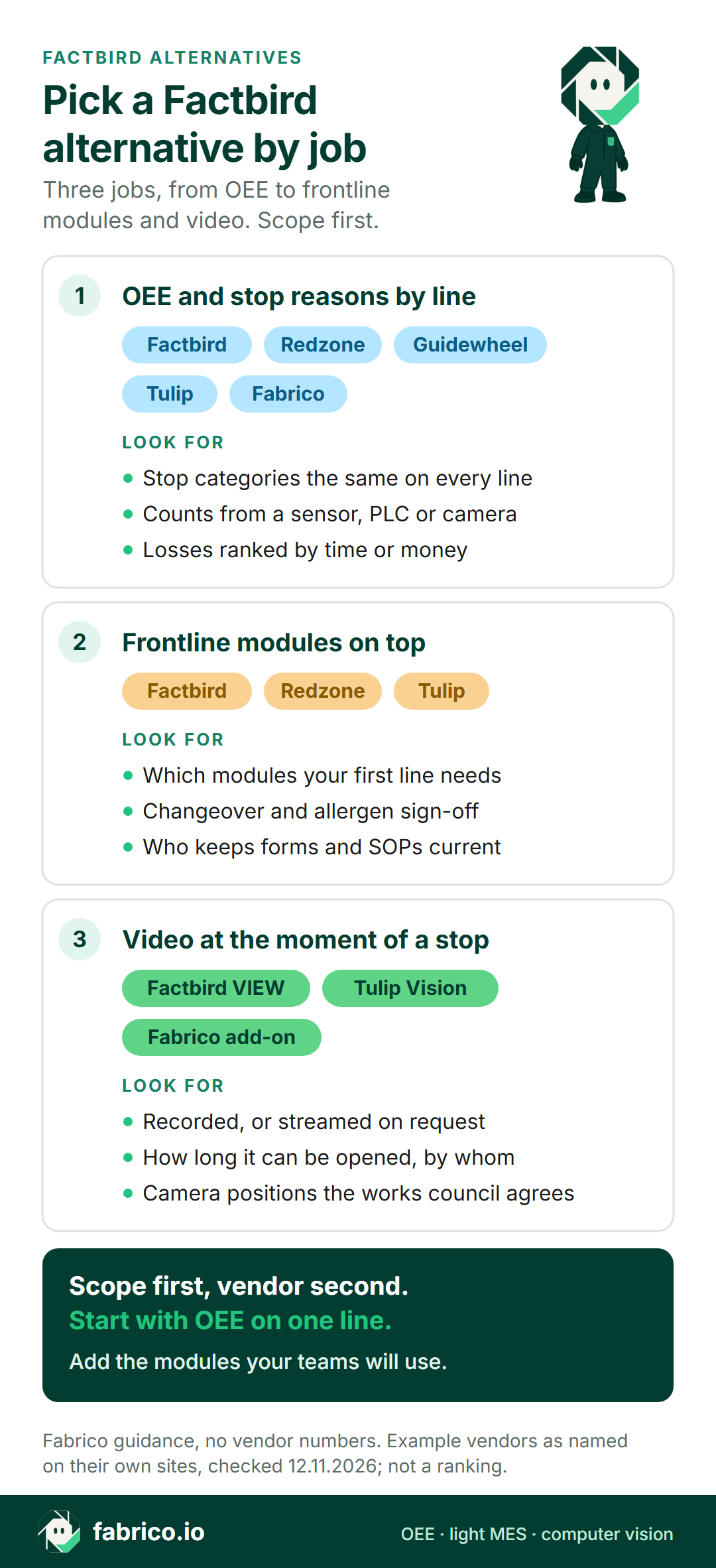
- Settle the scope first: OEE and stop reasons only, or digital checks, SOPs and training as well.
- If camera video matters, ask each vendor whether it is recorded or streamed, and how long it can be opened.
- Every vendor fact below is from that vendor's own site, checked as of 12.11.2026 and linked. No prices and no rankings.
A biscuit line runs four flavours a shift. Each change stops the wrapper for a quarter of an hour, and film splices and jams take more minutes on top. The first question is where those minutes go. The second is whether the changeover checklist, the allergen sign-off and the operator's training record should live in the same tool.
Factbird (factbird.com) answers both in one suite. Below, four other tools are compared by scope, machine data and what each names for food and packaging: Fabrico, Redzone, Guidewheel and Tulip. We are Fabrico, one of the four, so test our claims as you would any vendor's. For more packaging tools, see OEE software for high-speed packaging lines.
What Factbird sells (as of 12.11.2026, per Factbird's site)
Factbird began as a production tracking project by Emendo Consulting Group for Royal Unibrew, a Danish beverage company, and was called Blackbird until 2023, according to its about page. The same page says it has helped manufacturers since 2016 and lists offices in the US and Denmark. Its homepage describes three apps:
- Production Insights: real-time data, OEE tracking and scheduling. Its Production Insights page adds batch, shift and workforce scheduling, and video process analysis, where one click on a data point opens footage of the moment the line stopped.
- Connected Operations: digital SOPs and checklists, quality checks and e-signatures, automated workflows, compliance and audit trails, and maintenance.
- Knowledge Excellence: a skills matrix with gap tracking, structured onboarding, and digital training and qualification.
OEE and downtime. Its OEE software page lists OEE1, OEE2, OEE3 and TCU on a live dashboard with an OEE waterfall, a built-in structure for stop categories across lines and sites, and Pareto charts of downtime causes. Operators log and categorise stops in Operator View. Data comes from Factbird's IIoT edge devices, PLC integrations and software connections such as Kepware, the page says.
Hardware. Its edge devices page lists the DUO gateway for analog and digital sensors, PLC data sent straight to the cloud or through Factbird powered by OMRON, the EDGE device with an AI Visual Counter, and VIEW for video. The VIEW page says it works with off-the-shelf USB cameras and describes live and historical video synced with production data.
Food and packaging. Its food and beverage page describes digital stop cause registration, and its packaging page adds quality checkpoints scheduled at set intervals.
We leave the gains from Factbird's own benchmark report out of this page.
Ask in the demo: which of the three apps your first line needs, and how long VIEW footage is kept.
When Factbird fits
Factbird belongs on your shortlist if most of these hold:
- You want one supplier for OEE, digital checks and training records, the three apps its homepage describes.
- Your team wants to fit the hardware itself. Its edge devices FAQ says Factbird is user installable.
- Your lines mix sensors, PLCs and stations a camera should count, which its edge devices page covers with DUO, PLC data and EDGE.
- You want live and historical video synced with production data, which its VIEW page describes.
Suite or focused tool: settle the scope first
The tools on this page differ most in scope. Write down which jobs the first project must cover, then compare only the modules you will use. Our guide to tracking downtime on food and beverage lines covers the OEE part step by step.
On video, ask each vendor whether it is recorded or streamed, and how long it can be opened. Factbird's VIEW page describes live and historical footage, Tulip's vision page describes saving a clip leading up to a trigger, and the Fabrico section below states its standard setup.
Each cell below comes from the vendor's own site as of 12.11.2026; the links sit in each vendor's section.
| Tool | Modules, per its site | Machine data, per its site | Food and packaging named |
|---|---|---|---|
| Factbird (for reference) | Production Insights, Connected Operations, Knowledge Excellence | DUO sensors, PLC data, EDGE counter, VIEW video | F&B, CPG, packaging and containers |
| Fabrico | OEE and light MES, maintenance built in | PLC or IoT device; camera add-on where no signal | FMCG and food |
| Redzone | Productivity, Compliance, Reliability, Learning, Scheduling | Machines, ERP and SCADA via API or IoT sensors | F&B, CPG, plastics and packaging |
| Guidewheel | Downtime, OEE, production, cycles, energy | Sensors on the power cable; added inputs | F&B, consumer goods, plastics, packaging |
| Tulip | Composable apps: OEE, work instructions, quality, traceability | OPC UA, MQTT, edge hardware, Edge Drivers | F&B, consumer products |
Want to see OEE and stop reasons on a line like yours before you add modules? Book a demo.
Fabrico: OEE and light MES, with losses shown in money
This is Fabrico's own page. Fabrico is a cloud OEE and light MES platform for lines that mix connected machines, older machines and manual steps. Per its MES and OEE overview and computer vision page, today it does this:
- The machine signal records stops and counts: the PLC, a sensor or a counter.
- The operator tags the reason on a tablet or phone at the line, from your own reason list.
- Availability, performance and quality per line and shift, with losses shown in money, on the web, iOS and Android. Time with no recorded reason shows as its own figure.
- The AI camera add-on, on request, counts output at stations with no usable signal, such as promotion packing and kitting run by hand. With the camera add-on, a click on the shift timeline opens the video for that moment. In the standard setup, video for a stop is streamed when someone opens it and is not stored in Fabrico; how long video can be opened is agreed per plant.
- Maintenance is built in and linked to the same machine, and data can be exported by REST API, webhooks, Excel or CSV (connectivity page).
- Labelled roadmap, not live: camera add-on features that detect stops, mark jam zones or propose a stop reason for the operator to confirm. Production planning is on our roadmap too, with no release date; today Fabrico does not build or schedule your plan.
- Outside Fabrico's scope: inspection systems that check seals, labels or fill level.
Ask in the demo: to check a camera add-on count against a hand count at one manual station, and how checkweigher rejects reach the quality part of OEE.
Fits plants that want downtime shown in money by line and shift, with the camera add-on only where no signal reaches. Our OEE software guide lists what to compare.
Redzone: OEE with food safety records and a coach
Redzone (rzsoftware.com) calls itself a connected workforce solution for manufacturers. Its about page says it launched with its first 12 customers in 2013, was acquired by QAD, and got its start in Miami. As of 12.11.2026, its site says:
- Its products include Productivity for real-time OEE, Compliance, Reliability (maintenance, per its homepage), Learning, Scheduling and the ChampionAI engine (homepage).
- Its Productivity page says downtime and throughput are collected automatically and timestamped, and lists a dedicated Redzone coach and an application support team.
- Its food and beverage page says it connects to existing machines, ERP and SCADA systems via API or IoT sensors, builds CCP checks into operator workflows, and keeps records for HACCP, SQF and BRC audits.
Compared with Factbird: both pair OEE with digital work instructions, quality checks and training. Factbird's pages describe its own gateways and cameras; Redzone's pages describe connecting through API or IoT sensors, with a dedicated coach.
Ask in the demo: how machine data would reach Redzone from a filler or wrapper, and which food safety records the first line would move off paper.
Fits plants that want OEE, food safety records and frontline coaching in one platform, as its food and beverage page describes.
Guidewheel: downtime from power sensors, with a team beside yours
Guidewheel (guidewheel.com) says it monitors fillers, sealers, ovens, freezers, blenders and packaging lines without touching their controls, on its food and beverage page. As of 12.11.2026, its pages say:
- Sensors connect to power cables, and the page says PLC work is not needed to start.
- When a filler or sealer stops, operators add reasons and process context, so the team can tell jams, misfeeds and ingredient runouts apart.
- It tracks changeover and cycle times for SKU transitions, batch sequencing and fill rates, and OEE from blending to packaging.
- Its homepage adds inputs such as temperature, flow or production, and says its experts work alongside your team.
Compared with Factbird: Factbird's DUO reads sensors you choose, wired to the device, or takes data straight from the PLC. Guidewheel's food page describes sensors connected to the machine's power cable.
Ask in the demo: how the count from your wrapper or checkweigher would reach Guidewheel's OEE.
Fits plants that want downtime and changeover data from equipment that draws power, with no PLC work at the start, as its food page describes.
Tulip: a composable platform where plant teams build their own apps
Tulip (tulip.co) calls itself the frontline operations platform manufacturers use to transform how their operations work. Its about page says it was founded in 2014 as a spinoff of the MIT Media Lab, and its industry pages include food and beverage and consumer products. As of 12.11.2026, its site says:
- Its OEE tracking page combines automated machine states with operator reason codes. Availability and performance come from machine and PLC data over native OPC UA or MQTT, and older equipment connects through edge hardware.
- Its food and beverage page covers guided batching with connected scales, changeovers and line clearance, stop reasons from operators with data from fillers, sealers and packers, and checks on fill weights, seals, date codes and labels at the station.
- The same page says process engineers update workflows themselves and send them for approval.
- Its vision page lists barcode reading and video recording that saves a clip leading up to a trigger, with vision running locally at the edge.
Compared with Factbird: both pair OEE with digital work instructions and quality checks. Factbird's homepage describes three apps with its own edge devices; Tulip's pages describe a composable platform on which plant teams build and change their own apps.
Ask in the demo: which apps a first line would start with, and who on your team builds and maintains them.
Fits plants that want to build their own frontline apps, from batching to OEE, on one platform, as its food and beverage page describes.
Which tool fits which plant
- Factbird fits plants that want OEE, digital checks and skills records from one supplier, per its homepage.
- Redzone fits plants that want OEE, food safety records and a coach, per its food and beverage page.
- Guidewheel fits plants that want downtime from power sensors first, per its food and beverage page.
- Tulip fits plants whose engineers want to build and change their own apps, per its food and beverage page.
- Fabrico fits plants that want losses in money by line and shift, and the camera add-on only where no signal counts, per its computer vision page.
Worked example: what flavour changes cost on a biscuit line
Here is one sample shift on a biscuit wrapper line: invented numbers, not a customer's data or a product screen. The shift plans 480 minutes at an ideal 100 packs a minute, 48,000 packs in all, and the sample margin is €0.10 a pack.
Stops took 80 minutes: three flavour changeovers of 15 minutes each, 20 minutes of wrapper jams and 15 minutes of film splices. Run time is 400 minutes, so availability is 400 / 480 = 83.3%.
In 400 minutes the ideal is 40,000 packs. The wrapper counted 36,000, so performance is 90.0%. The checkweigher rejected 600, leaving 35,400 good, so quality is 98.3%. OEE is 83.3% x 90.0% x 98.3% = 73.8%, the same as 35,400 good of 48,000 possible.
The shift lost 12,600 packs. At €0.10 each, changeovers cost €450, slow running €400, jams and splices €350, and rejects €60: €1,260 in one shift.
In this sample the changeovers are the largest single loss, so the first project is the changeover itself; our guide to changeover standards on FMCG lines covers it. Ask each vendor to show the same shift's losses in money, not only in minutes. For biscuit and bread lines, see computer vision for bakeries.
What to check with every vendor before you choose
Ask every vendor these, including us, and test the answers on one line.
- Which modules does the first line need? Start with OEE and stop reasons; add checks or training only if teams will use them.
- Who fits the hardware? Your team, the vendor or an integrator, and how it copes with washdown.
- How are stop categories kept consistent? So a jam on one line means the same on the next.
- Where is video kept? Recorded or streamed, how long it can be opened, and who can open it. For any camera, agree positions and access with your works council before installing; see GDPR and production line cameras and production line cameras without surveillance.
- How do rejects reach OEE? From the checkweigher signal, an inspection system or the operator.
- How does data leave? API, webhooks, ERP connectors or export.
- What will the pilot prove? Pick one line and a fixed period, keep a hand count and the current downtime log for comparison, and send every vendor the same station list. Our computer vision OEE pilot plan sets one up.
For food lines, see OEE for food and beverage, the computer vision guide for food manufacturing and the FMCG buyer's guide. To choose a source per station, see camera or sensor by machine.
What buyers ask about Factbird alternatives
Is Factbird OEE software?
Yes, among other things. Its OEE software page describes live OEE with OEE1, OEE2, OEE3 and TCU, standard stop categories, operator stop causes and Pareto analysis, inside a suite that also covers digital checklists and skills.
Does Factbird use cameras?
Its site describes two camera products. Factbird VIEW shows live and historical video synced with production data in the cloud app. The AI Visual Counter on Factbird EDGE counts units on the line from video.
Can Factbird read our PLCs?
Yes, per its edge devices page: a PLC can publish data to Factbird's cloud over MQTT, OMRON controllers connect through Factbird powered by OMRON, and the page says its integrations handle many controller inputs and formats. Its OEE page also names software connections such as Kepware.
How is Fabrico different from Factbird?
Factbird sells a three-app suite with its own sensor gateways, PLC connections and cameras, per its site. Fabrico is an OEE and light MES platform: the machine signal records stops and counts, the operator adds the reason, losses are shown in money by line and shift, and an AI camera add-on counts where no signal can.
How do these tools handle changeovers?
Each describes it in its own words. Factbird's CPG page mentions optimising changeovers, Redzone's food page lists digital changeover clocks, Guidewheel's food page says it tracks changeover and cycle times, and Tulip's food page describes guided changeover and line clearance checklists. Fabrico's MES and OEE overview shows changeover as its own category, next to planned and unplanned stops. Ask each vendor to walk through a real changeover.
Want to compare tools on a line like yours? Bring one week of downtime records to a demo.
Related articles




Real Fabrico tiles, sample data.