







 Login
 Blog
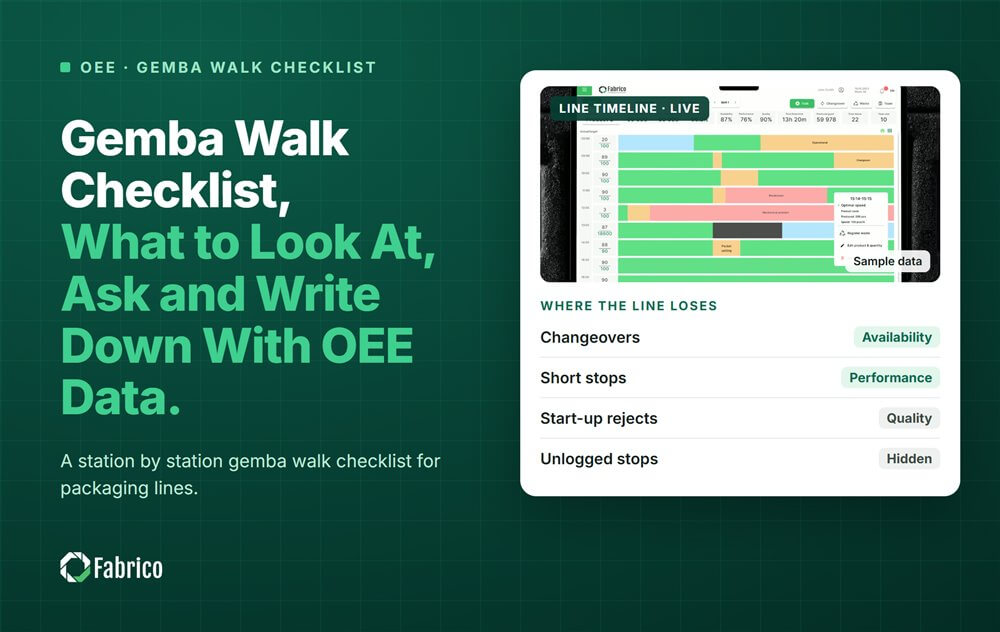
Gemba Walk Checklist: What to Look At, Ask and Write Down With OEE Data

Key takeaways
- Choose where to walk from the last shift's losses ranked by money, not from the OEE percentage.
- At each machine, compare what you see with what the data says: speed, stops, buffers and material.
- Ask open questions about the process. Never score or name people.
- Write down facts: the machine, the number, a clip or photo, one owner and a follow-up date.
- In the worked example, slow running and short stops were the same film problem, and only the data showed the slow running.
A useful gemba walk starts from last shift's OEE losses, ranked by money, and goes to the machine where the top loss happened. There you look at the machine, ask the crew about the process, and write down facts, numbers and one owner for each finding.
This checklist is from Fabrico, the OEE and light MES platform. It is built for FMCG packaging lines, and each question is about the process, never the person.
What is a gemba walk, and why bring OEE data?
Gemba means "the real place": the shop floor, where the product is made. A gemba walk is a leader going there to see the process with the people who run it.
Masaaki Imai's Gemba Kaizen (1997) gives five rules for it:
- When a problem arises, go to the gemba first.
- Check the actual machine, part or tool.
- Take a temporary countermeasure on the spot.
- Find the root cause.
- Standardize to stop it coming back.
Imai's rules start once a problem is known. OEE data tells you which problem to pick: the loss that cost the most last shift, not whatever is loud or recent.
What should you prepare before the walk?
- Pull the last shift's losses for one line, ranked by money.
- Pick the top three. Note the machine, the minutes, the count and the reason code.
- Check the speed loss. Slow running hides inside Performance and never shows as a stop.
- Watch the clip of a typical stop, where a camera covers that machine.
- Read the open actions from the last walk on this line.
- Tell the team leader you are coming and which loss you want to see.
Bring the loss list, not a clipboard for scoring people. Our guide to diagnosing speed loss on high speed lines explains why slow running is so easy to miss.
What should you look at on the line?
At each machine on your list, check what you see against what the data says. A gap between the two is a finding.
| Look at | Compare with |
|---|---|
| Is the machine running, stopped or waiting? | The state on the line screen or board |
| The speed set on the machine's screen | The rated speed for this product |
| The conveyor or table before and after it | Starved and blocked minutes |
| Film, labels, cases and glue at the line | Stops coded as waiting for material |
| Tools and spares for clearing jams | The count of short stops |
| The standard posted at the machine | What the crew actually does |
| The reason codes on the operator screen | The top loss on your list |
Stay long enough to see the problem happen. A short stop that repeats 40 times a shift will happen while you watch. Our six big losses guide helps you name what you see.
Which gemba walk questions should you ask?
Ask open questions about the process, then listen. The crew knows things no report shows.
- What stopped this machine last, and what did you do to restart it?
- Which stop happens most often? Which one annoys you most?
- What does the machine do just before it stops?
- What speed do you run this product at, and why that speed?
- Is anything you need missing or late: film, labels, cases, tools?
- Where do you wait for something or someone?
- Is there a standard for this job? Does it work?
- How do you code a stop when the cause is not clear?
- If you could change one thing on this machine, what would it be?
- What did we promise last time, and did it happen?
Avoid "who" questions. "Who caused this?" ends the conversation. "What happened?" starts it. If the codes on the screen do not match what the crew says, see our guide to reason codes operators can use.
What should you write down?
One line per finding, in the same order each time:
- Where: the line and the machine.
- What you saw: a fact, not an opinion.
- The number: minutes, count or units from the loss list.
- Evidence: the clip or a photo.
- Temporary fix: what was done on the spot.
- Owner: one role, such as the process engineer.
- Follow-up: when you will check it, usually at the next walk.
Then read the next shifts' loss list. If the loss fell, the fix worked. If not, the root cause is still open.
What does a gemba walk example look like on a packaging line?
Sample line (illustrative numbers, not a customer): a snack bagging line where the bagger is the bottleneck, rated at 80 bags a minute. The shift has 450 minutes of planned production time. Each bag earns a contribution of $0.25, or €0.25 in a euro plant, so each bagger minute is worth $20.
Last shift's OEE was 68.7%: Availability 84.4%, Performance 84.3% and Quality 96.5%. That number alone does not say where to walk. The loss list does.
| Loss, last shift | Bagger minutes | Bags lost | Cost |
|---|---|---|---|
| Slow running, 72 instead of 80 a minute | 35.6 | 2,848 | $712 |
| Sealing jaw heater fault | 25 | 2,000 | $500 |
| 40 short stops, film off track | 24 | 1,920 | $480 |
| Seasoning drum empty | 20 | 1,600 | $400 |
| 900 underweight rejects at $0.40 | 11.25 | 900 | $360 |
| Changeover overrun | 15 | 1,200 | $300 |
| Waiting for a film reel | 10 | 800 | $200 |
| Total | 140.85 | 11,268 | $2,952 |
- The bagger could make 450 x 80 = 36,000 bags. It made 24,732 good ones, so 11,268 were lost.
- OEE check: 24,732 / 80 / 450 = 68.7%.
- Rejects are priced at $0.40, not $0.25, because the film and product are lost as well.
- Slow running and the short stops are $1,192 of the $2,952. Both happen in the film path.
- A paper log would show the 25 minute heater fault first, and no slow running at all.
So the sample walk went to the bagger's film path first. Three lines went into the notes:
- Film path: the crew runs at 72 a minute because at 80 the film drifts after each splice. The clip of three short stops shows the film leaving the eye mark. Temporary fix: a guide check after each splice. Owner: process engineer.
- Film reels: new reels sit in the store, not at the line, so the bagger waited 10 minutes. Fix: two reels staged at the line. Owner: line logistics.
- Seasoning drum: there is no low level warning, so it ran empty. Owner: engineering.
At the next walk, the first question is simple: did slow running and film stops fall on the loss list?
What mistakes turn a gemba walk into a factory tour?
- Walking without data, so you see what is loud, not what costs most.
- Only walking on day shift, when night shift losses look different.
- Asking who instead of what and why.
- Scoring people on a checklist. That is an audit, and the crew will treat it like one.
- Writing nothing down, or writing notes nobody can act on.
- Never coming back. If nothing happens, the crew stops telling you things.
Cameras on a line raise fair questions from crews. Our guide to production line cameras without surveillance covers how to watch the machine, not the person.
Where Fabrico fits
Fabrico is a computer vision enabled Manufacturing Performance Platform. It gives the walk its starting point: stops logged automatically and OEE live by line and shift.
- Losses priced in money and ranked for the last shift, on any line.
- The operator confirms the reason in one tap, so the codes match what you see.
- A camera clip as evidence for a stop, to watch before you walk.
- One view across plants, to compare the same machine type on different sites.
Fabrico measures the losses. Your team runs the gemba walk and the fix. There is no free plan and there are no tiers: each plant gets a quote. Read how a light MES puts OEE and downtime first.
Frequently asked questions
What is a gemba walk?
A gemba walk is when leaders go to the place where the work happens to see the process for themselves. Gemba means "the real place". The aim is to understand problems and support the team, not to inspect people.
What questions should you ask on a gemba walk?
Ask open questions about the process. What stopped the machine last? What speed does it run, and why? What is missing or late, and does the standard work? Avoid questions that look for someone to blame.
How often should you do a gemba walk?
Many plant managers walk daily, and line leaders more often. Walk at different shifts, start from the loss list, and come back to check each action. A walk with no follow-up teaches the crew that talking is pointless.
How long should a gemba walk take?
Long enough to see one or two problems properly. On a packaging line that is often 20 to 30 minutes at one or two machines. Seeing one loss in depth beats a quick tour of the whole plant.
Do camera clips replace a gemba walk?
No. A clip shows what a stop looked like, which helps you choose where to go and what to watch for. The walk adds what a clip cannot: the crew's knowledge, the material at the line and the standard in use. Use clips to prepare, then go and see.
See your next walk's loss list in a demo
Bring one line and last shift's downtime log. We will show the losses ranked by money and the stops worth a walk.
Latest from our blog


Real Fabrico tiles, sample data.